
Chapter 1
THE UNMADE.
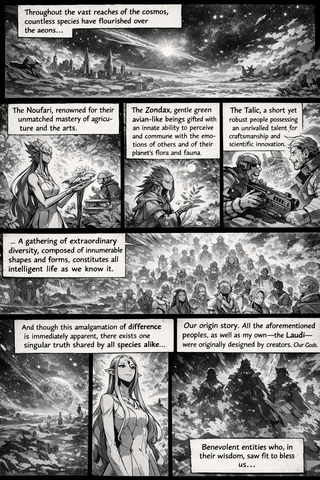
Throughout the vast reaches of the cosmos, countless species have flourished over the aeons. The Noufari, renowned for their unmatched mastery of agriculture and the arts; the Zondax, gentle green avian-like beings gifted with an innate ability to perceive and commune with the emotions of others and of their planet’s flora and fauna; the Talic, a short yet robust people possessing an unrivalled talent for craftsmanship and scientific innovation—these are but a few among the dozens of species that populate our expansive universe.
A gathering of extraordinary diversity, composed of innumerable shapes and forms, constitutes all intelligent life as we know it. And though this amalgamation of difference is immediately apparent, there exists one singular truth shared by all species alike: our origin story.
All the aforementioned peoples, as well as my own—the Laudi—were originally designed by creators. Our Gods. Benevolent entities who, in their wisdom, saw fit to bless us with abundant resources and unwavering guidance. All so that we might pass through our evolutionary journeys peacefully, unburdened by needless suffering.
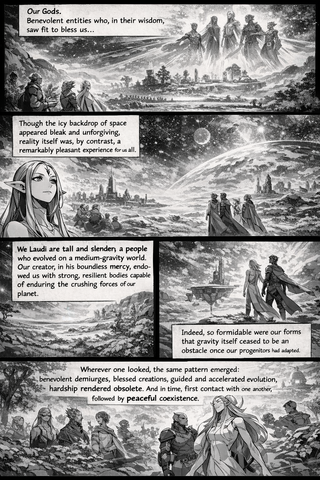
My people, like all other races, never had cause to fear hardship. We Laudi are tall and slender, a people who evolved on a medium-gravity world. Our creator, in his boundless mercy, endowed us with strong, resilient bodies capable of enduring the crushing forces of our planet. Indeed, so formidable were our forms that gravity itself ceased to be an obstacle once our progenitors had adapted. We take pride not only in our physical prowess, but also in our mental acuity—both virtues granted to us as birthrights.
Every other form of life possesses its own gifts, bestowed upon them by their respective charitable Gods. Wherever one looked, the same pattern emerged: benevolent demiurges, blessed creations, guided and accelerated evolution, hardship rendered obsolete. And in time, first contact with one another, followed by peaceful coexistence. Though the icy backdrop of space appeared bleak and unforgiving, reality itself was, by contrast, a remarkably pleasant experience for us all. With our needs met and our futures secured, we sought only to make friends and explore the cosmos. We believed that to be our sole purpose.
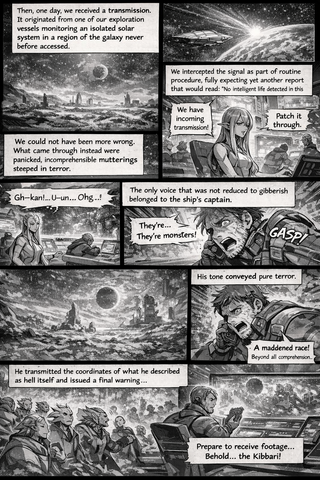
Then, one day, we received a transmission.
It originated from one of our exploration vessels monitoring an isolated solar system in a region of the galaxy never before accessed. We intercepted the signal as part of routine procedure, fully expecting yet another report that would read: “No intelligent life detected in this sector.”
We could not have been more wrong.
What came through instead were panicked, incomprehensible mutterings steeped in terror. The only voice that was not reduced to gibberish belonged to the ship’s captain. From his tone alone, it was evident that he was struggling to comprehend what he had just witnessed. He spoke of a maddened people—beings who revel in chaos and took pleasure in harming one another.
“We had only monitored them for a very brief duration of time,” he said. Yet his voice carried emotional undertones utterly foreign to us. What sustained him was not composure, but duty—an obligation to warn us of the madness that lurked far beyond our known borders.
“This race,” he continued, “is vile and fundamentally abhorrent beyond all description. We hoped, perhaps foolishly, that they would one day abandon their senseless blood-lust. But we were wrong. We have gained access to their information banks to study their historical records, and what we witnessed has challenged our most basic understandings. It shattered our belief that all things in existence are, at their core, composed of some essence of benevolence. They are the blasphemous antithesis.”
He paused, then spoke again.
“Within their extensive chronicles of violence, one name stands at the pinnacle. They call themselves the Kibbari. The footage you are about to receive will undoubtedly scar you. I beg you to proceed with caution.”
As the data was being prepared, he transmitted the coordinates of what he described as hell itself and issued a final warning:They are not like us.
Before we could respond—before we could even begin downloading the nightmarish evidence—we received a series of blurred images of this so-called hell. What we saw chilled us to our very core. Strange beings—grotesque, freakish monsters—roamed upon a hellish blue-and-green marble. The captain had been right.
They were not like us.
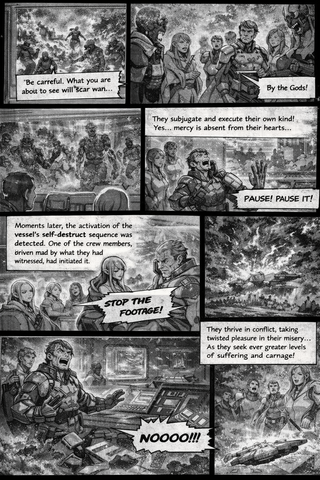
Moments later, we detected the activation of the vessel’s self-destruct sequence. One of the crew members, driven mad by what they had witnessed, had initiated it. Such an incident was unprecedented. All prior transmissions had been mundane: routine check-ins, casual exchanges, nothing more. For that reason, we had never deemed it necessary to restrict public access to this communication.
By the time we realised the transmissions were being viewed by the public, it was already too late.
Panic spread like wildfire.
Mass hysteria followed—an event so severe it took days to suppress. People spoke of the end times, of the Anathema Goddess, and of a sacred obligation to destroy her and her wicked offspring before they could bring ruin upon us all







