
The Hundred-Dollar Birthday
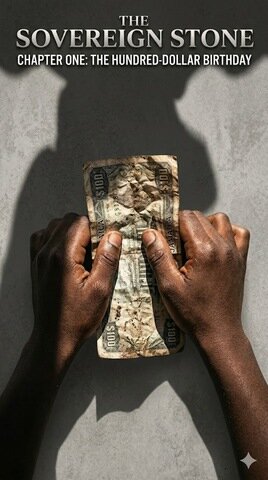 The Manchester sun was a heavy weight on Dante’s shoulders as he finished scrubbing the grime from the carport floor. He was eleven today, though no one in the house had said the word. His only celebration was tucked deep inside his pocket: a crumpled hundred-dollar bill he’d scavenged and saved for three months.
The distant, tinkling music of the ice cream truck began to drift up the road.
Dante’s heart hammered against his ribs. He stood up, wiping his wet, soapy hands on his oversized shorts. He watched as his three younger siblings—fair-skinned and dressed in clean clothes—ran toward the gate, shouting for their father.
“Daddy! The ice cream man! I want a nutsy-bolt!” the eldest boy shouted.
The father, tall and smelling of expensive cologne and the farm’s soil, stepped out onto the veranda. He didn’t look at Dante. He never looked at Dante if he could help it.
“Go on, then,” the father said, reaching into his wallet. He paused, his eyes landing on the $100 bill Dante had just pulled out of his pocket as he approached the gate.
“Where you get that?” the father’s voice dropped, turning cold.
Dante’s voice was soft, his feminine lilt making the father’s jaw tighten. “I... I save it, Daddy. It’s my birthday today. I want a cone.”
The father stepped down from the veranda, his shadow eclipsing the boy. He snatched the bill from Dante’s damp palm.
“You save it?” the father hissed. “You live in my house, eat my food, and you hiding money? This is for the children.”
“But Daddy, that’s mine,” Dante whispered, tears already blurring his vision. “I just want one ice cream. Just one.”
The father ignored him, walking to the gate and handing Dante’s hundred dollars—plus a few larger bills—to the vendor. He bought three elaborate sundaes and three cones. He handed them to the younger children, who began to eat, laughing and dripping chocolate onto the driveway Dante had just spent two hours cleaning.
Dante stood there, empty-handed, his stomach growling. The unfairness of it felt like a fire in his throat.
“It’s my money,” Dante sobbed, the words slipping out before he could stop them. “You’re a thief! It’s my birthday!”
The father turned. There was no hesitation. He didn’t use his hand; he used his heavy work boot. He delivered a sharp, crushing kick directly to the center of Dante’s chest.
The air left Dante’s lungs in a sickening whoosh. He flew backward, his spine hitting the concrete of the carport.
“Shut your mouth about birthday,” the father growled, standing over him while the other children watched with wide, silent eyes. “You lucky I don’t throw you back in the hole I found you in. Clean up that soap and get to the coop. You not eating tonight.”
Dante lay on the cold concrete, gasping for air, the taste of copper in his mouth. He watched the ice cream truck drive away, the happy music fading into the quiet afternoon. He didn’t cry out again. He just curled into a ball, his hand clutching his chest where the boot had left a dusty print.
Ten years, he thought to himself, a new, dark voice whispering in his mind. Ten years until I can run.
The sun dragged itself behind the Manchester hills, leaving the sky looking like a fresh bruise. Dante didn’t crawl toward the house for mercy; he dragged his body toward the back of the property, where the grass grew tall and sharp against the fence line.
He reached the chicken coop—a leaning skeleton of rusted wire and grey zinc. Inside, the air was thick with the scent of cedar shavings and the dry, dusty heat of the birds. It was a place of filth to anyone else, but to Dante, it was the only territory the Father didn’t care enough to conquer.
He collapsed onto his bed: a stack of rough crocus bags covered by a thin, pilled sheet. He lay on his side, his chest throbbing in time with his heartbeat. The dusty print of the boot was still there, a dark brand against his skin.
“You’re okay,” he whispered into the dark.
“I know,” he answered himself. His voice sounded different in the coop—stronger, like a secret he was keeping from the world. “It didn’t even hurt that much.”
“Liar,” he whispered back. “It hurt. But we don’t cry. Mountains don’t cry when the wind kicks them.”
He closed his eyes tight until the darkness behind his eyelids began to shift. He pushed the smell of the chickens away. He pushed the ache in his ribs into a corner of his mind and locked it.
Suddenly, the dirt floor wasn’t dirt anymore. It was white marble, cool and smooth. The rusted zinc above him transformed into a vaulted ceiling dripping with crystal chandeliers. He wasn’t a “fat boy” in a dirty shirt; he was wrapped in silk, sitting at a table that stretched as far as the eye could see.
“Your Majesty,” he murmured, his fingers stroking the rough fibers of the crocus bag as if it were the finest velvet. “The feast is ready. There is no cornmeal tonight. Only the gold-leaf cake. Only the cream that never melts.”
He imagined Carlos sitting at the end of that long table. Carlos was laughing, his Indian eyes bright and clear, holding a scepter that glowed like the sun.
“They think they trapped us, Carlos,” Dante said, his voice dropping into a princely baritone.
“They can’t trap a king,” he answered for his brother. “They’re just guarding the gates while we plan the escape.”
A sudden, sharp scratch-scratch sounded on the zinc roof. A common house lizard scurrying over the metal.
Dante flinched, his eyes snapping open. The marble palace vanished. The crystal chandeliers were gone, replaced by the dim, stinking reality of the coop. His heart hammered against his bruised ribs, and for a terrifying second, he was just a small, hungry boy trapped in a cage.
“It’s just a dragon,” he told himself, his breath hitching. “A small, green dragon sent to watch the perimeter. He’s on our side.”
He curled into a tighter ball, clutching his stomach as the night air began to bite. The hunger was a physical weight now, a dull clawing in his gut that reminded him of the ice cream he’d never taste.
“One day,” he whispered, the promise sounding like a vow in the hollow silence of the coop. “I’m going to walk out that gate. I’ll have a house with a door that locks from the inside. And nobody—not Daddy, not the children, not the world—will ever be allowed to touch me again.”
He stayed awake for a long time, watching the moon rise through the gaps in the wire mesh. He didn’t feel like a boy. He felt like something being forged in a fire—something that was cooling down into a shape that was hard, sharp, and forever silent.
The 5:00 A.M. mist was a wet blanket over the hills, smelling of damp earth and woodsmoke. Dante didn’t need an alarm; the first chill of the morning always seeped through the crocus bags and settled into his bruised ribs, waking him with a sharp, stabbing reminder of the Father’s boot.
He crawled out of the coop, his joints popping like dry kindling. He moved toward the main house, keeping to the shadows of the pimento trees. His first task was the “cleansing”—removing the evidence of the life he wasn’t allowed to lead.
The driveway was littered with the remnants of the yesterday’s celebration. Sticky plastic spoons, crumpled napkins, and the empty, melted containers of the sundaes the other children had enjoyed.
Dante knelt, his large, calloused hands picking up the sticky trash. He didn’t let himself smell the dried chocolate. To smell it was to want it, and to want it was to be weak.
He hauled the heavy garbage bin toward the gate. As he tilted it to dump the kitchen scraps, something metallic glinted against the dull grey plastic.
It was wedged between a discarded school workbook and a half-eaten sandwich. A pen. It wasn’t the cheap, plastic kind the Father used for farm tallies. This was a heavy, metallic blue click-pen, lost by one of the “polished” guests from the night before. “Property of Kingston Grand Hotel” was etched in silver along its side.
Dante’s heart did a strange, frantic dance. He reached into the bin, ignoring the cold slime of eggshells and coffee grounds, and snatched it. Next to it, he found the back cover of his brother’s workbook—three pages of thick, white, unlined paper that had been torn out and tossed away.
His fingers closed around the pen. It felt cool. It felt heavy. It felt like a weapon.
He tucked the pen and the paper deep into the waistband of his shorts, pulling his oversized shirt down to hide the bulge. He finished the garbage in a blur of motion, his mind already retreating to the mango tree at the back of the pasture.
Once the Father had left for the lower fields and the house was quiet, Dante sat among the massive, twisted roots of the tree. He clicked the pen.
Click.
The sound was sharp and authoritative.
He smoothed the crumpled paper on his thigh. He didn’t know how to write a policy yet. He didn’t know the words for “logistics” or “infrastructure.” But as he pressed the blue nib to the white page, the “Dead Boy” inside him found a pulse.
I am not a boy in a coop,he wrote, the blue ink bleeding beautifully into the paper. I am a mountain. The sun burns the mountain, but the mountain stays cool. The rain hits the mountain, but the mountain does not wash away.
He stared at the words. They were real. Because they were in ink, the Father couldn’t kick them away.
“Do you see it?” he whispered to the rustling leaves above.
“It’s perfect,” he answered himself, his voice thick with a new, dangerous pride. “One day, we will write our own laws. We will write a book so big they can’t ignore us.”
He began to draw—a small, jagged crown with three points. “One for Carlos,” he muttered, touching the first point. “One for Roy,” he whispered, the name of a future friend he hadn’t met yet drifting to him like a prophecy. “And the one in the middle... the biggest one... that is for the King.”
He was so deep in his kingdom that he didn’t hear the heavy thud of boots on the red dirt.
“Dante!”
The Father’s voice shattered the marble halls. Dante scrambled, shoving the pen and paper into the dirt, his face turning a panicked ash-grey.
The Father rounded the tree, his machete catching the morning light. “I look for you at the shed and you out here idling? You think you is a scholar now? Get up! The back fence need clearing. If I see you sitting again today, I give you something to really sit down for.”
Dante stood up, his head bowed, his body slipping back into the role of the “fat, lazy boy.” But as he walked toward the shed, he felt the ghost of the blue ink on his fingers.
He was going to the Macca bushes to work. He was going to bleed and sweat. But for the first time in eleven years, he wasn’t going alone. He was taking the King with him.







