
Chapter One: The Lonely Prince of Wallachia
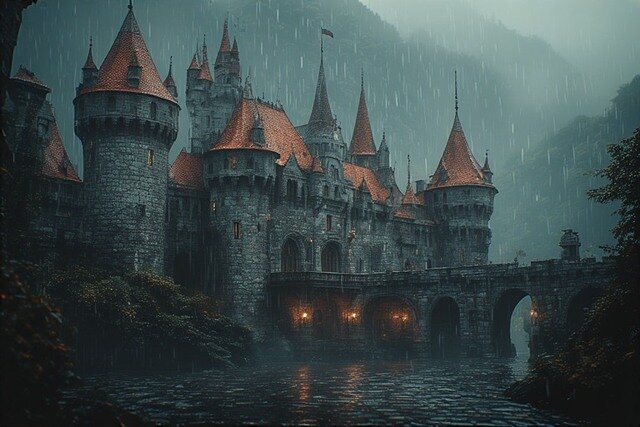


Blood had dried in the creases of Vlad’s gauntlets. He flexed his fingers, feeling the crust crack as he gripped the reins tighter, guiding his stallion toward the looming gates of Târgoviște. The late afternoon sun caught the metal of his armour, turning crimson stains to black shadows. Behind him stretched the remnants of his army, men whose faces had aged years in mere months of campaign against the Ottoman forces. Victory tasted like iron on his tongue, familiar and necessary.
The fortress walls rose before him, weathered stone stained amber in the dying light. Târgoviște stood defiant against the darkening sky, just as it had for generations, just as it would continue to do under his protection. Clouds gathered above the highest towers, threatening rain that would wash the streets clean of the dust his procession stirred. Vlad inhaled deeply, savouring the scent of home beneath the lingering odour of battle that clung to him – wood smoke, wet stone, and the peculiar mustiness of the river that curled around the city’s eastern edge.
“Open for the Prince! Open for the Dragon!” The shout echoed along the ramparts.
The massive gates groaned open, ancient hinges protesting the movement. Guards snapped to attention, their eyes averted as he approached. Fear or respect – the distinction mattered little to him. Results mattered. Loyalty mattered. And these men had held his city while he bled for it elsewhere.
Vlad passed beneath the archway, the sudden shadow cooling his face for a brief moment before the last sunlight touched him again. His horse’s hooves struck cobblestone, the rhythm a counterpoint to his heartbeat. The beast was as tired as he was, flanks trembling beneath him, yet it maintained a proud gait. Animals understood dignity in ways humans often failed to grasp.
The streets had filled with townspeople; word of his approach having raced ahead of him. They stood in uneasy clusters, pressing against buildings to clear his path. A few threw flowers that landed in sad, crushed heaps beneath his horse’s hooves. Others chanted his name or whispered prayers. Most simply watched with the wary eyes of prey in the presence of a predator they knew could strike or spare on indiscernible whim.
“The prince returns victorious!” someone called, voice cracking with forced enthusiasm.
Vlad acknowledged the declaration with the slightest nod. His victory had been costly. For every Ottoman soldier impaled along the southern roads as warning to would-be invaders, he had lost a Wallachian son. The trade was necessary – fear was the currency of respect – but he took no pleasure in the expense.
A dull ache pulsed behind his left eye. Three days with minimal sleep, pushing his men to reach home before news of their approach could spread beyond those he trusted. His right shoulder throbbed where an arrow had grazed him, the wound hastily cauterized in the field. Hunger gnawed at him, but it was a familiar companion, one he had learned to ignore long ago.
“My prince.” A child’s voice, unexpectedly close.
Vlad turned his head sharply. A small girl had darted from her mother’s grasp to stand directly in his path. His horse snorted, halting without command. The crowd held its collective breath. The girl’s eyes were large, unblinking, fixed directly on his face in a way few adults dared.
“You killed the monsters,” she said simply, with the certainty of youth.
Her mother lunged forward, face drained of colour and yanked the child back into the press of bodies with desperate apologies. Vlad considered the interruption, then nudged his horse forward without comment. The girl wasn’t wrong. He had killed monsters. The trouble was that to defeat monsters, one had to become something equally terrifying.
The soldiers behind him moved like ghosts, their armour dull with dust and rust-coloured stains. Some rode, many walked, a few were carried on makeshift stretchers. Their eyes held the vacant stare of men who had witnessed too much death to be shocked by anything anymore. These were the men who had stood with him in the valley of Poenari, who had watched him order the impalement of five hundred Ottoman prisoners in a forest of human suffering. These were the men who understood what sacrifice meant.
“My lord,” said a voice to his left. One of his captains, gesturing toward the inner keep. “The council awaits your report.”
Vlad gave a curt nod. The politicians would want details, numbers, assurances that the border was secure again. They would not want to hear how he had achieved this security, the brutal efficiency required. Ioan would handle them until Vlad had washed the grime from his skin and choked down whatever food his servants could prepare quickly.
The streets narrowed as they approached the inner fortress, houses pressing close on either side. Vlad noted repairs to buildings damaged in last winter’s fire, new merchants occupying shops that had been empty when he departed. Life continued in his absence. The thought was both comforting and strangely disquieting.
Windows above him filled with faces, some throwing flower petals that drifted down like snow. He caught the scent of freshly baked bread and realized that what he had initially taken as a celebratory welcome was also relief – relief that their prince was alive, that more sons would not be conscripted, that trade routes might reopen. Their fear of him was matched only by their fear of life without his protection.
The inner courtyard opened before him, servants and stable hands rushing forward as he finally allowed his posture to relax fractionally. His thighs burned as he swung down from the saddle, boots hitting stone with a solidity that ran up through his spine. For a moment, the world tilted – exhaustion taking its toll – but he caught himself before anyone could notice.
“See to the wounded first,” he ordered the waiting physician, voice rough from days of shouting commands over the clash of steel. “Then prepare reports on our losses.”
The horse was led away, its familiar weight and warmth suddenly absent. Vlad stood alone in the centre of activity that flowed around him like water around a stone. The sun had nearly vanished now, torches being lit along the walls, their flames reflecting in the windows of his private chambers high above.
Home. A word that meant something different to him than to the peasants who had lined the streets. To them, home was comfort, safety. To Vlad, it was duty, responsibility – a fortress from which to defend what was his. He looked up at the darkening sky and allowed himself one deep breath before straightening his shoulders.
The blood on his armour had dried to a dull brown, but he could still feel its sticky warmth on his hands, under his fingernails. No matter how much he scrubbed, it never truly washed away. Perhaps it never should.
“The Ottoman forces have retreated beyond the Danube, my prince.” The general’s voice echoed against the stone walls of the war room. Maps spread across the heavy oak table, corners held down by daggers and cups of untouched wine. Vlad stood at the head, his shadow stretching long in the torchlight. The men around him—commanders who had led his forces through mud and blood for months—watched him with expressions carved from the same weary stone as the fortress walls. He had heard enough.
“We will discuss reparations and border reinforcements tomorrow,” Vlad said, his voice a blade that cut through the stale air. “Go. See to your men. Rest while you can.”
The generals bowed—some deeply, others with the slight tilt of exhausted men who had earned the right to minimal deference—and filed out. Their boots scraped against the floor, shoulders bumping in the narrow doorway as they dispersed to their own quarters. Only Ioan Petru remained, his weathered face creased with concern that went beyond military matters.
“The wound on your shoulder needs attention,” Ioan said, his voice low enough that the departing men wouldn’t hear. His eyes, steel-blue and sharp even after days of hard riding, lingered on the dark stain visible beneath the edge of Vlad’s breastplate.
“It’s nothing.” Vlad’s gaze hardened, a silent command more effective than shouted orders.
Ioan’s jaw tightened. For a moment, he seemed ready to argue—one of the few men who might dare—but then he gave a short nod. “As you wish, my prince.” He turned toward the door, pausing with his hand on the iron handle. “The men fought well. Your strategy was... effective.”
Effective. A careful word for the brutality Vlad had ordered. The impaled bodies would rot for weeks, visible to any who might consider crossing the border with hostile intent. Ioan disapproved of such methods, though he never said so directly. But Vlad had not been appointed to make merciful choices. He had been tasked with keeping Wallachia safe, and fear was a more reliable defence than goodwill.
“Tomorrow, Ioan.” The dismissal hung between them like smoke.
The door closed with a heavy thud, and finally, Vlad was alone. The silence pressed against his ears, broken only by the occasional pop from the brazier in the corner. His private chambers adjoined the war room—a practical arrangement that suited his preference for function over comfort. A narrow bed stood against one wall, covered with furs rather than fine linens. A single window, tall and narrow, offered a view of the courtyard below. Weapons hung on the walls instead of tapestries, and the only personal touches were a few books stacked beside the bed and a silver goblet engraved with the dragon emblem.
Vlad began the laborious process of removing his armour. First the gauntlets, revealing hands crosshatched with small cuts and bruised knuckles. The vambraces followed, then the pauldrons. Each piece made a dull sound as he placed it on the wooden stand near the wall. The weight lifted from his body incrementally, a relief that brought its own pain as blood flowed more freely to compressed muscles.
The breastplate was the most difficult, especially with no squire to assist. He worked the leather straps free, fingers clumsy with fatigue. When it finally came loose, he sucked in a breath as the metal edge scraped against the arrow wound on his shoulder. Fresh blood bloomed against his sweat-darkened shirt. The breastplate joined the rest of the armour, bearing dents and scratches that told the story of the campaign more honestly than any official report would.
He peeled the shirt from his skin, fabric sticking to half-closed wounds. His torso was a map of violence—fresh bruises layered over older scars, a particularly vivid purple blotch spreading across his right ribs where a mace had connected despite the armour. He prodded it gently, assessing the damage. Painful, but nothing broken. He had ridden with worse.
The basin on the side table contained water that had been hot when first brought to his chambers but now sat tepid. Vlad dipped a cloth into it, anyway, pressing the fabric against his shoulder. Water trickled down his chest in rivulets, turning pink as it carried away dried blood. The wound was shallow but long, stretching from the top of his shoulder nearly to his collarbone. It should be stitched, but that would require summoning the physician, and the man was better employed tending to soldiers with more serious injuries.
Vlad’s hands trembled slightly as he cleaned the worst of the grime from his skin. Three days since he had truly slept. Five since he had eaten anything more substantial than hard bread and dried meat. His body demanded rest with increasing urgency, but his mind remained alert, cataloguing all that still required attention.
The metallic scent of blood mingled with the smells of leather, sweat, and woodsmoke that permeated the chamber. He had grown so accustomed to these odours that he barely noticed them anymore. They were the scents of war, of command, of decisions that weighed on him alone.
Vlad sank onto the edge of the bed, still holding the damp cloth to his shoulder. The campaign had been necessary. The Ottoman forces had grown bolder, testing Wallachia’s southern borders, counting on winter to have weakened their defences. They had not expected him to anticipate their movements, to strike first with merciless efficiency. The message he had sent by leaving their dead-on display would buy his kingdom days, perhaps even months of relative peace. Time to rebuild, to strengthen fortifications, to prepare for the inevitable next assault.
Such were the calculations that filled his days. Human lives reduced to numbers, to strategic advantage, to necessary sacrifice. Vlad wondered sometimes if this was what his father had felt—this cold certainty that brutality in measured doses prevented greater suffering. The nobles who criticized his methods from the safety of their estates did not understand what it meant to stand as the barrier between their comfortable lives and the chaos beyond their borders.
Leadership was isolation. Every man who called him prince, who bowed before him, who carried out his orders without question, reinforced the distance between them. Even Ioan, who had fought beside him since they were young men, maintained that crucial separation. It was necessary, Vlad knew. Closeness bred familiarity; familiarity bred contempt; contempt bred betrayal. He had learned that lesson early and painfully.
A log in the brazier collapsed, sending up a shower of sparks. Vlad watched them rise and fade, momentarily mesmerized by their brief, brilliant lives. Only now, alone in his chambers with no witnesses, did he allow his shoulders to slump. The weight of armour was nothing compared to the burden of appearing invulnerable.
He would rest. Not yet, but soon. First, he needed to review the latest intelligence reports from his spies in Constantinople. The wound on his shoulder could wait. The ache in his muscles could wait. The hollow feeling that sometimes crept into his chest in these rare solitary moments—that, too, could wait.
Vlad rose, back straight despite the protest of his body, and poured a measure of wine from the decanter on his desk. Tomorrow would bring new challenges, new decisions. The price of safety never remained paid for long.
Night had claimed Wallachia hours ago, wrapping the mountains in shadows so deep they seemed to devour the stars at their edges. Vlad stood at the high arched window of his private study; one hand pressed against the cold glass. His breath formed ghosts against the pane, appearing and vanishing with each exhale. Below, Târgoviște slept—or pretended to—while guards patrolled the walls, their torches tracing slow paths along the stone battlements.
His kingdom stretched before him—valleys and forests and villages dotting the landscape like fallen stars. Distant pinpricks of light marked settlements where peasants huddled around hearths, telling stories of the prince who protected them from Turkish invaders. Or perhaps they whispered of the prince who impaled his enemies and dined among the dying. Both stories served his purpose. Both contained their own truths.
The mountains stood sentinel at the borders of his land, their massive silhouettes a bulwark against the world beyond. Snow still capped the highest peaks, glinting silver in the moonlight, while forests cloaked the lower slopes in velvet darkness. Those woods had saved Wallachia more than once, swallowing invading armies in their depths, hiding his forces until the moment to strike arrived. He knew every pass, every hidden trail, every defensible position. This land was in his blood.
Vlad’s fingers traced the Order of the Dragon medallion at his throat, feeling each scale of the silver dragon pressed against his skin. The metal had warmed to his body temperature hours ago, yet he always remained aware of its presence—a constant reminder of oaths sworn and duties accepted. His father had worn this same emblem, had pledged himself to the same cause: defence of Christian lands against Ottoman expansion. The weight of it served as both comfort and burden.
The dragon coiled around itself; tail wrapped around a cross. Protection and faith intertwined, just as his own fate was bound to Wallachia’s. Some days he wondered which was the greater burden—the responsibility for thousands of lives or the knowledge that fulfilling that responsibility required actions that blackened his soul. His father had once told him that a prince who was loved would soon be betrayed, but a prince who was feared would endure. Vlad had learned the truth of those words at great personal cost.
The glass fogged with his breath again. He wiped it clear with his palm, leaving a smear that distorted the view. Beyond the city walls, the river gleamed like a silver ribbon in the moonlight, winding its way through valleys where farms and villages nestled in protective hollows. Those people knew nothing of court politics or international diplomacy. They knew only that their prince kept them safe, that taxes must be paid, that life continued in its seasonal rhythms despite the wars that raged at their borders.
How simple their concerns must be, he thought. To worry about crops and weather and local disputes. To never bear the weight of decisions that sent men to die. To never lie awake calculating the cost of peace in terms of blood.
A sound in the corridor broke his contemplation—hesitant footsteps approaching his door. Vlad turned from the window, his hand falling instinctively to the dagger at his belt. Even here, in the heart of his fortress, vigilance was second nature.
“Enter,” he commanded before the knock came.
The door opened slowly, revealing a young servant whose attempt to appear confident was betrayed by the slight tremor in his hands. He carried a silver tray with a folded parchment sealed with red wax.
“Forgive the intrusion, my prince,” the servant said, eyes downcast. “A messenger arrived from the Basarab estate. Lord Văcărescu seal... They said it was urgent.”
Vlad gestured for him to approach. The servant crossed the room with careful steps, extending the tray as if offering tribute to an unpredictable deity. Vlad took the parchment, noting the weight of the paper—expensive, as befitted a noble of Văcărescu standing—and the precise impression of the Basarab crest in the wax seal.
“Who delivered this?” Vlad asked.
“A rider in Lord Văcărescu colours, my prince. He awaits your response in the lower hall.”
“Have food and drink brought to him. I will send word if a reply is necessary.”
The servant bowed deeply and retreated, closing the door with painstaking quietness. Vlad turned the parchment over in his hands, examining the seal more closely. Văcărescu the Elder was a cautious ally—never openly opposing Vlad’s policies but rarely enthusiastically supporting them either. His estates provided considerable resources to Wallachia’s treasury, making him too valuable to alienate but too powerful to fully trust.
Vlad broke the seal with his thumb, the scent of wax rising as the parchment unfolded in his hands. The missive was written in a formal hand, the letters precise and evenly spaced. An announcement, he realized as he scanned the contents, of a diplomatic gathering to be held in Târgoviște in a fortnight’s time. Lords from across Wallachia and neighbouring regions would attend to discuss trade agreements and mutual defence—a necessary political exercise that Vlad typically endured rather than enjoyed.
His eyes paused on a particular passage. Văcărescu would be attending personally, which was not unusual. What caught Vlad’s attention was the mention that followed: “...accompanied by my daughter, Lady Elisabetha, who has expressed interest in court matters and whose presence I believe would honour Your Highness and the assembled nobility.”
Vlad had never met Văcărescu daughter, though he had heard mention of her—reportedly accomplished and well-educated, kept largely secluded at her father’s estate. That Văcărescu would bring her to court now suggested political manoeuvring of some kind. Perhaps a marriage alliance was being contemplated. It would not be the first time a noble had dangled a daughter before him in hopes of gaining favour or influence.
“A gathering, then,” he said aloud, his voice distant and hollow in the empty room.
He dismissed the messenger with a brief note acknowledging receipt and confirming that the diplomatic assembly would be accommodated. Court functions were unavoidable aspects of rulership, necessary for maintaining alliances and gathering intelligence. The presence of Văcărescu’s daughter was a minor detail, unlikely to affect the political discussions that would determine resource allocation for the coming seasons.
Vlad turned back to the window; the parchment still held loosely in his hand. The night had deepened while he stood there, clouds now obscuring portions of the stars. He watched their shadows move across the land—his land—and felt the familiar resolve harden within him. Let the nobles come with their daughters and their schemes. Let them play their careful games of alliance and advantage. He would endure their company as he had endured everything else—for Wallachia.
The dragon at his throat seemed heavier suddenly, each silver scale, a reminder of the price of power. Beyond the glass, his kingdom waited, sleeping under his protection, unaware of the cost of their safety.



















After watching Dracula: A love tale I was hunting for a prequel version of the story and found yours, so excited to read this!!!
Thank you so much, I hope you like my version, Dracula a love tale is the whole reason I wrote this, I loved the film and knew I had to write Vlad and Elisabetha's story!!! ♥