Chapter 1
The kingdom of Asterin had not seen a miracle in three hundred years.
Not because miracles stopped coming. But because the people had forgotten how to look.
They built temples to gods whose names they no longer remembered. They sang hymns with empty mouths. They raised their children on stories that became thinner with each telling, until the myths were only syllables without meaning. The priests spoke of purity as something to be protected— locked away, untouched, unsullied by the mess of ordinary life. The nobles nodded. The common folk bowed. And everyone, in their own way, forgot that purity had ever walked among them.
This was Asterin. A kingdom of mist and stone, of old forests and older graves. A kingdom that had once held a star in its palm and had closed its fingers out of envy.
Now the star was gone. And no one remembered to miss her.
King Emeric had ruled Asterin for twelve years when the restlessness began.
It came upon him slowly, like frost creeping across a window. He did not name it at first. He woke each morning before dawn, as he always had. He reviewed the petitions, signed the decrees, settled disputes between farmers and merchants, listened to the council’s endless arguments about trade routes and border taxes. His rule was just. His kindness spilled across the nation like rain over dry fields. The people loved him — not with the feverish adoration they might have given a conqueror, but with the quiet trust they gave to a man who had never lied to them.
But power cannot be love. Emeric knew that very well.
King Emeric was already 25 and his kingdom was growing anxious waiting for their queen and the next heir of the kingdom whom they could shower with love, but the king had other plans he was looking for the spark and mischievous a true love who isn't bound with royalty that he hadn't experienced since his childhood. There were indeed beautiful and kind princesses from other kingdoms desperate to be with him, but he never got what he was looking for.
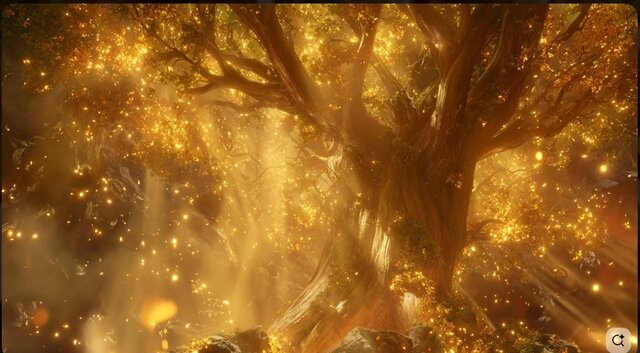
His advisors and his dear Sister Emilia have told him thousand times yet all he was fascinated was to the forest, lately at night he stood by the window of his chambers staring at a space in the forest that glowed with a soft yellow light illuminating around it.
On an afternoon in late autumn, Emeric did something he had not done in years.
He left the castle without telling anyone.
No guards. No advisors. No purpose. He simply walked out of the eastern gate, past the last houses of the city, and into the woods that the people of Asterin called the Veilwood.
The name came from the old tongue. It meant the place where seeing fails.
The trees were ancient here. Their roots broke through the forest floor like the knuckles of buried giants. The light fell in slanted shafts, golden and thin, filtered through leaves that had begun to turn. Emeric walked without intention, his boots sinking into the damp earth. He had left his crown behind today — a small rebellion that would have horrified Lord Renfrid.
He walked for an hour. Maybe more. The sounds of the castle faded — the clang of the smithy, the cries of merchants, the endless murmur of a kingdom living its ordinary life. Here there was only the rustle of leaves, the distant call of a bird, the soft whisper of wind through branches.
And then he heard something else.
Laughter.
Not the careful laughter of the court, measured and polite. Not the sharp laughter of soldiers around a fire. This waschild’slaughter — wild, breathless, the kind of laughter that came from a belly that had not yet learned to hide anything.
Emeric stopped.
He stood very still among the trees, his heart beating once, twice, three times against his ribs. The laughter came again, and with it, the sound of small feet pounding the earth, the rustle of skirts, the low murmur of a voice he could not quite make out.
He stepped forward. Slowly. Quietly. He did not know why he was hiding. He was the king. He had the right to walk anywhere in his own kingdom. And yet something told him to wait, to watch, to not interrupt.
He pushed aside a low-hanging branch.
And he saw her.
A woman sat beneath an oak tree — the largest oak in the Veilwood, its trunk wide as a cottage, its branches spread like arms opening for an embrace. She was surrounded by children. Four of them, maybe five, their faces flushed with play, their hair tangled with leaves and twigs. They were weaving flower crowns from weeds and fallen petals, their fingers clumsy but determined.
The woman laughed at something one of the children said. Her voice was sweet — sweeter than anything Emeric had ever heard. It landed somewhere beneath his ribs, in a place he had forgotten he owned.
He could not see her face clearly. The light did something strange around her — bending, softening, as if the sun itself could not decide how to touch her. But he saw her hands, gentle as she helped a small girl tie a knot. He saw her hair, dark as rain-soaked bark. He saw the way the children leaned into her, trusting, unafraid.
And then she looked up.
Not at him. He was hidden; he was certain of it. But she looked up toward the trees where he stood, and for a moment — a single, impossible moment — he saw her eyes.
Red.
Not the red of blood or fire. Something softer. Something older. The red of winter berries. The red of a sunset seen through smoke. They were not cruel eyes. They were not hungry eyes. They were simply other— and they looked directly at the place where Emeric stood, as if she knew he was there.
As if she had always known.
Then a child tugged her sleeve, and she looked away, and the moment shattered like glass.
Emeric did not move. He did not breathe. He stood among the trees like a man who had just seen something he was not supposed to see, something he had no words for, something that would follow him into every dream for the rest of his life.
The sun shifted. The light changed. And when he looked again, the woman was gone.
The children still sat beneath the oak, still wove their flower crowns, still laughed at nothing. They did not seem to notice her absence. They did not call her name. They simply continued their game with one less player, as if she had never been there at all.
Emeric stayed in the Veilwood until the sky turned amber and the air grew cold. He watched the children gather their things and wander back toward the village, chattering among themselves, disappearing into the trees. He walked to the oak tree and placed his palm against its trunk. The bark was rough. The moss was damp. He found a wilted flower crown on the ground — a small one, made for a child’s head — and picked it up.
He did not know why.
He returned to the castle as the gates were closing. His advisors asked where he had been. He did not answer. Lord Renfrid noted the flower crown in his hand and raised an eyebrow. Emeric said nothing. He went to his chambers, placed the wilted crown on his windowsill, and stood looking east toward the Veilwood for a very long time.
That night, he dreamed of red eyes and a voice like honey.
And when he woke, he could not remember her face.
But he remembered that he had forgotten. And somehow, that was worse.