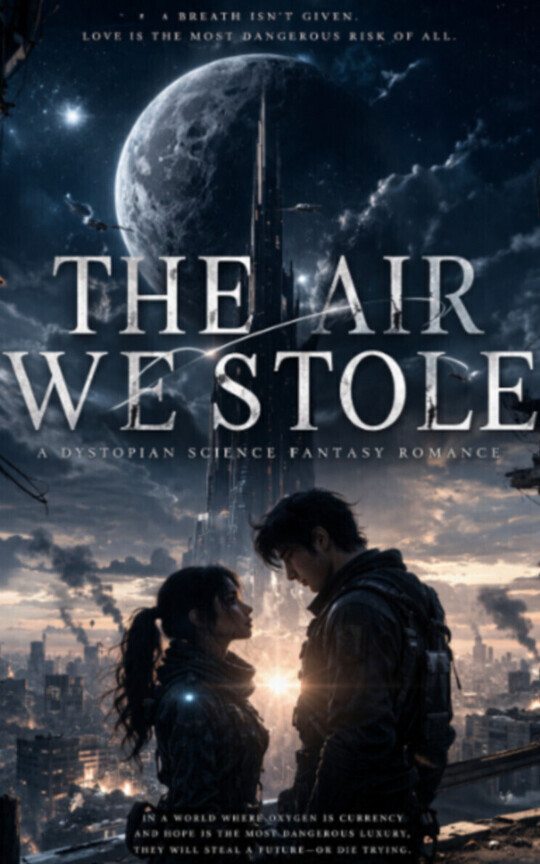
The Air We Stole
The first thing Aeria Goldener counted every morning was not people. It was breaths.
Not her own. Those came whether she wanted them or not, thin and metallic through the recycled filters of Haven 9. She counted the colony’s breaths instead. How many hours the oldest scrubber could still run before the membrane split. How many cartridges remained beneath the ration desk. How many children had started coughing in their sleep. How many adults had learnt to do it quietly, so they would not look expensive.
That morning, the numbers were worse.
She knew it before she reached the central duct and saw the condensation there, blackened with grit. Knew it from the sting at the back of her throat. Knew it from the way people moved through the passage as if each breath had to be negotiated first.
Haven 9 had once been a transport shelter, then a field hospital, then whatever came after the world ran out of proper names. Its ceilings were too low, its walls too damp, and every corridor smelt of rust, iodine, old sweat and bitter water. The lights buzzed overhead with the patience of insects.
A child laughed somewhere in the half-dark. Then came a fit of coughing, followed by a mother’s voice saying, “Slowly. Breathe slowly. Don’t waste it.”
As if there were a polite way to suffocate.
At the ration desk, Oren stood hunched over a terminal old enough to belong in a museum. He did not look up when she approached.
“You’re late,” he said.
“I was breathing.”
“That is becoming a luxury.”
She planted both palms on the counter. “How bad?”
“The east scrubber dropped below safe tolerance at 03:12. We patched it. It is still leaking. If we cut Section C by twelve per cent and the core by six, we may gain another day.”
“The core houses sixty people.”
“It houses the useful sixty.”
Aeria stared at him. “Say that again.”
“The med bay. The pump room. The nursery. Prioritised sectors.”
“You meant what you said.”
He did not deny it. “There are nineteen cylinders left in reserve. Thirteen once we account for contamination checks. Nine if we keep emergency margin.”
“Nine is not a reserve.”
“It is if you are realistic.”
She leaned closer. “Sami?”
That was the first time he looked tired.
“The clinic submitted a request during second watch,” he said. “Additional support. One priority cylinder allocation. Two clean masks. It was denied.”
“By you?”
“By protocol.”
“Protocol doesn’t sign forms.”
“No. I do.”
People had begun to slow around them.
“Sami is eight,” Aeria said.
“Sami has compromised lungs, recurring oxygen dependence, low labour value and high consumption probability.”
The corridor went silent.
Aeria’s fingers curled against the counter. “Labour value.”
“Aeria,” Oren said, and now there was fatigue in his voice rather than coldness. “If I sign one exception, then Mara wants one for her father, then Iven for his wife, then the pipe mechanics for their apprentice, and in three days we have no reserve and everyone dies in a more democratic way. Is that what you want?”
No.
That was what made him dangerous.
Men like Oren hid cruelty in their sums.
She stepped back before her anger made the choice for her. “I’m taking a surface run.”
“You’re not cleared.”
“I’m not asking.”
“The ash shifted west last night.”
“I know.”
“Three scavengers did not come back from the last line.”
Aeria knew their names. Knew one had a daughter who slept with her boots on because it made her feel ready. Knew another still owed Sami a carved bird made from melted conduit.
Still she said, “Then I’ll bring back what they missed.”
The clinic sat on the lower ring where the air stayed colder and the pipes sweated against the walls. It smelt of boiled cloth, alcohol, and sedatives thinned with too much water.
Sami was awake.
The second surprise was the drawing.
Sami sat propped against folded blankets with a mask over nose and mouth, graphite smudged across small fingers. On the pad balanced against narrow knees was the same impossible subject Aeria had seen a dozen times in a dozen versions.
A sky.
Wide. Blue. Clean.
Today there were clouds, round and soft as if the world had once been foolish enough to complain about too many of them.
Sami looked up and grinned behind the mask. “You’re scowling again.”
“You’re drawing fake weather again.”
“It’s not fake. It’s archived.”
Aeria dragged a crate over and sat beside the bed. “From where?”
“Old books. Old screens. Talia says people used to complain when there were too many clouds.”
“People used to complain about everything.”
Sami angled the pad towards her. “This one’s for the ceiling above your bunk.”
“So I can wake up disappointed every morning?”
“So you can wake up and remember there was something else.”
There it was. That terrible, gentle way Sami had of making hope sound practical.
Aeria adjusted the loose strap of the mask. The skin beneath Sami’s eyes looked bruised with exhaustion.
Dr Kess came in carrying a tray of wrapped instruments. “You’ve heard.”
Aeria nodded. “How long?”
“The inhaler can be stretched another day. Two if the coughing eases.”
“And if it doesn’t?”
Kess said nothing.
Aeria stood. “I’m going up.”
Sami’s pencil stopped. “No.”
“I’m not discussing it.”
“You always say that when you know you’re wrong.”
Aeria crouched so they were level. “Listen to me.”
“I am listening. That’s the problem.”
From beneath the blanket, Sami pulled out a folded strip of cloth, blue once, now faded grey at the seams. Their mother’s scarf. Or what remained of it.
“For luck,” Sami said.
“I don’t need luck.”
“Yes, you do. You just hate admitting it.”
Aeria tied the cloth round her wrist.
“Don’t trade your own mask seals,” Sami said.
“I won’t.”
“Don’t go near the glass fields if the ground hums.”
“I know.”
“Don’t trust any tank that isn’t sealed at the valve.”
“I know.”
Sami looked back at the drawing and added one more line of cloud. “Come back angry, then. Angry means you’re alive.”
Aeria touched the top of the child’s head, quick as a secret. “Sleep.”
“I can’t,” Sami said softly. “The air tastes old.”
By the time Aeria reached the equipment chamber, Talia Venn was already there, ankle-deep in opened crates.
“Tell me you’re not taking the west line,” Talia said.
“I’m not taking the west line.”
Talia squinted at her. “You are a terrible liar.”
“It’s the fastest route.”
“It is also the fastest route to dying in conductive ash.”
Aeria checked the seals on her mask. “I need membrane fibre. Filters. Anything with a working valve.”
Talia’s expression changed. “This is about Sami.”
“It’s always about Sami.”
Talia handed her a backup gauge. The needle stuck at thirty per cent and trembled there. “Your second tank is unreliable. Use it only if the first one cracks.”
Aeria clipped it to her belt. “You had a signal again?”
Talia hesitated. “Something under the static. A pulse pattern. Clean. Repeating.”
“From another colony?”
“Too regular.”
“Military?”
“Too quiet.”
Quiet meant shielding. Good power. Intact systems.
Talia stepped forward and checked Aeria’s mask seals herself, fingers quick and practised. Intimacy in Haven 9 lived in competence.
“Bring back anything with membrane fibre,” Talia said. “Even burnt sheets.”
“Medicine?”
Talia gave her a flat look. “Bring me a palace while you’re there.”
At the gate, the old steel mouth groaned open and let out a breath of heat and ash.
The surface was always worse than memory.
Even through the mask, the air carried burnt metal, scorched dust, and something sweet and rotten that might once have been forests. Concrete ribs jutted from dunes of black grit where buildings used to stand. Twisted vehicle frames stuck from the ground like fossils.
Aeria kept low and moved east.
By noon she had found little worth the weight: warped copper, a cracked condenser housing, one intact valve assembly. Useful, all of it. None of it would keep a child’s lungs from closing.
She climbed the remains of a collapsed transit arch to get a better view.
That was when she saw the seam.
Not a door at first glance. Only a line too straight to belong to the ruin around it, half buried beneath ash and broken concrete, beyond the marked scavenger boundary.
Aeria crouched and studied it through the cracked lens of her scope.
The seam ran vertical and unnaturally clean. No corrosion. No heat flaking. Something had protected that surface. Or hidden it.
This was how people died, she thought. Not always through bad luck. Often through curiosity dressed up as duty.
She went anyway.
The slope gave way under her boots as she descended. Once the ground gave a low hum beneath her feet and she froze until the vibration passed.
At the bottom, she brushed the ash aside with both gloves.
More of the shape emerged.
Smooth black alloy under the grime. An inset groove. A recessed panel almost erased by scorch marks. Not a cache. Not an ordinary bunker. A structure buried on purpose.
Her pulse quickened.
She cleared more of the face and found, half concealed by fused debris, a symbol she did not recognise: three interlocking arcs around a central line.
Then she laid her hand against the metal.
Cold.
Everything around it held the day’s heat, yet the surface beneath her palm remained cold, as if power still slept somewhere inside.
Slowly, she worked ash away from the right side and uncovered a narrow access plate. Beneath it sat a dead keypad and a recessed manual socket.
No scavenger cache needed a keypad.
No ordinary shelter stayed powered this long.
She fitted the socket head of her multi-tool into the housing and turned once.
Nothing.
She adjusted the angle and leaned harder.
Then something deep below the earth answered.
A click.
Dust shivered from the seams. The keypad flickered once beneath the grime, a thin blue pulse that vanished almost at once.
Aeria stared.
The old stories rose in her mind uninvited. Reserve habitats. Launch shelters. The rich who had not trusted the planet to keep them and had built ladders into the dark instead.
She climbed higher over the rubble for a better angle and saw it then, faint beneath the ash haze: the fractured spine of a launch rail disappearing into the ruin behind the sealed structure.
A launch system.

The breath caught in her chest.
Below ground, Sami was running out of air one ration slip at a time.
Above ground, somewhere beyond fire and ash and mercy, there had once been people who stored more oxygen than they deserved.
Aeria saw Sami’s drawing in her mind. A blue sky no one in Haven 9 had ever touched. Oren at the desk speaking of labour value as if that were a neutral property of the soul. The scrubbers failing. The cylinders shrinking. The whole colony closing around itself one denied request at a time.
Then she looked at the hatch again.
If there was a way up, real or broken, then waiting underground for kindness had become the stupidest plan she had ever heard.
Aeria brushed dust from the keypad and smiled inside the mask, though there was nothing kind in it.
“All right,” she whispered to the buried machine. “If the earth won’t keep us, I’ll steal air from the sky.”
She marked the surrounding rubble with three cuts only Talia would recognise, then turned and ran for Haven 9 before the light could fail, the idea burning brighter with every breath.
Somewhere under the ash, a hidden system had woken.
And Aeria Goldener was done asking permission.