
Backstory
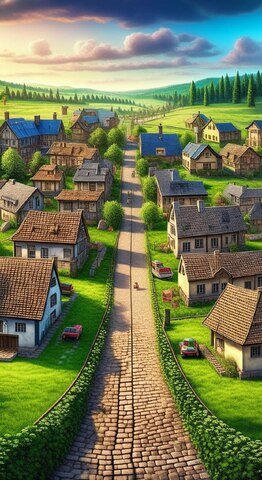
The story takes place in a small settlement called Meadowfield, located about 20 kilometers from the city. Meadowfield was founded in the 1950s. At first, a collective farm was established there, where residents of the surrounding villages worked. Later, regional authorities decided to build a settlement nearby so people could commute to work more easily.
Meadowfield was put together in a hurry: three long streets paved with poor-quality asphalt, five cross streets, and rows of cheap, standard concrete houses in between. In the center of the settlement stood a small shop that also served as a bar, a post office, a medical clinic, and a building that housed a school, a kindergarten, and a library.
Meadowfield remained like this for a couple of decades, until a major event—at least by local standards—took place. To the north of the settlement, a new area with the same name was established, filled with small summer houses where city residents came to relax or tend their garden plots.
Meadowfield gradually became a place divided into two very different parts—not only in terms of architecture, but in mindset as well. Residents of the old part saw the city newcomers as snobs and idlers who allowed themselves completely unacceptable things, like sleeping until ten in the morning. A self-respecting villager, in their view, would be up before dawn, taking care of the household.
Meanwhile, the residents of the newer part considered the locals backward and provincial. They often mocked them, exaggerating their simple way of speaking. Over time, people began jokingly referring to the two areas of Meadowfield as “civilization” and “the middle of nowhere.”
Starting in the 1990s, after the collapse of the Soviet system, two-story mansions began to appear in the newer part alongside the small summer houses. Wealthier city residents moved into them, seeking a quieter life away from the bustle of the city. Meadowfield appealed to them for its proximity, clean air, and picturesque surroundings.
Meanwhile, the farm fell apart, and the old part of the settlement began to decline. At one point, its only remaining residents were pensioners and a depressed younger generation—many of whom turned to alcohol and drugs—who had failed to find their place in the city. Now the two parts of Meadowfield were divided not only by architecture and mentality, but also by their standard of living.
In the newer part of Meadowfield, on one of its quiet green streets, lives Natalia, a 44-year-old freelance accountant and auditor who works with large city companies. She lives there with her 12-year-old son Nikita, her 9-year-old daughter Dasha, a German Shepherd named Jack, and a ragamuffin cat named Wilhelm, or simply Willy. He is the main character of these stories.







