Prologue


—————————————————
Thursday, 3rd March 2050
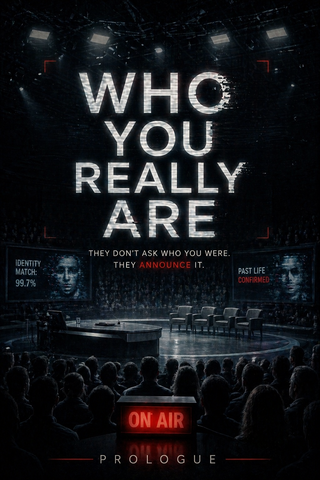
The studio had been rebuilt twice since the show first aired, but its essential geometry hadn’t changed. Tiered seating curved around a central floor in a wide horseshoe, close enough that the audience felt present rather than decorative. The lighting rig above was a dense grid of white and tungsten, and when it was fully up it washed the colour out of everything at floor level — the desk, the chairs, the carpet — until the whole space looked like a version of itself rather than the thing itself.
It was seven fifty-three in the evening.
A makeup artist moved around the desk with a small brush, working quickly. The man sitting there didn’t look at her. He was reading a printed rundown sheet, a pencil held loosely between two fingers, and he made a small mark in the margin near the bottom of the first page without seeming to decide to do it. His name was Marcus Webb and he had been presenting Question Time for eleven years.
Across the studio floor, a floor manager named Priya moved between the camera positions — quick, flat-footed, covering ground without looking like she was covering it. She spoke to the nearest camera operator in a voice too low to carry, checked the sight line, moved on. A stagehand had repositioned one of the guest chairs by a fraction and then stood back and looked at it, decided it wasn’t right, and moved it again. There were four of them arranged in a curved row opposite the desk, and nobody on the floor was paying them any particular attention.
The teleprompter operator sat off to the left of the main camera bank, her eyes on a small monitor, scrolling back through the opening segment. She’d done it three times already. She did it a fourth.
In the gallery above and behind the audience seating, visible through a long dark window, the director’s voice came through the floor earpieces at intervals — calm, procedural, rattling through shot numbers and timing adjustments in the same tone you’d use to read out a shopping list.
The audience had been seated for twelve minutes. Around two hundred people arranged in the curved tiers, quiet in the way that live audiences go quiet before broadcast — not told to stop, just gradually running out of things to say to strangers in the dark. A few of them looked at their phones. Most watched the floor.
Marcus turned the rundown sheet over and set it face down on the desk.
The makeup artist stepped back, assessed him, decided she was finished, and retreated without a word.
Priya crossed the floor and crouched beside the desk. She spoke quietly, directly to him — final timing, guest positions confirmed, the second segment’s updated timing had it running four minutes longer than the original brief, did he want to know why. He said no. She nodded, straightened, and moved back to her position near Camera Two.
The production assistant’s voice came through the earpiece, counted and unhurried.
“Two minutes to transmission.”
One of the camera operators rolled his position forward eighteen inches and locked the wheel. The teleprompter operator made a final scroll adjustment. Someone in the back of the audience coughed once and didn’t again.
Priya raised her hand toward Marcus, five fingers open.
The gallery counted down through the earpieces.
At one finger she pointed at him and stepped back.
The on-air light above Camera One went red.
Marcus Webb looked into the lens. He didn’t sit up straighter or adjust his expression. He just came on — more present, more precise. It happened in under a second and he didn’t seem to notice he was doing it.
“Good evening,” he said. “Welcome to Question Time. I’m Marcus Webb, and tonight we are doing something we have never done in seventy-one years of this programme.”
A genuine hesitation — the kind that comes from having said something in rehearsal a dozen times and finding that it still doesn’t quite fit in your mouth.
“We are going to talk about the dead.”
A small laugh from the audience. He waited for it to fade.
“Specifically — and I appreciate this is the kind of sentence that would have ended a career in broadcasting about fifteen years ago — we’re going to talk about what happens when the dead turn out not to be entirely finished.”
He glanced down briefly, then back up.
“For those of you who are new to the programme, or who have somehow spent the last decade living entirely off grid — and if so, I have questions — a brief recap. In 2040, a joint research team confirmed something that, depending on your disposition, either answered the oldest question in human history or immediately replaced it with several worse ones.”
“They confirmed that consciousness does not end at the point of biological death.”
No laugh this time. The audience had heard it before. It still landed differently said plainly in a room.
“What followed was a decade that I think most of us are still processing. Medicine changed. Psychology changed. Philosophy stopped being something that happened in universities and started happening at kitchen tables. And organised religion—” he made a short, carefully considered gesture with one hand — not dismissive, not reverent, somewhere precisely between the two, “—has had what I will diplomatically describe as a complicated ten years. We will be getting into some of that tonight.”
He leaned forward slightly.
“But the reason we are here this evening specifically — the reason this particular episode of this programme has had more advance attention than anything we have broadcast in over a decade — is not the original discovery.”
“The team behind that discovery has done something new. Something that goes further. Something which, in the past several weeks, has prompted emergency meetings in government buildings that I am not permitted to name, and letters to this programme from people I am not permitted to quote.”
He looked directly into the camera.
“What they have found — and what it means — I am going to let my guests explain. Because they can do it better than I can, and because frankly I think it is the kind of thing that deserves to be heard from the people who actually did it.”
He turned toward the guests.
“Joining me this evening — Professor Yara Osei, Chair of Consciousness Studies at the University of Edinburgh, and one of the original members of the 2040 research team. And Professor Daniel Ashworth, Director of the Institute for Post-Mortem Intelligence at Imperial College London, whose team is responsible for the development at the centre of all of this.”
The side door at the edge of the studio floor opened and the two scientists walked in together.
Professor Yara Osei came first. Tall, composed — dark green blouse, tailored trousers, small silver earrings that only caught the studio lights when she turned her head. She walked steadily, which took an effort she didn’t quite hide. She smiled at the audience on the way in, and the smile reached her eyes, which was the part that mattered.
Professor Daniel Ashworth followed half a step behind her. He was slightly older, greyer, and visibly less interested in what he was wearing. The navy blazer had been a compromise. There was no tie. His face arranged itself into warmth before it did anything else.
As they crossed the studio floor, Daniel’s hand came to rest briefly against the small of Yara’s back — guiding her past a cable taped to the carpet. He didn’t look at her when he did it. She didn’t look at him. Then Yara glanced at him, and the corner of her mouth moved.
Marcus rose from the desk, leaned across, and shook their hands in turn.
“Professor Osei. Professor Ashworth. Thank you for coming.”
“Marcus,” Yara said, warm and a fraction amused.
“Genuinely glad to be here,” Daniel said.
They settled into the two chairs closest to the desk. The outer two chairs remained where they were. Marcus lowered himself back into his own seat, waited for the applause to run down.
“Right,” he said. “I want to begin by thanking you both for agreeing to come on the programme, because I understand that the last few weeks have been — and I am putting this delicately — not entirely quiet ones for either of you.”
Yara laughed — short, unguarded, the laugh of someone who has spent a fortnight explaining her life’s work to every government on earth and is still slightly surprised to find it funny.
“That’s one way of describing it,” she said.
“I should say at the outset,” Marcus continued, “that I am almost certainly the least qualified person in this studio to be asking the questions I’m about to ask. I want that on the record.”
“In our field,” Daniel said, “that’s essentially a qualification.”
The audience laughed. It was the first proper laugh of the broadcast, and it unlocked something in the room. Marcus smiled, acknowledged it, moved on.
“How’s the day been? Tell me you’ve had a chance to eat something.”
“I had a sandwich in the car,” Yara said. “Daniel had half of it.”
“More than half,” Daniel said.
“More than half,” Yara agreed.
“Have either of you been recognised lately? I imagine it must be getting strange.”
Yara shook her head. “Edinburgh is very kind to academics. Most people assume that if they’ve seen me before, it was on the bus.”
“London is less gentle,” Daniel said. “A man in Tesco last week asked me if I was the afterlife bloke. I said yes. He said, oh right, and went back to looking at yoghurts.”
The audience laughed again. Yara was laughing too, her shoulder very close to Daniel’s, and Marcus — watching them both with the careful stillness of someone whose job is to notice — let his eyes drift for a fraction of a second to her left hand, resting on the arm of the chair.
He didn’t remark on it immediately. He finished the thought he was on, asked a follow-up question about Edinburgh, let Yara answer it. Only when there was a natural break did he tilt his head slightly and say, almost as an afterthought:
“That’s a lovely ring, by the way.”
Yara looked down at her own hand. Her face did a very small thing that she did not manage to hide, a flicker of private delight surfacing before she could decide what to do with it.
Before she could answer, Daniel — not looking up from the notes on his lap, his voice entirely level — said:
“I proposed to her about an hour ago.”
The audience made a sound — collective, warm, somewhere between a gasp and not quite a cheer. Then applause, real applause, the kind audiences give when something unexpectedly lovely happens in front of them.
Marcus laughed. Actually laughed — forgot, for a second, that he was on air.
“I’m sorry. An hour ago?”
“Roughly,” Daniel said. He had the slightly trapped expression of someone who had not planned to announce this on live television.
“In the car?”
“In the green room.”
“I had been meaning to do it for a while,” Daniel said, “and I thought — well. Why not now.”
Yara was looking at him. Not at Marcus, not at the audience, not at the cameras. At Daniel. Not finished being surprised by him.
Marcus sat back. He let the applause run a little longer than he had to. When it faded, he spoke more gently than he had a moment before.
“Well,” he said. “Congratulations. Both of you. Genuinely.”
“Thank you,” Yara said.
“Thanks, Marcus,” Daniel said.
“I will say this, because I think it’s worth saying. We are about to spend the next forty minutes on some of the largest questions there are. Life, death, what persists, what doesn’t. And I think it’s not the worst thing in the world that we begin with two people who have just decided to spend theirs together.”
The audience applauded again. Yara and Daniel looked at each other for a moment that was a shade too long for television, and neither of them seemed to mind.
Marcus cleared his throat — quietly, deliberately — and the rhythm of the programme shifted.
“So,” he said. “I’ve told the audience a little bit about what you’ve been doing over the last ten years, and I’ve told them that you are here tonight to explain something new. And I’m now going to do what any sensible broadcaster does when he is out of his depth, which is hand this over to the people who actually know what they’re talking about.”
He turned to them.
“Start wherever you’d like. Take us through it.”
Yara glanced at Daniel. A small negotiation. She would lead.
“I’ll try to keep this to the broad strokes,” she said, “and Daniel can correct me when I oversimplify.”
“I’ll allow one correction,” Daniel said.
“Generous of you.”
She turned slightly toward the audience.
“For most of human history, the reason we couldn’t detect what happens after death wasn’t because there was nothing there. It was because we couldn’t hear it. A living human brain generates enormous electromagnetic activity. Even a recently deceased body generates residual biological activity for some time afterward. Anything that might exist beneath all of that was buried under it. Imagine trying to listen for a single whispered word during a thunderstorm, at the centre of a concert, next to a running engine. That was the problem.”
“For a very long time,” Daniel added, “people assumed the absence of signal was the absence of a thing. It wasn’t. It was the absence of an instrument.”
Yara nodded at that. It was a sentence she had clearly heard him say before, and still liked.
“Three things changed in the late 2030s,” she continued. “Not one. Three, and all of them at once. Quantum field detection — developed originally for deep-space astronomy — became sensitive enough to register fluctuations at a subatomic level. Neuroscience had by then mapped the electromagnetic signature of living consciousness in sufficient detail that we could model it. And artificial intelligence had reached a level of sophistication at which it could subtract that model from a live environment in real time. Filter out the noise. Leave only what was underneath.”
“In real time,” Daniel said. “Which matters. Everyone focuses on the detector. The real breakthrough was the filter.”
“The filter was yours,” Yara said, glancing at him.
“The filter was a lot of people’s.”
“It was mostly yours.”
“It was partly mine.”
Marcus lifted a hand. “For the record — I’m going to make you both take credit for everything as we go, so if you could resist the impulse to be modest about each other’s work, that would help me enormously.”
“Noted,” Daniel said.
“And what was underneath,” Marcus said, bringing them back, “turned out to be something.”
“Yes,” Yara said. “It was a signal. Not random. Not static. Structured. It carried informational coherence. It behaved, in every measurable sense, like a pattern of organised consciousness — only without any biological substrate to sustain it. We called it the residual consciousness signature. RCS.”
“The field that studies it,” Daniel said, “is called post-mortem intelligence. Which I should say sounded considerably better in the original grant proposal than it does said out loud.”
A small laugh from the audience.
“Over the last decade,” Yara said, “we’ve come to understand that the RCS exists within what we call the resonant field. Which is — and I’m going to be careful with this language, because it matters —”
“Here we go,” Daniel murmured, and she almost laughed.
“— not another world. Not a realm in the theological sense. It’s a layer of reality that exists at a frequency range beneath biological detection. It has always been there. We simply did not, until very recently, have the instruments to perceive it.”
“In the same way,” Daniel said, “that radio waves existed before Marconi. They weren’t waiting for us. We were behind.”
“Every consciousness that has ever existed,” Yara said, “has left a signature in the resonant field. Those signatures are unique. They are structured. They are persistent. And — this is where it gets interesting — they are identifiable.”
Marcus nodded slowly. “Which brings us to what you’ve done recently.”
Daniel leaned forward.
“Six years ago, my team at Imperial started asking a specific question. When consciousness returns to biological life — when a child is born — the previous signatures the consciousness has carried remain embedded within its spiritual line. Not as memories. Not as accessible personality. As a structural trace carried forward at a level below awareness. The person has no conscious access to their former lives, but the continuity is singular and measurable. We wanted to know if those traces could be matched. If we could take a living person, scan their consciousness pattern, identify the historical signatures embedded within it, and cross-reference those against a database of recorded RCS data.”
“And?” Marcus said.
“And the answer, after considerable effort, is yes.”
“How far back does the database go?”
Daniel glanced at Yara.
“Currently, we have verified signatures for approximately two hundred and forty thousand historical figures, reaching back roughly three thousand years. Authentication is painstaking — we cross-reference historical attestations, documents, sites and artefacts that carry trace-resonance from prolonged contact with a specific individual. Once authenticated, the profile is statistically verifiable to a standard — ninety-nine point seven percent confidence — that has held up in peer review and in court.”
“So,” Marcus said, and a small smile was already forming, “theoretically — and I want to stress the word theoretically — you could find out who I used to be.”
“Yes,” Daniel said. “Quite easily, in fact.”
Marcus raised his eyebrows at the camera.
“For the record, if it turns out I was Winston Churchill, I’m going to be insufferable about it for the remainder of this broadcast.”
The audience laughed. Daniel laughed. Yara laughed too, and then glanced at him. He gave a small nod.
She turned back to Marcus.
“Would you like to find out?”
The tiers went quiet in a way that hadn’t happened yet.
Marcus looked at her. Then at Daniel. Then, briefly, at Camera One.
“Right now? On the programme?”
“The machine is here,” Daniel said. “We brought it tonight for exactly this reason. This unit is a terminal — it links to the International Resonance Array, eighty-six observatories across six continents. The real work happens there.”
Marcus was silent for a second longer than he needed to be. Then he smiled.
“Yes,” he said. “Alright. My agent is going to have opinions in the morning, but — yes.”
Yara nodded to someone at the edge of the studio floor.
The side door opened. Two crew members wheeled the machine in.
It was smaller than the audience seemed to expect. Roughly the size of a large photocopier, but that was where the resemblance ended. Matte dark grey casing, clean architectural lines, no visible branding. The front carried a single curved recess at about waist height — the reading chamber, shaped to receive a hand. Above it ran a thin horizontal display strip that glowed a soft, constant blue. On top sat a second chamber, shallower, covered by a small hinged panel of clear glass. Along the left side, in small neat lettering, was a single word.
ORACLE.
It did not look like a medical scanner. It looked like something from a company that did not want you to know what it cost.
The crew positioned it between the desk and the guests’ chairs. Cables were run. A soft internal tone sounded as it powered up, and the blue strip along the front brightened by a fraction.
“ORACLE,” Marcus read aloud. “Please tell me that stands for something.”
Daniel sighed, as though the question had been asked of him many times and always pained him in the same specific way.
“Observational Resonant-field Analysis and Cross-reference Locator Engine.”
“Oh dear.”
“It was chosen by our head of engineering. A woman of strong opinions. She felt the acronym was important. Nobody wanted to argue with her.”
“Is she here tonight?”
“She is not. But she’ll be watching.”
“Then on behalf of the programme — lovely acronym. Really.”
The audience laughed. Daniel inclined his head slightly, accepting the joke with the weary grace of a man who had long since stopped resisting it.
Marcus rose from the desk. Yara rose with him.
“Come over,” she said. “I’ll walk you through it.”
He crossed the floor. He was a broadcaster of eleven years’ standing and he knew precisely how many cameras were on him. His hands were not entirely steady.
Yara stood beside the machine. She had done this enough times that the instructions came out unhurried. She gestured to the recess.
“Right hand,” she said. “Palm down. You’ll feel a small warmth. That’s all.”
“No pain? No lasting damage? I’d quite like to keep the hand.”
“No damage. We reattach the ones that fall off.”
“Reassuring.”
He placed his hand in the chamber. The warmth came — faint, even, neither unpleasant nor particularly noticeable. Yara stepped back half a pace and addressed the audience, her voice slightly raised.
“I want to explain what’s about to happen, because otherwise it’s going to seem faster than it should. What ORACLE is looking at is something we call the spiritual line. Everybody has one. It is not a bloodline — a bloodline is biological, and this is something else. The spiritual line is a trace. A footprint. A sequence of signatures that the current consciousness carries embedded within itself, stretching back as far as we can detect.”
“It’s a bit like search history,” Daniel offered, from his chair.
Yara turned, amused. “Daniel.”
“It is. It’s like search history, except instead of showing where you’ve been online, it shows who you’ve been over the course of several thousand years.”
“That is a very Daniel comparison.”
“It’s accurate.”
“It’s accurate. I’ll give you that.” She turned back to Marcus. “Although — for the record — it’s probably for the best that nobody in the studio has access to Marcus’s actual search history.”
Marcus looked up at the ceiling, mock-alarmed. The audience laughed.
“Alright,” Yara said. “I’m going to run it now.”
She addressed the machine directly, her voice clear and unhurried.
“ORACLE. Identify the most significant historical figure within the spiritual line of Marcus Webb.”
The blue strip along the front of the machine pulsed once.
A soft chime.
Zero point five three seconds.
Marcus actually jumped — a small, involuntary motion, the physical startle of a man who had been prepared to wait.
“Sorry — that’s it?”
“That’s it.”
“I thought I’d at least have time to be properly anxious.”
“Not this machine.”
Yara lifted the glass panel on the top of the unit. A thin printed slip had emerged from a slot beneath. She took it between two fingers.
She read it.
Her smile caught before it fully formed — private delight, suppressed almost immediately, then a suppressed laugh on top of it. She turned and handed the slip to Daniel without speaking.
Daniel read it. He looked up at Marcus. He did not quite manage to keep his face in order either.
“What,” Marcus said. “What is it.”
Yara composed herself.
“Marcus,” she said, “you were Boudica.”
There was a half-second of complete silence.
Then the audience broke.
Laughter — not quite laughter, more like two hundred people losing their composure simultaneously. Marcus stood beside the machine with his hand still in the chamber, his face going through several calculations at once, none of them landing cleanly.
Then the broadcaster came back.
He withdrew his hand from the machine. He looked directly into Camera One.
“In my defence,” he said, “I think I’ve been carrying it well.”
The laughter went on considerably longer than it needed to.
When it finally settled, Marcus held up the small printed slip between two fingers. He looked at it for a moment before he spoke. When he did, his voice had shifted.
“No — honestly. What a thing to find out. Thank you, both of you. Truly.”
Yara met his eyes. “Glad to hear it.”
Daniel nodded once.
Yara returned to her seat beside Daniel. She was smiling.
Marcus turned, the slip still between his fingers, and began to walk back toward the desk. He was halfway there when Daniel spoke again, still sitting, his voice carrying easily across the studio floor.
“It works in reverse, by the way.”
Marcus stopped. He turned.
“Sorry?”
“The machine. It works in reverse as well.”
“What does that mean?”
Daniel set down his notes.
“It means we can ask the question in the other direction. Rather than asking who were you, we can ask who is this historical figure now.”
Marcus tilted his head slightly. “You don’t need them?”
“No.”
“Not at all?”
“Not at all.” Daniel glanced at Yara, then back. “The resonant field isn’t somewhere we go looking. It’s everywhere. It’s a layer of reality that exists at every point in space, simultaneously. Your signature is in it. Mine is. Everyone’s is. Right now. As we speak.”
The audience had gone quiet in a different way.
“Living consciousnesses broadcast into the field continuously,” Daniel said. “They always have. That’s not something the machine does to you. That’s something you do, by being alive. The only question is whether anyone is listening.”
Yara picked it up.
“For most of history, nobody could listen. For the last ten years, we’ve been able to listen to the dead — the signatures that persist after biological activity stops. What Daniel’s team has done in the last two years is build a system that can listen to the living as well. And because the field has no edges, no distance, a sufficiently powerful detection array can scan the whole of it at once.”
“The whole of it,” Marcus repeated.
“The whole of it,” Yara said. She was smiling. She was proud. “Every living consciousness on earth. Simultaneously. In the same scan.”
Marcus took a moment with that.
“So when you say the machine works in reverse —”
“We give it a historical signature,” Daniel said. “Someone from the database. The AI scans the living field globally, looking for the person whose spiritual line contains that signature embedded within it. And it identifies them. Legal name. Age. Municipality of residence, where local law permits disclosure. A historical signature embeds once. Not multiple times. One consciousness, one line, one current carrier. The Array cross-references the detected living signature against participating nations’ civil-resonance records — which link consciousness signatures to legal identities — and returns whatever level of detail the relevant jurisdiction authorises. That is how a signal in the field becomes a name.”
He paused.
“The match is in the field already. We just read it. Once. The query is a single event — it runs during the broadcast window, under independent audit. This is not continuous surveillance. It’s a photograph, not a film.”
Yara leaned forward slightly. There was real brightness in her voice now — the brightness of a woman describing what she considered the best part.
“For the first time in human history, Marcus, we can find anyone. We can find everyone. We can look at a historical figure and ask where are they now — and we get an answer. A living person, anywhere in the world, carrying that signature forward.”
She sat back.
“The historical names are chosen in advance. Researched. Authenticated. But the reverse query — the part that tells us who carries that signature now — that runs live. During the broadcast. Under independent audit. We submit the query, the Array scans, and the result comes back in front of the audience. Nobody in this studio knows the answer before it appears on that slip.”
She turned slightly, so that she was addressing the audience as much as him.
“This is why we’re here tonight, Marcus. This is — honestly — the reason we said yes to the programme.”
“In eight weeks, in co-production with several major broadcasters, we are launching a television series. It’s going to be called Who You Really Are.”
“The format is straightforward. Each episode, we will reveal the modern reincarnations of three authenticated historical figures. Scientists. Artists. Leaders. The names will be announced live. We’re talking about da Vinci. Alexander the Great. Cleopatra. Marie Curie. Einstein. Mozart. Shakespeare. All of them. Over the course of the series.”
Her face was bright with it.
“All of them. Every week. Names people have wondered about for centuries. We’ll announce them, one after another, and the individuals revealed will be contacted — offered support, a platform, the opportunity to share their story with the world.”
She was smiling. She was, very visibly, in love with what she was describing.
“We think of it as a celebration. A way of honouring the continuity of human consciousness. A recognition that these extraordinary figures never truly left us. That they are here, among us, walking around, going to work, raising children, and that we finally — finally — have the chance to know them again.”
Daniel was nodding. He added:
“We expect the people we reveal to receive extraordinary support. A platform. The world’s attention. The opportunity to be honoured as very few people ever are in their lifetimes. It will change lives.”
Marcus had stopped on his way back to the desk. He was watching them with an expression that was friendly and unreadable, the small printed slip still between his fingers. Behind him, the audience had started to applaud — most of them. He didn’t turn.
Yara had just opened her mouth to add something else when the side door opened.
A man’s voice came from the darkness beyond it. Calm. Measured.
“At what cost?”
Yara’s head turned sharply. Daniel’s face, which had been open and happy, closed by degrees. The warmth of the last ten minutes thinned. Nobody onstage moved.
Marcus did not turn toward the voice. He stood where he was for a moment — one beat longer than the format required — then turned, unhurried, toward Camera One.
“Which brings us,” he said, “to the debate.”
He looked at Yara and Daniel — the register had changed now, and they understood it. Daniel closed the notepad on his lap. Yara glanced at him once, and both shifted slightly to face the new guests.
Marcus returned to the desk. The slip was still in his hand.
“Joining us now,” he said, “for the second half of tonight’s programme — Dr Adam Reyes, Lecturer in Applied Ethics at King’s College London, whose work on consent and biometric surveillance will be familiar to anyone who has been paying attention to the discussion around tonight’s announcement. And Dr Iris Callaghan, Research Fellow in Ethics and Social Theory at University College London, who, together with Dr Reyes, has a joint paper currently under review at The Lancet on the psychological and political implications of publicly disclosed reincarnation data.”
“Both of whom, I should say, have written in some detail in the last two months about why they think we should not be doing what we are doing tonight.”
The audience applauded — the careful applause of people reserving judgment.
Adam Reyes stepped through the doorway first. He was young — mid-twenties, tired and underdressed. Black jeans, dark shirt buttoned almost to the collar, no jacket. He walked with the slight tension of someone who had been preparing to say something for weeks and had arrived at the place where he was going to say it.
Iris Callaghan came in behind him — a soft cream jumper over dark trousers, small gold hoop earrings, hair cut to just above the shoulder. She was slighter than Adam. She walked without the tension he carried. She looked up at the audience as she came in, serious, but there was something warm in her face — the room picked it up before she’d said anything.
The ORACLE machine was wheeled out past them as they entered, disappearing fully through the side door before they reached their chairs.
Iris reached the chairs first. She noticed Yara and Daniel as she sat down, and smiled at them.
“Congratulations, by the way,” she said. “I heard it in the green room. Genuinely. That’s lovely.”
Yara blinked.
“Oh — thank you.”
Daniel nodded once, too late, still processing.
Iris sat back in the outer chair. The gesture had taken perhaps three seconds and quietly realigned the studio. Whoever Iris Callaghan was, she hadn’t come to fight them personally. That much was now clear.
Adam said nothing. He was looking straight ahead.
Marcus gave the room a beat to settle.
“Welcome to you both,” he said. “I want to begin by saying that we’ve had quite a first half. I’m not sure we’ll top it. But I trust you’ll try.”
Iris laughed — a real laugh, audible across the studio.
Adam did not.
He glanced at her — a small, private signal. Iris’s laugh narrowed. Didn’t leave her face, but narrowed.
Marcus saw the exchange and absorbed it.
“So,” he said, sitting forward. “Let’s begin. Dr Reyes. You’ve been vocal, over the last few weeks, in opposition to the programme the professors have announced tonight. I’d like to hear your argument. In your own words. Take us through it.”
Adam breathed in.
“Before I do — I want to say something clearly. The work Professor Osei and her colleagues did in 2040 is one of the most important scientific achievements of the last hundred years. I teach it. I have enormous respect for it. My argument tonight is not about that discovery. I want that on the record.”
Yara looked up. A flicker of surprise.
Daniel said, quietly: “Thank you.”
Adam nodded once.
“My name is Dr Adam Reyes. I’m a lecturer at King’s. My field is applied ethics — specifically, the ethics of consent in technologies that act on people without their participation. I grew up in Coventry. I got into this area in my teens, when I watched what social media did to people who had not agreed to become subjects of an experiment that was being run on them in real time.”
He paused.
“I am here tonight because I believe what is being announced on this programme is the largest act of non-consensual public disclosure in human history. And I am here to argue that it should not happen.”
He turned slightly toward Iris. She picked up without needing to be cued.
“The scanning itself,” she said, “as Professor Ashworth explained earlier, does not require the subject to be present. It does not require the subject to know. It does not require the subject to agree. Professor Osei described the reach of the system as everyone. I wrote the word down. Every living consciousness on earth. Simultaneously. In the same scan.”
She looked at the scientists.
“What you are planning to do, in eight weeks, is broadcast the identities of human beings who have not consented to that disclosure. Many of whom will never have heard of the technology. Many of whom will hear their name for the first time on live television.”
Yara opened her mouth.
Daniel got there first. He smiled.
“That is a serious concern, and I want to address it directly. The legal framework we are operating within is the International Consciousness Accord, ratified in 2046 by a hundred and ninety-two nations. The Accord authorises the use of resonant-field scanning for research and educational purposes without requiring individual consent — on the basis that the resonant field is a natural environmental layer, not a private biological space. The signature exists in the field whether anyone reads it or not. Reading it is not considered extraction of personal data under the Accord.”
Marcus nodded at the audience, helpful.
“For anyone not familiar — the Accord was controversial at the time it was signed, but it has been in effect for four years without significant public challenge. The scanning of resonant-field data for historical research has been routine for most of that period.”
Yara added: “And it is not something we have done alone. The development of the broadcast format has been conducted in consultation with governments in the United Kingdom, the United States, the European Union, and many others. The legal review has been extensive. This is not a novel interpretation of the Accord. It is the Accord being applied as written.”
Most of the audience nodded. A murmur of approval. Four years of global consensus — it was hard to dispute.
Adam and Iris looked at each other.
Iris spoke.
“The Accord wasn’t written for this.”
She continued.
“The 2046 Accord was written to enable academic and medical research. That’s in the negotiating record. Bereavement studies. Historical verification of RCS database entries. Neurological research into the interaction of living and post-living consciousness. The exemption from individual consent was drafted because requiring consent from deceased historical figures to read their signatures was impossible. The framers of the Accord were solving that problem. They were not solving the problem of broadcasting the identities of living private citizens to a global audience. That wasn’t imagined. That wasn’t debated. That wasn’t voted on.”
She turned to Yara.
“You are using a treaty that was written to let you study the dead. You are applying it to the living.”
Daniel, who had been nodding along during his own explanation, opened his mouth slightly too quickly.
“It doesn’t matter what it was meant for. It matters what it says.”
Yara glanced at him — quick, involuntary. He had said it wrong. Not wrong factually. Wrong tactically.
Iris didn’t respond.
Adam stood up.
He crossed to the edge of the stage and raised his voice slightly toward the gallery.
“We have the board I requested?”
Marcus turned to the gallery. A voice came through his earpiece. Priya gestured, and a crew member rolled out a small wheeled blackboard — clearly something the programme kept for exactly this kind of moment. The chalk tray held a stub of white chalk and a grey cloth eraser.
Adam picked up the chalk. He didn’t write immediately. He turned to the audience.
“Let me give you a thought experiment.”
Yara folded her hands in her lap. Daniel watched.
“Suppose — for the sake of argument — that in one of your broadcasts you reveal the modern reincarnation of Adolf Hitler.”
He drew a rough caricature on the board — the side parting, the moustache — and drew a line from the face to a large question mark.
“Setting aside for a moment the question of whether that name is even in your database —”
“It is,” Daniel said, briefly.
“Thank you. Setting that aside. You reveal the modern reincarnation of Hitler. Not to a seminar. Not to a classroom. To several billion people. Simultaneously.”
He put the chalk down on the tray.
“I want you to think about what happens to that person. Not hypothetically. Actually. What happens, at the moment their name is read out on live television?”
He turned to the audience.
“Imagine it’s your neighbour. Your colleague. Someone you passed on the bus this morning. The name appears on screen. You now know that the person in the seat across from you was — in a previous life — responsible for the attempted extermination of an entire people. What do you do?”
A voice from the middle of the audience, male, middle-aged, immediate:
“I’d kill them.”
The person next to him flinched.
Another voice, further back, not loud but clear:
“I’d kill them for what they did to us.”
Adam’s face changed. He hadn’t expected an answer that quickly.
From the second tier, an older woman stood up.
She was in her seventies. Grey hair pulled back. A dark cardigan. One hand rested on the seat in front of her because she had risen quickly and was steadying herself against it. Her accent, when she spoke, was Polish, heavy and clear.
“My grandmother told me,” she said, “about when her own mother was made to stand and watch. They brought her family into the yard. They shot them. One by one. My great-grandmother was the last. They made her watch all of them. And then they nearly killed her too. Nearly. A neighbour found her. Hid her. Lied for her. That is how I am here. That is how my children are here.”
The studio had gone completely silent.
“So when you stand there,” she said, looking at Adam now, and only at Adam, “and you ask me as a rhetorical question what I would do — I want to tell you something.”
Her voice was shaking.
“You are asking me whether I think a monster should suffer in every life he is given. You are asking me, with your chalk and your blackboard, as if it is a debate.”
She drew breath unevenly.
“Absolutely fucking yes. I want him to suffer in every life. Every single one. Until the end of time. Do you understand me?”
Adam’s face had gone completely white.
“I — I’m so sorry. I shouldn’t have —”
The woman’s daughter — the family resemblance visible — was already standing and reaching for her arm. A floor crew member was moving up the tier steps toward them. The woman was trembling. She allowed herself to be guided, her daughter’s arm around her waist, the crew member on her other side. The three of them went slowly down the tier steps and out through the side door.
Adam took two steps forward.
“I am so sorry. I am so sorry. I should not have used that example. I wasn’t — I’m sorry.”
The woman didn’t look back. She was concentrating on walking.
Iris was standing. Nobody had seen her rise. She was looking at Adam. Her expression was steady.
Iris caught his eye as he sat down. She didn’t speak.
She sat down again.
The studio was quiet.
Marcus let it be quiet for several seconds. When he spoke, his voice was gentler than it had been all evening.
“I think,” he said, “we can all agree that the Hitler analogy is — with the greatest respect to Dr Reyes — not the one that best serves his argument.”
A small, uncertain laugh from the audience. A release.
Adam sat down. He was staring at the floor.
Yara and Daniel exchanged a glance.
Iris rose from her chair and walked back to the blackboard.
She picked up the cloth eraser and wiped the caricature away — slowly, completely, in long patient strokes — until the board was clean.
Adam watched her.
She set the eraser down and turned to the audience, not the scientists.
“Before I say anything else — I want to say, clearly, that my colleague’s example was wrong. It was cruel to put that question to this audience without warning. But listen to what just happened. A person none of us has met has already been sentenced for the crimes of a previous life. Two people in this room just said they would kill them. That is the danger Adam is trying to describe.”
She looked at Adam briefly. He met her eyes.
“But the point itself deserves a better example.”
She picked up the chalk. She wrote, in clear block letters:
WHOSE NAME WOULD PLACE THE GREATEST BURDEN ON THEIR PRESENT INCARNATION?
She stepped back.
“I want you to think about one name. Not a monstrous one. A name that reaches every continent. The one name that — unless you are very young, or you have lived an extraordinarily sheltered life — you have heard more than once in every decade you have been alive. A name that carries, uniquely, a claim of incarnation. Divinity made flesh. A figure worshipped, not merely remembered.”
A voice from near the back: “Santa Claus.”
Laughter. Someone immediately hushed them — there were children in the upper tier.
Iris smiled. It was the first real smile the audience had seen from her.
“It can’t be Santa. He’s still making presents.”
Easier laughter now. The room coming back.
Hands started going up. Voices calling out.
“Shakespeare.”
“Too regional, I’m afraid. Billions of people have never read him.”
“Einstein.”
“Recent. Not universal.”
“Muhammad.”
“A prophet — a great one — but not a divine incarnation. The category matters for this question.”
“Elvis.”
She laughed. “A good answer. Still not it.”
“Napoleon.”
“No.”
A small voice from the upper tier said:
“Jesus Christ.”
A woman’s voice immediately after, sharp and reflexive:
“Lily! We don’t say —”
Then the mother stopped. Because she had realised, halfway through the correction, that her daughter had not been swearing.
Adam looked up from the floor for the first time since he had sat down.
Iris had gone completely still.
She looked up toward the tier.
“Who said that?”
A small hand went up.
“Me.”
The cameras had already swung before Marcus was on his feet. He crossed to the front of his desk, then around it, arriving at the bottom of the tier just after the follow-spot found the girl. A girl of about seven, sitting next to her mother, her hand still raised.
“Could we get a microphone up there? Not too close — just enough.”
A runner was already moving. Marcus came around the desk.
“Sweetheart — would you and your mum be willing to come down? It’s alright if not. But if you’d like to.”
The girl looked at her mother. The mother, flustered, nodded. They came down the tier steps together, the mother holding her daughter’s hand tightly. Adam had not moved. Iris was still at the blackboard.
Marcus met them at the bottom of the tier and crouched.
“Hello. What’s your name?”
“Lily.”
“Lily. Lovely name. And your mum — sorry, could I —”
“Ellie,” the mother said. “Ellie Harper. We’re from — just outside Norwich. Dereham.”
Marcus nodded. “A long train.”
“It was a long train.”
“Have you ever been in a television studio before, Lily?”
She shook her head.
“Do you like it?”
She nodded.
“Are you being very brave?”
She nodded again.
The audience laughed — softly. Yara’s face had softened entirely. Daniel was smiling. The whole studio had, in thirty seconds, fallen in love with this child.
Marcus, still crouched:
“Lily — the answer you gave. Why did you say that name?”
Lily shrugged.
“Well. He’s famous. We all know the story. How he was born. And how he died for us.”
She said it the way children say things they have been told, without quite understanding why adults find them significant.
Yara and Daniel looked at each other.
Iris, from the stage:
“Lily, you’re absolutely right. That was the answer. You are a very clever girl.”
She looked at Ellie.
“Your mum is very lucky to have you.”
Ellie’s eyes filled. She nodded.
Marcus stood and placed a hand lightly on Lily’s shoulder.
“We’ll make sure you get something for that. How does that sound?”
Lily nodded.
A floor crew member was already there and guided mother and daughter back toward the tier, with a stop by the production desk where Lily would be given something small and official to mark the moment. Ellie was trying very hard not to cry.
Marcus watched them go. Then he turned back to the stage.
The softness of the last minute began to leave Iris’s face.
“Jesus Christ.”
Yara and Daniel were still looking at each other. The audience read what was passing between them as delight — isn’t this charming, a child said Jesus — but a closer observer might have read it differently.
“That’s the name,” Iris said. “That’s the name that reaches further than any other name in human history. And unlike every other figure we’ve discussed tonight, this name carries a specific claim — incarnation. Divinity made flesh. A being who is worshipped, not merely remembered. Billions of people are already waiting for some form of return.”
She took a breath.
“I want to ask you, as plainly as I can. In your programme. In the format you have described to us tonight. Are you going to reveal the modern reincarnation of Jesus Christ?”
The studio was very quiet.
Yara glanced at Daniel. Daniel looked at Yara.
Then — so briefly that almost nobody in the audience registered it — Yara’s eyes flicked past him. Past his shoulder. Toward the edge of the studio floor. Toward someone the cameras could not see.
The answer took half a second longer than a natural one would.
“Yes,” Yara said. “Like any other name.”
A stir in the audience. People turning to each other. A murmur rising, moving along the tiers, settling.
Marcus, at his desk, straightened his tie.
Adam had put a hand over his mouth.
Iris did not move. The anger that had been in her face at the beginning of the segment was gone. What had replaced it was something steadier.
“Really,” she said. Her voice was level. “You are going to reveal, to billions of people, the identity of the person currently carrying the signature of Jesus Christ in their spiritual line. On a television programme. In prime time.”
Yara and Daniel were smiling.
“We are,” Daniel said.
“And you don’t think that will destroy them.”
Daniel’s expression shifted — the look of a man who has been over this ground and believes the concern has been addressed.
“Of course there will be hostile reactions. Some will call the result fraudulent. Others will call it blasphemy. That is precisely why we have built an international security framework around the programme. The revealed individuals will be contacted immediately and, where a credible threat is identified, placed under state protection. Governments have been preparing for this for months.”
The audience nodded. Murmurs of agreement.
Marcus, from the desk: “I don’t think destroy is quite the word, Dr Callaghan.”
Iris laughed.
It was not a kind laugh.
She stepped away from the blackboard.
“I want to tell you something,” she said. “About why I study this. About why I went into this field.”
The studio settled.
“The area I work in — the ethics of identity, the ethics of how we are classified and named and known by other people — is not abstract to me. I did not choose it from a list of available PhDs. I chose it because I grew up being told, repeatedly and consistently, who I was by people who did not know me. They looked at me, and they decided, and they told me. And the thing they told me was wrong.”
She paused.
“I am a trans woman. I worked out who I was. I said so. I started to live as the person I had always been. And from the day I did that, I have spent my life being corrected — by strangers, by institutions, by systems, by people who had never met me — about what I really was. What I was really called. Who I really was, underneath.”
Her voice was even. She was not performing.
“Every single one of them believed they were telling me the truth about myself. Every single one of them believed they knew me better than I knew me. And every single one of them kept insisting anyway, because when you have decided what someone is, it is very difficult to let that decision go — especially when you believe the decision is a kindness, or a truth, or a fact, or a gift.”
She turned to Yara and Daniel.
“I know, at a scale so small it barely compares, what you are about to do to a human being. You are going to look at them and tell them who they are. You are going to do it in front of the world. And because the world will believe you, because you have the instruments and the database and the ninety-nine point seven percent, the person you name will not be allowed, for the rest of their life, to disagree with you.”
Daniel leaned forward.
“We are not telling them who they are. We are identifying a continuity they carry. The distinction —”
“Then why have you called the programme Who You Really Are?”
Daniel stopped.
Iris didn’t press. She let the question sit where it had landed.
Yara’s face had stilled. Daniel had gone very quiet.
Iris turned back to the board.
“You may be right about who they were. That does not give you the right to decide who they are now.”
She set the chalk down.
Adam stood up.
He was sober. Focused. Sharp.
Iris handed him the chalk and sat down.
Adam stood in front of the board. Then he wrote, in smaller letters beneath her question:
WHAT HAPPENS NEXT.
He turned to the room.
“We do not know who this person is. We do not know their name, where they live, their age, whether they are well, whether they have family. We do not know anything about them. That is the situation we are in, tonight, right now. It is also the situation they are in — except they do not know yet that they are in it.”
“In eight weeks, that changes. Religious extremists will have a name. Governments will open files. The person will be offered money, threatened, coerced. Their family will be approached. Everything they have ever said will be pulled out of context. They will not be able to walk down a street. Every sentence they speak will be treated as scripture. And if they refuse to speak, their silence will be interpreted for them.”
He breathed.
“And then there is them. The person themselves. They will not get to be a person. They will be a symbol in the most total sense any human being has ever been a symbol. They will not be able to make a mistake, or have a bad day, or be wrong about anything — because being wrong about anything will mean that a billion people who believed they were right will suddenly believe they are an enemy.”
He looked at the scientists.
“We do not know who this person is. That is the entire point. You are about to name someone you have never met, whose life you have not assessed. You will read their name out. And then everything I have just described begins. Immediately. Whether they are a university professor or a paramedic or an eight-year-old child. You have no way of knowing.”
“So I want you to answer the question I said at the beginning. And I want you to hear it this time. At what cost?”
Marcus had been listening. At some point during Adam’s speech, his face had changed.
“That,” he said carefully, “is a serious argument, Dr Reyes.”
Yara and Daniel looked unsettled.
Iris spoke again. Her voice was quieter now. Almost pleading.
“Why can’t you do this privately? Why can’t you tell the person themselves, first? Let them decide what to do with it. Let them decide whether to come forward. Let them choose. Why does it have to be on television?”
Yara opened her mouth.
She turned her head, just fractionally, toward the edge of the studio floor, where a figure in a dark suit had been standing throughout the evening, out of the camera’s sight.
Daniel glanced at her, puzzled. He was waiting to hear her answer.
Yara spoke. Her voice was warm and confident, but the cadence had changed — rehearsed, less her own.
“The nature of the discovery is that it belongs to everyone. It would be deeply paternalistic of us to decide, on behalf of the public, what they are and aren’t allowed to know about the continuity of human consciousness. The individuals involved will be supported. But the findings themselves are, in a sense, common human heritage.”
Daniel nodded, but the nod came a fraction late.
Adam had been watching her closely.
“And what protections,” he said, “have you put in place. Specifically. For the people you intend to reveal. What is the plan?”
Yara’s eyes didn’t move this time.
“We have worked extensively with government and security partners to ensure that any individual revealed through the programme will be immediately taken into a protected environment. Secure location. Medical support. Psychological support. Full resources of the state. Nothing will be left to chance.”
Daniel’s head turned at the word taken. Yara kept facing Iris.
Iris was looking at Yara very carefully.
“And what happens,” Iris said, quietly, “if the people charged with keeping them safe — are the danger themselves?”
Nobody answered. The silence after it was different from the silences before.
Yara started to speak. Stopped. Started again. Managed a sentence about oversight. About regulatory accountability. About multi-agency frameworks. It wasn’t an answer.
Iris did not push. She did not have to.
Adam spoke, once more, slowly.
“If the person you reveal turns out to be someone who cannot absorb what you are about to do to them. A child. A person gravely ill. A person alone in the world. Anyone for whom your announcement causes demonstrable, catastrophic harm. Will either of you take personal responsibility for what happens to them, once their name is read out on live television to the world?”
Yara looked at Daniel.
Daniel looked at the desk.
Neither of them answered.
Marcus saw the room.
He saw Adam standing. He saw Iris beside the blackboard. He saw Yara and Daniel, both silent, neither looking at the other. He saw the audience — subdued now, uncertain, not sure what they had just watched.
He turned to Camera One.
“We’re going to —” He stopped. Started again. “We’re going to take a short break. When we come back — your questions.”
The on-air light dimmed.
The studio, under the lights, did not immediately relax. The audience remained mostly seated. The four guests did not look at each other.
At the edge of the studio floor, the figure in the dark suit stepped through a doorway. Yara watched it close, then turned to Daniel.
He was looking at his hands.