
01 | Weighted Gold
Windermere, Florida — Friday, December 12 | 07:03 PM
The air in the Soros estate was filtered through money.
Cold. Clean. Breathless.
Nate sat at his desk beneath the hard white glare of a brass lamp, his body still carrying the dull, rattling ache of the long-haul flight from New Haven. Twenty-four hours ago, he had traded Yale’s gray winter bite for Florida humidity and the suffocating perfection of home.
Home.
The word felt dishonest here.
The estate rose around him in polished silence: Narra panels, antique rugs, climate-controlled air, windows that looked out over manicured darkness. Everything expensive. Everything still. Even the walls seemed trained not to make a sound unless his father permitted it.
Nate adjusted the lamp by half an inch.

The light caught on the dense pages of Property Law & Statutes, turning the text into a field of sharp black teeth. He had been reading since morning, though almost nothing had stayed. Concepts entered his mind, arranged themselves into obedient little rows, then dissolved under the pressure behind his eyes.
To the world, Nathaniel Edmund Soros was a crown jewel in progress: Yale Law, second year, future counsel to a family empire that treated ambition like bloodline.
To himself, he was a man drowning in an expensive, shallow pool.
His phone buzzed.
A burst of purple hearts lit the screen.
ARYANNA 💜
Nate glanced at the closed bedroom door before tapping his earbuds into place. Only then did he answer.
The screen exploded into violet light, strobing shadows, and Aryanna Prakash’s face framed by dark bangs and circular glasses. She appeared to be inside some velvet-lined booth in New Haven, surrounded by music, movement, and the kind of reckless joy Nate only ever observed from a safe distance.
“Nate Edmund Soros,” she said, each word sharpened by disbelief. “Tell me you are not studying right now.”
Nate lowered his voice automatically. “I’m just reviewing the break syllabus.”
“It is December twelfth.”
“I know.”
“You flew home yesterday.”
“I also know that.”
“And your first instinct was to open a property law book?” Ari leaned closer to the camera, horrified. “Bestie, I’m saying this with love: you are one cardigan away from becoming a haunted adjunct professor.”
Despite himself, Nate almost smiled.
Almost.
“My father already texted about my Con-Law marks,” he said. “He’s not pleased.”
“Your father thinks joy is a misdemeanor.”
“Ari.”
“No, truly. Somewhere in Florida, Rafael Soros is trying to find precedent for criminalizing serotonin.”
Nate pressed his fingers against the edge of the desk. The joke should have helped. It did, a little. But the weight in his chest remained.
“He expects me at the gala on the 20th,” Nate said. “Mother has already reminded me twice.”
“Forget the gala.” Ari’s eyes lit with sudden, dangerous purpose. “Actually, no. Attend the gala for exactly fifteen minutes, steal something ornamental, then run away and commit one meaningful act of rebellion.”
“That sounds like a felony.”
“That sounds like character development.” She pointed at him through the screen. “Listen to me. I’m coming to Florida next week, and when I do, we are finding you someone massive and emotionally irresponsible.”
Nate blinked. “What?”
“Someone rugged. Someone allergic to billable hours. Someone who looks at your family name and says, ‘Cool, but can you hold my beer?’”
“Ari, please never say that again.”
“I’m manifesting it. A legend. A walking bad decision. Someone who makes a Soros ancestor faint.”
Nate looked toward the door again. The hallway beyond remained silent, but silence in the estate was never empty. It listened.
“I have the gala,” he repeated, softer this time. “And Father. And everything else.”
Ari’s face changed. The chaos dimmed, just for a second.
“Nate,” she said gently. “You’re allowed to want one night that doesn’t belong to them.”
His throat tightened.
Before he could answer, someone shouted her name offscreen. The music surged.
“Damn it, the DJ just dropped my song.” Ari pointed at him again. “Close the book. Drink water. Do something human. I love you. Bye.”
The screen went black.
The silence that followed was worse than before.
Nate sat very still.
His mother’s voice lingered in memory, polished and careful, reminding him that the gala was an “absolute necessity.” His father’s text sat unopened again in his mind, cold with disappointment. Lackluster. Unfocused. Not yet operating at the level expected of him.
Expected.
That word had followed him his entire life.
A memory surfaced before he could stop it: his father standing in a study not unlike this one, looking down at a portrait Nate had painted when he was thirteen.
“Portrait painting is a beautiful hobby, Nathaniel,” Rafael had said, calm as a closed door. “But beautiful things rarely survive the real world.”
Nate’s hand moved before thought caught up.
He opened the desk drawer.
Beneath printed case briefs, gala cufflinks, and a fountain pen engraved with the Soros crest lay a rusted iron key.
It looked wrong among all that polish. Old. Stubborn. Honest.
His grandmother’s key.
For a long moment, Nate only stared at it.
Then he picked up his phone and opened the sibling group chat.
His fingers trembled as he typed.
Nate: Guys, I can’t do this tonight. The gala, Dad, all of it. I need to go to Granny’s house for a bit. I know it’s late. I just need to see it. Please cover for me?
He watched the message deliver.
Seconds passed.
Then a minute.
The room seemed to tighten around him.
A ping finally broke the quiet.
Elena: Nate. Hey. Breathe first. Are you okay?
Julian: Have you seriously been studying since we left this morning?
Nate: I need to pull my grades up before Dad loses it.
Julian: You’re on top of everything. That’s not the problem.
Elena: I’m still at the hospital. I can go with you after my shift, but please don’t go alone tonight. That place has been abandoned for years.
Nate looked at the key in his palm.
Abandoned.
The word landed badly.
Nate: I’ll just visit, grab a few things, maybe sleep in the car or a nearby hotel. I’ll be back in the morning.
Another pause.
Julian: Let him go, El.
Elena: Julian.
Julian: Nate needs this.
A new message appeared.
Julian: We’ll cover for you. Stay safe. Text when you get there.
Nate’s breath left him all at once.
Nate: Thank you. I love you both.
He didn’t pack properly. He didn’t think far enough ahead for that. He grabbed his wallet, his phone, the rusted key, and the fragile remains of his courage.
Then Nathaniel Soros walked out of his room without permission.
Matanzas Inlet, Florida — Friday, December 12 | 09:32 PM
The drive lasted two hours.

For most of it, Nate held the steering wheel too tightly and thought about nothing in particular with violent concentration. Highway lights smeared across the windshield. His father’s estate disappeared behind him mile by mile, but the pressure in his chest did not loosen until the road narrowed and the air changed.
Salt reached him first.
Not perfume. Not polished wood. Not the sterile vanilla-floral barrier his mother liked to spray before galas.
Salt. Damp earth. Atlantic wind.
Nate lowered the window.
The air came in rough and alive, and something in him unclenched.
This was the only place where he had once existed without being measured.
The unpaved road curved beneath moss-draped oaks. The tires crunched over shell and gravel. Beyond the black lattice of branches, the old house waited near the inlet.
For one foolish second, Nate expected ruin.
Peeling gray paint. Overgrown weeds. A porch sagging under years of neglect.
Instead, the porch light was on.
Nate braked too hard.
The house glowed softly against the dark. The old gray had been replaced by a warm cream that caught the light like candle wax. The weeds were gone, shaped into a thriving garden that moved gently in the coastal wind. Through an open window drifted the low, aching hum of a blues record.
Someone was inside.
His sanctuary had a pulse.
“No,” Nate whispered.
The word barely escaped him.
Then the grief he had been pressing flat for years rose so fast it burned.
Someone had entered the only place his grandmother had ever made safe for him. Someone had touched the walls that remembered him before Yale, before suits, before Rafael’s expectations had hardened around his name like gold poured into a mold.
Nate didn’t call the police.
He didn’t analyze liability.
He didn’t think like a law student.
He got out of the car and marched up the steps.
His fist hit the door hard enough to sting.
“Hello?” His voice cracked on the word. He hit the door again. “Who is in there? Open the door.”
He reached for his grandmother’s key.
Before the rusted iron touched the lock, the door swung inward.
Nate’s breath stopped.
A man filled the doorway.
Not blocked it. Filled it.
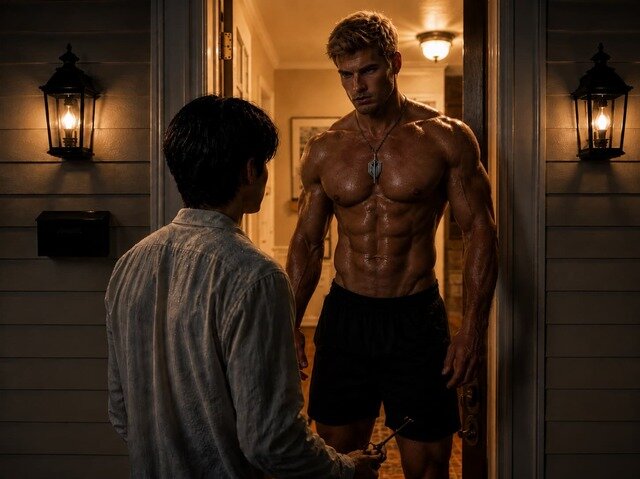
He was tall enough that Nate had to tip his head back, broad enough that the warm light from inside broke around him. His hair was a messy gold-blond tangle, damp at the ends. Stubble beard framed a strong, unbothered mouth. He wore dark gym shorts and nothing else, and against his bare chest rested a silver pendant: a small sword and shield on a metal cord.
Nate registered all of this too quickly.
Then he saw the man’s eyes.
Blue. Clear. Alert.
Not cruel.
Concerned.
“Hey,” the man said, voice low from the chest. “You okay?”
The question disarmed him more effectively than a threat would have.
Nate tightened his grip on the useless key. “This... this is my house.”
The man blinked once.
Nate forced his spine straight. “I’m Nate Soros. My grandmother owned this property... I have the key.”
At the name, something flickered across the man’s face. Not fear exactly. Recognition edged with caution.
“Soros,” he repeated. “As in the Soros family?”
“Yes.”
The man looked past Nate toward the dark driveway, then back at him. His expression shifted into something guarded but not hostile.
“Well,” he said slowly, “that explains the shoes.”
Nate stared at him. “Excuse me?”
“You’re about a head shorter than I expected a ruthless Soros to be.”
The absurdity of it hit Nate wrong. He was furious. He was grieving. He was standing on the porch of his grandmother’s resurrected house being insulted by a half-dressed trespasser with ocean eyes.
“My height is not legally relevant.”
The man’s mouth twitched.
“And your key,” he said, glancing at Nate’s hand, “isn’t mechanically relevant. I changed the doorknob years ago.”
Years.
The word landed like a slap.
Nate pushed past him.
Their shoulders brushed.
Heat flashed through Nate’s awareness before he could suppress it: skin warm from the house, from movement, from life. The man smelled faintly of cedar, salt, and clean sweat. Not expensive. Not curated. Real.
Nate hated that he noticed.
The foyer stopped him cold.
The house was beautiful.
Not renovated into anonymity. Restored. Loved. The floorboards gleamed. The walls were clean. Old details remained where they mattered: the carved banister, the little ceramic dish by the entryway, the narrow table where his grandmother used to leave wrapped candies and church bulletins.
But there were new things too. A woven rug. A repaired window latch. Potted herbs near the kitchen. Evidence of daily life layered carefully over memory.
Nate turned on the man with the only weapon he had.
Words.
“By what legal instrument do you claim the right to occupy this property?” he demanded. His voice shook, which made him angrier. “Lease? Deed? Possessory interest? Or are you simply committing ongoing illegal entry and hoping no one notices?”
The man leaned against the wall with infuriating calm.
“You’re not in the mood for an explanation.”
“I am precisely in the mood for an explanation.”
“No,” the man said. “You’re in the mood to bleed on someone.”
Nate went still.
The words were too accurate. Too quiet.
The man’s gaze softened a fraction.
“I made it livable,” he said. “That’s all. And I didn’t touch everything.” He nodded toward the stairs. “There’s one room upstairs I left alone. Felt like it belonged to someone in a way the rest of the place didn’t.”
Nate’s heart lurched.
The master suite.
Granny’s room.
He was moving before the thought finished.
“Hey, careful,” the man called behind him. “Those stairs are old.”
Nate didn’t slow down.
At the end of the upstairs hallway, he reached the door he had been afraid to imagine for years. His hand closed around the knob.
He opened it.
The room was intact.
Not abandoned.
Kept.
The faded floral wallpaper remained. The lace doilies. The old wooden vanity. The quilt folded over the bed with its careful rows of hand-stitched flowers. The air held the powdery ghost of dried lavender, so familiar that Nate’s knees weakened.
And on the nightstand, centered as if waiting for him, lay the leather-bound book of fantasy stories.
Nate crossed the room in three unsteady steps.
He knelt on the edge of the bed and took the book into his hands.
The leather was cool. The embossed gold design had worn smooth in places where a child’s fingers had once traced it again and again. As he pulled it close, something faint crackled inside the back cover, hidden within the binding, but grief moved through him too quickly for curiosity.
A sound tore out of him.
Not elegant. Not controlled.
A sob.
Then another.
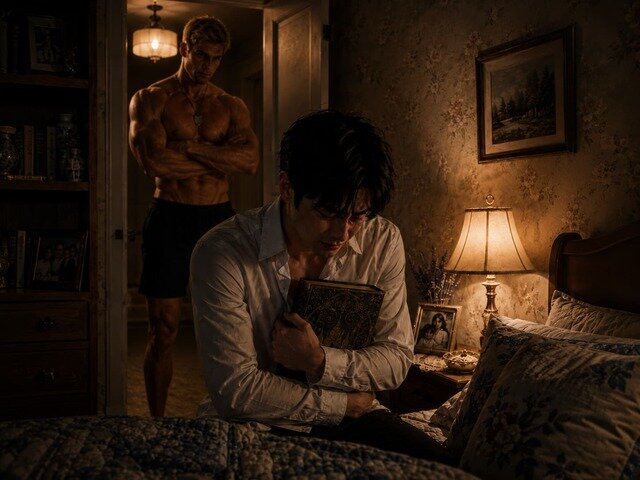
Six years of not crying correctly. Six years of becoming useful. Six years of hearing his grandmother’s voice only in the spaces where he was most alone.
He clutched the book to his chest and bent over it.
For a while, he forgot the man in the doorway.
Then a large hand settled carefully on his shoulder.
Not gripping.
Not claiming.
Only there.
“I didn’t change this room,” the man said quietly. “I saw the picture on the nightstand. The lady with the kid. Figured somebody loved her here.”
Nate looked toward the photograph through blurred vision.
His grandmother smiled from behind the glass, one arm wrapped around a much smaller version of him. He had been missing a front tooth. He had been holding the same storybook.
“That child is me,” Nate whispered.
The man’s hand stilled.
Nate looked down at the book again. Legal language rose instinctively, desperate to give shape to devastation.
“This is part of the non-probate personal property that should have remained with the family line,” he said. “It has no fair market value to a stranger, but to the rightful heir it’s—”
His voice broke.
The word heir collapsed in his throat.
He pressed his hand against the cover, fingers trembling.
“It’s hers,” he said instead. “And mine. It was ours.”
The room blurred again.
“This house was the only place where I didn’t have to be useful.”
The admission came out before he could stop it.
Nate hated how small it sounded.
He turned toward the man in the doorway, expecting mockery, awkwardness, impatience—anything easier than the look he found.
The man was watching him as if the grief mattered.
Not the property.
The grief.
“Why?” Nate asked. “Why keep it? Why not throw everything out?”
The man glanced around the room, then back at him.
“I kept it for whoever needed it,” he said.
The answer was simple.
That made it worse.
Nate looked at him, really looked this time. At the silver sword and shield resting against his chest. At the careful distance he kept from the bed. At the hand he had already withdrawn, as if he understood that comfort could become intrusion if held too long.
“What’s your name?” Nate asked.
“Danny,” the man said. “Danny Miller. Most people at work call me Titus.”
“Titus,” Nate repeated before he could stop himself.
The name fit the size of him less than the steadiness.
Danny gave a small, tired smile. “Look, Nate. You’re exhausted. I’m guessing you drove here on fumes and panic. Stay tonight. Lock the door if it makes you feel better. In the morning, I’ll explain everything. The taxes, the repairs, the whole adverse possession mess.”
Nate stiffened. “You know that term.”
“I know a lot of terms when my survival depends on them.”
Something in the sentence pulled at Nate, but he was too raw to examine it.
“You expect me to sleep under the same roof as a trespasser?”
“No,” Danny said. “I expect you to sleep in the room that was waiting for you.”
Silence settled between them.
Downstairs, the blues record reached the end of a song. The needle hissed softly through the floorboards.
Nate should have called the police.
He knew the proper sequence. Remove himself from the property. Contact local authorities. Notify counsel. Establish legal ownership. Document all unauthorized alterations.
Instead, he held his grandmother’s book against his chest and breathed in lavender.
“One night,” he said.
Danny’s mouth curved, but he didn’t make the victory easy. “One night.”
“And tomorrow we discuss the legal reality of your situation.”
“Absolutely.”
“I’m watching you.”
“I figured.” Danny stepped back from the doorway. “I was making dinner before you tried to break down the door. Come down if you get hungry. Or don’t. Take your time.”
He paused.
Then, softer, “She must’ve loved you a lot.”
Nate’s grip tightened around the book.
Danny left before Nate could answer.
The door clicked halfway shut, leaving him alone with the room and the lavender and the photograph of the only person who had ever called him Little Prince without turning it into a title.
For several minutes, Nate did not move.
Then he lay down on the quilt, still holding the storybook to his chest.
The house breathed around him.
Not like the estate in Windermere, with its filtered air and expensive silence.
This house breathed with salt, old wood, dried flowers, and the faint trace of cedar left in the hallway by a man who had no legal right to be there and yet had protected the only room that mattered.
Nate closed his eyes.
“Granny,” he whispered, voice breaking into the quilt. “I don’t know what to do.”
No answer came.
Only the low murmur of the ocean beyond the walls.
Only the scent of lavender.
Only the impossible fact that after years of abandonment, his sanctuary had not been ruined.
It had been waiting.
And downstairs, so was Danny.







