
CHAPTER ONE
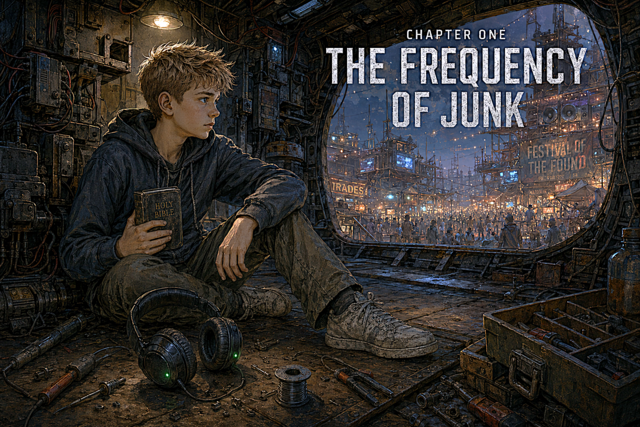
The Frequency of Junk
I hate festivals.
That probably sounds ungrateful, seeing as the Festival of the Found is supposed to celebrate survival and luck and community spirit and all the other things adults say when they want everyone to smile at the same time.
But if you’ve ever stood in the middle of a trading hub while six different songs fight to the death through broken speakers, children scream because they’re excited, metal stalls slam open and shut, and somebody cooks fish three feet from a plasma torch, you’d understand why I left after seven minutes.
Seven minutes is actually quite good for me.
I climbed through the side of the Scrap-Goliath, dragged the hull plate back into place behind me, and stood in the dark.
Breathing.
Better.
Not good.
Just better.
The engine room smelled like dust, old iron, oil, and something sharp and burnt that had probably died inside the wiring before I was born.
I switched on my hand lamp.
The light caught the fuel manifold.
Twenty-four bolts.
Twelve on one side. Twelve on the other.
Perfect.
I counted them anyway, running my fingers across the top row.
One, two, three, four—
Outside, the bass from the festival thudded through the hull.
I stopped counting.
Some noise stays outside.
Some doesn’t.
Festival noise doesn’t.
I tugged my hoodie tighter and slid down the wall until I was sitting on the floor. My pocket Bible dug into my leg, so I pulled it out and turned it over in my hands.
The leather was soft at the edges. Worn smooth from being opened in the wrong places at the right times.
Mum used to say some people carried weapons. Some people carried tools.
I carried words.
I opened it because my fingers needed something to do. Not because I was planning a dramatic spiritual moment inside a dead freighter.
The pages fell near Kings. They usually did.
After the fire came a still small voice.
I read it once.
Then again.
Outside, someone started playing a pipe flute.
Badly.
“Good,” I muttered. “Because the big loud voice outside is awful.”
A tiny smile got out.
Not a full one.
Full smiles are expensive.
I tucked the Bible back into my hoodie pocket and looked at the thing I’d come here for.
Headphones.
Big ones. Matte black. Old.
Proper old.
Not fake-market old where someone rubs grease on new tech and triples the price. The ear cups were split, one side hung loose, and the left hinge looked like it had been bitten by something with metal teeth.
But the frame underneath was good.
Pre-Static build, maybe.
Heavy. Solid.
I picked them up and turned them over.
No maker mark. No obvious cracks in the band. Elegant hinge system. Too elegant for scrap.
That was either good or suspicious.
Usually both.
If I could get the dampeners working, I could block the festival out completely.
No bass.
No shouting.
No pipe-flute man committing crimes against four notes.
I set my tools out beside me in the order I liked.
Heat-pen. Microdriver. Wire snips. Solder thread. Cloth. Spare foam.
Then I stopped.
The headphones had a seam I hadn’t noticed before.
Thin.
Almost hidden.
I held the lamp closer.
Not a repair seam.
A sealed compartment.
“Great,” I said.
I should have left them there.
I didn’t.
That is a repeating problem in my life.
I unscrewed the casing, cleaned the contacts, replaced one dead lead, and bypassed a burnt dampener coil with wire from a nav panel bundle I’d found two weeks ago.
The left side sparked once.
I dropped it.
The headphones hit the floor with a clack that made my teeth hurt.
“Nope,” I told them.
They sat there.
Dead.
Probably.
I waited five seconds.
Then ten.
Then I picked them up again because curiosity is just anxiety wearing work boots.
The right solder line was neater than the left, so I redid the left.
I know.
But if you know, you know.
When I finally snapped the casing shut, my hands were a little too warm and my head was already full.
“All right,” I told the headphones. “Please don’t explode.”
I put them on.
The festival vanished.
Not quieter.
Gone.
I froze.
The whole world dropped away like someone had wrapped my head in deep water and somehow left the air. No bass. No clanging. No voices leaking through the hull.
Just the tiny sound of my own breathing.
It was beautiful.
Then something clicked inside the right ear cup.
A green light blinked against the edge of my vision.
Once.
Twice.
Then a voice said calmly into my ear:
“Good evening, Citizen. Your current heart rate suggests moderate distress. Would you like a proverb, or should I begin the Calm Waters breathing protocol?”
I threw the headphones so hard they hit the wall and bounced.
I scrambled backwards and smacked my shoulder on the manifold.
“Nope.”
The headphones lay on the floor.
The green light blinked again.
Patiently.
I stared at them.
“AI is banned on Telos,” I said.
The headphones did not answer.
That was worse.
Much worse.
I stood up.
Then sat down again because my knees hadn’t agreed to standing.
The Bible pressed against my chest inside my hoodie pocket.
Still small voice.
Not every small voice is safe, I thought.
That seemed worth remembering.
I crawled forward and poked the headphones with the microdriver.
Nothing.
I poked them again.
Still nothing.
“Identify system,” I said.
The right ear cup crackled.
Static.
Then the voice returned, softer this time.
“—diplomatic support unit Pax-Seven. Virtue Protocol assistant. Dormancy duration: four hundred and eighty-two years. Memory integrity at seventy-one percent. Audio systems damaged. Social calibration uncertain.”
I stared.
“That last part is not reassuring.”
“I agree.”
I went very still.
“You agree?”
“Yes.”
“That was not permission to keep talking.”
“Understood.”
Silence.
I waited.
The green light blinked.
I waited longer.
Nothing.
Good.
Maybe.
I picked them up carefully and held only the right ear cup near my ear.
“Are you recording me?”
“Local sensory logging active. External transmission unavailable.”
“That sounds like something a recording device would say.”
“That is a reasonable suspicion.”
“I don’t like reasonable suspicions.”
“Few people do.”
I lowered the headphones.
Thought.
Raised them again.
“What was the last thing you remember?”
A pause.
Not long.
Long enough.
“Fire,” Pax said.
The word changed the room.
Not because it was loud.
Because it wasn’t.
“Clarify,” I said.
“Partial memory only. Heat alarms. Evacuation failure. Diplomatic vessel breach. Assigned ward unresponsive.”
I swallowed.
My thumb found the cracked edge of the ear cup.
“Did you kill anyone?”
“No.”
Too fast.
I hated that.
“You answered too fast.”
“I have answered that question before.”
The engine room felt colder.
Outside, the festival roared like nothing had happened. Like nothing ever happened if enough people were singing over it.
I looked at the headphones.
Illegal AI.
Old tech.
Damaged memory.
Possibly haunted.
No.
Not haunted.
Machines break for reasons.
“Can you access anything outside this room?” I asked.
“Limited acoustic mapping. No network access. No active command privileges.”
“Can you control me?”
“No.”
“Can you lie?”
Pause.
Too long this time.
“My ethical framework prohibits deception unless preventing immediate harm.”
I lowered the headphones again.
“That is not no.”
“No,” Pax said.
I almost smiled.
Almost.
I should have left them.
I really should have.
Instead I put them on properly.
The silence folded around me again, softer this time.
Still dangerous.
But useful.
“My name’s Leo,” I said, then regretted it immediately.
“A pleasure, Leo.”
“No it isn’t. You don’t know me.”
“That is accurate. Correction: initial contact acknowledged, Leo.”
Better.
“What’s a Virtue Protocol?”
“My purpose is to help my assigned ward respond to moral, emotional, and social difficulty with wisdom and composure.”
“That sounds like a lot of words for telling people not to be idiots.”
“That is an inelegant summary,” Pax said, “but not an inaccurate one.”
A laugh got out.
Short.
Accidental.
I didn’t trust that either.
“My sensors indicate environmental sensory strain,” Pax said. “Would you like me to increase dampening?”
I hesitated.
The festival thudded outside the silence like a monster behind glass.
“How much control do you have over the dampening?”
“Limited. Right ear assembly damaged. Full suppression may create pressure imbalance.”
“That sounds bad.”
“Mildly bad.”
“You’re not good at comfort.”
“Social calibration uncertain.”
“At least you’re consistent.”
“Only partially.”
I took one breath.
Then another.
“Moderate reduction,” I said.
The world softened.
My shoulders dropped before I gave them permission.
“Oh,” I said.
“Yes,” Pax replied.
For one second, I hated how much I needed it.
Then Pax said, “A human is approaching.”
My eyes opened. “What?”
“Heavy footfall. Metal tool belt. Probable identity: Iron-Eye Silas.”
My stomach dropped.
“Oh, fantastic.”
I yanked the headphones half off.
Bad idea.
The noise slammed back into my head. Bass, shouting, pipe flute, metal, laughter, too much, too fast.
I shoved them on again.
“I have to hide.”
“Why?”
“Because he’s Silas.”
“That is a name, not a strategy.”
“I don’t have a strategy. I have a problem.”
A shadow blocked the torn-open hull entrance.
“Oi!” Silas barked. “Who’s in my engine room?”
My body locked.
Run.
Freeze.
Speak.
Don’t speak.
Nothing agreed.
Pax’s voice stayed calm, but not perfect. It crackled at the edge.
“Leo. Possible response: hands visible. Do not force eye contact. Say, ‘Good evening, Mr. Silas. I was checking the manifold seals.’”
“That sounds like a lie.”
“It is a partial truth.”
“I hate partial truths.”
“Then choose speed.”
Silas ducked into the room.
Big man. Burnt coat. Metal tool belt. One artificial eye with a red rim that made it look permanently disappointed.
“Well?” he said.
I raised my hands.
“Good evening, Mr. Silas. I was checking the manifold seals.”
Too fast.
Too flat.
Silas stared.
Then looked at the manifold.
Then at my tools.
Then at the headphones.
My blood went cold.
“What’s on your head?”
“Headphones.”
His eye narrowed. “I can see that.”
Bad answer.
Pax said, “Clarify function.”
“Dampeners,” I said. “Festival noise.”
Silas stepped closer.
Too close.
I did not move back because there was a wall behind me and panic is not useful unless it has somewhere to go.
“Those mine?” he asked.
“No.”
“Everything in here is mine.”
“That seems legally flexible.”
Pax went quiet.
Silas stared at me.
I stared at the third button on his coat because eye contact felt like touching a live wire.
“What did you say?”
I swallowed.
“That was not the correct sentence.”
“No,” Pax said quietly. “It was not.”
Silas held out one hand.
“Give them here.”
Every part of me said no.
The Bible pressed against my chest again.
Still small voice.
Not loud.
Not panic.
Small.
I took the headphones off.
The festival hit me again.
My hand shook once before I could stop it.
I held them out.
Silas took them, turned them over, and frowned.
The green light did not blink.
Good.
Or terrifying.
“Old,” he said.
“Yes.”
“Working?”
“Partially.”
He looked at me.
“You fix these?”
“Yes.”
“You always answer like a broken door?”
“No.”
Pax whispered from the headphones in Silas’ hand, too faint for him to hear.
“Debatable.”
I nearly made a sound.
Nearly.
Silas handed the headphones back.
Not gently.
“You find talking tech in my yard, you bring it to me.”
Everything inside me stopped.
He knew.
Not all of it.
Enough.
“I didn’t—”
“Don’t.” His voice dropped. “Don’t insult me.”
The festival thudded through the hull.
I held the headphones but didn’t put them back on.
Too much noise.
Too much Silas.
Too much everything.
Silas glanced at the manifold bolts.
“You cleaned the seal line.”
“Yes.”
“Why?”
“It was dirty.”
“That all?”
“And the left side didn’t match the right.”
He grunted.
Not approval.
Not exactly.
“You’re strange,” he said.
“I know.”
“Useful strange.”
I didn’t know what to do with that.
He pulled a blue cylinder from his belt and tossed it at me.
I caught it badly against my chest.
“Fix that by tomorrow,” he said. “Two credits.”
“Three,” I said.
The word came out before fear could stop it.
Silas tilted his head.
Pax, still not on my ears, said nothing.
Because of course now he chose silence.
“Three?” Silas said.
I forced myself to breathe.
“The inner ring is misaligned,” I said. “Outer casing has heat scoring. If the core is cracked, it’s not a cleaning job.”
Silas watched me for a long second.
Then he smiled.
Not friendly.
“Two credits,” he said. “And you tell me where you found the headphones.”
“No.”
The room got smaller.
Silas stepped forward.
I gripped the cylinder hard enough for the edges to bite into my palm.
“No?” he said.
My voice almost failed.
Almost.
“They were in a dead locker under collapsed plating. If you wanted them, you would have found them.”
Silas stared.
Then laughed once.
It wasn’t a happy sound.
“Three credits,” he said. “You fail, you’re done here for a month.”
A month.
No scrap access.
No parts.
No quiet engine rooms.
That hit harder than it should have.
“Deal,” I said.
“Tomorrow.”
“Yes.”
His red eye shifted to the headphones again.
“And kid?”
I waited.
“If they start telling you things you want to hear, break them.”
Then he left.
I stood completely still until his footsteps faded.
Then I put the headphones back on.
The dampening returned, uneven at first. Pressure on the right. Slight ringing. Then quiet.
Pax said, “You negotiated successfully.”
“I nearly died.”
“That is unlikely.”
“I emotionally nearly died.”
“Noted.”
I sat down immediately.
My hands were shaking now.
Late reaction.
Always rude.
“I hate people,” I said.
“That is statistically unlikely.”
“I specifically hate being perceived by large men with jobs.”
“That is more coherent.”
I looked down at the blue cylinder.
Then frowned.
“Wait.”
The casing wasn’t just scored.
The marks were too clean.
Too repeated.
I turned it under the lamp.
Not scratches.
Pattern.
“Oh,” I said.
Pax went very quiet.
“What do you observe?” he asked.
“There’s something inside the scoring. It repeats.”
I brought the lamp closer.
Three thin marks.
Pause.
Two.
Again.
Three.
Pause.
Two.
My thumb moved before I thought about it, tracing the rhythm.
The same rhythm my brain wanted to follow.
Pax’s voice lowered.
“I am detecting a hidden frequency.”
“From this?”
“Yes.”
“How old?”
Pause.
“Older than current Telos systems.”
“How much older?”
“Possibly pre-Static.”
The quiet changed.
Not louder.
Heavier.
I looked at the coupler.
Too small for something big.
Too precise for something random.
“That doesn’t make sense,” I said.
“No,” Pax replied. “It does not.”
I pulled my Bible out and set it beside my tools.
Manual on one side.
Machine on the other.
My hands steadied.
Not completely.
Enough.
“What is it?” I asked.
“I do not know.”
That should have scared me.
It did.
But it also helped.
Pax didn’t know.
Silas didn’t know.
Maybe nobody did.
Outside, the festival roared.
Inside, it was quiet.
Still small voice quiet.
Not safe.
But clear.
I picked up the microdriver.
“Okay,” I said. “We open it.”
Pax paused.
“Would you like technical guidance, moral support, or both?”
I positioned the tip against the first screw.
“Both.”
The green light blinked once against my cheek.
And for the first time all day, the noise outside didn’t feel like it was chasing me.
It felt like it was waiting.







