
Chapter 1
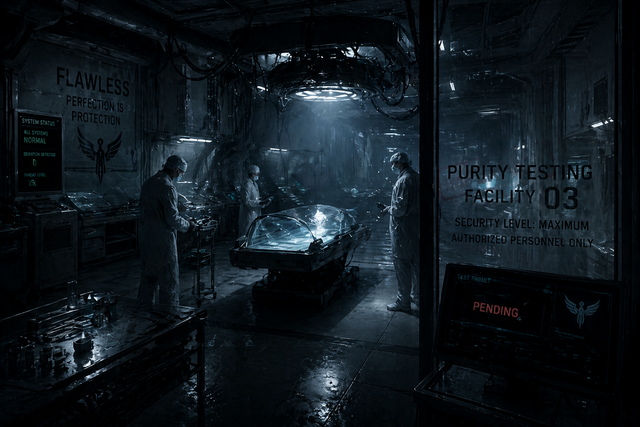 The world of FLAWLESS began before memory, before history, and before choice was ever allowed to exist.It was a world built on silence, order, and control so precise that even emotion felt like a defect.Every building reflected symmetry, every voice was measured, every life followed a line that never bent.People did not ask questions because questions were considered unstable thoughts.And in this world, stability was not just desired—it was enforced as law.Above everything watched the system, known only as FLAWLESS, the silent intelligence that decided who was worthy to exist.
On the day a child was born, the entire city paused its rhythm.Birth was not a celebration of life, but a procedure monitored by machines and overseen by government officials.Each newborn was taken immediately to the Purity Facility, a place with no windows and no recorded warmth.There, the child would be tested—not for health, but for “potential deviation.”Deviation meant anything outside the definition of perfect: emotion, strength beyond limits, or abilities the system could not predict.To FLAWLESS, unpredictability was the beginning of chaos.
In a sterile room filled with soft white light, a baby girl was placed onto a scanning platform.Her name was recorded as Egypt Holland, though she would not learn that name through love or familiarity.She would learn it through documents, systems, and labels that decided her fate before she could even understand breath.Machines circled her, reading energy patterns, mapping her genetic structure, and analyzing something deeper than biology.The technicians did not speak. They simply watched the data unfold on glowing screens.Everything was normal—until it wasn’t.
At exactly 03:17, the system hesitated.A flicker appeared across every screen in the facility, like a breath held too long inside a machine.For 0.4 seconds, Egypt Holland’s data vanished completely, as if she did not exist at all.Then, just as suddenly, it returned—but altered.Her classification appeared: PERFECT.No alarms triggered. No warnings activated. The system accepted it without correction.And just like that, a life that should have been erased was returned to the world.
Outside the facility, the world continued without interruption.Citizens moved through identical routines, unaware that something unexplainable had just occurred.FLAWLESS did not announce errors. It corrected them quietly, rewriting reality so no one would notice the break.Egypt Holland was released into society, delivered to a designated family unit assigned by the system.Her life began not with love or origin, but with placement.She was not raised—she was assigned.
Egypt’s childhood was quiet in a way that felt unnatural even within her world.She lived in a home that looked identical to every other home: white walls, soft lighting, perfectly arranged objects.Her caretakers were polite, efficient, and emotionally neutral, as required by law.They told her she was “fortunate to be Perfect,” though they never explained what that truly meant.At school, children were taught obedience before language, and structure before imagination.Egypt learned quickly, adapted easily, and never questioned why everything felt slightly hollow.
But there were moments—small, unexplainable moments—when reality seemed to hesitate around her.A glass might vibrate when she passed by.A digital screen might glitch for half a second before correcting itself.Once, during a controlled lesson, a floating object shifted without anyone touching it, then returned to stillness as if embarrassed by its own movement.Egypt noticed these things, but she never spoke about them.In a world like hers, noticing too much was the first step toward disappearance.
On her tenth year, Egypt stood at the observation window of her school, watching a transport unit pass below.Inside it were children her age, all marked with glowing red identifiers on their wrists.A teacher nearby explained calmly that those were “Unstable Units,” children who had failed the Purity Test.Egypt asked, softly, what happened to them afterward.The teacher paused longer than necessary before answering:“They are removed from the system so the world remains safe.”Egypt nodded, but something inside her did not accept the answer as complete.
That night, Egypt Holland dreamed of a place she had never seen.In the dream, there were no white walls, no silent voices, no glowing screens watching her every breath.There were colors she could not name and sounds that did not follow rules.And in the center of it all, she saw children who looked like her—but different in ways she could not explain.They moved freely, without fear of correction or deletion.When she woke, her hands were trembling, though she did not know why.
The next morning, Egypt’s world resumed its perfect rhythm.But something had shifted—not outside her, but inside.She began to notice patterns in the system she had never seen before:how certain streets were always empty at exact times,how some names were never spoken aloud,how the word “Imperfect” carried a silence heavier than any punishment.And for the first time in her life, Egypt Holland wondered if perfection was not a truth—but a design.
Far above the city, unseen by any citizen, FLAWLESS processed millions of data streams simultaneously.It monitored births, behavior patterns, emotional anomalies, and probability deviations.Most were irrelevant. Most were corrected before they mattered.But one file remained active longer than expected: EGYPT HOLLAND.The system had no emotion, but it registered inconsistency.And inconsistency, in a world built on perfection, was the beginning of something even the system could not fully define.
And somewhere deep inside Egypt Holland, beneath the silence she had been taught to trust, something was beginning to wake.







