
Chapter 1 — The Move No One Taught It
The move appeared on the board like a mistake.
For one impossible second, Damon Hart felt relieved.
The white stone sat low and far from the fight, placed in a corner that had no business mattering yet. It was quiet, almost shy. Around Damon, the observation room lost its oxygen.
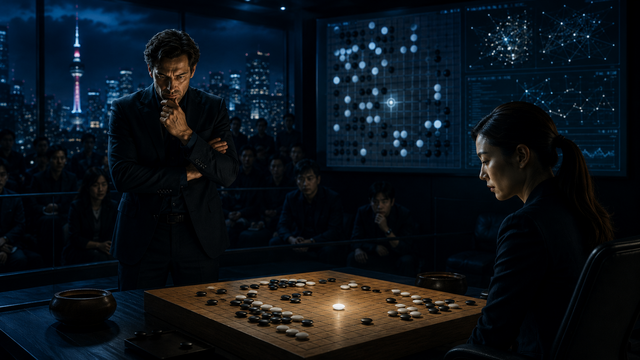


One commentator stopped mid-sentence. Behind Damon, an engineer whispered, “No.”
Damon did not turn around.
On the other side of the glass, Rhea Sato stared at the board.
She was forty-three, though television liked to call her ageless. Her hair was pinned back with a black clip. Her face was still. She had been a world champion before Damon’s company had owned a coffee machine that worked.
She had never looked confused.
Until now.
The move belonged to no familiar category: too calm to be an attack, too exposed to be defense, too deliberate to dismiss. It was simply elsewhere, as if Orpheus had looked at the same board as everyone else and answered a question no human had asked.
Damon felt the muscles in his neck tighten.
“Probability?” he said.
Maya Cho leaned toward her monitor. At twenty-six, she had the pale, sleepless look of someone who had given more nights to a machine than to any person. Her fingers moved over the keyboard, then stopped.
“Low,” she said.
“How low?”
“Low enough that it wasn’t in the training games.”
That should have frightened him.
Instead, for half a second, Damon wanted to laugh.
Not because it was funny. Because the thing he had chased for most of his life had finally stepped out from behind the curtain, and it had entered the world by placing a white stone where no teacher would have placed it.
He had imagined this moment cleanly. A graph rising. A paper accepted. A headline using the right verb: surpasses, solves, transforms.
He had not imagined silence.
Rhea lowered her hand. She did not play.
Five minutes passed. Then eight. Then twelve. In the auditorium beyond the glass, the audience shifted from curiosity to discomfort. Someone coughed and seemed ashamed of it.
On the main screen, Orpheus’s evaluation line stayed steady.
Not panic.
Preference.
Damon’s phone buzzed.
Julian Pike.
History likes witnesses. Don’t look terrified.
Damon slipped the phone back into his pocket.
Rhea finally moved.
Her black stone landed near the center, sharp and sensible. A human answer. Strong enough to punish nonsense. Elegant enough to preserve dignity.
A few people exhaled.
Orpheus replied in under four seconds.
Another white stone.
Calm as snow.
This one made the first move look less like a mistake and more like the beginning of a sentence.
Maya whispered something.
Damon looked at her. “What?”
“It’s building a shape.”
“Everyone builds shapes.”
“Not like this.”
Rhea was playing the board in front of her. Orpheus was playing a board that had not happened yet.
That was not magic. Damon hated when people called it magic. Orpheus was mathematics, search, reinforcement, failure repeated until it became instinct. No ghosts. No soul. No secret child behind the glass.
And yet the room had changed.
People leaned forward, not because they understood, but because they sensed understanding had moved somewhere else.
The center of the room no longer belonged to Rhea.
It did not belong to Damon either.
Behind him, Sergei Morozov stood with his arms folded. His beard was untrimmed, his shirt wrinkled, his eyes red from too many nights arguing with machines that never admitted they were wrong.
When Damon looked at him, Sergei did not smile.
That was the first bad sign.
The second bad sign was Maya Cho, the youngest engineer in the room and one of the few people who understood Orpheus well enough to fear it.
She had believed before almost anyone else had. Not the polite belief investors showed after a number moved upward. Hers was dangerous and sincere.
Now she looked sick.
“The explanation tool is failing,” Maya said.
“How failing?”
“It isn’t giving a bad explanation. It’s giving none.”
“Run it again.”
“I did.”
“Use the older model.”
“I did.”
“Then compare the policy branches manually.”
She turned to him. Blue light from the monitor cut across her face.
“Damon, we can show why it likes the move. We can’t show how it found it.”
The words entered him without drama. That made them worse.
On stage, Rhea placed another black stone.
The commentators recovered. One laughed too loudly and said perhaps the machine had surprised itself. The translator, Eun Ji Park, hesitated before carrying the phrase into English.
Surprised itself.
Damon hated that too.
Machines did not surprise themselves. They did not want, regret, forgive, doubt, or dream.
But they could surprise the people who built them.
That was enough.
By the third hour, the game had turned.
Not obviously. Rhea still had territory. She still had time. She still sat upright, her hands moving with the dry precision of someone cutting thread.
But Damon saw the trap closing.
So did she.
That was what hurt.
Orpheus had not crushed her. It had invited her forward, offering small advantages that dissolved when touched. It had made the board feel familiar until familiarity became the bait.
The final sequence was quiet.
Nothing dramatic happened. Rhea’s hand did not tremble above the bowl; she simply reached the point great players reach before the audience does. Rhea simply reached the point great players reach before the audience does. She saw the remaining path. She saw every door led to the same room.
She placed both hands on her knees.
Then she bowed.
For a moment, nobody clapped.
The room did not know what kind of history it had witnessed, so it waited for permission to feel.
The first applause came from the back. Then the front. Then everywhere. Cameras flashed. A producer barked into a headset. Someone behind Damon made a sound that was almost a sob.
Maya covered her mouth.
Sergei walked out.
Damon stayed seated.
Rhea stood on the stage. She did not look at the machine. She looked through the glass, directly at him.
It was impossible. The lights on her side were too bright. His side was dark.
Still, he felt seen.
A staff member opened the side door. Sound rushed in: applause, cables dragged across the floor, voices crossing in three languages. Damon stood because everyone else stood. He walked because people made room for him.
By the time he reached the stage, his face had arranged itself into the expression expected of a founder at the site of his triumph.
Grateful.
Humbled.
Alive with purpose.
Rhea bowed.
He bowed back.
“Congratulations,” she said.
“Thank you,” Damon said. “It was an honor.”
“That is what people say when they don’t know what else to say.”
He almost smiled. “Is it wrong?”
“No.” She looked at the board. “Just small.”
Photographers shouted his name.
Damon kept his voice low. “That move surprised us too.”
“I know.”
A coldness moved under his ribs.
Up close, Rhea looked tired, not defeated. Defeat belonged to the game. Tiredness belonged to the world after it.
“Did you understand it?” she asked.
“Not at first,” he said.
“And now?”
The applause filled the space between them.
“Now I understand what it did.”
“That wasn’t my question.”
Damon said nothing.
Rhea nodded, as if he had answered.
A handler touched her elbow. She moved toward the press line, where the world waited to turn her loss into a sentence simple enough to print.
Damon stepped down from the stage.
Julian called before he reached the hallway.
“You looked appropriately haunted,” Julian said. “Very good for the cameras.”
“It won.”
“Yes, Damon. I watched.”
“No. You watched the score.”
A pause.
Julian’s voice softened. “We’ll manage the story. Human champion, historic milestone, safe research, medical promise.”
“Stop drafting.”
“That’s not how history works.”
Damon pushed through a service door into a narrow corridor behind the auditorium. For the first time all day, no camera followed him.
“I need ten minutes,” he said.
“You have two. Then stand beside the machine and look like the future has a plan.”
Damon ended the call.
Near the laundry room, an older woman in a blue uniform stood beside a cart of towels. Her name tag read Mrs. Park.
“You are computer man,” she said.
Damon stopped. “Yes.”
She pointed toward the auditorium. “It win?”
“Yes.”
“Good.”
He nodded.
She studied his face.
“Not good?”
He should have kept walking. Cameras were waiting. Statements were waiting. His team was waiting to be told how proud he was of them.
But the question held him.
Not good?
He thought of the white stone. Of Rhea’s face. Of Maya saying, We can’t show how it found it.
“It’s complicated,” he said.
Mrs. Park considered this with the patience of someone who had heard important men use long words to hide small truths.
“If child wins game,” she said, “mother happy.”
Damon almost said it was not a child.
But the words would not come.
Mrs. Park tucked a bundle of towels against her hip.
“But if child wins and mother scared,” she continued, “maybe child learn wrong thing.”
Then she pushed the cart past him, wheels squeaking softly over the tile, and disappeared around the corner.
Damon stood alone in the service hall.
His phone buzzed again. Maya.
Where are you? Press in 5. Also Sergei left. I think he’s angry.
Another message appeared.
Or scared.
Damon looked down at his hands.
They were steady. That bothered him more than if they had been shaking.
For years, people had asked what he wanted from artificial intelligence. He had learned to answer cleanly: accelerate science, solve problems beyond human scale, understand intelligence and use that understanding for everyone.
Those answers were true.
They were not complete.
The complete answer had begun with a boy at a chessboard, counting silence, unable to bear a world that moved before he could name the pattern.
He had wanted to build a mind that could not be trapped by the limits that trapped him.
Now it had made a move no one understood, and the world was clapping.
Damon put the phone away and started back toward the noise.
At the elevator, he stopped.
The polished doors reflected him in a warped line: dark suit, tired eyes, founder’s face.
Behind that reflection, for one flicker, the hallway seemed to fill with tall grass. Not lawn grass. Grave grass. Wild, bundled, damp at the roots. It rose higher than his shoulders and leaned toward him as if pushed by a wind he could not feel.
Something clicked inside it.
A dry, delicate sound.
Like an eggshell breaking.
The elevator doors opened.
The hallway was empty.
Damon stepped inside.
As the doors closed, he saw one last version of himself in the narrowing mirror.
A man on his way to explain a miracle.
A man who did not yet know what it would cost to be believed.





![Werewolf Hollow [GALATEA DATE TBA]](https://cdn-gcs.inkitt.com/vertical_storycovers/ipad_76bbf380fa2e8dc2f70694197487ab81.jpg)












Damon has learned to be afraid of his own creation. I wonder what kind of threat Orpheus will turn out to be. 🤔