
Chapter 1 – The Crown in Decline
The great river ran through Napata like a vein of molten gold, threading the heart of the kingdom beneath the blaze of the afternoon sun. From the heights above, the city unfolded in vast sandstone tiers carved into the cliffs that bordered the riverbanks, each level crowded with homes, temples, workshops, and markets stacked upon one another like layers of an ancient monument. Obelisks towered over the skyline, their surfaces etched with fading glyphs of forgotten kings, while colossal statues of warrior rulers watched the kingdom with weathered stone eyes. Higher still stood the palace district, where broad columns and painted walls gleamed warm ochre beneath the light, banners stirring lazily in the river breeze.
To outsiders, Napata still looked immortal.
But beneath the splendor, cracks had begun to spread.
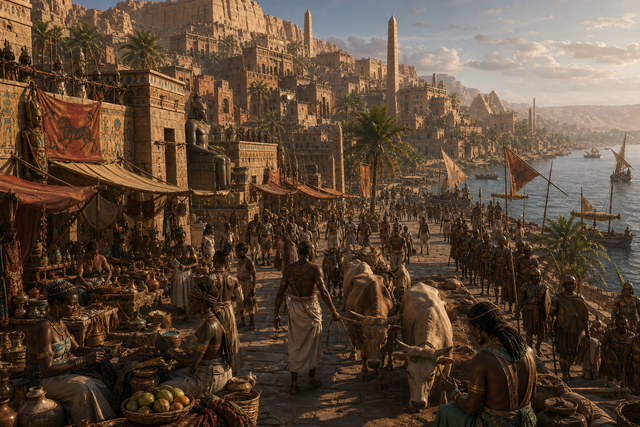
The markets along the lower tiers remained crowded, though the energy within them had changed. Traders shouted prices with strained voices rather than pride, glancing constantly toward the patrols moving through the streets. Fishermen sold smaller catches now, fearful of the levies waiting at the docks. Mothers bargained harder for grain. Brewers watered down beer to stretch supplies. The smell of spice and roasted meat still drifted through the air, but it mingled now with tension, sweat, and quiet resentment.
Kito moved through the crowd with practiced ease, his broad shoulders parting the flow of bodies as he crossed the market square near the river steps. A woven satchel rested against his hip, filled with fresh ink, oil, and reed pens gathered for his father's library. The heat clung to his skin, though years of training had long since hardened him against discomfort. His frame still carried the disciplined strength of a soldier despite the months since he had last worn armor—muscle layered lean beneath dark bronze skin, scars pale against his forearms where spear shafts and blades had once grazed him during drills and border skirmishes. His face remained composed, but his dark eyes missed little.
Especially now.
A dhibari patrol had entered the square.
The shift in the crowd was immediate.
Conversations softened. Heads lowered. Merchants who moments ago argued loudly over prices suddenly became eager to appease.
The dhibari moved in formation through the market like a blade through cloth, foreign among Napata's sandstone streets. Mercenaries drawn from distant deserts and southern coasts, they served no throne or people beyond their own ranks. Prince Aroja had brought them into the kingdom months earlier, and unlike the city guards born among the citizens, the dhibari enforced his decrees without hesitation or mercy. Some wore layered leather armor reinforced with bone and bronze plates; others carried curved bows strung taut across their backs, feathered braids swaying as they walked. Men and women marched side by side beneath Aroja's insignia, their expressions cold with practiced detachment.
At their center walked one of the female archers.
She was tall and lean, her dark braids threaded with hawk feathers, a bow resting loosely in one hand while a hooked blade hung at her waist. Her gaze swept across the square with calm indifference until it settled upon an elderly grain merchant kneeling beside sacks of barley.
"You are short again," she said.
The merchant immediately bowed lower. "I paid the levy at sunrise."
"The levy changed."
His face drained. "Changed?"
"By order of the prince."
The woman gestured lazily.
Two dhibari soldiers stepped forward and overturned one of the grain sacks into the dust.
The old man lunged instinctively toward it. "Please—"
A soldier struck him hard across the face with the shaft of a spear.
The crowd flinched.
Kito's jaw tightened.
Beside him, Tarmal spoke quietly without looking at him. "Don't."
Kito hadn't even realized his hand had clenched.
Tarmal stood half a head shorter but moved with the wiry stillness of a hunter, his lean frame wrapped in sun-faded cloth stained from the morning's work along the riverbanks. A bundle of traps hung over one shoulder beside a freshly skinned hare. His sharp eyes remained fixed on the patrol.
"You step in," Tarmal muttered, "and they drag you away with him."
The merchant fell coughing into the dirt as the dhibari seized half his grain.
No one intervened.
Not because they agreed.
Because fear had become survival.
Kito watched the patrol continue deeper into the market, boots grinding grain beneath them.
"They're bleeding this city dry," he said.
Tarmal gave a humorless snort. "And you only noticed today?"
Kito exhaled slowly and resumed walking. "It gets worse every week."
That much was true.
Napata's suffering no longer hid itself behind palace walls.
Prince Aroja's rule had tightened steadily in recent months, becoming harsher with each passing decree. Taxes spread through the kingdom like a plague—on harvests, cloth, livestock, river trade, even market stalls already struggling to survive. Punishments came swiftly for those who resisted. Public beatings had become common. Arrests more so.
People whispered the prince ruled like a man terrified of losing power before he had fully claimed it.
Others whispered worse things.
That King Jabari was dying.
That the old king's illness was no natural sickness.
That something followed him back from the shifting wilds years ago.
Kito hated those conversations, though he heard them constantly now in taverns and marketplaces alike. Stories of curses and forgotten gods had a way of spreading whenever kingdoms weakened.
Yet even he could not deny the change that had settled over Napata.
The kingdom's wealth had once seemed endless.
In his youth, King Jabari had journeyed beyond the river territories into the shifting wilds—an immense region of unstable forests and ruins swallowed by time. He returned from those expeditions carrying treasures no kingdom had seen before: gold relics that glimmered strangely in darkness, statues carved from unknown stone, scrolls preserved in hides from beasts no hunter recognized. Those discoveries transformed Napata into a center of wealth and influence, drawing merchants and scholars from distant lands.
Jabari became legend.
But legends aged.
And now the king had vanished behind palace walls for months.
No healer could name the sickness consuming him. Fever struck unpredictably. His skin paled. His limbs trembled. Some days he reportedly could not stand at all. The palace denied rumors constantly, but rumors multiplied faster than denials ever could.
Most governance had fallen instead to Aroja.
The adopted prince.
The former slave child Jabari had rescued years ago from a conquered kingdom and raised as heir.
Kito remembered when the people once admired him.
Not anymore.
A sudden blast from a ram's horn rolled across the city.
The market froze.
Another horn followed from the upper tiers.
Then another.
Palace summons.
All around the square, people lifted their heads toward the cliffs overlooking the river.
Tarmal frowned. "What's this now?"
Kito already knew.
"The king."
The horns continued sounding across Napata, echoing between the sandstone tiers as citizens emerged from homes and workshops alike. Conversations spread quickly through the streets.
Jabari was appearing publicly.
For the first time in months.
The flow of people began moving uphill toward the central square beneath the palace balcony. Merchants abandoned stalls to apprentices. Laborers left half-finished carts. Even dhibari patrols shifted position, tightening security along the roads leading upward.
Kito exchanged a glance with Tarmal before joining the crowds.
The climb through the city revealed the divisions within Napata more sharply than ever. Lower-tier mud-brick homes gradually gave way to sandstone villas painted with faded murals of kings and river gods. Incense replaced the smell of livestock. Wealth still lingered in the upper districts, but tension lingered too.
Dhibari archers stood watch from rooftops and balconies.
Their arrows were already nocked.
By the time Kito reached the central square, hundreds had gathered beneath the towering palace walls. Nobles stood beneath shaded canopies attended by servants, while laborers crowded shoulder to shoulder near the fountain basins below. Murmurs rippled constantly through the assembly.
At last the bronze doors above the balcony opened.
King Jabari emerged slowly between two attendants.
A hush spread across the square.
Even from below, Kito barely recognized him.
Jabari had once been a giant of a man, broad-shouldered and commanding, the kind of ruler whose mere presence silenced rooms. Kito had seen him only twice as a child during military ceremonies, but the memory remained vivid: a king who seemed carved from the same stone as the monuments surrounding the city.
Now he looked hollowed.
His white robes hung loose over a gaunt frame. His skin had taken on the dry pallor of river clay left too long beneath the sun. Yet despite the frailty consuming him, his eyes still retained traces of the fire that had once driven him beyond the borders of civilization.
He raised a trembling hand.
The square fell silent.
"People of Napata," Jabari began, his voice rough but carrying across the stone. "I have heard your suffering."
The words alone stirred movement through the crowd.
"The burdens upon this kingdom grow heavier with each passing season. I know this. I have not been blind to your hardship."
Behind him, partially obscured by the pillars, stood Prince Aroja.
Tall, composed, and motionless.
Unlike the king, Aroja radiated strength. Gold-threaded black garments draped over fitted armor at his chest and shoulders, and his expression remained unreadable as he observed the crowd below. Beside him stood Ronkan.
The sight of the mercenary commander alone unsettled the square. Ronkan looked less like a court official than a weapon given human shape—short and broad, his body compact with hardened muscle beneath layered armor stitched from leather and bronze scales. Old scars crossed his bald head and dark skin alike, pale against the torchlight. Stories followed him through the kingdom like smoke from a battlefield: tales of rebellions crushed without mercy and men disappearing after earning his attention. Whether any of it was true mattered less than the certainty of violence surrounding him. He said nothing, but his gaze swept constantly across the crowd with cold precision, and even Aroja's own guards avoided meeting his eyes for too long. Kito understood immediately why people feared him.
Jabari continued speaking.
"In my youth, I walked paths beyond the reach of this kingdom. I ventured into the shifting wilds, where the land itself bends beneath forces older than memory."
Murmurs spread uneasily.
Everyone knew stories about the wilds.
Forests where trees twisted into impossible shapes.
Ruins swallowed by vines and mist.
Creatures altered by unstable magic.
Travelers who vanished without trace.
Jabari drew a slow breath before continuing.
"From those journeys came the treasures that strengthened Napata. But something was lost there as well. Something of great importance."
The square listened in complete silence now.
"It remains within the wilds still," the king said. "Hidden somewhere beyond the river territories, where few dare travel."
Kito felt the tension shift around him.
Curiosity.
Fear.
Hope.
Jabari straightened slightly despite the visible strain on his body.
"So I call upon the brave among you. Warriors. Hunters. Nobles. Any soul with courage enough to face the wilds. Find what was lost and return it to Napata."
The crowd erupted immediately into confused murmurs.
"What is it?"
"A relic?"
"A weapon?"
The king raised his hand again.
"To the one who succeeds, I promise wealth beyond measure. Gold enough to raise great houses. Lands to carry your name for generations. Honor before the kingdom and the favor of the gods themselves."
Hope flickered visibly through the square.
Even skepticism could not entirely smother it.
Napata had become desperate enough that men would chase almost anything if it promised escape from the prince's rule.
As the announcement ended, the square exploded into conversation. Speculation spread rapidly through the crowd as people debated what treasure could possibly lie hidden within the shifting wilds. Some spoke of ancient relics. Others imagined divine weapons or forgotten vaults of gold.
Kito remained still.
Not because he believed the promise.
Because of the way Aroja watched the crowd.
The prince's expression never changed, but calculation moved behind his eyes constantly, measuring reactions, weighing possibilities.
This announcement unsettled him.
That alone made it dangerous.
Beside Kito, Tarmal folded his arms. "People will die chasing this."
"Probably," Kito replied quietly.
"And you?"
Kito looked toward the palace balcony where the king stood weakened beneath the fading light.
"I haven't decided."
But part of him already knew that was a lie.
As the crowd slowly dispersed beneath the deepening orange glow of dusk, palace guards began directing people back toward the lower tiers. Dhibari patrols tightened around the square while nobles retreated into private discussion circles.
Above them all, the palace loomed silently over the city.
Within its inner chambers, far from the noise of the square, King Jabari sank heavily onto a cushioned couch beside burning incense bowls. The audience had drained what little strength remained in him. Sweat clung faintly to his brow despite the cool air drifting through the chamber windows.
Only Thutmose remained with him now.
The adviser knelt nearby, concern etched deeply into his lined face. "My king," he said carefully, "the court will not respond calmly to this. Especially the prince."
Jabari gave a weak, humorless smile. "Aroja ceased caring for calm long ago."
Thutmose hesitated before asking the question weighing upon him. "What truly lies in the wilds?"
The king stared toward the darkening river visible beyond the lattice windows.
"The means to correct my greatest mistake."
Thutmose frowned slightly.
Jabari's breathing grew shallow. "The reward I promised publicly was wealth. But the true reward is the throne itself. Whoever retrieves what was lost shall rule Napata after me."
Shock crossed the adviser's face.
"My king—"
"Aroja cannot inherit this kingdom," Jabari interrupted. "I raised him from pity and mistook ambition for strength. Now our people suffer beneath him."
"The court could fracture over this."
"Then let it fracture."
Silence settled heavily between them.
At last Thutmose bowed his head. "As you command."
Neither man realized they were no longer alone.
Beyond the chamber, hidden behind hanging bead curtains while tending oils and folded linens, a palace maid stood motionless.
Lira.
Young, quiet, and easily overlooked.
She listened carefully as every word settled into memory.
The throne.
Not gold.
Not land.
The throne.
Her pulse quickened.
Prince Aroja would want to hear this immediately.
But Lira understood the palace too well to move carelessly. Information survived through patience. Rash servants disappeared quickly within these walls.
So she remained silent.
For now.
Outside, evening settled slowly across Napata. Torches flickered alive along the sandstone roads while the river reflected the last dying light of the sun. Across taverns, homes, and crowded markets, the king's announcement spread like fire through dry reeds.
The shifting wilds.
A lost treasure.
A promise of unimaginable reward.
And somewhere beneath the rising hope and speculation, unseen currents of ambition and betrayal had already begun to move.







