Of Flame and Water
In the shadow of the jagged peaks of the Eternal Frostrange, where snow-laden pines whispered secrets to the howling winds, lay the hidden enclave of the Wavehowl Clan.
Their village, called Mistshore, clung to the rocky shoreline like a wolf’s paw gripping wet stone. Towering white-capped mountains rose behind them, their glaciers feeding crystal-clear rivers that tumbled into the restless ocean ahead. The air always carried the sharp bite of salt and pine, mingled with the distant rumble of waves crashing against black cliffs. Here, the anthropomorphic wolves of the Wavehowl lived not as scattered packs, but as one living tide—tight-knit, matriarchal, and bound by ancient codes that kept their numbers strong against the unforgiving world.
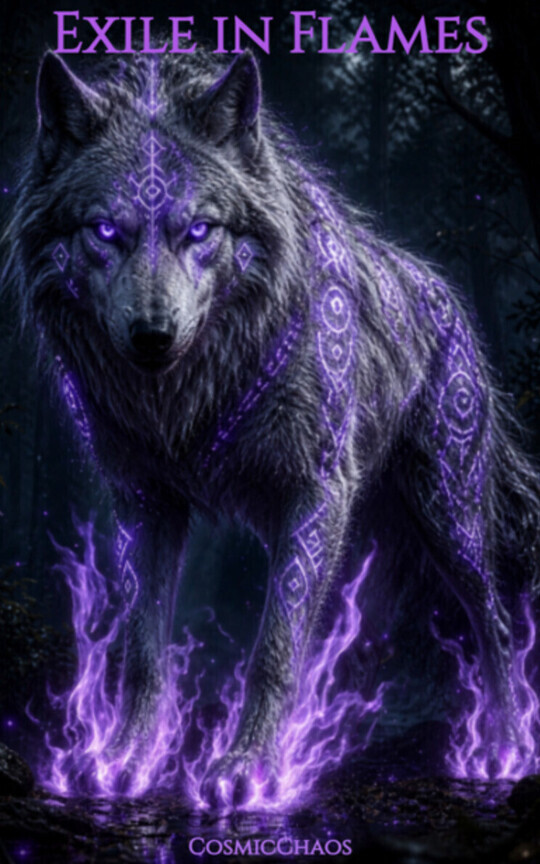
The wolves themselves were magnificent: tall and powerfully built, with thick pelts ranging from
storm-gray to midnight black, streaked with silver that caught the moonlight like foam on the sea. Their muzzles were long and keen, ears alert and tufted with frost, and their eyes glowed with the deep blue of glacial melt. They moved with the silent grace of ninjas, paws wrapped in supple sealskin tabi that left no trace on snow or deck. Their traditional garb was a fusion of shadow and sea: dark indigo haori robes reinforced with woven kelp fibers, embroidered with silver wave patterns that seemed to ripple when they shifted. Hidden beneath were kunai forged from mountain iron, and water-skins etched with runes that amplified their elemental gift—the sacred ability to command the waters as both blade and shield.
Life in Mistshore revolved around the Great Longhouse, a vast timber hall carved into the mountainside and reinforced with driftwood beams lashed by sinew and spell. It was the beating heart of their communal existence.
No wolf lived alone; dens were shared by extended families under the watchful eye of the Matriarchs’ Council. Pups tumbled together in the central hearth-pit, learning to swim before they could walk, their tiny howls echoing off rafters hung with drying nets and sacred scrolls. Elders—gray-muzzled she- wolves whose eyes held the wisdom of a hundred voyages—sat on raised thrones of whalebone, their voices carrying the final word on every matter. The clan’s matriarchal order was absolute: the strongest females, proven by trials of storm and steel, ruled.
Males served as guardians, sailors, and hunters, their strength channeled into protecting the bloodlines that only a she-wolf could carry and nurture. Heterosexual bonds were not mere tradition but sacred law, etched into the Clan Codex and reinforced in every rite. “One paw to the sea, one paw to the den,” the saying went. Only through chosen pairings of male and female could the pack endure the long winters and perilous voyages. Romances bloomed under the aurora-lit skies during the Festival of Tides, where young wolves danced on the beach, paws intertwined, eyes locked in the ancient promise of lineage and loyalty. Deviations were unthinkable; the ocean was vast and merciless, and only strong litters ensured the clan’s survival.
Dawn in Mistshore began with the Call of the Current.
A senior Matriarch would stand on the observation deck overlooking the harbor, her voice rising in a resonant howl that carried on the wind. The entire clan stirred as one. Pups were bundled into communal nurseries tended by aunt-mothers while warriors and sailors assembled on the frost-crusted docks. The fleet—sleek, black-hulled longships named for legendary waves like Tempest’s Fang and
Glacier’s Kiss—bobbed at anchor, their sails woven from enchanted spider-silk that repelled water and caught the slightest breeze. The Wavehowls were born sailors. Their culture sang of the sea: every pup memorized the maps of hidden currents and fog-shrouded isles. Voyages were not mere travel but sacred quests—trading rare mountain crystals for southern spices, scouting enemy shores under cover of mist, or hunting the great krakens that threatened their fishing grounds.
Water was their birthright and their weapon. Each wolf trained from weaning to shape it.
A young male might summon a coiling tendril from the harbor to lift a fallen mast, his paws glowing with faint azure light as the liquid obeyed his will. Females, drawing on deeper ancestral wells, could freeze seawater into razor-sharp shuriken or summon walls of churning surf to swallow invaders. In battle drills on the pebbled beach, the ninjas moved like liquid shadows. One would blur forward in a burst of mist, kunai flashing, while her partner called forth a vortex from the shallows to hurl foes skyward. Offense and defense flowed seamlessly: a defensive dome of pressurized water could repel arrows, while an offensive lance of ice could pierce armor from a hundred paces. Yet these powers were never wasted on pride. They served the clan—guarding the longships through gales, or creating safe channels through ice floes during the brutal winter migrations to southern hunting seas.
Community was everything.
Meals were communal feasts in the Longhouse: roasted seal, smoked salmon caught with water-drawn nets, and steaming kelp broth shared from great iron pots. Stories flowed as freely as the mead—tales of Matriarch Elowen the Tidebreaker, who once parted a tsunami to save a sinking fleet, or of the mated pair Thorne and Lira, whose bond had birthed the strongest litter in three generations. Work was divided by skill, not status: a male ninja might spend the morning forging blades in the mountain forges, then join his mate on the rigging of Tempest’s Fang that afternoon.
She-wolves oversaw the nurseries and the codex archives, their decisions shaping the next voyage’s route. Evenings brought the Circle of Howls, where the clan gathered around driftwood bonfires on the beach. Paws linked in concentric rings—elders innermost, pups outermost—they sang hymns to the Mother Ocean and Father Frost. Bonds were reaffirmed here: a young warrior might publicly declare his intent to court a skilled sail-mistress, their union blessed by the Matriarchs with a vial of blessed seawater to ensure fertile voyages ahead.
One such evening, as the auroras danced green and violet overhead, young navigator Kael—a broad- shouldered gray wolf with a scar across his muzzle from a kraken skirmish—stood beside his betrothed, Mira. She was a rising Matriarch-in-training, her fur a sleek silver that shimmered like moonlight on waves. Their courtship had been swift and proper, as custom demanded: three moons of supervised sails together, proving their harmony on deck and in the den. Tonight, the clan watched as they performed the Binding Rite. Kael knelt, offering a kunai etched with their paired sigils. Mira accepted it, then called forth a gentle spiral of seawater that encircled their joined paws, freezing momentarily into a crystalline band. The crowd howled approval, the sound rolling out across the dark ocean like a challenge to the night itself.
Yet life was not without peril. Raiders from the distant Fireclaw Isles sometimes tested the clan’s borders, drawn by rumors of their water-weaving secrets. When the warning bells tolled—hollowed whale bones struck in urgent rhythm—the Wavehowls became ninjas of legend. The fleet would launch under cover of summoned fog banks. Warriors leaped from ship to wave, riding liquid platforms across the surf. Matriarchs stood at the prows, directing torrents that capsized enemy vessels while their mates flanked in stealth, water-blades slicing rigging and throats alike. The clan fought not for conquest, but for the survival of Mistshore—their shared home, their bloodline, their eternal tide.
In the end, the Wavehowls endured because they were one pack, one current. Their matriarchal wisdom guided the sails, their rigid bonds of male and female strength filled the nurseries with howling life, and their mastery of water turned the unforgiving sea and snow into allies. As the longships creaked at anchor and the mountain winds carried the scent of coming snow, the wolves of Mistshore slept soundly in their communal dens, dreaming of vast horizons and the unbreakable bonds that held them together against the endless waves.
- - - - - - - - - - -
On the other side of the continent, in the scorched heart of the Ashforge Mountains, where the continent’s eastern spine cracked open like a dragon’s maw and belched rivers of molten stone into the sky, stood the citadel of the Thunderpride Clan.
Black volcanic glass cliffs rose in sheer walls, their summits crowned with perpetual plumes of smoke and lightning. Lava tubes and obsidian caves formed natural fortresses, while sulfur springs hissed beneath the surface, feeding hot springs that the lions used for ritual purification. The air tasted of ash, iron, and ozone—sharp, alive, and unforgiving. Here, far across the same vast landmass from the snowy coastal peaks where the Wavehowl wolves sailed their misty seas, the anthropomorphic lions of the Thunderpride ruled as undisputed masters of fire and storm. Their domain was rugged, volcanic, and proud, a realm of domination where every roar echoed brotherhood and every blade sang of conquest.
The lions were titans of muscle and flame: broad-shouldered, golden-furred warriors standing seven feet at the shoulder, their manes thick and black as midnight ash, streaked with crimson and silver from the heat of battle. Their eyes burned amber or electric blue, reflecting the lightning they commanded.
Sabers and katanas hung at their hips, blades forged in the clan’s volcanic forges from star-iron and obsidian, etched with runes that channeled their elemental fury. They wore layered crimson-and-gold haori armor reinforced with lacquered lava-rock scales, the pauldrons shaped like roaring lion heads. Their paws were callused from sword drills and the grip of war-claws, and every male bore the clan’s brand—a stylized thunderbolt crossed with a flame—seared into the left shoulder as a mark of unbreakable bond.
The Thunderpride was patriarchal to its core.
No female voice held sway within the citadel walls; the clan was a fraternity of brothers, fathers, and sons, bound by blood and chosen fire. Leadership fell to the Elder Roar—a council of the oldest, most battle-scarred males whose manes had turned to living embers from years of channeling lightning.
They ruled from the Obsidian Throne Hall, a cavernous chamber lit by eternal lava flows and crackling braziers. Here, the rigid system of homosexuality was law and sacrament, forged to keep the brotherhood ironclad. “Fire shares only with fire,” the Codex of Dominance proclaimed.
Within the clan, males courted males with the same fierce passion they brought to the battlefield: public displays of dominance and affection during the Festival of Embers, where pairs would wrestle bare- pawed amid sparks and then retire to private lava-lit dens to seal their bonds in heat and lightning.
These unions strengthened the pride’s cohesion, turning brothers-in-arms into mates whose loyalty could never be divided by external claims. Many clans within the greater Thunderpride were direct family lines—sires and their sired sons, uncles and nephews—living in sprawling family barracks where training, feasting, and intimacy wove an unbreakable web of shared blood and shared desire.
Yet the pride’s survival demanded strength beyond the citadel.
To keep their numbers fierce and their blood pure, the lions adhered to a strict procreative code.
Young warriors, once proven in their first monster hunt, were sent on courtship quests to distant villages and city-states across the continent. There, they would court willing lionesses or compatible females of allied species with gifts of gold, spices, and promises of protection. The mating was brief, passionate, and transactional—never a bond of the heart, for the heart belonged to the pride. When strong sons were born, the fathers returned with golden litters, claiming the cubs for the citadel and raising them in the all-male ways of fire and brotherhood. Daughters, left behind with their mothers, received a king’s ransom in gold coins stamped with the Thunderpride seal—an accepted child support that ensured the females’ security and the clan’s honorable reputation. No resentment lingered; it was the way of dominance. The sons grew into the pride, learning to call lightning from their paws and fire from their roar, their first lessons taught by the same sires who had sired them across the mountains.
Daily life revolved around the eternal test of strength, courage, and pride.
Dawn broke with the Call of the Forge—a deep, rolling roar from the Elder Roar that shook the cliffs.
The entire pride assembled in the training crater, an ancient caldera where lava bubbled at the edges and storm clouds gathered overhead by ritual command. Young males sparred with wooden bokken first, then live steel, while elder brothers channeled offense and defense in perfect harmony. One lion might summon a roaring wall of flame to shield his mate-brother while the other hurled a crackling spear of lightning from his katana, the blade acting as a conduit that turned steel into living thunder. Their powers were devastating: fire could engulf an enemy in infernos hot enough to melt armor, or be shaped into precise blades of plasma that danced along sword edges. Lightning allowed blinding speed, stunning arcs that paralyzed foes mid-strike, or defensive cages of electricity that repelled arrows and claws alike. Every strike, every parry, reinforced the brotherhood—paws brushing in passing, manes touching in shared triumph, low rumbles of affection between bouts.
The pride’s culture was built on domination over the continent’s monsters and the mercenary trade that proved their worth. The Ashforge Mountains teemed with horrors: magma drakes that slithered from fissures, ash-wraiths born of ancient eruptions, and colossal stone titans that woke hungry every decade. Hunting parties—always all-male, bonded by blood and bed—ventured out in disciplined phalanxes. They tracked beasts through sulfur-choked valleys, roaring challenges that shook the
ground. A typical hunt might see a warrior leap onto a drake’s back, driving his katana into its spine while channeling lightning to seize its nerves, his brother below summoning a ring of fire to contain the thrashing tail. Victory feasts followed in the citadel, where the kill’s heart was roasted over open flames and shared among the pride, stories of the battle told in booming voices while pairs slipped away to celebrate in private.
When not hunting, the Thunderpride sold their services as mercenaries.
Word traveled across the continent: for the right price in gold and glory, the lions would answer any call. Villages plagued by bandit hordes or cities threatened by warlords sent ravens pleading for aid. The Elder Roar would dispatch companies of twenty to fifty warriors, their crimson banners snapping in the wind. These deployments were sacred tests—opportunities to dominate, to prove courage, and to return with scars that only deepened their brotherhood. In foreign camps, the lions maintained their ways: tents arranged in tight circles, shared meals, and nightly rituals where mates reaffirmed their bonds beneath the stars, lightning playing harmlessly between their manes. They fought with merciless efficiency—firestorms clearing enemy lines, lightning chains linking sword strikes into devastating combos—then collected their pay and marched home, pockets heavy, pride heavier.
One such return unfolded under a blood-red sunset.
Captain Rorak, a massive black-maned veteran whose body bore the white scars of a hundred battles, led his company through the obsidian gates. At his side strode his chosen mate, young Lieutenant Kaelthar, their paws brushing in quiet affection as they walked. Behind them marched a new litter of golden-furred cubs—Rorak’s own sons, sired months earlier in a distant river city and now claimed for the pride. The mothers had received their chests of gold without protest; the boys already wore tiny training haori and stared at the volcanic majesty with wide, hungry eyes. The Elder Roar greeted them on the throne steps, voices thundering approval.
That night, the Festival of Embers blazed hotter than usual. Feasts of roasted drake and spiced wine flowed while the pride sang of conquest. Rorak and Kaelthar slipped into a private lava-warmed chamber, manes entwined, bodies moving with the same fierce rhythm they brought to the battlefield— fire and lightning shared between brothers, sealing the pride’s strength for another generation.
The Thunderpride endured because they were one roar, one flame, one unbreakable fraternity. Their patriarchal code, their rigid bonds of male to male, and their calculated siring of sons across the continent kept their numbers strong and their dominance absolute. While the distant Wavehowl wolves tamed the northern seas with water and matriarchal wisdom, the lions of the Ashforge claimed the volcanic east with fire, steel, and the fierce love of brothers. In the end, the continent itself bowed to both—but the Thunderpride bowed to no one save their own roaring code. As lava glowed and thunder rolled across the peaks, the lions slept in piled heaps of golden fur and scarred muscle, dreaming of the next monster, the next contract, and the eternal pride that bound them tighter than any chain.
- - - - - - - - - - -
In the vast, windswept heart of the continent—where the Eternal Frostrange’s icy rivers gave way to rolling golden grasslands that stretched like a sea of amber beneath an endless sky—the ancient rivalry between the Wavehowl Clan and the Thunderpride Clan burned hotter than any forge.
This central prairie, known to both as the Shatterplain, was a neutral no-man’s-land of swaying grasses, hidden ravines, and ancient standing stones etched with forgotten runes. Here, the wolves’ misty northern shores and the lions’ volcanic eastern peaks met in uneasy truce, their borders blurred by the endless expanse. But truce was a fragile word. For generations, the two clans had clashed in cycles of fury and reluctant peace, their battles painting the grasslands in steam and ash, flood and flame. What drove them was more than territorial pride or mercenary greed; an almost supernatural elemental hunger seemed to pulse beneath their fur and mane, as if the very gods of water and storm had chosen the wolves and lions as vessels for an older war.
The Wavehowls spoke in hushed tones around their driftwood fires of the Mother Ocean, an ancient deity of depths and tides whose liquid essence flowed through their veins, granting them mastery over wave and mist. Her rival, they whispered, was the Stormfather of the Ashforge—lord of fire and lightning, a thunderous entity whose rage crackled in the lions’ manes and roared from their blades.
These elemental gods filtering their immortal grudges through mortal flesh.
Water and fire could not coexist without clash; mist and lightning demanded reckoning. The wolves felt it as an itch in their paws during calm seas—a pull toward the grasslands to test their currents against living flame. The lions felt it as a growl in their chests during quiet hunts—a spark that yearned to evaporate the wolves’ precious water into harmless steam. It was no mere instinct; shamans of both clans reported visions during rituals: the Mother Ocean’s waves rising against a sky-split by the Stormfather’s bolts, their divine fury echoing in every howl and roar.
The conflicts erupted without warning, sweeping across the Shatterplain like seasonal storms.
A skirmish might begin when a Wavehowl scouting party—sleek ninjas gliding on summoned water- sleds through the tall grass—stumbled upon a Thunderpride mercenary caravan escorting a village’s tribute. Swords flashed alongside elements: a wolf Matriarch would raise a wall of churning surf to douse incoming fireballs, her male mate slicing through the steam with kunai while lightning arced from a lion samurai’s katana, seeking to electrocute the liquid shield itself. Battles were spectacles of elemental poetry and brutality. Wolves summoned fog banks thick as milk to blind the lions, then struck from the mist with ice-shuriken that hissed into vapor on contact with lion-flame. Lions countered by channeling lightning through the wet grass itself, turning the prairie into a crackling trap, or igniting vast rings of fire that forced the wolves to part the flames with pressurized water jets. Casualties were rare among the elites—both clans fought with ninja precision and samurai honor—but the land suffered. Grasslands turned to scorched mud, rivers rerouted by wolf-tides, and lightning-scarred craters pocking the earth where fire met sea.
These wars flared for months or years, then guttered into uneasy lulls. The clans would withdraw to their respective domains—the wolves to Mistshore’s snowy harbors, the lions to Ashforge’s glowing citadels—licking wounds and rebuilding fleets or forges. Pups and cubs were born in those quiet years, bonds reaffirmed, voyages and hunts resumed. Yet the elemental itch always returned, often after a decade of fragile silence, sparked by some omen: a wolf’s water-vision of encroaching flame, or a lion’s lightning-dream of drowning depths.
The High Elven Empire, whose crystalline spires and verdant farmlands dominated the continent’s true center, watched these cycles with growing impatience.
Ruled by the Eternal Council—a circle of ancient high elves whose silver-haired elders had outlived empires and whose magic wove the very ley-lines of the land—the Empire saw the clans’ in-fighting as a cancer. Their destructive clashes disrupted trade routes, poisoned rivers with ash and salt, and threatened to spill into elven territories. Twice before, the Council had intervened with veiled threats: legions of golem-armored elven knights and archmages capable of glassing entire battlefields. “Cease, or be unmade,” the edict read, delivered by floating orbs of light that hovered over Mistshore’s docks and Ashforge’s gates alike. Both clans, proud as they were, adhered begrudgingly. The wolves’ Matriarchs convened in the Great Longhouse, their howls tinged with resentment as they signed the Treaty of Shatterplain on parchment sealed with enchanted kelp-ink. The lions’ Elder Roar gathered in the Obsidian Throne Hall, manes bristling as they pressed burning paw-prints to the same document, their roars echoing vows of temporary restraint.
Peace held—for a time.
The latest armistice had endured for seven years, a rare span of calm where wolf longships traded peacefully with elven ports and lion mercenaries patrolled distant borders without crossing paths. But peace, like still water, hid currents. It shattered over a small slight, as it always did: a lone Thunderpride patrol, led by a hot-blooded young samurai named Varak, claimed a sacred watering hole in the Shatterplain’s eastern fringes—one the wolves had used for centuries as a ritual site to honor the Mother Ocean. Varak’s pride-brother, scenting the wolves’ lingering mist-marks, had roared a challenge and scorched the earth in declaration. Word reached Mistshore within days via a swift ninja runner riding a summoned current across the grass. Matriarch Lira, her silver fur bristling, declared it an insult to the tides themselves. “The Stormfather stirs his cubs again,” she murmured to her council, eyes gleaming with the old divine fire.
Within a fortnight, the grasslands stirred once more.
Wolf ninjas slipped through the night on liquid shadows, their water-blades humming, while lion samurai kindled their manes with lightning, katanas drawn in perfect formation. The first clash erupted at dusk: a howling vortex of seawater met a roaring wall of flame, steam exploding skyward as lightning cracked through the haze. The elemental gods, it seemed, smiled in their distant realms— water testing fire, storm answering wave.
The High Elven Council would soon dispatch their emissaries again, but for now, the Shatterplain belonged to the clans’ ancient grudge, the cycle turning anew beneath a sky heavy with unspoken thunder and gathering mist. The continent held its breath, knowing the peace would return only when the gods’ vessels had spent their fury once more.