
Chapter 1 The First Will
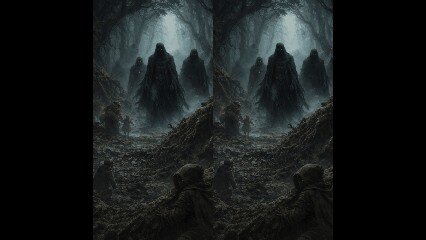
Before light was given a name, and before darkness became something feared, there was Ki. He was not a god with a body, nor a ruler seated above creation, but the first will from which intention, judgment, and balance emerged.
Ki was not light, and he was not darkness. Light was the state of balance, while darkness was the force of correction. Both came from the same origin, and neither appeared unless purpose required it. When Ki brought existence into motion, he did not do so out of mercy or affection. He did it because stillness could not endure forever. Something had to begin.
From his own essence, Ki shaped seven beings known as the Nai. They were not his children, and they were not servants. They were conduits through which his will could pass into existence without Ki descending directly. Through them, creation could be guided, restrained, or corrected.
The Nai had no fixed form. Their nature shifted between clarity and shadow according to what was required of them. They did not need worship, food, or devotion. Their only purpose was to translate intention into reality.
Together, Ki and the Nai shaped Arda, a realm where energy no longer drifted without meaning. In Arda, action left memory behind, and consequence could not simply fade. The world was not made to be peaceful. It was made to be stable.
To bring life into this realm, Ki entrusted creation to the Seas. He did not treat them as subordinates, but as forces capable of creating endlessly without attachment, memory, or regret. Life began in simple forms: algae, fish, predators, and then the great creatures of the deep. Life consumed life, and for ages the balance held.
But the Seas, lacking restraint, eventually created something that could not be returned to balance. From depths untouched by the Nai, they shaped Serima, a colossal serpent with three heads. She did not hunt to survive; she devoured to erase. Serima could mimic the forms of other creatures, drawing them close before driving them toward extinction. The oceans began to empty, and the collapse of balance reached even Ki.
For the first time since existence began, Ki did not act through the Nai. He descended himself and forged from his own essence a three-pronged trident. Each blade carried a law: annihilation, judgment, and balance.
Ki struck Serima, and the seas convulsed around them. The serpent was wounded, but the Seas rose against Ki in fury. Waves became weapons, currents tightened like chains, and the pressure of the deep tried to crush him. Bound beneath the water, Ki did not strike Serima again. Instead, he drove the trident into the ocean floor.
The seabed fractured. Stone surged upward from the depths, and mountains rose through the water, lifting Ki toward the surface. That was how land was born. It was not a blessing, but a division.
Serima was not slain. She was wounded, bound, and buried deep beneath the oceans, sleeping and waiting. From that moment, existence carried a fault within it.
The land did not emerge empty. It breathed in its own way. Stone carried memory, and roots carried echoes of the depths. Ki understood that the land could not be left without awareness, so he shaped the Zeta from the living energy of vegetation.
The Zeta were small, green-skinned, and hairless by design. Their bodies were not made for consumption. They did not eat, hunt, or harvest. Instead, they lived by absorbing plant energy without draining it, harmonizing with the land rather than taking from it. Where the Zeta walked, forests did not thin. Where they rested, the soil did not weaken.
They lived long lives, ended quietly, and reproduced without excess. Their law was simple: anything that disrupted balance could not be allowed to continue.
At the heart of Arda stood the ancient forest later known as Gnarled. It was not governed, worshiped, or claimed. It decided. The Zeta lived within it not as masters, but as extensions of its will.
As centuries passed, the forest grew dense and animal life multiplied until the land began to strain beneath abundance. Ki acted again and created humans, not as rulers or servants, but as a corrective force. Humans consumed. They altered land to survive and adapted by taking from what surrounded them.
They were placed near the ancient forest, but not within it. At first, balance held. Humans and Zeta shared territory, knowledge, and restraint. But restraint eventually failed. Humans cut more than they needed, hunted beyond replenishment, and cleared land not for survival, but for growth.
The Zeta sensed the imbalance before it became visible. They sent warnings, not as threats, but as signs. Humanity ignored them.
When the damage became irreversible, Samo, king of the Zeta, chose war. He was not a conqueror, but a warden of continuation. The conflict was brought into the Forests of Mirma, where numbers meant little and brute force failed.
Humans entered with steel and fire. The Zeta entered with the land itself. Roots shifted beneath advancing armies, paths closed behind them, and the forest exhausted the invaders rather than meeting them in open slaughter. The Zeta struck briefly and vanished. They broke will, not bodies.
Humanity collapsed, not because it was weak, but because Mirma was never theirs.
Victory was not enough. If humans returned, war would repeat. If peace depended on promises, it would eventually break. So the Zeta took a final measure. Along the forest’s edge, they inscribed symbols using living black ink. It was neither spell nor poison, but an autonomous system of natural governance. The symbols answered only to Arda itself.
Any human who crossed the boundary was not punished in the ordinary sense. They were removed, as if nature had concluded they no longer belonged inside that part of the world. There was no hatred in it, and no mercy. Only function.
The forests of the Zeta were sealed.
The Zeta withdrew into the depths of Gnarled. They knew humanity would suffer beyond the boundary, but they also knew that allowing further encroachment would doom everything. Samo watched the black ink dry upon the earth, aware that the necessary act had fractured the future.
Balance, once enforced, leaves scars. Through that scar, the darkness yet to come would enter Arda.
After the forests of the Zeta were sealed, humanity was not merely cut off from land. It was severed from its source. Beyond the boundaries, vegetation withered slowly. Trees did not die all at once; they simply stopped giving. The soil lost its life, and the seasons no longer answered as they once had.
At first, humans believed the change was temporary. Then animals began to die, rivers shrank, and hunger settled over them as a permanent condition. They consumed what remained, then the seed meant for future harvests, and finally whatever desperation placed before them. When nothing was left to take from the earth, they turned their eyes toward the sky.
They did not pray to Ki. Ki was distant and silent, and he did not answer those who had broken balance by choice. Instead, humanity called upon the Nai.
In the beginning, their prayers were simple pleas for survival, spoken into the dark with whatever hope remained. No answer came. As years passed, the prayers changed. They became louder, more desperate, and shaped more by fear than faith.
In ruined places, something else began to appear. Among collapsed temples, at the sealed edges of the forest, and within cities hollowed by starvation, seven figures took form. They were called the Nerdr.
They did not descend from the sky, and they were not summoned by ritual. They formed from energy drained too often and never returned, from fear repeated until it lost meaning, and from worship emptied of will. They stood in silence, skeletal and covered in long dark garments, with hollow eyes and a presence heavier than speech.
They did not move, speak, or attack. They stood at city edges, on barren hills, and before the doors of broken temples. Some believed they were gods. Others called them signs of death. But the Nerdr did nothing. Their existence alone carried the message that what came next could not be stopped.
As starvation deepened and fear thickened the air, the Nai finally descended.
They did not arrive in light or radiance. They came with weight, as though the world itself resisted their presence. Their forms had no fixed features, and their eyes were entirely black, closed to both light and darkness. They did not ask for worship and did not waste words.
They told humanity to stop, to return to the boundaries, and to cease what was breaking balance.
Humanity knelt, wept, and swore obedience, but their obedience was not honest. They begged the Nai to remain, claiming they wished to learn how to restore the land and understand balance. The Nai, who had not yet learned deception, agreed.
Their decision changed everything.
At first, humanity brought offerings of gold, silver, and precious stones. Then they built monuments, altars, and symbols in the Nai’s name. Over time, offerings were no longer enough. The rituals became darker and more degrading, not expressions of devotion, but attempts to draw power from beings humanity did not understand.
In that period, the Nerdr vanished. They did not flee. Their purpose had simply been fulfilled.
After the Nai descended and the rituals began, rain returned. The land bloomed again, animals recovered, and humanity believed salvation had come. But what returned was not true balance. It was a distorted system built on dependence, fear, and extraction.
From that distortion came the Tainted.
The Tainted carried the blood of both humans and the Nai, though their skin resembled that of serpents. They were tall, strong, and capable of taking human form. They could deceive, persuade, and manipulate with frightening ease. Humans, drawn to their strength and strangeness, placed them in positions of reverence and worshiped them alongside the Nai.
The Nai themselves did not fall in fire or battle. No enemy struck them down. They were emptied.
When they entered the ancient forest and reached for the roots of Gnarled, they believed they were reclaiming power that still belonged to them. For ages, energy had flowed through them without question. They had been conduits of Ki’s will, never needing to ask where the current came from, only where it should go.
At first, the exchange felt familiar. Energy moved, the roots answered, and the forest did not resist. But the Nai did not understand Gnarled. The forest did not give. It balanced.
What entered the Nai was not nourishment, but passage. What left them was something they had never learned to guard: the last residue of Ki within them, not power or memory, but presence.
They remained standing as the roots withdrew, believing the ritual had succeeded. There was no pain, no warning, and no visible judgment. The forest simply closed itself, and the Nai departed convinced they had reclaimed what humanity could no longer provide.
Only when they returned to rule did the truth reveal itself. Their commands no longer carried weight. Their judgments produced no consequence. Their authority could be invoked, but the world no longer answered.
At first, the change was not visible to human eyes. Within themselves, however, the Nai felt something more terrifying than death. Their mass no longer anchored them. Their forms wavered. Their connection to the material world weakened, as if reality had begun to forget how to hold them.
They could still be seen and heard, but they were no longer fully present. Where their presence once bent air and ground, it now only disturbed the light. Their steps left no mark, and their touch carried no certainty. They had become echoes of intention, will without substance.
Only then did they understand what Gnarled had taken. Not strength. Not dominion. Weight. The right to exist as something solid.
Every attempt to draw more energy only worsened the decay. Power passed through them without settling, slipping away like water through fractured stone. They were no longer vessels, only channels leaking into nothing.
So they stopped, not out of repentance, but out of survival. To return to the forest would mean complete dispersal. To continue reaching would mean vanishing entirely, becoming command without voice and intention without form.
The Nai withdrew from Gnarled in silence, carrying a truth they would never speak aloud. They had not been punished or judged. They had simply been rebalanced.
From that day forward, the Nai ruled only through illusion. Their kingdoms still stood, but their thrones were hollow. Their power remained in name, but it could no longer anchor itself in flesh or land. They were present and absent at once, while deep within Arda, Gnarled remained unmoved, having reclaimed what was never meant to be held.
When the Nai entered the Gnarled forests of the Zeta again, they believed they were approaching salvation. They had ruled through kingdoms, drained devotion from humanity, and bent the flow of power for centuries. Yet they continued to weaken. The Tainted multiplied, the conduit collapsed, and desperation drove the Nai into the one place no conduit was ever meant to stand.
The Gnarled trees did not welcome them, but they did not resist either. They responded.
Roots older than language reached inward. Bark drank essence without judgment. What the Nai offered was not received as power, but as excess energy that no longer belonged to the cycle. One by one, the Nai unraveled. Their forms lost cohesion, their presence thinned, and their authority dissolved into silence.
They did not die. They were erased.
The forest took back what had once passed through it, and the world exhaled as the Nai vanished from material existence. The balance shifted, the thrones emptied, and the heavens fell quiet.
All of it should have ended there, but one thing remained.
As the final traces of Nai essence were drawn into the roots, a concentration refused to disperse. It was not a soul, and not a will shaped by Ki. It was refusal itself, dense enough to force existence to pause. That refusal compressed inward until it imposed form upon itself.
From the residue of erased divinity, a single figure emerged among the roots.
Faelrith.
He was not Nai, though he carried their gravity. He was not Tainted, though his presence disturbed the flow they fed upon. Where he stood, energy moved toward him and stopped. He could not create, restore, or renew. His nature was interruption. He could only prevent return.
The forest rejected him, not out of fear, but because he was not part of the exchange. He had not been offered, consumed, or returned. He had remained by force alone. So the trees released him.
Centuries passed before Faelrith returned to the edge of Gnarled. By then, he was no longer forming or becoming. His presence carried the weight of something that had survived erasure and refused to dissolve.
The forest sensed him before he spoke. Leaves stilled, branches tightened, and roots twisted beneath the soil as if remembering a name they had tried to bury. Faelrith stood at the boundary where root and shadow met, lifted his head, and called Ki by name.
The name moved through Arda like a wound reopening. Mountains groaned beneath the crust, distant seas convulsed, and the sky dimmed as though existence itself hesitated to answer. Gnarled drew inward, not in reverence, but in fear.
Faelrith did not kneel or pray. He accused Ki of hiding behind distance and calling absence balance. He reminded him that Serima had been faced directly, wounded by Ki’s own hand, and sealed beneath the oceans because her existence could not be endured. But humanity and the Nai had been left to hunger, worship, desperation, and time.
“You let others do your work,” Faelrith said. “You let them be drained slowly so your own essence would remain untouched.”
The land cracked beneath him, and the forest recoiled when he named Ki as the origin of both light and darkness. It was not blasphemy that disturbed Arda. It was truth.
Faelrith said Ki did not balance; he delayed. He said Ki desired darkness but feared claiming it, so he fed it with humanity. He said free will had not been given as a gift, but as insulation, allowing humans to choose error so Ki would not bear the blame for consequence.
Then he spoke of the Nai. They had been made as conduits, not thinkers or choosers. Light passed through them, darkness passed through them, but nothing truly belonged to them. When they weakened, Ki abandoned them and allowed the trees to drink what remained.
At last, Ki answered, not with words, but with pressure. His presence bent reality without moving it and reminded the world of its smallness. Faelrith did not step back.
He said he had not come to judge Ki, but to remember what Ki refused to face. Balance built on depletion was not balance. It was collapse postponed.
Standing at the edge of Gnarled, where shadow and root intertwined, Faelrith named himself not as light, not as darkness, but as consequence.
Arda fell silent, and even Ki did not speak.
Humans would later kneel before Faelrith, believing they had found the last of the Nai. Kings offered allegiance, priests shaped rituals around his presence, and the Tainted watched closely, recognizing not kinship, but opportunity. Faelrith allowed the lie because he did not need worship or a throne. He ruled only by endurance. Where he lingered, oaths weakened and rituals lost coherence.
What surrounded him was not energy in motion, but the end of motion. It did not flow or return. It was cold, blue, and unmoving, like the trace left behind when all paths have closed. The forest did not sense power in him. It sensed cessation. That was why the roots withdrew. Not because they feared him, but because the cycle no longer recognized him.
Arda was not divided by war. No great battle tore its lands apart, and no god descended to split it by force. It was divided by advice.
When the Nai began fading from the material world, their absence created space. The Tainted felt it first. Where divine authority had once pressed heavily upon the land, there was now uncertainty, and uncertainty was easy to shape.
The Tainted entered human courts not as conquerors, but as counselors. In stone halls and royal chambers, they took human form, flawless and convincing. Their voices were calm, their words measured, and they spoke not of domination, but of order. They told kings and chieftains that Arda was too vast to remain united, that unity invited chaos, that borders meant protection, and that division was wisdom.
Humanity listened. Fear had softened them, and without the Nai standing in flesh to enforce balance, the world felt unguarded. The Tainted fed on that uncertainty and turned it into policy.
Maps were drawn. Lines were traced across parchment and stone. Rivers became borders, mountains became walls, and forests were claimed, renamed, and restricted. The land did not protest because no one had asked it.
Arda was divided into four kingdoms, not through conquest, but through carefully engineered agreement. Each realm received a ruler, and each ruler received an adviser. Every adviser was Tainted.
They stood behind thrones rather than upon them. They whispered instead of commanding. They drafted laws, interpreted threats, and guided decisions until rulers became dependent on them. To the people, they were mostly unseen. To the kings, they were necessary. To Arda, they were poison.
Through counsel, the Tainted reshaped human governance. Laws became rigid where conscience once lived. Obedience replaced judgment. Fear was renamed loyalty. Power appeared to rest in crowns, but in truth it gathered around those who advised them.
The Nai watched from a distance, unable to intervene or anchor themselves to the structures rising in their name. The Tainted had become what the Nai could no longer be: the interface between power and flesh.
By the time humanity understood the cost of division, it had already become law, identity, and tradition. Borders were defended. Kingdoms hardened. Unity became something remembered in songs rather than practiced in life.
The Tainted had succeeded. Arda remained whole in form, but fractured in spirit. From the shadows of the new kingdoms, the architects of division waited patiently, feeding on the surrender of will and preparing the world for what would follow.
Decades passed. The kingdoms survived, but they did not heal. Borders hardened, faith splintered, and fear learned new names. Then the Nerdr appeared again.
They did not rise from ritual or bloodline. They emerged from places where energy had been consumed too often and returned to nothing: collapsed temples, drowned cities, burned fields, and ruins where belief had been harvested until only residue remained.
They were malformed, silent, and wrong. Not beasts, spirits, or creations, but consequence given shape. Every kingdom witnessed them. Ora sealed its gates. Vron called them heresy. Shuria hunted them and failed. Aria went silent and pretended they did not exist.
Even the Tainted took notice.
In a sealed chamber beneath Shuria, a council gathered in darkness. Among them stood Malrien, adviser to the Tainted throne, his human form stretched too tightly over what he truly was. He told the council that the Nerdr were not errors, but consequences. They were born where the flow of power had collapsed entirely, where fear had been drained too often and belief harvested until nothing remained.
Some dismissed his warning, but Malrien understood what the others refused to see. This was not a mortal rebellion and not Ki’s correction. It was the omen they had been warned of: the moment when what had been consumed began to look back.
He told them something older than the Nerdr was moving, something that remembered Arda before division.
The council rejected his fear as exaggeration, until the doors opened and Faelrith entered without announcement.
He was not radiant, crowned, or divine, but he was unmistakable. The Tainted recoiled instinctively, their forms wavering because they recognized him not by name, but by absence.
One of them whispered that he was what remained of the Nai.
Faelrith did not bow, threaten, or explain himself. He simply told them they had divided Arda to feed themselves.
The chamber chilled.
The Tainted argued as they always had. They spoke of balance, sustainability, and order maintained through fracture. They described kingdoms as systems, humans as currents, and suffering as inevitable. Faelrith listened until they were finished.
Then he told them they had mistaken continuation for order. They were not preserving Arda. They were hollowing it.
They offered him alliance, restoration, authority, even a throne above all kingdoms. All he had to do was accept the division they had built.
Faelrith refused.
“A world that survives by being eaten does not deserve to continue unchanged.”
Malrien understood then that Faelrith was not opposition. He was termination.
The Tainted watched him leave without resistance, not because they were powerless, but because they sensed something worse than war: a will that did not seek dominion.
Outside, Faelrith walked through cities that no longer remembered unity. The Nerdr stood at the edges of existence, proof that the system was already collapsing. He had no power to create and no right to begin again, but he knew who still did.
The Seas.
They had always created without conscience. They shaped monsters where Ki shaped meaning, and monsters were enough.
Faelrith turned toward the distant horizon where land surrendered to water. Behind him, Arda trembled. Ahead of him, the oceans waited.







