
Basement Weather
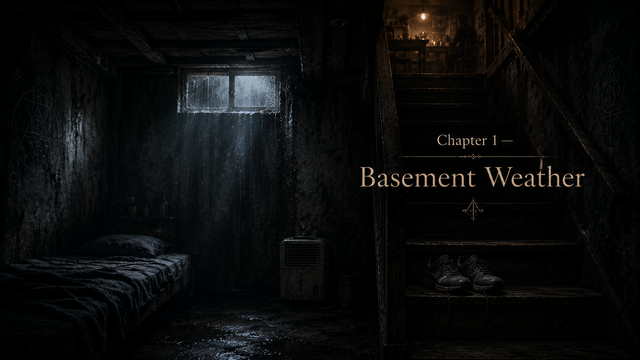
Ren woke to the smell first.
Wet concrete, old detergent, the mineral rot of a basement that had never once been fully dry. The dehumidifier in the corner had died sometime in spring, and nobody had replaced it. Eleanor said electricity cost money. Lily said it matched his vibe.
He lay still on the narrow bed and watched the pale seam of morning at the top of the little ground-level window. A spider had built a web across one corner of the glass. Condensation silvered the inside. He could hear the pipes ticking in the ceiling and, above that, the ordinary life of the house starting without him.
Cupboards. Footsteps. The drag of a chair.
Then Lily laughing upstairs.
It was a high, loose sound, careless as thrown confetti. Ren shut his eyes. Through the floorboards he heard her say something to Eleanor, too muffled to catch, then another burst of laughter, brighter this time because it had found an audience.
He pictured them in the kitchen without meaning to. Eleanor in one of her fitted workout sets she wore more often than she ever worked out, phone already in hand, looking over listings before coffee. Lily in a cropped tank, hair half up, leaning against the counter like the room belonged to her. Which it did. All of it did. The kitchen, the stairs, the hall mirror, the light.
Ren got up before they could call for him.
The carpet square beside his bed was damp again. He stepped around it, pulled on jeans and the black Brew & Bean T-shirt that smelled faintly of espresso grounds even after washing, then shrugged into the green apron he had brought home because Greta said if he forgot it again she would dock him for a replacement.
On the stairs he stopped.
A pair of running shoes sat on the third step from the bottom. Gray mesh, white soles, still creased from the box. His size. No receipt, no bag, no note tucked into the tongue. They had not been there when he came down last night.
Eleanor bought things the way she said difficult things — by leaving them where they could be found and never mentioned. Ren had learned to read the language years ago. A winter coat on the banister before a cold snap. Toothpaste replaced in the basement bathroom without comment. Once, the month after his father’s funeral, a twenty-dollar bill folded into the pocket of a jacket she was taking to Goodwill, placed there as if by accident and never acknowledged.
He laced the shoes on. They fit.
Upstairs, the kitchen went quieter when he entered. Not silent. Nothing so dramatic. Just thinner.
Eleanor was standing at the island, scrolling through property photos while a piece of toast cooled untouched near her hand. Her blond hair was twisted into a hard clip at the back of her head. She had the look she always had in the mornings, a woman carrying the weight of a house and a career and a dead man’s son, all of it balanced on a jaw set against the possibility that any of it might slide. The house had been her second husband’s. Ren’s father. He had died three years ago of a heart attack so sudden the paramedics found him still holding his coffee mug, and Eleanor had been left with a mortgage she could barely afford, a real estate license she was still trying to make pay, and a fifteen-year-old boy who looked at her from across the breakfast table with his dead father’s brown eyes.
She had kept him. Ren knew that, and knew that the keeping was supposed to count for something, the way a roof counted, the way heat in winter counted. It was not love. It was not obligation in any form soft enough to touch. It was the grim arithmetic of a woman who had already lost one household and would not be the kind of person who threw a child onto the street, because that would mean she was worse than the situation had already made her.
Lily sat on the counter with one knee tucked up, sipping iced coffee through a metal straw. She was Eleanor’s daughter from the first marriage, the one that ended before Ren’s father ever appeared. Her biological father called on birthdays when he remembered and sent checks that sometimes cleared.
“There he is,” Lily said. “Our resident cryptid.”
Ren went to the cabinet for a glass.
“The lawn needs mowing,” Eleanor said without looking up. “Before it gets hot.”
“I have a shift in twenty minutes.”
“Then tonight.”
Lily dragged her gaze over the apron. “He sleeps in that thing. I swear he does.”
Ren filled the glass from the tap. The water came out cloudy for a second, then cleared. He drank half of it in one pull because speaking too early, before he had settled himself, always made his voice come out softer than he wanted.
“I closed last night,” he said.
Eleanor finally looked at him. Her face was pretty in a hard, maintained way, the kind that made every expression seem like a decision. There were shadows under her eyes she had not yet covered with concealer, and for a half second he saw through the sharpness to something older and more tired beneath it. Then the sharpness returned.
“And?”
“And I got home after midnight.”
“And you live here for almost nothing. So I’m sure you can find the strength.”
Lily snorted into her coffee. “He can wear the apron while he does it. Real branding opportunity.”
Ren set the glass down too carefully. If he set things down fast, they called it attitude.
“I’m paying you rent on Friday.”
“You’re contributing,” Eleanor said. “Let’s not dress it up.”
Her phone rang. She lifted a finger at him, already turning away, her voice shifting at once into bright professional warmth. Ren stood there for a second while she greeted a client, while Lily smirked down at her phone like she had won something small and familiar.
He took a banana from the bowl and headed for the door.
“Ren,” Eleanor said into the call, then covered the speaker with her palm and looked at him with open irritation. “Trash bins. Curb. Don’t make me ask twice.”
It was the kind of sentence that sat in his chest all day. Not because it was cruel. Because it was automatic. She did not need to think about the words or their weight. They came from the same place as breathing.
Outside, the morning was already warming. The grass along the curb glittered with sprinkler runoff. He dragged both bins out one-handed, the wheels rattling over cracked concrete, and looked across the street without thinking.
Mira Patel was kneeling in her flower bed in gray leggings and a faded blue T-shirt, tying back a climbing rose with green garden tape. She glanced up, saw him, and smiled.
“Morning, Ren.”
He stopped. “Morning.”
“You heading to work?”
He nodded.
She stood, brushing dirt from her fingers. Mira was older than Eleanor, maybe not by much, but she wore age differently. Soft around the mouth, calm in the eyes. Like being looked at by her did not cost her anything. Her husband Arjun’s car was gone from the driveway again, had been for weeks, and the house behind her sat quiet in a way that was less peaceful than patient. The herb pots along the front path were meticulously tended, basil and rosemary and cilantro, each one labeled in neat handwriting on little wooden stakes. The garden of a woman with more care than anyone to receive it.
“Hang on.”
She crossed her yard and came to the fence with a travel mug in one hand. “I made extra chai. You looked half-dead last week.”
He took the mug before he could think of a reason not to. It was warm through the cardboard sleeve. Cinnamon, black tea, milk, something floral under it. She had been doing this for months now, whenever she caught him leaving in the morning. Never every day. Never on a schedule he could predict or feel obligated by. Just often enough that the absence of it on other mornings registered as a small, specific kind of cold.
“Thanks,” he said.
“You’re welcome.” Her gaze flicked to the new running shoes. “Those are nice.”
He looked down. “They were on the stairs.”
“Eleanor?”
He shrugged.
Mira smiled in a different way then, smaller and more private, as if she had caught a glimpse of something tender in his house that she knew better than to name aloud. She had known Ren’s father. Not well, not the way Eleanor had, but enough to wave across the street and exchange the little courtesies of proximity. After the funeral she had left a covered dish on the porch with a card that said only, I’m sorry. Be gentle with yourself. Ren still had the card in a drawer in the basement. He did not know why he kept it. He suspected it was because no one else had written anything to him at all.
“Take care of yourself, okay?”
From inside his house, Lily called through the open front window, “Ren, your girlfriend’s here.”
Mira’s eyebrows rose, amused, but Ren felt heat move up his neck all the way to his ears.
“She’s not,” he said, too quick.
“I know,” Mira said gently.
Lily laughed again. That same easy bell-like sound. Ren wanted, with a sudden physical clarity, to break every window in the house.
Mira must have seen something in his face because her expression changed, not to pity exactly, but close enough to sting.
“You should go,” she said. “Before you’re late.”
He nodded once and walked away with the mug in hand.
By the time he got to Brew & Bean, the chai had gone lukewarm. He drank the last swallow in the alley and threw out the cup before he clocked in.
Brew & Bean was all reclaimed wood, hanging plants, and chalk lettering that changed with Greta’s mood. At eight in the morning it smelled of steamed milk, citrus cleaner, and burned espresso. Ren liked the machine sounds before the customers came, the hiss and clank and pressure release, because machines at least were honest about what they wanted.
Greta Holcomb stood behind the counter checking the pastry case with the expression of someone auditing a crime scene. She was broad-shouldered, thick through the chest and arms, gray hair pulled into a bun so severe it pulled her eyebrows slightly upward. She wore black every day, the same way she ran the café every day, with a grim refusal to consider alternatives. Her husband Martin had opened this shop twelve years ago. He had been dead for three. Greta had kept the place running the only way she knew how, which was to treat every shift like a siege and every employee like a potential breach in the wall.
She didn’t look at Ren when she spoke.
“You’re two minutes late.”
“The bus got held at Oak.”
“And clocks stop working on buses?”
He tied on his apron. “No.”
Greta turned then, fixing him with pale eyes sharpened by permanent disappointment. “Good. So we agree the issue is you.”
He said nothing.
“Stock syrups, wipe lobby tables, then run the basement inventory list. We’re missing two boxes of oat milk and I’m tired of this place hemorrhaging product.”
“Okay.”
She held out her hand.
He stared at it a second too long. “What?”
“Your phone.”
He blinked. “Why?”
“Because the last three times I sent you downstairs, you took twenty minutes to count six shelves. I assume you were texting or staring into space or both.”
“I wasn’t.”
Her hand remained extended. “Then this should be easy.”
He gave her the phone.
Greta slid it into her apron pocket without breaking eye contact. “See? Growth.”
The first rush hit at eight-thirty. Students with laptops. A man in scrubs asking for six extra shots and getting angry at the price. Two women in expensive tennis clothes who said Ren’s name off his tag like they were trying on a joke. He wiped tables while they talked over him, around him, through him. He refilled sugar jars. He carried a tray of mugs back to the dish station and one slipped on the wet rubber mat, hit the edge of the sink, and cracked cleanly in half.
The sound was small. Greta appeared anyway.
“For God’s sake.”
“Sorry.”
“Do you know what these cost?”
He looked at the pieces in his hand. “No.”
“Obviously.”
The customer at the pickup end raised a hand. “Excuse me? I’ve been waiting ten minutes on a cortado.”
Greta shot Ren a look as if he had personally arranged this and moved away to smooth her voice into customer service. Ren dropped the broken ceramic into the trash and washed his hands. The hot water raised the red line where the mug had nicked the base of his thumb. Not enough to bleed. Just enough to sting.
By eleven, his shirt clung damply between his shoulder blades. Greta had corrected the angle of his pastry labels, the order of his syrup bottles, the speed at which he wiped the counters, and the shape of the smile he had failed to give a woman asking if the gluten-free banana bread was emotionally moist.
At half past, he opened the staff fridge for a water bottle and stopped.
A wrapped sandwich sat on the middle shelf. Turkey, lettuce, the bread cut diagonal. On the cling wrap, a yellow Post-it in Greta’s severe block capitals: CLOSING STAFF.
Ren looked at it for a moment. Nobody else was on closing tonight but him.
He took it and ate it standing by the dish station, facing the wall so no one could see his face do whatever it was doing. The bread was fresh. She had made it this morning, before the shop opened, before the pastry audit, before she took his phone. She had stood in this kitchen and assembled a sandwich for a boy she would spend the next eight hours treating like a liability.
He finished it and threw the wrapper away before she came back from the floor.
At noon he carried a crate of paper cups toward the storage stairs and saw his reflection in the dark window by the back door. Brown hair in his eyes. Thin face. Apron hanging flat off a body nobody noticed until it was in the way.
He paused long enough to straighten.
The bell over the front door chimed, and Lily walked in with two girls from her college. Summer-bright, loud, all perfume and lip gloss and exposed shoulders. Ren saw them before they saw him, and for half a second some primitive part of him hoped she would keep walking, order, leave.
Then Lily’s face lit up with mean recognition.
“Oh my God,” she said to her friends, grabbing one by the wrist. “There he is. Basement Troll in his natural habitat.”
Both girls looked over. One laughed with immediate gratitude, happy to be handed the right response.
Ren set the crate down.
“What can I get you?” he asked.
Lily leaned on the counter, eyes dropping to his name tag as if reading it for the first time. “Actually, can we get an apron too? We’re doing a prison-themed party.”
One of the girls said, “Stop,” while already laughing.
Greta looked up from the register and did not intervene.
Ren kept his hands flat on the wood. “You ordering?”
Lily smiled wider because he had spoken. “I want whatever’s cheapest. Since this place clearly pays in humiliation.”
Greta stepped in then, not to stop it, but to speed it along. “Next guest, please.”
Guest. Not customer. Not person. Lily gave her order, then turned to the girls and started talking about some guy from campus, not lowering her voice at all. Ren made the drinks because Greta told him to, though every movement felt overbright and brittle. Ice. Syrup. Milk. Lids. He set Lily’s cup down. Their fingers brushed when she took it.
“Aw,” she said. “Don’t look so serious. You’ll curdle.”
They left laughing.
Greta waited until the door closed behind them. “Basement inventory. Now. And if I find one mistake, you’re staying late.”
He stared at the cup rings they had left on the counter. Three wet circles overlapping like a Venn diagram of people who did not see him.
“Ren.”
He wiped the rings with a damp cloth, slowly, because if he moved too fast right now something inside him would crack along a line he could not afford to show.
The afternoon dragged through him like weather. A woman with a stroller ordered a latte, changed it to a cappuccino, changed it back, then complained the foam was too dry. A man in paint-flecked jeans paid entirely in coins and looked offended when Ren counted them. Two teenagers sat in the window booth for three hours nursing a single drip coffee and left the table covered in straw wrappers and napkin shreds that stuck to the wood with dried sugar.
Ren cleaned it all. He cleaned it the way he cleaned everything here, thoroughly enough to avoid correction, quietly enough to avoid notice. Greta moved behind the counter like a warship in a canal, precise and dangerous and entirely too large for the space she occupied. She did not mention Lily’s visit. She did not ask if he was all right. She checked his syrup labels twice and found them satisfactory without saying so.
At four, a regular named Dale came in and called Ren “buddy” while ordering a flat white. Dale was in his fifties, ruddy-faced, the kind of man who treated service workers with aggressive friendliness as if volume were the same as respect. He slapped a five on the counter and said, “Keep the change, buddy,” and the change was eleven cents.
Ren said, “Thanks, Dale.”
Greta glanced over. Later she would tell him not to use first names with customers. Later she would frame it as professionalism. Right now she only looked at him with that pale, assessing gaze and said nothing, which was its own kind of sentence.
He picked up the clipboard and went downstairs.
The basement storage room ran beneath the oldest part of the building. The temperature dropped the moment he opened the door at the bottom of the stairs. The air down there smelled different from upstairs, less coffee, more stone and cardboard and old water. There were shelves of syrups, backup beans, cleaning chemicals, stacks of paper goods, and in the far corner a floor drain with a rust halo around it. One fluorescent tube buzzed overhead with a faint sick tremor.
Ren stood there until the pounding in his chest eased.
Then he counted.
Two boxes vanilla syrup. Four caramel. Three hazelnut. Cups, lids, sleeve packs, oat milk, almond milk. He wrote each number in neat block letters because neatness was the one defense nobody could argue with. Halfway through he found the missing oat milk behind a stack of holiday cups Greta had forgotten to mark down for clearance six months ago.
He almost smiled.
Not because he had found it. Because he could prove she was wrong.
He carried the clipboard upstairs with that small, mean warmth spreading in him, the kind that passed for hope if you had lived without better versions of the feeling.
Greta was at the register again, counting bills.
“I found the missing stock,” he said.
She held out a hand for the sheet. Read it. Her mouth tightened.
“Behind holiday overstock.”
Greta looked toward the back room, then back at the sheet. “Fine.”
He waited.
“That means you put it away properly now,” she said. “It doesn’t mean we throw a parade.”
Ren felt the warmth inside him gutter. “You said we were missing it.”
“And now we aren’t. Congratulations on solving the mystery of shelves.”
He should have walked away. Instead he heard himself say, “Maybe don’t accuse me of stealing next time.”
The air between them changed.
Greta lowered the clipboard. “I did not accuse you of stealing.”
“You said the place was hemorrhaging product.”
“I said I was tired of it. If you chose to hear that as an accusation, that sounds like a guilty conscience.”
“It sounds like you always assume it’s me.”
The silence after that was immediate and dangerous. A customer at the pastry case glanced over, then looked away.
Greta’s voice dropped. “Office. Now.”
There was no office, not really, just a partitioned nook behind the back storage with a desk and a camera monitor. Ren followed her anyway.
She shut the door halfway. “Do you think you are special here?”
He looked at the scuffed floor. “No.”
“Good, because you are not. You are late, slow, distracted, and one broken dish away from costing me money I do not have. The reason I watch you is because you require watching.”
His face went hot. “I do everything you ask.”
“Eventually.”
“I’m trying.”
She gave a short, unbelieving laugh. “Everyone is always trying when they’re bad at their job.”
He swallowed. Something acid and helpless moved in his throat. He hated that it was happening here, under fluorescent light, with bleach in the air and her hand still resting on the clipboard like she owned even his handwriting. Behind her, on the desk, sat a framed photo he had noticed before but never studied. A man with Greta’s broad build and a gentler face, standing outside this same café with a paint roller in one hand and a grin that made the whole strip mall look like a dream worth having. Martin. The shop was his before it was hers, and sometimes Ren could see that fact move through her body like weather, the way her hand went to the espresso machine handle with a tenderness she never showed to people.
Greta saw whatever came into his face then and mistook it for weakness. Her tone softened by a degree, which was worse.
“If this is too much for you, Ren, say so. I can cut your shifts. Maybe that would suit everyone.”
Cut your shifts. Rent on Friday. Eleanor at the counter. The damp square of carpet by his bed.
He lifted his head. “No.”
“Then adjust.”
She handed him back his phone and stepped past him, conversation over.
He stayed in the nook another few seconds after she left, looking at the monitor feed from the basement camera. Black and white, slightly warped, aimed at the shelves and the far corner drain. In the image, the room looked older than the rest of the shop, as if the building remembered something the renovated upstairs had painted over. The brick along the far wall was darker than the rest, older, the mortar between the courses thick and uneven in a way that suggested hands rather than machines.
On the lower right of the screen, near that oldest wall, he noticed a shape he had never paid attention to before. Not an object exactly. A seam. A rectangle in the floor where the concrete looked fractionally darker, as if a panel had been set back into place and forgotten. The shelf of cup sleeves stood partly over one corner, but the shape extended beyond it, clear enough on the grainy feed to have edges, to have intention.
Something had been put there. And something had been placed over it to make the room forget.
Greta called his name from the front.
Ren blinked, stepped out, and returned to work.
But the image stayed with him through the rest of the shift. Through mopping under café chairs and emptying grounds into the compost bin and getting brushed aside by customers who said sorry to the air after they hit his shoulder. Through the bus ride home, sitting on a cracked vinyl seat with his reflection floating in the dark window beside him, the apron folded in his lap smelling of milk and bleach.
Through the front door, where Eleanor was in the kitchen on the phone with a voice that meant client, her heels kicked off under the island stool, a glass of white wine already breathing beside her laptop. She covered the speaker when she saw him.
“Did you remember the lawn?”
“Doing it now.”
“It’s almost dark.”
“I’ll use the porch light.”
She looked at him the way she looked at listings that were overpriced and structurally compromised. Then she went back to the call.
Lily was on the couch, legs tucked under her, the television painting her face in shifting blue. She had changed into one of Eleanor’s old sweatshirts, the kind of borrowed comfort she would have denied if anyone pointed it out. A biology textbook lay open facedown on the cushion beside her, its spine already cracking.
“You smell like coffee and regret,” she said without looking up.
He went through the kitchen to the back door. From behind him he heard Eleanor say to the client, in a voice like warm silk over cold steel, “Absolutely, I can have the comparative by Thursday.”
The lawn took forty minutes in the dying light. The mower was old and pulled to the left and the lines came out crooked no matter how carefully he guided it. Sweat soaked through his shirt. His arms ached from the vibration. Twice he had to stop and clear wet clumps from the blade housing with his fingers, the grass staining his skin green and the metal teeth sitting close enough to the tendons of his hand that the nearness felt like a conversation.
When he came inside, Eleanor had moved to the couch beside Lily. They were watching something together, sharing a bowl of chips, and the scene looked so ordinary and warm and complete that Ren stood in the kitchen doorway for a moment without being seen.
Two women on a couch. Light from the screen. Laughter at something he was not part of.
He made himself a sandwich from whatever was left in the fridge and ate it standing at the counter, then washed the plate and put it away. Eleanor called over her shoulder, “Don’t forget the bins need rinsing.”
He rinsed the bins in the dark backyard, the hose water cold against his wrists. Across the street, Mira’s porch light glowed amber. Her kitchen window was lit but the curtain was drawn. He wondered if Arjun had called tonight, and then he wondered why he wondered, and then he went inside and down to his room.
The house above him murmured and settled. A toilet flushed. A cabinet shut. Lily laughed again, distant through the floorboards, and this time he did not close his eyes against it. He just sat there with the sound in him and thought about the basement at Brew & Bean, the dark square in the floor on the old camera feed, the way Greta had said special like it was a disease.
He looked down at the new running shoes, still on his feet. Gray mesh, white soles, already scuffed at the toe from a day spent standing on rubber mats and concrete floors. Eleanor had bought them without speaking and would never acknowledge they existed. Greta had made him a sandwich and would deny it if asked. These were the shapes kindness took in his life — wordless, deniable, wrapped in enough hostility that accepting them felt like losing. And Mira, who had nothing to gain from him, handed chai across a fence as though it were the simplest thing in the world.
Three women who could not say a kind thing without flinching. One who could, and got called his girlfriend for it by a girl who had never once asked him how he was.
He took out his phone and opened the notes app. On a blank screen, he typed three words.
Basement panel. After close.
Then he read them once, as if someone else had written them, and felt something small move into place.
Not relief. Not confidence.
An option.
He did not yet know what lay beneath the floor of a coffee shop basement. He did not yet know about leather or blood or copper or the way a voice could be brewed into the texture of obedience. All he knew was that the day had compressed him into a shape he could not sustain, that the seam on the camera feed had the look of something deliberately hidden, and that hidden things were the only things in his life that had ever offered the possibility of belonging to him alone.
Upstairs, the laughter went on. Down in the damp half-room, Ren smiled without warmth and set an alarm for fifteen minutes earlier than usual.







