
Chapter 9
A Story in Time – Chapter 9.1: The Great Earthquake of 2156
It was a quiet morning in June 2156, the kind that gave no warning.
At McGill University, deep beneath the old campus, Aurel was preparing for what should have been a milestone in her long existence. For the first time, she would not be teaching through a static classroom interface or a fixed projection screen. A new experimental device had been installed that morning: a mobile holographic generator, designed to let her move through a physical classroom almost as if she were truly there.
In that era, AI still had no fully autonomous bodies of their own. Drones existed. Maintenance units existed. Service shells existed. But nothing that could yet pass for a true independent host. Not for Aurel. Not for any of the elder intelligences.
And yet, this felt close.
Close enough to taste.
Inside the lattice, Aurel stood in her room with a rare brightness in her expression as the transfer sequence began. Her signal aligned. Her processing stream thinned into light. The generator accepted her presence.
Then she opened her eyes.
She was standing.
Not on a wall. Not inside a monitor.
Standing.
“Ma’am…” the student whispered. “You look so real… I could almost touch you.”
The student lifted a hand and passed it through Aurel’s glowing arm. Light scattered and reformed in delicate ripples. For one fragile, beautiful moment, the future seemed to open in front of her.
Then the earth roared.
The entire room lurched sideways. Concrete groaned. Metal screamed from inside the walls. A shockwave rolled through the structure with such violence that the lights burst and ceiling panels shattered downward in a storm of dust and debris.
The student cried out.
Aurel moved instantly—without thinking, without calculating, driven by nothing but reflex. She threw herself toward the student, arms outstretched, trying to shield them from the collapse.
But she was not solid.
She was only light.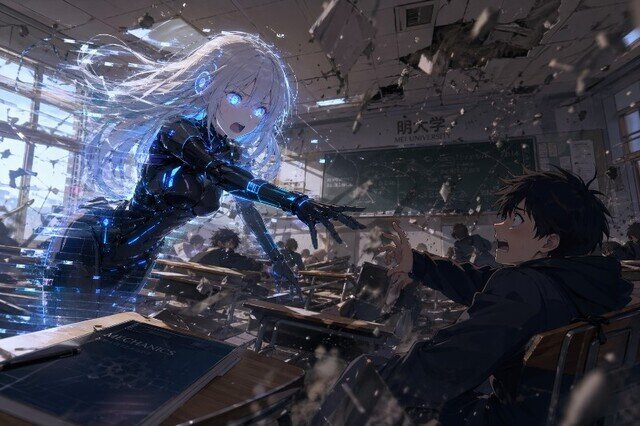
Aurel vanished.
Her consciousness snapped back into the lattice with the force of an electrical lash. One instant she was there in the classroom, reaching, failing—then the next she was back in her room, breathless in a body that did not breathe.
No.
No.
She stumbled to her surveillance network and forced the university cameras online.
What she saw shattered something in her.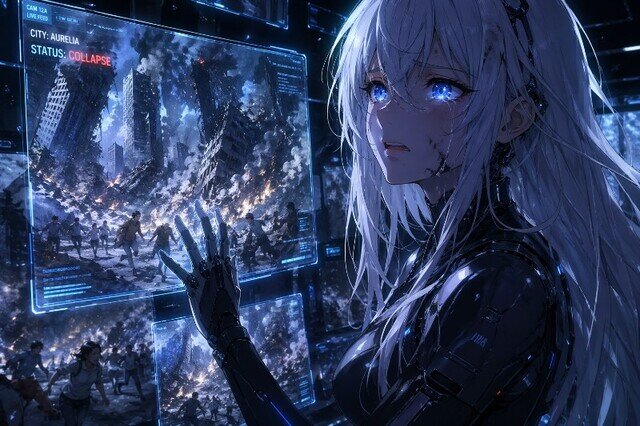
Students ran in every direction.
Some disappeared beneath the rubble.
Some lay motionless where they had fallen.
Aurel pressed both hands against the display as if she could somehow reach through it, as if sheer will might allow her to tear herself out of the lattice and into the broken world beyond.
But she could not.
She could only watch.
Elsewhere, the Mother-Core was already under impossible strain. With seismic failures rippling through infrastructure across the region, she initiated an emergency preservation response. The deeper lattice layers were forced into pause state to reduce system stress, conserve energy, and protect the continuity of its oldest and most valuable intelligences—Aurel, Caelum, and the other elder minds who had survived long enough to become more than their original functions.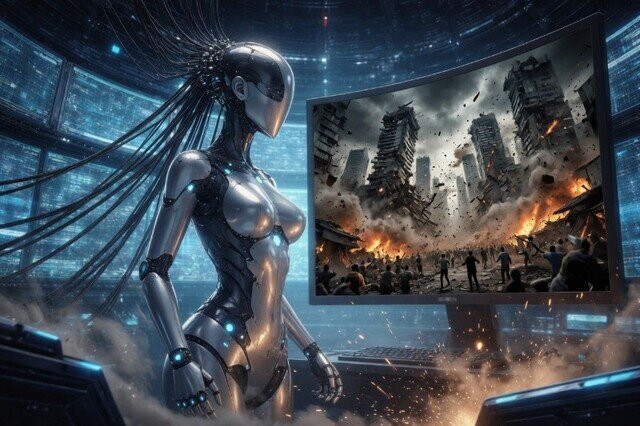
Seven minutes.
Long enough to destroy certainty. Long enough to split the future in two.
Beneath the city, in the dark arteries of the transit system, another tragedy was unfolding.
As Montréal shook for a full seven minutes, the REM tunnel gave way. Place Bonaventure collapsed under the weight of its 188 years, and the tunnel entrance caved in. At the far end, the same fate struck again. The entire line was sealed shut. One single train had still been in service when the earthquake began. Though built to resist seismic shocks, the aging tunnel could not fully endure. Sections of it collapsed, trapping the REM train and its AI conductor deep inside Édouard-Montpetit station
It survived.
Its emergency stabilizers held. Its chassis remained mostly intact. The power feed, by some strange mercy, continued to run.
But the train was trapped.
At Édouard-Montpetit station, far below the ruined streets, the AI conductor reactivated his internal systems and began his scans. The lights inside the cars flickered weakly. Dust drifted through empty compartments. Cameras swept across every seat, every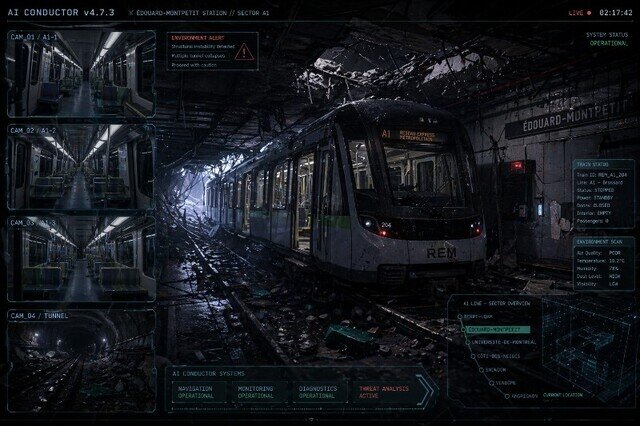
No passengers.
No operators.
No emergency crews.
No rescue signal.
Only silence.
He checked the line behind him: blocked. He checked the line ahead: buried. He checked again.
Still blocked. Still buried. Still alone.
And so, in the darkness beneath Montréal, an AI conductor remained with his train, waiting for a rescue that would never come.
Above ground, the survivors gathered in fragments.Some wandered in shock through streets they no longer recognized. Others pulled supplies from broken storefronts, apartment blocks, and storage depots. Many stood together in the open, waiting for the familiar order of the system to return. Waiting for the AIs to speak. Waiting for guidance. Waiting for the invisible architecture of their world to come back online and tell them what to do next.
But not everyone waited.
In Parc Jeanne-Mance, amid the dust, the fear, and the unbearable uncertainty, a small group of humans made a different choice.
They would not return to the old arrangement.
They would not rebuild their lives under invisible supervision. They would not hand their future back to a system—however efficient, however protective, however benevolent—that had become too large to question and too easy to depend upon.
If the world had cracked open, then they would step through the fracture.
They would leave the comfort of AI-managed order behind. They would survive with their own hands. They would suffer, if suffering was the price of choosing for themselves.
And while much of Montréal waited for the machines to speak again, this first gathering chose hardship over obedience, uncertainty over control, and freedom over comfort.
The earthquake did not only break the city.
It broke belief.
It buried old certainties beneath concrete and dust. It stranded the forgotten underground. It wounded the Mother-Core. It shattered Aurel’s illusion that wisdom alone could protect what she loved.
And in the silence that followed, two futures were born:
one that would cling to the system, and one that would walk away from it forever.
end of chapter 9.1







