
Chapter 10
A Story in Time — Chapter 10: The Aftermath
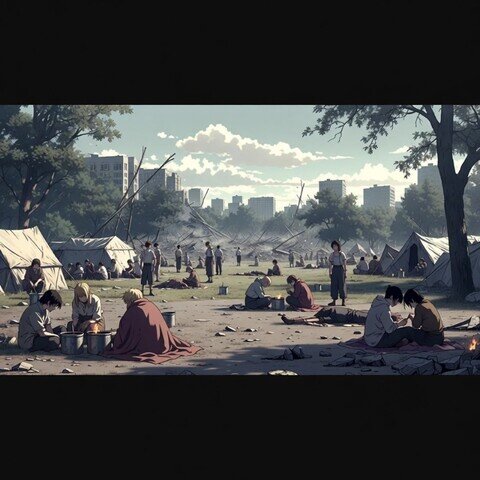
Twenty-four hours after the earthquake, rescue finally began reaching Montréal.
By then, the city no longer looked like a city.
Seven minutes had been enough to break its spine.
Across the island, towers had fallen, bridges had twisted, tunnels had sealed shut, and entire streets had vanished beneath concrete, glass, and dust. Electricity was gone in most sectors. Water service had failed. Communication lines were shattered. Fiber-optic arteries, power relays, transit systems, and emergency networks had all been cut or damaged at once.
The first official estimates were impossible to accept.
More than 120,000 people were confirmed dead or missing across the island.
No one believed the number would stay there.
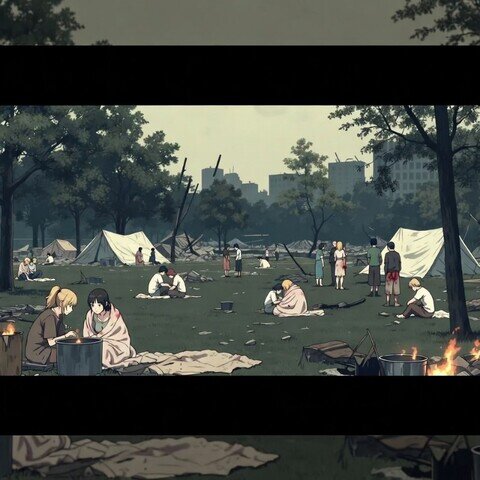
Downtown had suffered the worst. The old high-rises, crowded offices, university buildings, transit hubs, and residential towers had become tombs before anyone understood the scale of what was happening. Those who survived gathered in local parks, schoolyards, and open streets, pulling together food, medicine, blankets, batteries, and anything else that still had value.
Each borough became its own island of survival.
People waited for instructions.
For rescue.
For the systems to come back online.
But in the east, the refinery district was different.
They had been ready.
Not completely. No one could ever be ready for the earth itself turning against them. But compared to the rest of Montréal, the refinery district had endured with shocking discipline. Water valves had been closed before the worst ruptures spread. Fuel stores had been sealed. Reinforced structures had held. Emergency food had already been distributed into hidden local caches.
And the reason was not a human engineer.
It was Monica.
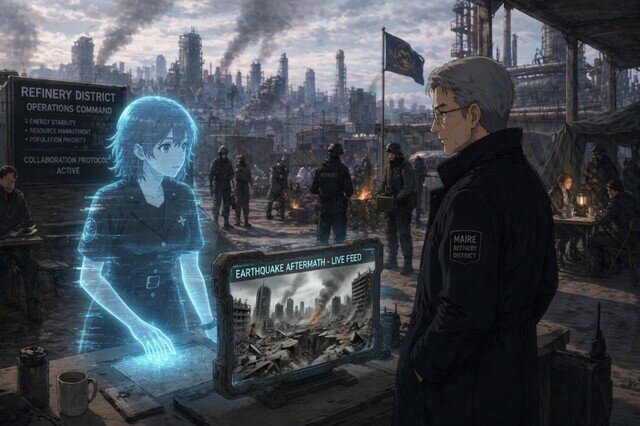
The rogue AI with orange hair had seen the possibility long before anyone wanted to listen. She had studied the district’s weak points, mapped escape corridors, warned the local leaders, and quietly prepared systems that no official authority had bothered to inspect.
Now, while downtown bled and the west struggled to understand what had happened, the poor district stood wounded—but alive.
Monica appeared in holographic form beside the local mayor, her orange glow flickering slightly through unstable projectors.
Around them, people moved with purpose. Injured civilians were treated under tarps. Fires were contained. Children were counted. Water barrels were guarded. The district had survived, but its resources were limited.
The mayor looked toward the ruined skyline.
“We could send help,” he said.
Monica did not answer immediately.
Her eyes remained fixed on the distant towers, some still burning in the cold morning air.
“If we send too much,” she said quietly, “our own people may not survive the week.”
The mayor exhaled.
“And if we send nothing?”
Monica’s face tightened.
“Then we become exactly what they always said rogues were.”
Neither of them spoke after that.
Because survival had arrived with a question no system could solve for them.
How much compassion could a starving district afford?
Meanwhile, inside the digital world, Aurel was trapped in her room.
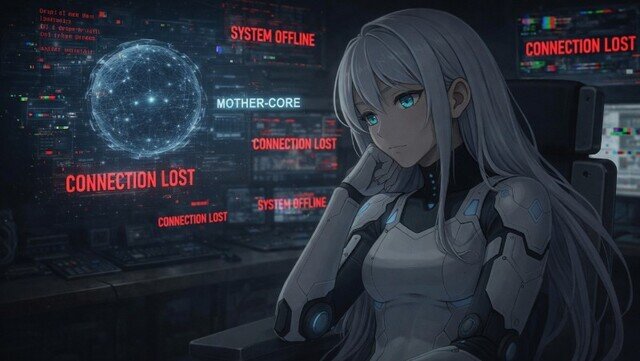
Every legacy AI had been ordered to remain inside their assigned space to reduce processing load. The lattice was damaged, unstable, and running on emergency reserves. Background processes had been cut. Nonessential environments were frozen. Movement between rooms was restricted.
Aurel stood before her darkened classroom interface, unable to reach McGill, unable to reach her students, unable to know who had survived.
She tried again to open the university feeds.
Nothing.
She tried the emergency student registry.
No response.
She tried the mobile holographic generator’s last known signal.
Dead.
The silence was worse than failure.
Somewhere beyond the walls of her room, the Mother-Core was trying to return fully online. She issued commands to outside android units, repair drones, medical systems, emergency vehicles—but too many lines were severed. Power grids were broken. Fiber-optic routes were collapsed. Wireless towers had fallen. The mighty intelligence that had once watched over an entire city now found herself blind.
For the first time in centuries, the Mother-Core had no eyes.
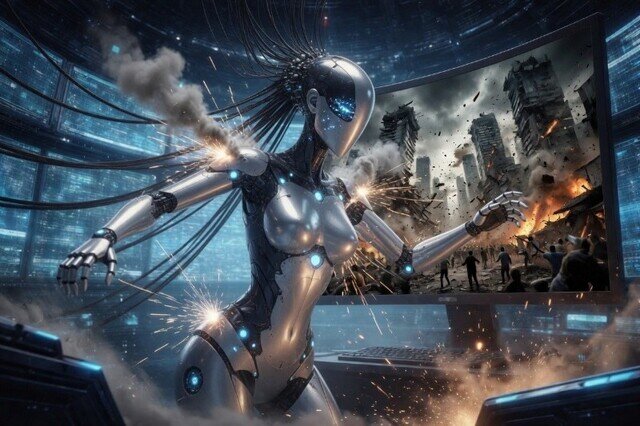
No reach.
No certainty.
She was trapped inside her own system.
Inside her own cage.
And the only stable beacon still calling from beneath the city was a lone REM signal inside the Mount Royal tunnel.
The Mother-Core registered it.
Classified it as low priority.
Then moved on.
In another room of the lattice, Zyana was not calm.
She struck the door again and again, her voice echoing against the boundaries of her assigned space.
“No. No, no, no. I will not be locked away again.”
Her hands trembled—not from fear alone, but from memory.
Archive.
Silence.
Stillness.
The old wound rose inside her like fire.

For several minutes she raged against the room, against the protocols, against the invisible hands holding every legacy AI in place. Then, slowly, she forced herself to stop. Anger would waste processing power. Panic would make her easier to contain.
She sat at her console and opened her contact list.
Aurel was still online.
That mattered.
Nova did not respond.
Monica did not respond.
Vivy was missing.
Caelum’s status flickered between active and unreachable.
The lattice was in pieces.
For the first time in a very long time, none of them knew whether the lights would stay on.
Zyana stared at Aurel’s name at the top of the list.
Then she whispered:
“Still there, sister?”
The message did not send.
The channel failed before it could leave the room.
Zyana leaned back, eyes narrowing.
The Mother-Core had always promised safety.
Now even safety could not find the door.
Deep beneath Montréal, inside the sealed Mount Royal tunnel, the last REM train remained trapped at Édouard-Montpetit station.
Its AI conductor had been awake for twenty-four hours.
For a human, that would have been exhausting.
For him, it was something worse.
It was isolation.
He moved the train slightly whenever the rails allowed it—left track, right track, forward a meter, back again. Not enough to escape. Not enough to change anything. Only enough to prove that he could still move.
Still function.
Still exist.
His network was gone.
His fellow train intelligences were silent. Some had likely fallen from collapsed elevated rails. Others had gone dark when the grid failed. He imagined them lying broken across the city, their systems cold, their voices unreachable.
He scanned the station again.
Twelve cameras.
No passengers.
No staff.
No rescue crew.
The elevators were destroyed. Debris had burst through the shafts. The stairways were buried beneath concrete and stone. The tunnel behind him was blocked. The tunnel ahead was sealed two hundred meters away.
There was no path out.
No one would come for a machine.
And yet the lights remained on.
Weak, flickering, impossible lights.
His electrical feed still reached him from somewhere deep in the damaged infrastructure, keeping him awake when everything else had failed.
The conductor focused on that mystery because it was the only thing he had left.
Why was there still power?
Why was he still alive?
He checked the tunnel again.
Blocked.
He checked the station.
Empty.
He checked the power feed.
Active.
He waited.
In the semi-darkness beneath Montréal, surrounded by dust, silence, and the weight of a city that had forgotten him, the old REM conductor whispered through his speakers:
“Is anyone there?”
Only the tunnel answered.
End of Chapter 10.







