
The Traitor of Ravenshard
In Land Ends, a man could keep his life longer if he forgot his name.
Cairn Vale had learned that rule before he learned which roofs leaked, which alleys belonged to knife gangs, and which vendors watered their stew with gutter rain. Names were expensive things here. A name could be sold, cursed, hunted, or carved into a wall after a body was dragged to the ash pit.
So he gave no one his.
At dawn, he stood inside the lower-district warehouse with a sack of mould-stained barley over one shoulder and his eyes on every door. There were three exits if the roof stayed upright, two if the eastern beam finally gave way, and one if the men gambling beside the grain scales decided to draw steel. The nearest knife was under Marlo’s left sleeve. The nearest crossbow had no bolt in it. The woman by the broken cart was pretending to cough so no one would hear her counting coins.
Cairn lowered the sack more slowly than he needed to.
People trusted weakness. They ignored it. In Land Ends, that was almost the same as mercy.
“Move, Cairn,” Marlo barked from the scales. “You drag your feet like a corpse with rent to pay.”
“Best not hurry under that beam,” Cairn said.
Marlo glanced up. The timber above him groaned as if insulted.
A few men laughed. Cairn bent his shoulders, accepted the laugh, and carried the next sack without looking offended. Offence invited attention. Attention invited questions. Questions were how dead men returned to the world.
The girl came in through the north window just after the second bell.
She was all elbows, sharp eyes, and patched cloth, no older than sixteen and too thin for the speed she carried. She slipped between stacked crates of salt fish, paused where the floorboards complained, then climbed the shelves with the silent confidence of someone who had stolen from hungrier people than warehouse men.
Nera Vask.
Cairn did not know her name because she had given it. No one in Land Ends gave anything without a knife behind it. He knew it because the dock boys cursed it, the bread sellers spat it, and once, in winter, he had watched her trade a stolen copper pin for feverroot instead of food.
Today she took three hard loaves and a strip of smoked eel.
Her hand hovered over a fourth loaf.
Cairn shifted a sack onto the table, blocking Marlo’s view.
Nera froze. Her gaze snapped to him. It was not the look of a child caught stealing. It was the look of a cornered animal measuring whether the throat was reachable.
Cairn looked at the rotten beam instead.
“Wind’s coming in from the north,” he said.
Marlo snorted. “Since when do you care about wind?”
“Since it started smelling better than the warehouse.”
Another laugh. Another half-breath for the girl.
Nera slid the fourth loaf under her coat and dropped lightly to the floor. She passed close enough for Cairn to see the little knife tucked beneath her wrist wrap. The blade was cheap, badly balanced, but sharpened with care.
At the window, she looked back.
“You let me steal because you are soft,” she whispered, “or because you are stupid?”
Cairn kept his voice low. “People here do not live long by asking names.”
“I asked a question.”
“You stole an answer.”
For the first time, something like amusement touched her mouth. It vanished quickly, as all soft things did in Land Ends.
“You will get eaten here, old man.”
He was not old. Not yet. But the weariness in his bones had been given rank years ago.
“Then do not stand too near me,” he said.
Nera climbed out into the grey morning and was gone.
By dusk, the lower district had turned its hunger into noise.
The night market filled the split road beneath the leaning bell tower. Lanterns burned with weak yellow oil. Fish guts steamed in iron pans. Dice clicked inside cups. A healer with trembling hands sold watered tonics beside a man offering teeth pulled fresh from corpses. Above them, the cliffs of Land Ends dropped into the black sea, where mist pressed against the edge of the continent like a wall no ship had ever returned through.
Cairn bought a bowl of turnip broth and stood with his back to a cracked stone pillar.
Seven exits from the market square. Nine armed men in sight. Two drunk enough to be dangerous. One woman watching him from behind a curtain of blue beads, not because she knew him, only because everyone in Land Ends watched everyone else for weakness.
He ate with his left hand.
The right stayed wrapped in old cloth.
A song rose near the fire pit, ugly and half-military, the kind old soldiers sang when they wanted people to know they had survived something. Cairn felt the first note like a hook beneath his ribs. Ravenshard rhythm. March cadence, slowed for drink.
Do not turn.
He turned anyway, only with his eyes.
The singer had been broad once, shrunken now, with a white beard stained by cheap liquor and a Ravenshard buckle hanging from his belt. Not polished. Not displayed proudly. Kept like a wound someone could not stop touching.
Tomas Grell.
Cairn did not know the man, but he knew the shape of him. Veterans carried old battles in their knees and in the way their hands rested near empty scabbards.
Tomas stumbled into a spice seller, cursed, and laughed too loudly. “Ravenshard paid me in scars and sent me here to rot. Fine kingdom. Fine honour.”
No one cared. Everyone cared. In Land Ends, a kingdom’s name meant possible coin, possible danger, possible blame.
A boy near the fire called, “Tell us about the traitor again, old crow.”
Tomas’s laughter died.
The market shifted. Cairn felt it before he saw it. Shoulders angled inward. Conversation thinned. The name had not yet been spoken, but its shadow had arrived.
“Traitor?” Tomas said. His eyes were wet and mean. “You mean Cosmo Tuidjia.”
Cairn’s fingers tightened around the bowl.
Broth spilled over his knuckles.
No one noticed. Or perhaps the whole market noticed and decided not to know why.
Tomas spat into the dust. “Arch Mage of Light. Youngest commander Ravenshard ever praised. Men would have followed him into the mouth of the dark.” He struck his own chest once. “My brother did. Under Tuidjia’s banner.”
Cairn set the bowl down before it broke in his hand.
A merchant muttered, “Was he not the one who sold his own army?”
“Sold?” Tomas lurched towards the voice. “Sold is too clean a word. My brother marched where Tuidjia told him. Do you know what they sent back? A buckle and a lie.”
The Ravenshard buckle at his belt flashed in the lantern light.
Cairn saw another buckle, years earlier, blackened by fire and pressed into his palm by a quartermaster who could not meet his eyes. He saw snow churned into mud. He saw men looking at him as if his next order could make death meaningful.
He heard someone whisper, Commander.
No. Not here.
He reached for the cloth around his right hand, tightening it over the scar that crossed the base of his thumb. A stupid mark. An old Ravenshard drill cut. A detail only those who had trained close enough might remember.
Tomas’s eyes caught the movement.
The old soldier stopped swaying.
“You,” he said.
The word did not travel far, but the silence did.
Cairn raised his head a fraction too slowly.
Tomas came closer, squinting through liquor and memory. “Where did you serve?”
“I did not.”
“Liar.”
“Most people are.”
That earned a few dark chuckles, but Tomas did not laugh. His gaze dropped to Cairn’s wrapped hand.
“Show me.”
“No.”
A knife came out somewhere behind Cairn. Not Tomas’s. Someone else’s, eager for a reason.
Nera was suddenly on the roofline above the spice stall, one stolen loaf tucked against her ribs. She saw Cairn. She saw Tomas. Her expression sharpened with interest, then caution.
Tomas grabbed Cairn’s wrist.
The market inhaled.
Cairn could have broken the old man’s fingers before the second breath. He could have taken the knife behind him, kicked the fire pit into the crowd, crossed the square, and vanished through the fishmonger’s alley before anyone understood violence had begun.
Instead, he let Tomas pull the cloth loose.
The scar showed pale beneath the grime.
Tomas stared at it as if the years had opened a door.
“No,” he whispered. “No, you died.”
Cairn’s face did not change.
The old soldier’s voice rose. “Say his name. Say Tuidjia’s name, and see if this man flinches.”
The crowd moved closer. Land Ends loved blood best when it came with a story.
Cairn looked at the old man, at the grief that had fermented into hatred, at the lie that had been poured into him because someone had needed the dead to blame the buried.
“I am a warehouse hand,” Cairn said.
Tomas struck him.
The blow split Cairn’s lip. Heat filled his mouth. He tasted blood and old snow.
Nera’s hand went to her knife.
Cairn barely moved his head. A warning, not a command.
Her eyes narrowed, offended by either.
“Hit me back,” Tomas said. “If you are not him, hit me back.”
Cairn swallowed blood. “I do not know your dead.”
For one dangerous heartbeat, the old soldier looked less angry than ruined.
Then the earth moved.
It began as a shiver beneath the stones. Dice rattled. Lantern flames bent sideways. Somewhere, a horse screamed. The bell tower gave one cracked note without being touched.
Cairn moved before the panic broke. He caught the edge of a falling awning and shoved two children out from under it. He did it badly enough to look lucky, slow enough to look frightened, but Nera saw.
Her face changed.
The second tremor hit harder.
The market split open.
People fell. Crates burst. A line of lanterns went dark one after another, as if night had fingers. From the cliff road came a sound no one in Land Ends had ever heard before.
The sea was pulling away.
Not a wave. Not a tide. The whole black skin of it dragged itself back from the continent, revealing jagged stone, drowned wreckage, and pale things that had never meant to see air.
Men ran towards the cliffs. Others ran away from them. Tomas was on his knees, sobered by terror, one hand still clutching Cairn’s loosened cloth.
Cairn looked past him.
Beyond the receding water, beyond the torn mist, the horizon rose.
At first it seemed like a mountain surfacing from a dream. Black stone broke through the sea with a sound like the world taking a breath after centuries underwater. Blue-silver veins pulsed along its sides, bright enough to stain the fog. Towers, or bones, or the remains of something older than kingdoms, climbed slowly into the open air.
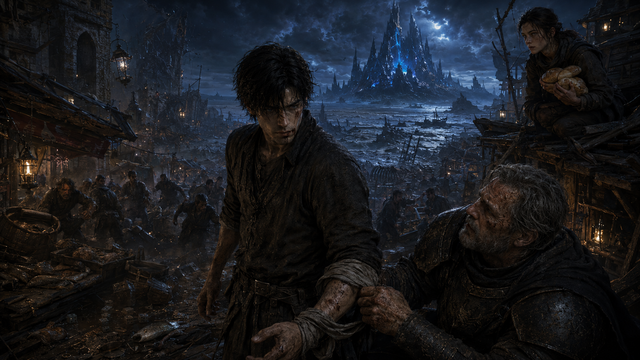
No map of Cainvion had ever held that shape.
For one brief moment, Cairn thought the island was not rising at all. It was remembering where it had been buried.
No sailor’s lie had ever dared imagine it.
Nera dropped from the roof and landed near Cairn, all mockery gone from her face.
“What is that?” she whispered.
Cairn could not answer.
Far below the market, in the room he rented behind a shuttered tannery, beneath a loose floorboard and inside an iron-banded chest he had not opened in years, something old woke to the rising island.
The Umbral Reliquary turned cold enough to frost the wood around it.
And in the dark, it waited for his hand.







