
Missing Lincoln
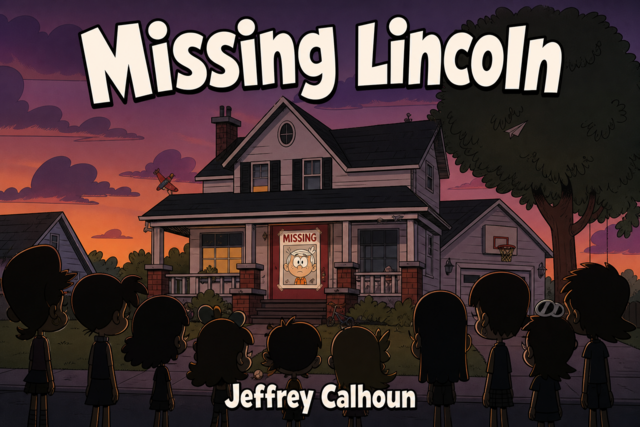
This is the proper book cover. I couldn't resize it, unfortunnately.
The baseball came out of nowhere, like the sky had decided to throw something back at the earth.
It was a lazy afternoon in Royal Woods, the kind where everything felt stretched and half-dreaming. The backyard of the Loud house was alive with noise, as usual. Someone was practicing guitar riffs that shook the windows. Someone else was arguing about rules that probably didn’t exist five minutes ago. And right in the middle of it all, Lincoln stood with a bat in his hands, trying to look confident while quietly hoping nothing dramatic would happen for at least ten minutes.
Luna was pitching.
Which, in hindsight, was already a warning sign.
“Alright, Lynn taught me this grip,” Luna called out, rolling her shoulders like she was about to perform in front of a stadium instead of her own backyard. “This one’s gonna be clean!”
“Define clean!” Lincoln shouted back, tightening his grip on the bat.
The ball left her hand with more enthusiasm than accuracy.
It didn’t arc. It didn’t curve. It simply arrived.
A sharp crack echoed through the yard.
Then everything tilted.
Lincoln’s world flickered like a broken TV signal. The sky smeared sideways. The sound of his sisters dissolved into something distant and underwater. The bat slipped from his fingers, and the last thing he registered clearly was the sensation of falling without quite understanding why.
Then nothing.
When he opened his eyes again, the ceiling was unfamiliar.
White. Quiet. Too still.
He blinked slowly, trying to assemble the shape of the room. It felt like a puzzle missing most of its pieces. The smell was clean, faintly antiseptic. A hospital.
He tried to sit up. A sharp ache pulsed through his head and forced him back down.
“Hey! Easy, easy!”
A voice came from the side of the bed.
Lincoln turned his head.
A woman stood there, eyes wide with relief. She looked like she had been holding her breath for a very long time and had only just been allowed to release it.
“You’re awake,” she said softly.
He frowned. “Where… am I?”
Her expression flickered. Not fear exactly, but something uncertain. Like she was stepping onto thin ice.
“You’re in the hospital,” she said carefully. “You got hit in the head with a baseball. Do you remember your name?”
He hesitated.
The word should have been simple. Automatic. But it wasn’t there at first. Just a blank space where something important should have lived.
“…I don’t know,” he admitted.
Her hand tightened slightly on the bed rail.
“It’s okay,” she said quickly. “That can happen sometimes. You’re safe. You’re going to be okay.”
Footsteps hurried into the room.
Then more voices.
Too many voices at once.
A crowd filled the doorway like a sudden storm breaking through a calm sky. A tall man. A tired-looking woman. And a cluster of girls, all overlapping in color and energy and worry.
“Lincoln!”
The name landed in the room like something heavy finally being put down.
The man stepped forward first. “Hey, buddy. It’s me. Dad.”
The woman beside him added gently, “And I’m Mom.”
They both looked at him like they were trying to anchor him to something invisible.
Then the girls started speaking at once.
“Lincoln, it’s me, Lori!”
“Leni, hi, remember me?”
“Back off, I want to talk first!”
“Guys, don’t overwhelm him!”
“Is he okay? Is he actually okay?”
Their voices tangled into a knot he couldn’t unravel.
He stared at them.
Something inside him twisted uncomfortably.
“Wait,” he said slowly. “You’re saying… you’re my family?”
Silence.
Then nods. Immediate, urgent nods.
“Yes,” Lori said. “We’re your sisters.”
All of them.
Every single one of them.
His mind tried to accept it and failed.
He looked from face to face, searching for recognition that didn’t come. There was warmth in their expressions, familiarity in the way they leaned toward him, but none of it connected to anything inside him.
It was like being handed a photograph of a life he couldn’t remember living.
“I don’t…” he started, then stopped. His throat tightened. “I don’t remember any of you.”
The room shifted.
Not physically, but emotionally, like a dropped stone rippling through water.
Leni gasped softly. Luna went still. One of the younger girls looked like she might cry but was trying very hard not to.
His mother stepped closer. “That’s okay,” she said, voice steady but fragile at the edges. “Head injuries can do that. It might come back.”
Lincoln searched her face.
“I feel like I should know you,” he said quietly. “All of you. But it’s just… blank.”
That was when the identity crisis began.
Not as a dramatic moment, but as a slow, creeping realization that everything he was being told about himself had no weight inside his own mind.
Over the next hours, they explained things.
Names. Birth order. Inside jokes that meant nothing to him. A house that apparently belonged to all of them, filled with chaos and noise and love and constant motion.
He listened.
And the more he listened, the more unreal it became.
At one point, he looked down at his hands.
“These are mine,” he said.
“Yes,” Lisa replied immediately, as if confirming a scientific fact.
“And I live… with all of you.”
“Yes,” they said again.
He leaned back against the hospital pillow, staring at the ceiling again.
“That feels impossible,” he whispered.
When he was discharged, the ride home felt like traveling into a story that had already started without him.
The house appeared on the horizon like a character waiting to be introduced.
It was loud before they even reached the door.
Inside, it was worse.
Not worse in a bad way. Worse in a volume that defied logic.
Doors slammed somewhere upstairs. Something crashed. Someone shouted about socks. Music leaked from multiple directions at once.
Lincoln stood frozen in the entryway.
“This is home?” he asked.
“Yep!” one of the girls said brightly.
He stepped inside.
The house seemed to recognize him, even if he didn’t recognize it.
People moved around him like he was part of the furniture. They gave him space, but not distance. They watched him carefully, like he was something precious that had been cracked and glued back together imperfectly.
That night, he sat on the edge of his bed.
The room was unfamiliar but supposedly his. Posters, objects, small traces of personality all pointed to a version of him he couldn’t access.
A knock came at the door.
“Hey,” Lori said, leaning in slightly. “You okay?”
Lincoln hesitated. “I don’t know what I am right now.”
She nodded slowly, like she understood more than she was saying.
“You’re still you,” she said. “Even if you can’t reach it yet.”
“That’s the problem,” Lincoln replied. “What if I’m not?”
Silence stretched between them.
Then Lori stepped inside and sat on the edge of the bed, not too close.
“You know,” she said, “you’ve always been the one holding things together here. Even when everything’s loud and messy and falling apart. That’s you. That’s been you for as long as I can remember.”
He looked at her.
“I don’t remember any of it.”
“I know,” she said. “But we do.”
Downstairs, laughter erupted suddenly, followed by another crash.
Lincoln flinched slightly, then noticed something.
Even without memory, his body reacted like it understood the rhythm of the house. Like it had been trained by years of surviving it.
That realization didn’t fix anything.
But it made the blank space feel slightly less empty.
Over the next days, fragments started to behave strangely.
A spoon in the kitchen felt familiar in his hand. The layout of the house began to make sense without explanation. He found himself stepping aside at the exact right moment when someone ran past him, even though he didn’t consciously know why.
It was like living inside someone else’s habits.
One afternoon, he stood in the backyard again.
The baseball lay in the grass.
Luna stood a few feet away, unusually quiet.
“I’m sorry,” she said.
He picked up the ball carefully.
“I think I used to know how to play this,” he said.
“You did,” she replied.
He tossed it lightly from one hand to the other.
“I still don’t remember,” he said.
Luna nodded. “Does it feel like it’s missing?”
He thought about that.
Then he looked at the house behind him, filled with noise and life and fragments of a self he couldn’t access.
“It feels like it’s still happening,” he said quietly. “Just without me inside it.”
Luna didn’t answer right away.
Then she said, “Maybe you’re just finding your way back in.”
He looked at the ball again.
For the first time, the emptiness didn’t feel entirely empty.
It felt like a space waiting to be reoccupied.
And somewhere inside it, faint as a distant echo, something like Lincoln Loud began to stir again.







