
Chapter 1
Liam
Music on: Hildur Guðnadóttir — «Bær»
We are conditioned to believe that distance is a panacea. That by traveling far enough, one can leave their past on the roadside like a worn-out tire. Yet the truth is more insidious: you carry yourself into every new landscape. And the silence you pursue so fervently turns out to be nothing more than the lingering resonance of the very things you tried to escape.
Ohio in January is no backdrop for a Christmas card; it is a purgatory rendered in monochrome. Here, in Julian Lockwood’s country house on the shores of Lake Erie, winter did not toy with us—it methodically erased the boundaries between heaven and earth, turning the world into a hermetic capsule. Julian had purchased this refuge for family excursions, hoping to bestow upon his wife and sons a sanctuary of serenity, but for me, it has become a personal Panopticon, where I perform the dual roles of both warden and sole inmate.
This self-imposed exile was the only viable barrier I could erect between myself and New York. I retreated into this desolation with a solitary purpose: to insulate myself against the temptation to succumb, to climb into a car and return to her. I built a wall of hundreds of miles of snow-choked highways and icy voids, clinging to the hope that physical displacement would stifle the morbid obsession that threatened to bury Ester’s future beneath its weight.
By day, I attempted to simulate productivity to stave off the onset of madness within this viscous silence. I embarked on hour-long treks along the shore, baring my face to the biting wind, as if hoping it might incinerate the memories of December. But by evening, the weather invariably deteriorated; the blizzard severed this refuge from civilization, and I was left alone with the hearth, a decanter of Lockwood’s whiskey, and an assortment of volumes from his library. My leisure devolved into a form of intellectual flagellation, where every line I parsed merely underscored the depth of my descent. My life had succumbed to stasis—a state where time had surrendered its meaning and agency had become an impossibility.
This isolation was sanctioned by my closest allies. Lockwood maintained a chilling restraint: he simply left me to contend with the catastrophe I had authored. He assumed the mantle of coordination in New York, managing client consultations and allowing me to dissolve into this wasteland while the associates maintained the firm’s infrastructure. Marcus Gates, conversely, would intermittently fracture my solitude with calls, promising to extricate me from this malaise; yet, when his pressure grew untenable, I simply severed the connection.
Abram Goldman operated with surgical precision: that same evening, he neutralized every reporter and photographer who might have caught a whiff of our entanglement. In his world, his daughter’s reputation was an asset as tangible as a shipping terminal, and he had no intention of devaluing it for the sake of a forty-two-year-old attorney. For the tabloids, this narrative would have been effortless fodder, but Abram liquidated the very possibility of exposure, ensuring that those who had witnessed us together lost all appetite for publication or interviews.
The world has forgotten us, oblivious to the fact that we ever existed within one another’s lives. I tried to convince myself this was a benediction—that when Ester emerges as a virtuoso whose name commands the world’s greatest halls, she might recall me, whether with warmth or disdain. I retreated into the cowardice of hoping for the former, even though I understood that I deserved nothing save for her contempt.
Yet, as night descended, my vaunted self-possession invariably withered. I would wake in a cold sweat, haunted by the phantom sensation of her presence. My fingers would frantically trace the sheets, seeking the warmth of skin or a familiar curve, only to encounter an icy void. Neither she nor her scent remained—only the dying embers of the hearth and the acrid aftertaste of yesterday’s whiskey.
In these hours, when the silence in the house became almost palpable, I would descend to the nadir of my exile, surrendering to the most degrading accoutrement of this new life: a mobile application. Kaden Brooks, a prodigy from Cincinnati, had provided it without inquiry. The software,M-Tracking, was Kaden’s personal toy for monitoring his wife. And now, I—a man who built his career upon logic and flawless argumentation—voluntarily utilized this loophole to remain closer to her existence than reality had ever permitted.
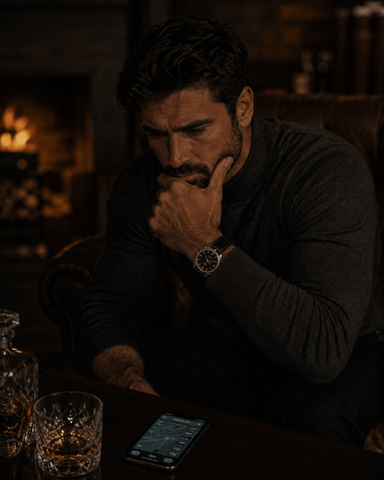
The screen in the dim living room looked like a death warrant: a tiny, pulsating dot on the map of New York—the only remnant of my entire universe. I had spent hours watching it drift from her apartment to the academy and back, tracing the geometry of loneliness I myself had designed that very day. She had not written, nor had she called. In the most shameful recesses of my consciousness, I had anticipated her breaking—expecting her to beg for my return or overwhelm me with vitriolic messages. But Ester displayed a dignity for which I was entirely unprepared. Her silence was methodically dismantling my certainty that I had acted for the best.
Today was January 14th—her twenty-first birthday. I sat in the armchair, staring at the embers, forcing myself into total inertia. No flowers, no gifts. My absence was the only honest tribute I could offer her. I was a pathetic coward, hiding in the forests of Ohio from the only person capable of bestowing meaning upon my existence.
A sharp sound fractured the room’s silence. My phone vibrated on the coffee table. My hand twitched with traitorous instinct before logic could erect a barrier. In that spasmodic haste, there was only a wretched hope that her name might illuminate the display. I pressed “accept” without looking.
“Yes?” I exhaled, barely suppressing a tremor.
“Monroe?”
The voice was gravelly and painfully familiar. It lacked Ester’s tenderness, but it possessed enough lead to pierce the walls of this house.
“Yes,” I replied, feeling hope dissolve into icy dust.
“It’s Abram Goldman.”
I had expected anything but him. The man who, at our last encounter, had favored physical violence over rhetoric, was not the type to initiate friendly discourse.
“Where are you?” his question was stripped of pleasantries. “Are you in New York?”
“No, I’m far from the city.”
“Listen to me carefully, Liam,” Abram’s voice deepened, menacingly calm. “Whatever festering hole you are hiding your pampered hide in, you need to return. Immediately.”
I gripped the phone until my knuckles turned white, but Goldman gave me no room to interject.
“You are obligated to cleanse the Augean stables you’ve made of my daughter’s life,” he continued. “You know, Monroe, I have seen my share of wreckage, but what I discovered in New York instead of her—that is your own private catastrophe.”
I surged to my feet, nearly overturning my glass. The base clinked pitifully against the tabletop. My breath hitched, and a fuse seemed to trigger in my chest, severing all emotion save for an icy dread.
“You didn’t just leave,” Abram stated mercilessly. “You left her in a state of ‘latent decay.’ It is a slow-motion suicide, and the fault lies solely with your cowardly nobility.”
“What is wrong with her?” My voice broke into a raw growl.
“Physically, she is intact, if that is your concern,” Abram sneered with palpable contempt. “But you have left behind a scorched earth, Liam. And by an ironic injustice, I am the one left to shoulder the blame for thismeshugas. She blames me for every one of your spineless steps; she refuses to even hear me. My ‘consent’ to your relationship is worthless if you have turned me into a monster to justify your flight. Yes, I set a condition, Monroe, but the final choice was yours.”
Listening to him, I felt bile rising in my throat. Abram was a virtuoso at shifting blame, perfectly aware of the true reason I had chosen to leave her. Now, he was framing it as if I had feared his threats—though to me, they were nothing more than dust.
I had done it because I was saving her... saving her from myself. I knew she would be devoted to me to the bitter end, simply by virtue of her character, but I was not prepared to exact such a sacrifice. I did not want to one day see in her eyes not love, but the realization that she had condemned herself by binding her life to mine.
“I was trying...” I began, then fell silent. Words were futile.
“She is not attending rehearsals,” Abram’s voice grew colder, filling the silence. “Latz is in despair—she refuses to even pick up the violin. Do you understand, with that legal mind of yours, what that signifies? She attends only minor theoretical disciplines, existing like a ghost within the academy walls.”
I closed my eyes, feeling each syllable of his voice strike a blow to my gut.
“I flew in today to wish her a happy birthday, despite the wall of resentment she has erected over the past month,” Abram paused, and his heavy, wheezing breath crackled over the line. “I wanted to be there, but when I saw what had become of her apartment... and of her...”
He fell silent again, and the quiet was more eloquent than any scream.
“...Liam, she is simply fading away. With every second you play the hermit, you are extinguishing her belief that music is life.”
There was such exposed, almost primal paternal helplessness in that sound that I momentarily forgot how to breathe. I had expected threats, fury, even the execution of his old promise to finish me—but not this fractured, frighteningly personal admission. This was no longer a conversation with a corporate titan; it was a man who had finally lost his tether to the only sentient being that mattered to him.
“You must return my daughter to me. Make it so that every ounce of her contempt and hatred is channeled exclusively at you. Make her fury an instrument for her return to life. I do not care what means you employ, just ensure you do not inflict further damage. Fix this, Monroe. Or I shall ensure that your absence from this world becomes permanent.”
The line went dead. I stood in the dark living room, staring at the phone screen where the dot in New York still pulsed. It was no longer just a geolocation; it was an epitaph for my composure—the final threshold beyond which not even a shadow of my former, ordered life remained. My “correct” decision had proved to be an act of supreme cruelty, and the price had just skyrocketed to the heavens.
Abram demanded my return, turning me into his instrument. He wanted me to convert her quiet agony into concentrated hatred, focused on me alone. His plan was cynical: force me to trample the remnants of what we had built, if only to goad her into breathing again—even if only from sheer rage.
But this call ignited a different resolve within me. Until today, I had, like a complete fool, deluded myself into believing things were taking their natural course. I had naively presumed she had accepted my departure, excised me from her life, and regained her peace in music, losing herself in endless rehearsals. I believed she was fine—that she was truly living, not merely existing.
But now—enough of my “concern,” which had nearly cost her her future. I had no intention of inflicting further pain. I intend to rectify every transgression, even if it is already too late.
I checked my watch. Less than six hours until midnight—and less than six hours until my only chance at redemption becomes irrevocably inaccessible.
New York was distant. The winter highways of Ohio would have devoured all my time, leaving me stranded in the middle of Pennsylvania, hundreds of miles away, as the final minutes expired. Lockwood lacked a private jet, but I possessed a checkbook and sufficient malice to breach any barricade.
I swiftly dialed the number for a private charter service in Cleveland.
“I need a flight to Teterboro. Now.”
“Sir, weather conditions...” a sleepy voice began, “we are not accepting bookings for the next few hours due to the blizzard...”
“Spare me the bureaucracy,” I cut him off, offering no room for protest. “I am not interested in protocol. Triple the rate, full liability waiver. Find me a pilot prepared to take flight, or I shall switch to your competition within the minute. You have ten minutes for confirmation.”
I terminated the call. I required no possessions, no farewells to this house. I slammed the door, leaving my vaunted composure behind. It was time to settle the debts I had levied upon myself.







