
The Castle of the Crying Stones
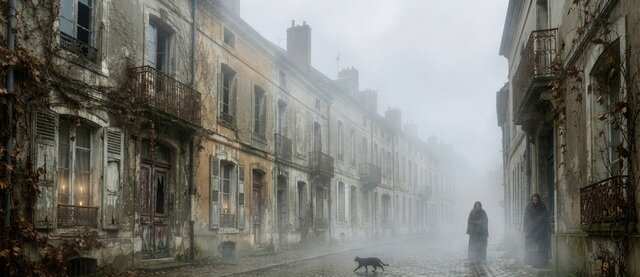
In the crumbling, once-prosperous port city of Valerian, Romania, autumn did not arrive with a gentle sigh, but with a season of decay that mirrored the slow fading of Liam Valerius within the damp-stained walls of his family’s townhouse.
Eléonore Valerius, his elder sister, was desperate to find a cure for her brother’s illness in the city’s medical circles. She had dragged her hope from one physician’s office to another, her hems stained with the mud of the bustling, indifferent streets. The answers were always the same, delivered with a helpless shrug. It was not the plague. It was not a common fever. It was a strange and gradual weakness, stealing his strength for no clear reason. Her brother wasn’t dying from a known sickness; he was fading away. Each day was a battle against the inevitable. Eléonore struggled to manage the household, her brother’s care, and the slow erosion of their finances, all while watching the light in Liam’s eyes grow fainter.
Liam’s soul was once of ink-stained fingers and whispered sonnets to the Carpathian mist. Now, the pen lay too heavy in his hand. The vibrant world he once dreamed of capturing was reduced to the four walls of his sickroom, the rhythm of his verses replaced by the ragged, shuddering cadence of his breath, and to simply wake up and be able to stand at the window without the world turning grey at the edges.
His fever was a constant, malevolent presence, and a cold seemed to have settled deep within his bones, a chill no fire could ever hope to thaw. For Eléonore, the greatest horror was not the sickness itself, but the silence of medicine in the face of it. No one knew what was happening to him, and in that void of knowledge, a terrifying and final conclusion began to take root.
In its guttering light, Liam’s face was the colour of old parchment. A sheen of sweat clung to his brow, though he shivered beneath a mountain of quilts.
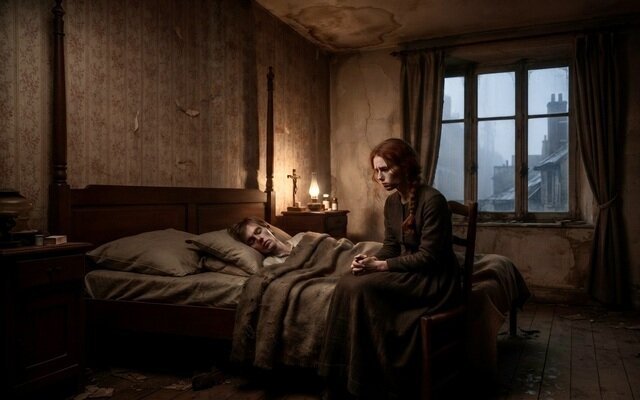
“The draught, El?” His voice was a thread, barely audible over the spit and crackle of the logs.
“Here.” She supported his head, her hand steady despite the tremor in her heart.
The vessel of bitter-smelling tea—a futile concoction of yarrow and feverfew—met his lips. He swallowed with a wince, his throat working painfully. Each of his swallows was a small, agonizing victory. She watched the fragile column of his neck, the skin so thin she could trace the frantic, struggling pulse beneath.
As she laid him back, her own reflection shimmered in the night-darkened window pane: a ghost with fiery hair and a face etched with a weariness that had settled deep into her bones. At twenty-two, she felt decades older.
“The physician came while you were gathering herbs,” Liam whispered, his eyes closed. “He said… he said to make me comfortable.”
Comfortable. A polite, useless word for dying. Eléonore’s jaw tightened. She would not accept polite. She would not accept being useless.
“Physicians see only what their dusty books tell them to see,” she said, her voice firm despite the lump in her throat.
She smoothed the damp hair from his forehead. “They don’t know everything.” His eyes, too large now in his gaunt face, fluttered open. They held a poet’s dreamy clarity, even now. “There’s a frost coming. I can feel it in the air. You should bank the fire.”
She merely nodded, her attention caught by the book lying open on her bedside table. It was not one of her modern medical texts, but her late mother’s journal, its pages filled with a frantic, beautiful script and unsettling botanical illustrations. It had been her mother’s life’s work, a study of maladies that polite society refused to name. Eléonore’s fingers, stained green from crushing leaves, traced a particular passage she had decoded just that morning.
The Blood-Wasting, the heading read. A pallor not of this earth, a vitality siphoned as if by a shadow. The old texts whisper of a cure, but it lies not in any common leaf or root. It resides with those who understand the essence of the malady itself.
“Seek the master of the Castle of the Crying Stones, if you dare the road. His knowledge is as deep and as dark as the forests that surround him”.
A master. A castle with a mournful name. It was the desperate fancy of a superstitious mind, the kind of thing she, a woman of science and reason, would have scoffed at a month ago.
But a month ago, Liam could still walk.
A log collapsed in the fireplace, sending up a shower of sparks that died before they reached the hearth. The room seemed to grow darker, the shadows in the corners deepening, stretching like living things. Eléonore looked from her brother’s fading form to the cryptic words in the journal. Reason had brought her to the edge of this abyss. Perhaps it was time to abandon reason.
She closed the journal, the soft thud of its cover a decisive sound in the quiet room.
“Sleep, Liam,” she murmured, her voice low and resolute. “I’m going to find a different kind of medicine.”
Outside, the first sharp wind of the coming storm rattled the windowpane, a promise of the long, cold journey ahead.
The next day, she begins the journey on her loan horse to the road through Wolfswood, which isn’t a pleasant forest. It’s a tangle of skeletal branches that scrape like bony fingers, a mist that clings with damp insistence, and a silence so profound it feels predatory. Her rational mind tries to dismiss the superstitions about the forest, labeling them peasant folklore. But her heart, heavy with fear for Liam, hammers a frantic rhythm against her ribs. The journal in her satchel feels unnaturally heavy, a physical weight of her desperation. Just as doubt creeps in, have a single, stark event solidify the danger. A gaunt, black wolf emerges from the mist. It doesn’t snarl or attack. It simply watches her with unnervingly intelligent, pale eyes before melting back into the shadows. It feels less like an animal and more like a sentry.
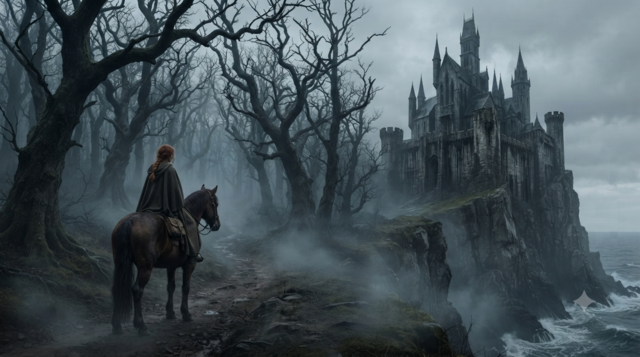 The forest breaks abruptly, on a jagged cliff face, stands the Castle of the Crying Stones. The dark, weeping stone of the walls is streaked with damp mineral stains that look like endless tears. The wind whistles through the towers, creating a low, mournful wail—the sound of the stones crying. It looks both terrifying and mesmerizingly beautiful in its decay. It is a place of undeniable power and profound sorrow.
“What kind of creature calls this despair home?”
Her feet met the ground, and the earth itself seemed to cling to her, staining her shoes with dark intent. As she approached the gate, a primal fear screamed in her blood, her heart a wild drum against the cage of her chest. Yet, her determination sharp and unyielding. She would face the devil himself for Liam.
The gate is a massive, iron-toothed maw. It groans open before she can even announce herself, as if the castle itself was expecting her. The courtyard within is a graveyard of forgotten statues and dead ivy. The air inside is cold, still, and smells of dust, old parchment, and dried roses—a scent of elegant decay. The silence is heavier than in the forest.
Eléonore took a final, steadying breath as she witnessed a grand hall lost to shadows. Dust motes danced in the few slivers of pale light that stabbed through high, grime-coated windows. She had taken only three steps inside when her heart stuttered. She felt a presence, hovering behind her, wrapped in a velvet black robe.
She turned back to face him, and he was simply there. The unnatural stillness with which he held himself was more frightening than any sudden movement could have been. One moment, the space beside the colossal, cold fireplace was empty, and the next, a man stood within it, as if he had not walked into view; he had materialized.
“You are lost.”
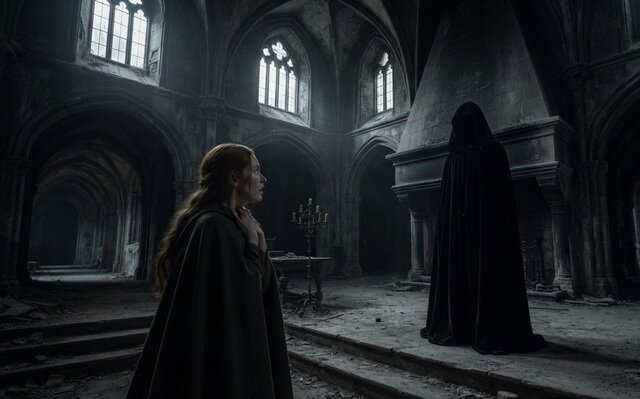
His voice was low, cultured, and devoid of any warmth. It was a sound, not a feeling, as a stone dropped into a deep, bottomless well. He was tall and gaunt, clad in impeccably tailored black that swallowed the light. His face was not clearly visible, seeming as a pallid marble, so pale that it gleamed in the twilight of the hall. But it was his eyes that arrested her. They were eyes that had witnessed centuries, trapped in a face that had not aged a day past thirty.
Eléonore’s courage nearly failed her. She clutched her satchel like a shield.
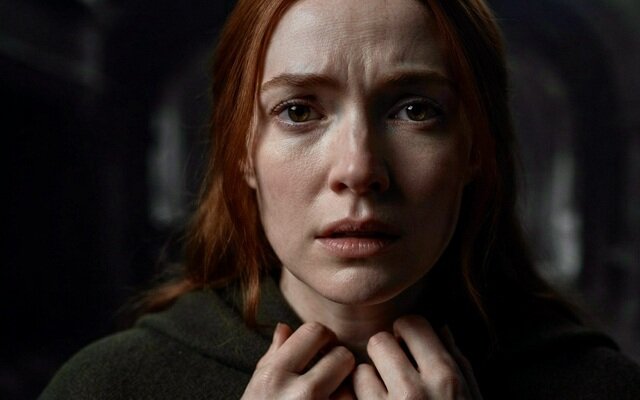 “I am not lost. I am Eléonore Valerius. I have come seeking Lord Cassian de Winters. My brother is dying.”
"A common tragedy,” he replied, his gaze unmoving. “Physicians exist in the city for such matters.”
“This is beyond physicians.” Desperation lent her strength. She fumbled in her bag and brandished her mother’s journal. “It is a wasting sickness. Your name… your family’s name… is in this text. It speaks of your knowledge of blood maladies.”
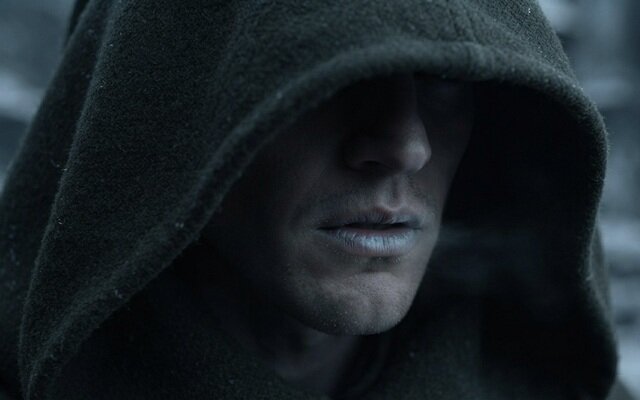
Cassian’s eyes flickered to the journal, then back to her face, his expression one of profound boredom.
“The fancies of old wives’ tales. What your brother suffers from is a malaise of the spirit. Some fates are kinder than a cure, Miss Valerius. You would do well to return home and let nature take its course.”
The cold finality in his tone was a physical blow.
Her hope, so fiercely guarded, began to crumble.
He seemed to be on the verge of turning away, of dissolving back into the shadows from whence he came.
“Please. I have nowhere else to go.” She cried, her cries echoing through the castle. He paused. His head tilted almost imperceptibly. His nostrils flared, a subtle, fleeting inhalation. His entire demeanor shifted.
When he saw into her welling eyes, the dismissive boredom in his eyes melted away, replaced by a sharp, predatory focus. He looked at her now not as a nuisance, but as a collector beholding a rare and fascinating specimen. He took a single, silent step forward.
"A… possibility exists,” he said, the words measured and new.
“My library is extensive. It contains texts that your city physicians could not dream of. You may search it for your answers.”
Eléonore cut him off, “Thank you, you’re gracious and kind. ”
“I haven’t finished,”
Cassian roared, his voice more frivolous than before, which made her petite figure shiver as he continued,
“I want something from you in exchange for the access to my library”
Eléonore’s breath caught.
“In exchange for what?”







