Grosgrain Dreams
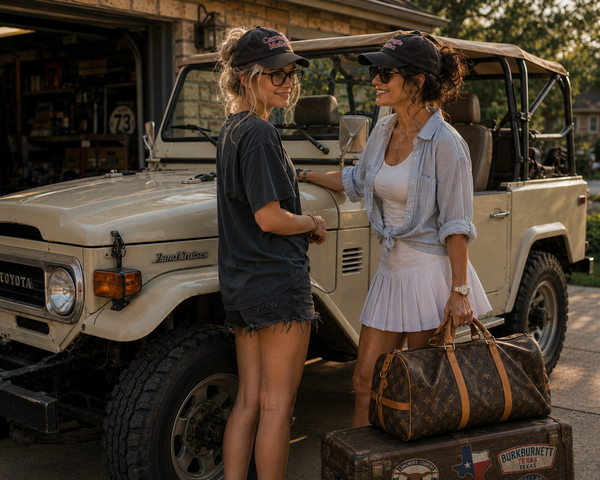


First place at state. Placed at nationals. I was sixteen when I won it. Seventeen now, packing at the tail end of a Texas August, which is its own kind of survival. My father—a petroleum engineer—and I had spent eight months building a drill bit that outperformed the commercial standard by eleven percent. Apparently that made me old enough to be trusted with real engineering work twelve hundred miles north, and still too young to skip high school because a diploma had to be “earned.” I was petrified of a new school.
Still, I had a ribbon and a medal and a certificate with my name spelled right, which at a Texas science fair is not a guarantee. But it was the ribbon I kept picking back up — blue, a little gaudy, the kind of thing they hand a nine-year-old for a prize-worthy potato. Except this one said Novel Downhole Drill Bit Geometry and Environmental Factors, Harper, and under the gold foil was eight months of my dad and me in the garage arguing about tungsten carbide — heat and cold and rain and mud and dry — until Mom made us come inside.
“You’re going to wrinkle it,” Dad said from the doorway. The smell of coffee drifted into the room, mixing with cardboard dust and packing tape.
“Ribbons don’t wrinkle, Dad. They’re grosgrain.” I set it flat in the box anyway.
“Listen to her. Grosgrain.”
“It’s a real word.”
“So’s humble. Never met it either.” But he was grinning, and I let him have it, because in about forty hours I’d be twelve hundred miles from that doorway and I was already storing his voice up like canned goods.
“Leave the child alone, Clifford.”
That was Dutch.
My Aunt Dutch was leaning in the hall behind him, arms crossed, dressed like the kitchen owed her money — some soft camel-colored thing that probably cost more than the truck and looked, on her, like she’d thrown it on in the dark. She’d flown into Dallas two days ago to ride back up with me. Twelve hundred miles is not a drive you do alone at seventeen, she’d said on the phone, and I’m not shipping my niece’s Cruiser to be eaten by Pittsburgh salt — and, quieter, I want to see my brother before we point that truck north.
“You,” she said to me, “packed the ribbon before the socks.”
“The ribbon’s fragile.”
“The ribbon’s pure pride, baby. It’ll outlive us all.” She picked it up anyway, thumbed the foil, and read Harper under the gold without a word — which from Dutch is the loudest thing she does.
Here is the thing about my aunt that took me most of my life to find funny.
My grandfather, Cliff and Dutch’s father, a man I mostly know from photographs where he’s squinting at an engine — named his daughter after Earl “Dutch” Clark. Hall of Fame quarterback. Detroit Lions, back when the leather helmet was a real safety innovation and not an aesthetic. Drop-kicker. Player-coach. The guy on the field who was also, quietly, running the field.
Then his son grew up and had a daughter of his own and looked down at seven pounds of screaming Texan and, with his whole chest, named her after Tony Romo.
“You could’ve gone with a scientist,” I’d told Dad once. “Curie. Franklin. Anyone who’s held a beaker.”
“Romo threw for over thirty-four thousand yards.”
“And zero playoff-defining ones.”
He’d shrugged, immune, the way I’m immune to almost everything except him. “It’s a Harper thing, Toni. We name our girls after men who could read the whole field before the snap.”
Dutch had raised her coffee like a toast. “To reading the field. And to your father naming you after a man who spent his best years not making it to the Super Bowl.”
“He can hear you.”
“I know. Hi, Cliff.”
Dutch Clark was amazing, though — maybe my favorite football player ever. What I loved was that the man called the plays and ran them. That he was famous for seeing, a full beat before anybody else, exactly where the whole thing was about to go.
My goal was to do the same. I’d love to do it in a lab. Right now, though, I knew I couldn’t do it at a brand-new high school.
“Okay.” I taped the good box shut. “That’s the grant stuff. Lab stuff.”
“And that pile by the closet?” Dutch was assessing the territory, reading the field that was my wardrobe.
That pile was dread and fear and a nagging element of frustration with adults who should have been able to understand my situation and accept the tests.
“That’s high school,” I said.
Mom set the good tape down gently, the way you set something down near a sleeping animal.
“You tested out of so much, though,” she offered.
“I tested out of everything but Pennsylvania history — which is basically American history — and chemistry lab, Mom. The whole subject. Sat the exam, got the score, they signed the form.” My voice started to climb and I let it. “But it doesn’t count. Because the diploma doesn’t care whether I know chemistry. It wants seat time. Hands-on hours at the bench.”
I dropped a fistful of socks in the box harder than socks require.
“And I can do the lab. In my sleep. I’ve been running real reflux setups since I was fifteen — I do grant-level materials work in the daylight, and then Pennsylvania wants me to go titrate vinegar for a grade, to prove I can, so a form is satisfied. It’s not hard. It’s an insult with a lab coat on.”
“Language,” Mom said, to no crime in particular, which Dutch noticed.
“It’s stupid,” I said. “I know it’s stupid. Everyone in this room knows it’s stupid.”
Dutch, who had drifted to my closet somewhere in the middle of that and started going through it like a customs agent, did not disagree. She held up a hoodie, considered it, set it down. Held up a second hoodie. A third. She pulled out a shoe, examined it, reached back in, and produced its twin, and then — with the grim patience of a woman confirming a diagnosis — three more pairs of the exact same Converse in escalating states of death.
“Toni.”
“What.”
“Do you have winter shoes or boots?”
“Those are shoes.”
“Those are canvas.” She held a low-top up by one frayed lace like evidence. “It snows in Pittsburgh, my love. Real snow. Sideways snow. You own three pairs of the same shoe and not one of them will keep a single toe attached to your foot in January.”
“Clothes are for not being cold and not being naked. Those are the two jobs.”
Dutch looked at me for a long moment — not annoyed. Almost tender, which was worse. She came back across the room, took my chin between two fingers, and turned my face gently side to side like she was reading a shot before she called it.
“Oh, darling.” She let go. “You don’t understand armor yet.”
“It’s a jacket.”
“It’s signal control. Everything you put on that body tells a room what it’s allowed to do to you before you open your mouth. You’ve been walking around your whole life letting your science speak for you. Fine when the room’s been your same stage for eight years.” She resumed her judgment of the high-school pile. “It’s going to be less fine at a school full of people who’ve never once been the smartest thing in it — and would love to take that out on the girl who is, with Mother Nature backing them up.”
I opened my mouth. Closed it.
“The lab’s the easy part, baby,” she said. “You’ll sleep through the lab. It’s the two hundred kids in the hallway you can’t test out of.” She smiled, and the steel went back wherever she keeps it. “That’s the class. And nobody signs a form.”
Doug—my faded tan 1973 Land Cruiser FJ40—waited outside, already looking like he was dreading the winter ahead.
I could do the drill bit in my sleep. I could do the whole two semesters of lab with my eyes shut and one hand behind my back.
It was everything after the snap I was going to have to learn.
Dutch clapped once, brisk, the tenderness folded back up and put away.
“Right. New school year, first winter east of the Mississippi and north of the Mason-Dixon Line, and you have the winter footwear of a woman who has never met a consequence.” She hauled me up off the box by one wrist like I weighed nothing. “So. Tell me you like retail therapy.”
“Not opposed!”
“God, there’s hope.” She was already steering me toward the door. “Socks are packed. Boots and the rest we buy up north, where they actually sell the real ones.”
I hugged my parents and then we drove.