Chapter 1. The Old Man Who Never Got Through
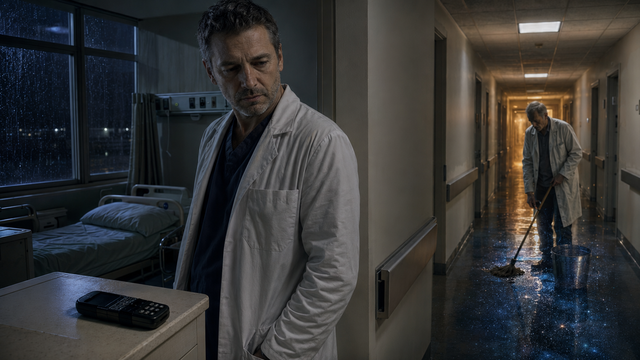


Grigory Selivanov died at 4:17 in the morning because Dr. Pavel Somov said, “In the morning.”
Not according to the medical record, of course. According to the record, Selivanov died of acute heart failure complicated by age, high blood pressure, diabetes, damaged vessels, forty years of cheap sausage, and the particular Russian habit of avoiding doctors until something important inside you begins to come loose. The record was clean and harmless. His condition deteriorated. His blood pressure dropped. Resuscitation was unsuccessful. Time of death: 4:17 a.m. Attending physician: P. A. Somov.
The human version was shorter. The old man asked Pavel three times to call his daughter, and three times Pavel told him they would do it in the morning.
That night the hospital smelled of wet wool, bleach, and fear. A thin March rain scratched at the windows. In the emergency department, two drunk men were shouting at each other, a woman in a faded lilac coat was demanding a cardiologist for her husband because “he isn’t just anybody, he runs a company,” and a feverish child lay in his father’s arms staring at the ceiling with the exhausted wisdom of someone who had already discovered that adults were very good at worrying loudly and not always good at helping.
By the coffee machine, the security guard Borisych ate a sandwich as if disposing of evidence. The machine wheezed, blinked red, and produced something called cappuccino on the plastic cup. In reality, it was hot water that had once heard a rumor about milk.
Pavel Somov moved through the corridor with the quick, forward-leaning stride of a doctor who had trained himself not to look sideways.
It was a useful skill. Once you looked, you stopped being a doctor and became a witness. A doctor could prescribe, sign, observe, wait for test results, and hide behind a language designed to make living people sound like faulty equipment. A witness noticed the slippers beneath the bed. The grey hair on the pillow. The hand of an old woman stroking a sheet as though it were her husband’s face.
Pavel had been a witness for fifteen years. Then one day he discovered that the place inside him where things used to ache and resist had been replaced by a white filing cabinet.
He was forty-one. In the mirror above the staff-room sink, he looked like a man somebody had forgotten to switch off after a long shift. His skin was grey, his eyes bruised with sleeplessness, his temples beginning to silver. His neck hurt from bending over charts. His back hurt from standing. Sometimes something fluttered beneath his ribs—not pain exactly, but a small, angry warning.
He knew he should get it checked.
He knew he should sleep more, drink less coffee, stop speaking to patients as though they were interrupting the important work of treating them.
Pavel knew many things. Knowledge changed very little when a man used it as furniture.
His phone vibrated in his pocket.
A message from Olga.
I found the yellow blanket in the hall closet. I’m not taking that box to the new flat. Tell me what you want me to do with it.
He read the first line, locked the screen, and put the phone away.
The blanket had been bought for someone who never used it. Pavel had no medical language for what it had become after that. So, like most things for which he had no language, he left it to Olga.
Grigory Matveyevich Selivanov occupied the bed beside the window in Room Six. He was eighty-two, with a diagnosis longer than the queue at a district clinic and a temper that appeared worse than it was. He spoke to doctors the way people spoke to plumbers: suspiciously, irritably, and with the conviction that they would either overcharge him or fail to tighten something vital.
On his bedside cabinet stood a glass jar of water, a packet of dry bread rings, a small icon of Saint Nicholas, and an old push-button phone held together with black electrical tape. The phone looked as though it had survived the Soviet Union, the nineties, two pension reforms, and several falls from kitchen furniture.
It still worked out of spite.
“Doctor,” Selivanov called as Pavel passed the doorway. “Doctor, come here a moment.”
Pavel had already pretended not to hear. That was another useful hospital skill: failing to hear just convincingly enough to believe yourself afterward.
The old man called again.
The patient in the next bed, a heavyset man with a bandaged leg, lifted his head from the pillow.
“Leave him alone, Matveyevich. Can’t you see he’s running? There are more people here than cockroaches in a dormitory.”
“I’m not Matveyevich. I’m Grigory Matveyevich.”
“What difference does it make? After a week in here, every man becomes Matveyevich and every woman becomes Nikolaevna.”
Pavel stopped at the door. He remained on the threshold, hoping the problem might reconsider and cease to be one.
“What is it?”
“I need to call my daughter.”
Pavel glanced at the telephone.
“Then call her.”
“My fingers don’t work properly. The number disappeared. You dial it, and I’ll speak.”
“It’s the middle of the night.”
“I know it’s night. I’m old, not stupid.”
“Then call her in the morning.”
The old man pressed his lips together. For a moment, he looked like a schoolboy who had been humiliated in front of the class but had decided not to cry.
“I need to call now.”
Behind Pavel, someone shouted for a nurse. The woman in the lilac coat had begun demanding the name of the hospital director. In the emergency department, a possible stroke had just arrived. Pavel’s intern had already written down the wrong dosage twice, thankfully only on paper. Three charts were waiting on the desk. Olga’s yellow blanket waited inside his phone.
“Grigory Matveyevich,” Pavel said in the gentle voice doctors used when they were already angry, “it is half past one. Your daughter is asleep. You’ll frighten her, she’ll come rushing here, and then nobody will sleep. Call her in the morning.”
“She isn’t asleep.”
“How do you know?”
“She never sleeps when she’s worried.”
“Then don’t worry her.”
The old man looked at him with something more unsettling than hurt. Surprise. As though Pavel had suggested he leave his heart on the bedside cabinet while he went to the bathroom.
“You’re still young,” Selivanov said.
Pavel almost laughed.
“Thank you. That’s the nicest thing anyone has said to me tonight.”
“You’re young,” the old man repeated. “That’s why you think morning always comes.”
Pavel disliked the sentence immediately. Hospitals were full of sentences like that—things said by strangers in worn pajamas that remained in your head longer than their test results.
They interfered with work.
“In the morning, Grigory Matveyevich.”
“Doctor—”
“In the morning.”
There was a new orderly standing by the service elevator.
Pavel noticed the shoes first. Old black shoes, poorly polished but stubbornly so. The man’s white coat sat awkwardly over a stretched grey sweater. He was perhaps sixty, perhaps older. Some faces did not look old so much as used by many different lives.
His hair was iron-grey and pushed back with his fingers. His cheeks were hollow, his nose large. His eyes were pale, amused, and very tired.
He held a mop and a dented metal bucket.
There was no badge on his coat.
“Who are you?” Pavel asked.
“Semyon.”
“I asked who you are, not your name.”
“I came down from the third floor.”
“That isn’t what I asked either. Who sent you?”
“Anna Viktorovna.”
“The head of department?”
“That’s the one. Loud voice. Sensible shoes.”
Pavel looked again at the empty place on the man’s coat.
“Where’s your badge?”
“They didn’t give me one.”
“Why?”
Semyon considered this.
“Maybe they already knew my name.”
Pavel was too tired to decide whether the answer was foolish or insolent.
“This is a hospital, not a philosophy club. If you’re new, stay out of the way. If you don’t understand something, ask the charge nurse.”
“I did.”
“And?”
“She told me not to interfere with the doctors.”
“Good advice.”
“It was,” Semyon said. “Until a doctor began blocking my elevator.”
The doors opened with a mechanical groan.
A man lay on the gurney inside, pale beneath an oxygen mask. His wife—the woman in the lilac coat—hurried beside him, one hand gripping a bag stuffed with documents, medicine, chargers, and biscuits. Relatives arrived at hospitals prepared for a siege.
“Doctor, please look at him properly,” she said. “He’s a very important man. He has a meeting tomorrow. He has employees. He runs—”
“Intensive care,” Pavel told the nurse pushing the gurney. “Now.”
The man turned his head toward his wife.
“Sveta,” he rasped through the mask. “Stop talking.”
She stopped.
There was more marriage in those two words than in any certificate. Her mouth remained open, but no sound came out. Until then she had been ridiculous in her lilac coat, trying to persuade illness that it had selected the wrong person. Now she was simply a woman watching the man she had argued with for twenty years disappear behind metal doors.
She did not know what to do with her hands.
Semyon held the elevator open.
The gurney rolled inside. The woman followed, still silent.
“At least he made himself clear,” Semyon said.
“Do you comment on everything you see?”
“No.”
The doors closed.
“Only the things people pretend not to see.”
Pavel turned away before the orderly could say anything else.
For the next hour, the hospital swallowed him. A woman with fluid in her lungs. A man whose left arm had stopped obeying him. A child burning with fever. Charts, signatures, instructions. At two fifteen Pavel drank half a cup of coffee. At two twenty he poured the rest into the sink because even his exhaustion refused to accept it.
His intern, Alyosha, stood in the staff room with the eyes of an abandoned dog.
“Can I sit down for five minutes?”
“You can sit when you retire.”
Alyosha continued standing.
Pavel looked at him.
“Sit. Just don’t die here. We’re already above capacity.”
The young man dropped into a chair.
“Who’s the new orderly?” Pavel asked.
Alyosha blinked slowly.
“What orderly?”
“The older man. Grey sweater. Semyon.”
“I saw him by the lift.”
“Who brought him in?”
“I thought he was from transport.”
“Nadya,” Pavel called.
The nurse appeared in the doorway, tying back her hair.
“What?”
“The new orderly. Is he ours?”
“I assumed he came from the third floor.”
“He said Anna Viktorovna sent him.”
Nadya frowned.
“She’s on leave.”
“Since when?”
“Monday.”
Pavel looked toward the corridor.
Semyon was mopping the floor outside Room Six, his movements unhurried, the water in his bucket already grey.
“Maybe she arranged it before she left,” Nadya said. “Ask administration in the morning.”
“In the morning,” Pavel repeated.
Nadya gave him a puzzled look, but he had already turned away.
At half past two, Selivanov called again.
This time he sounded different.
Pavel entered with his irritation prepared. The old man sat propped against his pillows, breathing through his mouth. The patient with the bandaged leg snored beside him, his jaw hanging open.
“What is it?”
“Call her, Doctor.”
He was no longer demanding. He was asking. There was an unpleasant weight in an old man’s request. It did not push. It seeped.
Pavel looked at the phone on the bedside cabinet.
He could pick it up. Find the number. Let the old man speak.
Two minutes, perhaps five.
Maybe the daughter would not answer. Maybe she would answer and panic. Maybe she would come to the hospital and demand explanations. Maybe she would cry. Maybe she would thank him. Maybe nothing would change.
Hospitals were built from maybes. They stood in every doorway and made simple acts look complicated.
“Your readings are reasonably stable,” Pavel said. “You need to rest.”
Selivanov kept his eyes on the phone.
“She’s the only one I have.”
Pavel said nothing.
“She isn’t good or bad. She’s ordinary. Took after me, poor fool. Proud. If she’d been clever, she would have taken after her mother. Her mother was gentle. Too gentle. Life pressed right through her.”
“What did you argue about?”
“Soup.”
“Soup?”
“She brought me soup before I came here. I told her it had no taste.” The old man shook his head. “Imagine that. A person brings me soup, and I behave like a restaurant critic in sagging underwear.”
Pavel saw it without wanting to: a small kitchen, steam above a bowl, a daughter still wearing her coat, an old man frightened by his own failing body and striking the person standing nearest.
Most lives did not break apart over great betrayals. They broke over soup. Over a sentence spoken in a kitchen. Over one exhausted person choosing the wrong moment to be cruel.
“You’ll make up in the morning.”
Selivanov smiled faintly.
“You’re a kind man, Doctor.”
“You don’t know me.”
“You hide it badly.”
Pavel looked at the telephone.
He could have taken it then. Later, he would return to that moment so often it became more familiar than some years of his life. There was no warning in the air. No flickering light. No voice from above. Only a cabinet, a telephone, an old man, and a doctor with two free hands.
Then someone shouted from the corridor.
“Doctor!”
A second voice joined the first.
“Doctor, quickly!”
Pavel turned.
“I’ll come back.”
“When?”
“Soon.”
He left the room.
Soon did not come.
At 3:40, a woman arrived with pulmonary edema. At 3:52, the businessman in intensive care developed an arrhythmia while his wife waited outside clutching her bag to her chest. At 4:05, Alyosha dropped a metal tray. At 4:10, Pavel was signing an order when a sound came from Room Six.
It was not a cry or a groan.
It sounded as though something inside the old man had quietly snapped.
Pavel ran.
He knew as soon as he entered.
There was a moment when the body remained but the person had already stepped away from it. Doctors knew that moment. They rarely spoke about it. It was not scientific, and when doctors said unscientific things, they either became jokes or appeared on television.
Selivanov lay on his pillow with his mouth open and his eyes half closed. One arm hung over the side of the bed, his fingers almost touching the floor. The telephone rested on the blanket.
The screen was lit.
Vera — daughter.
Perhaps he had tried to dial. Perhaps he had called and she had not answered. Perhaps his thumb had pressed the wrong button. Perhaps he had only held the phone like a key to a home he no longer had time to reach.
After that, everything happened as it was supposed to.
Oxygen. Monitor. Orders. Hands. Nadya beside him. Alyosha white against the white wall. The patient in the next bed sitting upright, his blanket clutched to his chest.
“Matveyevich?” the man kept saying. “Matveyevich?”
Pavel did everything correctly. Fast, controlled, without wasting a movement.
He was a good doctor.
That was the ugliest part. A good doctor could do everything right too late.
At 4:17, Pavel stopped.
“That’s enough,” he said.
No one liked those words in a hospital. They were too small for death.
A man had lived eighty-two years. He had stood in winter queues, kissed a woman in an apartment stairwell, buried her decades later, quarreled with his daughter over soup, repaired his telephone with electrical tape, and carried keys to a flat where his slippers still waited beneath the bed.
Then someone said, That’s enough.
Nadya pulled a sheet over him.
The man in the next bed began to cry with his face turned toward the wall. He had known Selivanov for less than a week, but a hospital week could be longer than kinship. They had listened to pipes groan at night. Complained about the porridge. Waited together for the morning round.
It was a kind of intimacy. It simply left no photographs.
Pavel picked up the telephone.
It was still warm from Selivanov’s hand.
He pressed the call button.
The ringing began at once.
Once.
Twice.
Three times.
On the fourth ring, a woman answered.
“Papa?”
Her voice was thick with sleep and already afraid. Old fathers did not call from hospitals at four in the morning to share good news.
“Vera Grigoryevna?”
Silence.
“Yes.”
“My name is Dr. Somov. I’m calling about your father.”
He used the correct phrases. His condition deteriorated suddenly. We performed resuscitation. We did everything we could. Unfortunately. My condolences.
Doctors carried a set of phrases for death the way mechanics carried tools. The phrases fit nearly every situation and repaired nothing.
The woman did not scream. That was worse.
She breathed.
Then she asked, “Did he ask you to call me?”
Pavel looked at the sheet. At the old phone in his hand. At the shaking back of the man in the next bed. At Nadya’s eyes. At Alyosha, who was staring at the floor as though the instructions for surviving his first death might be written there.
“Yes,” Pavel said.
The word came out small and bare.
“When?”
He could have lied.
The lie was ready. Just before his condition worsened. We tried to reach you. He spoke about you.
Hospital lies were easy if spoken gently. People wanted their pain given a shape they could hold.
“Earlier tonight,” Pavel said.
Vera did not speak for several seconds.
Then she said, “I was awake.”
The call ended.
Pavel stood with the telephone against his ear until the empty line began to pulse.
“Doctor.”
He turned.
Semyon stood in the doorway with his bucket. His mop rested against one shoulder. There was no surprise on his face, no pity, no professional sympathy. He looked at the covered body, then at the phone.
“What do you want?” Pavel asked.
“To clean the floor.”
“A man has just died.”
“I can see that.”
“Then wait outside.”
Semyon did not move.
“Did he get through?” he asked.
Pavel lowered the phone.
“That is none of your business.”
“He asked three times.”
Cold anger rose through Pavel.
“You were listening?”
“I heard him.”
“Then why didn’t you call her yourself?”
Semyon looked at him for a moment.
“He didn’t ask me.”
Pavel wanted to strike him. Not seriously. Doctors did not strike orderlies in rooms where patients had just died. They signed forms, drank coffee, and developed ulcers.
“He died of heart failure,” Pavel said.
Semyon set down the bucket.
The water trembled beneath the fluorescent light.
“No,” he said. “He died of morning.”
“What is that supposed to mean?”
“Tomorrow. Later. After the shift. Useful words.”
He dipped the mop into the water.
“Until they aren’t.”
“Are you a philosopher?”
“No.”
“A priest?”
“No.”
“Then who are you?”
Semyon wrung out the mop.
“On duty.”
“As an orderly?”
“Tonight.”
He began to wash the floor.
The simplicity of it offended Pavel. A man had died, his daughter had missed his final words, and the floor still needed cleaning. Wet tracks spread over the linoleum, gathering the dirt carried in on shoes, the dust beneath the beds, the marks left by the night.
Semyon straightened the small icon on the bedside cabinet.
“Don’t touch his things,” Pavel said.
Semyon removed his hand.
“All right.”
“If you comment on my decisions in front of a patient or relative again, I’ll have you dismissed before the end of this shift.”
Semyon looked at him without fear or challenge.
“Before the end of this shift,” he said, “someone else may die.”
Pavel’s jaw tightened.
“Start with the living, Doctor.”
Someone called from the corridor.
Not his name. Not his surname. Only his function.
“Doctor!”
Pavel put Selivanov’s phone into the plastic bag holding his belongings and left the room.
He walked past the nurses’ station, past the sleeping intern, past the machine still pretending to make coffee. The floor beneath his shoes seemed to lead somewhere other than the next room. Somewhere all his unfinished things had been stored.
Unanswered messages. Calls he had watched ring out. Apologies postponed until they became useless. A yellow blanket inside a box in Olga’s hall closet.
An old man asking for two minutes.
“Doctor,” Semyon called behind him.
Pavel stopped.
“What now?”
“The woman in the lilac coat wants to see her husband.”
“No visitors in intensive care.”
“She’s afraid the last thing he ever says to her will be ‘stop talking.’”
Pavel closed his eyes.
“Tell her she can see him in the morning.”
The words reached his mouth and stopped there.
Semyon waited.
Pavel opened his eyes and looked toward the glass doors. The woman stood against the wall, holding a pair of disposable shoe covers she had forgotten to put on. She seemed to have shrunk inside her coat.
“Two minutes,” Pavel said. “No touching the equipment. No shouting.”
Semyon nodded and went to fetch her.
He did not smile. He did not explain what Pavel had just learned. For once, he said nothing.
The woman followed Nadya into intensive care. Behind the glass, she approached her husband’s bed. She bent over him, speaking too quietly for Pavel to hear. Her shoulders shook. The man lay among tubes, wires, and the vast indignity of illness.
His fingers moved.
She took his hand.
She did not promise him anything. She did not tell him everything would be fine. She simply held on.
Semyon stopped beside Pavel.
“Are you always this unbearable?” Pavel asked.
“No,” Semyon said. “Sometimes no one notices.”
He walked away, pushing the mop before him in slow, even strokes.
Pavel watched him go.
“Nadya.”
The nurse looked up from a chart.
“Who signed in the new orderly?”
“Semyon?”
“Yes.”
“I thought Anna Viktorovna sent him.”
“So did I.”
“Ask administration when they open.”
Pavel looked down the corridor. Semyon was washing the floor outside Room Six while two attendants wheeled Selivanov’s body toward the service elevator.
Every doctor wore a badge. Every nurse wore a badge. Even Borisych had one pinned crookedly to his sweater.
There was nothing on Semyon’s coat.
Morning had arrived beyond the windows, grey and ordinary.
It was much too late.
Subscribe now