THE SUN IS GOD Chapter One
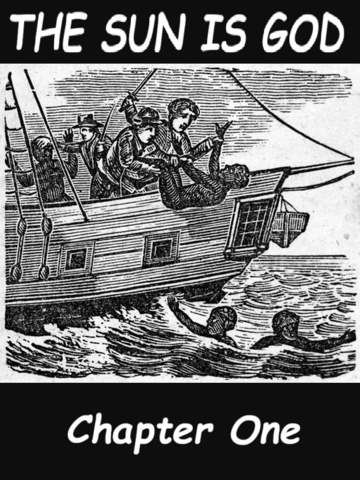


“I’ve been here before. No, that’s wrong. But I know this place, this moment.” The Doctor was confused, striding out of the TARDIS onto the deck of the Zong, then hesitating.
“Where are we?” Turlough looked doubtful. “Did we miss again?”
“No, I think we’re supposed to be here. If I remember, though, this won’t be at all pleasant.”
“Oh, lovely. Good reason to stay, then. But where is everyone? Even at night, shouldn’t there be....?” The deck had been absolutely silent but now there was something like a rumble, only slightly higher pitched, from below, and it picked up steam as it rose, until several sailors burst onto the deck, dragging with them a few barely struggling black women and children, whom they unceremoniously pitched over the side of the ship, into the roiling black sea.
“Count them! Count them!” roared the First Mate. “Get them over! Quickly!” Beside him was the Second Mate, apparently writing down the number of jettisoned persons.
“Slaves,” whispered the Doctor, wanting to look away and not permitting himself to do so. “There will be more. I know where we are. I know where we are!”
“Can’t we do something?”
“I wish. I wish. First of all, it’s a fixed point in time, more’s the pity. Second of all, we’d be thrown overboard as readily as the slaves, and probably counted as well. For the insurance. And C, look out.”
“Look out?”
“Oh, Captain Collingwood will want to meet you two, for sure!” A burly sailor had Turlough by the collar and another was twisting the Doctor’s arms behind him. “Stowaways!”
“Look out,” repeated the Doctor, mildly.
“Why are you being so placid? This is awful!” Turlough rattled his chains like a ghost of himself. “And not just this. Those poor people!”
“I’m not being placid. My hearts, my hearts, Turlough, my hearts hurt for these people. You have no idea how much self-control I need to exert just to speak to you right now. Their screams are still echoing in my head. Inside, I’m screaming too. But tell me what good it would do to be screaming on the outside? Getting ourselves killed would help them how? They’re gone, and more will be murdered in the next few days. The best we can hope to be at the moment, all we can do, is to survive to be witnesses so their agony will not be forgotten, and won’t be in vain.”
“We have to do something,” whispered Turlough.
“Such as? Burn down the ship and kill us all?” Turlough was silent. “Yell at the slavers and tell them they’re bad, bad people? Think now. Feel later.”
Finally Turlough said, “You said you knew where we were. How?”
“There’s a painting. A horrible, brilliant, necessary painting.”
The two time travelers, separated by so little distance from their time machine -- a distance that may as well have been light years for all they could reach it -- sat in chains, without food or water, like the slaves with whom they were stored like the cargo they were, and who barely glanced at them. The Doctor, on the other hand, studied each face until he felt he knew these people inside and out. He hated being unable to save them. He couldn’t even comfort them.
There were about 50 of them, a little fewer, maybe, all women and children, little girls and boys, and then two men were brought in, wheezing and coughing and looking quite feverish. “They’re cutting their losses,” rasped the Doctor, his throat dry. “The ones they can’t sell, the ones who will probably die anyway.”
“Cold,” said Turlough.
“Cold indeed. These people wouldn’t even be ill if they were given food and water. They’re mistreated half to death and then dumped, because if a human being dies, insurance doesn’t cover it, but if cargo is lost, well, cargo is insured.”
“And we’re cargo too.”
“At the moment, yes. But my friend Erich taught me a trick or two. Sit tight.”
“Can I sit any other way?”
The enslaved people were familiar enough with the ship’s routine to know when it was safe to talk; they did better than that: they sang. One of the two men was a griot, the Doctor explained to Turlough. “A storyteller. He should have an instrument, either a harp or kind of xylophone, but of course these people have nothing but each other. They’re learning their history from him, all of them, on the off chance any of them survive.” The Doctor slipped his slender wrists out of his manacles, reached into one of his pockets, pulled out two safety pins and began to work on his leg irons. Once free of those, he freed Turlough’s hands and handed him the other safety pin.
The TARDIS, four decks above the hold (rather than the standard two), and only one above the extra deck where the Doctor, Turlough and the dehydrated, starving slaves were held, translated what the Doctor said into Gur for the slaves and what they said into Gallifreyan for the Doctor. “This girl child,” said the griot. “If you can take her away, if you can ensure her survival, our history will not be lost.”
“I will do my best,” responded the Doctor, freeing the seven-year-old. “I wish I could take you all.”
“No,” said the griot. “If you try that we shall all perish. You can only do what you can do.”
“You will not be forgotten,” whispered the Doctor.