Chapter 1. The Box Without a Tracking Number


By eleven in the morning, people had already returned a red evening dress, two humidifiers, a child’s scooter, a knife set that smelled faintly of someone else’s perfume, a self-help book called How to Stop Putting Your Life Off with an untouched spine, an electric toothbrush without the brush head, and a forty-something man in a gray overcoat.
The man, technically, wasn’t being returned. He was just standing at my counter with a shoebox under his arm and the expression of a product that hadn’t worked out for anyone, including itself.
We saw that expression a lot.
The OmniCart pickup-and-returns counter occupied the ground floor of a new condo building called Northline Residences. The building had been advertised as Scandinavian living in the heart of Chicago, though the only Scandinavian things about it were the prices, the wind tunneling between the towers, and the depression visible through the floor-to-ceiling windows.
Above our door, a backlit sign read:
PICK UP. SEND BACK. LIVE EASY.
The word EASY flickered every few minutes, which made the message more honest.
PICK UP. SEND BACK. LIVE.
Nothing was easy except the way cheap packaging split along the seam.
I worked as senior shift associate at OmniCart’s neighborhood returns counter. Senior shift associate meant I earned eighty dollars more a week and got to be the first person yelled at by customers who believed their entire lives had been ruined by a rejected refund of $6.49.
My name tag said:
MATT. I’M HERE TO HELP.
The badge lied more professionally than I did.
Every day people brought back things that had looked, only twenty-four hours earlier, like the beginning of a new life.
They placed the box on the counter and tried to look innocent, as though returning a purchase were a minor crime against their own enthusiasm.
They all used the same phrases.
“Didn’t fit.”
“Changed my mind.”
“It looked different online.”
“I never used it.”
“It’s not me.”
That last one was my favorite.
People said it’s not me about dresses, cookware, running shoes, ring lights, pregnancy pillows, calligraphy sets, home gyms, coffee grinders, sequined shirts, books they had intended to become intelligent enough to finish, and mirrors that had reflected them too accurately.
People loved saying it’s not me whenever something caught them being more hopeful than they wanted anyone to know.
I scanned the barcode, selected a reason, checked the condition, and pressed ACCEPT RETURN.
Sometimes I thought that was adulthood in its purest form.
Scan it.
Regret it.
Choose a reason.
Send it back.
Collect the refund.
Pretend nothing happened.
The trouble was, the older you got, the shorter the return window became and the more signs of use you carried.
“Sir,” Alex called from the next counter, “are you planning to return that box, or are you proposing to it?”
Alex Carter had worked with us for three months and had already reached the advanced stage of customer-service enlightenment where she could chew a protein bar, argue with the app, smile at a customer, and hate humanity without any visible drop in performance.
She was twenty-six, but her exhaustion belonged to a woman who had managed a train station, a maternity ward, and a small civil war in a previous life.
The man in the gray coat flinched.
“The app says I need the original packaging.”
“The app says a lot of things,” Alex said. “The air freshener in aisle six says ‘ocean breeze.’ Have you ever smelled an ocean breeze on the Kennedy Expressway?”
The man looked at me.
People always looked at me after Alex told them the truth. They expected the senior associate to return the illusion of normal customer service.
I took the box.
Inside was a pair of expensive leather shoes. Almost new. Clean soles, tags attached, no creases.
They were the kind of shoes a man didn’t buy for walking. He bought them because he wanted to enter a restaurant and not feel like part of the furniture.
“Reason for return?” I asked.
“They don’t fit.”
“Wrong size?”
“No. The size is right.”
“Color?”
“Color’s fine.”
“Defect?”
“No.”
“So what doesn’t fit?”
He tightened his jaw.
Behind him, the line had grown: a woman with a shopping bag, a guy holding a gaming monitor, an older lady with a robot vacuum, and a little girl clutching an oversized plush goose as if she had come to identify it at the morgue.
“They pinch,” the man said.
I looked at the shoes.
Then at him.
Then back at the shoes.
They didn’t pinch. You could tell.
Some shoes pinched. They wore guilt openly: a bent toe, a crease across the leather, human suffering concentrated around the stitching.
These shoes looked calm.
They had simply ended up with the wrong man.
“All right,” I said. “They pinch.”
The system gave me four options:
WRONG SIZE.
APPEARANCE DIFFERENT FROM LISTING.
DAMAGED ITEM.
OTHER.
The greatest human tragedies always ended up under OTHER.
I selected WRONG SIZE.
The scanner beeped like a mouse being stepped on.
Return accepted.
The man exhaled, took the receipt, and walked toward the door. At the threshold he stopped and looked back at the shoes as I lowered them into a gray returns bin.
I wanted to tell him to take them.
Not the shoes.
Himself.
Take yourself back while there’s still time.
But I didn’t say things like that to customers.
First, no one paid me for it.
Second, people dislike it when a pickup-counter employee starts acting like an undertrained prophet.
“Next,” I said.
A woman placed a garment bag on the counter. Expensive packaging. Crisp paper. Careful folds.
The woman herself looked expensive and carefully folded too, though whatever paper she carried inside seemed to have gotten wet years ago.
Her makeup was exact. Her lipstick didn’t move. Her fingers were clenched tightly enough for the ring on her right hand to leave a red line.
Forty-two, give or take one divorce.
“Return,” she said.
No hello.
People rarely said hello at our counter.
Return had become the new good morning.
I scanned the code on her phone.
WOMEN’S EVENING DRESS. RED. SIZE 12. PICKED UP YESTERDAY AT 6:42 P.M.
“Reason?”
“Didn’t fit.”
“Size?”
“Yes.”
I opened the garment bag.
The dress was beautiful.
Deep red. No cheap glitter. The kind of dress that didn’t merely get worn. You entered it the way you entered a room where someone had been waiting for you.
The size would have fit her.
After three years in returns, you learned to estimate more than bodies.
You learned who was too small for the life they wanted.
Who had bought confidence one size too large.
Who felt trapped inside an opportunity that fit perfectly.
The dress wasn’t what she was returning.
She was returning the evening she hadn’t been able to walk into.
The fabric smelled faintly of perfume.
And salt.
Tears smell unpleasant when a person keeps them too long.
“Tag’s attached,” I said.
“Of course.”
“No signs of wear.”
“I said it didn’t fit.”
Her voice became thinner. Not louder. Thinner, like receipt paper near the end of the roll.
The system asked:
ACCEPT RETURN?
The system was the only creature in our store that asked questions without curiosity.
I pressed YES.
The dress went into the gray bin.
The woman took the receipt and left quickly, as if she were afraid the dress might change its mind and run after her.
“You’re doing that thing again,” Alex said.
“What thing?”
“Looking at customers like a neighborhood therapist who lost his license.”
“Do neighborhood therapists make more than we do?”
“They get paid in medication and moral superiority.”
“Not for me.”
“Return yourself, then.”
By lunchtime, the line had become meaner.
People brought a specific kind of midday return: hungry, rushed, smelling of office soup and resentment.
A guy returned a gaming monitor because “one pixel felt wrong.”
A woman tried to return a food-storage set missing three lids and insisted it had arrived that way.
A red-eyed father brought back a child’s building set. While I counted the pieces, he kept glancing at the door as if a kid might walk through and say, Come on, Dad. Don’t be a coward.
“Two pieces missing,” I said.
“It came like that.”
“The listing says eight hundred forty pieces. You have eight hundred thirty-eight.”
“You counted them?”
“Do I look happy enough not to?”
He didn’t answer.
The older lady’s robot vacuum was also rejected.
Not because we were heartless. Because the robot arrived at the counter under its own power.
It rolled out of the box, pushed a receipt off the edge, bumped into the scanner, turned around, and headed toward the door.
“It works,” I said.
“That’s the problem,” she replied. “I don’t need another working thing in the apartment. My husband worked his whole life. Walked around humming, hit every piece of furniture, and always got stuck near the recliner. I thought this one would be quieter. It keeps going to his chair.”
“Maybe the floor map is wrong.”
“Young man, my whole life was mapped wrong. It’s a little late for updates.”
The robot bumped into the baseboard and beeped miserably.
“Keep it,” she said. “But if it goes back to the chair again, I’m putting both of them in the hallway.”
She packed it away.
From inside the box, the robot gave a short beep that sounded almost relieved.
By four, my jaw hurt from politeness.
Customer-service workers develop a special kind of pain. Not dental. Not muscular.
It comes from wearing a face that doesn’t belong to you for eight hours straight.
The face hangs on you like a company polo: synthetic, the wrong size, and impossible to remove during working hours.
I went into the back room and poured coffee from the machine.
The coffee was the color of an old radiator and tasted like an administrative punishment.
On the wall hung the shift schedule, fire instructions, and a poster that read:
THE CUSTOMER IS RETURNING AN ITEM, NOT YOUR ATTITUDE.
Management had put it up after Alex replied to “Why is this taking so long?” with:
“Because we’re all going to die eventually, and the app has already started.”
I took a sip.
My phone showed three missed calls from a number I hadn’t saved but knew by heart.
Valerie.
My ex.
Normal people saved their exes under names. I had kept her as a number because names demanded answers. A number could be ignored like a system notification.
Then came a message:
Matt, I need to give you your box. I don’t want to keep it anymore.
I stared at the screen.
Then at the poster about attitudes.
Then back at the screen.
My box.
Every man over thirty has one.
Old cables. Expired passports. Chargers from dead phones. A postcard from a woman he failed to keep. Documents he may need one day but hopes he won’t.
Mine contained something worse.
It contained the man I had almost become.
I locked the phone.
From the customer area, someone shouted:
“Hello? Is this line moving, or are we all just standing here for the aesthetic?”
I went back.
By six, the counter smelled of wet coats.
Rain had started, and customers came for their packages as if bad weather had reminded them of everything they’d ordered to make life warmer.
A woman picked up a nail lamp.
A man returned a neck massager because it “applied too much pressure.”
A mother collected an enormous high-chair box. Her son looked up at her and asked:
“Can you return me?”
“Don’t start,” she said.
“Only in the original packaging,” I told him.
The boy laughed.
His mother didn’t.
Mothers have complicated relationships with jokes that contain evidence.
Alex was processing a pair of sneakers and humming under her breath. When Alex hummed without lyrics, it meant she had about two more customers left before an internal fire.
“Matt,” she said, “if one more person tells me they’re a loyal customer, I’m moving to the woods.”
“There are no returns in the woods.”
“There are mushrooms. At least mushrooms don’t ask to speak to a supervisor when I refuse them.”
That was when the door opened.
Technically, the rain came in first.
Then the smell of wet fabric, cold cardboard, and rusted apartment railings.
Then the courier.
Tall, thin, hood pulled low. A delivery bag over one shoulder and a plain brown box in both hands.
No OmniCart tape.
No proper shipping label.
Only a faded barcode smeared across one side and an arrow drawn by hand.
“Returns close at nine,” Alex said automatically.
The courier didn’t look at her.
He placed the box on my counter.
Carefully.
Almost gently.
The way you set down something that might take offense.
“What is this?” I asked.
“A return.”
“Code?”
“No code.”
“We can’t accept it without a return authorization.”
“You will.”
I was tired.
Tired people become honest before they become intelligent.
“We have procedures. Without a code, an active return request, or a readable label, the only thing I can accept is my own death, and even that probably requires app confirmation.”
Alex snorted.
The courier remained still.
Everyone inside the store was moving. Customers shifted bags. Children touched displays. Alex tapped her scanner. The monitor blinked. Rain dripped off coats.
The courier stood as though someone had forgotten to turn time on around him.
“Where did it come from?” I asked.
“The returns department.”
“You’re standing at the returns counter.”
“No,” he said. “You’re standing at the counter. The department is below.”
I looked at Alex.
Alex looked at me.
Beneath our store was a maintenance basement, the building-management office, and a hair salon called Destiny Curls, where every haircut looked like destiny had filed an appeal.
“Do you have paperwork?”
The courier took a damp rectangle of paper from his pocket and placed it on the counter.
It wasn’t an OmniCart form.
It was thick, yellowed paper, the kind you found in old municipal offices and accounting departments where middle-aged women knew more about your life than your doctor.
Written by hand:
DO NOT DISPOSE.
“This isn’t a valid document,” I said.
“It is now.”
“What service are you with?”
“The one that comes after the last.”
“The last what?”
“Attempt.”
Someone in line shifted impatiently.
“Can you two do the philosophy later?” a man called. “Some of us have places to be.”
Alex turned toward him with the smile of a woman mentally choosing a place to hide the body.
“We’ll return everything shortly, sir. Don’t worry.”
I aimed the scanner at the faded barcode.
Nothing.
Again.
A red beam crossed the cardboard like a scratch.
Nothing.
On the third attempt, the scanner made a sound unlike its usual beep.
More like a cough.
The screen displayed:
ITEM NOT FOUND.
“You see?” I said.
The courier looked at the box.
Something knocked from inside.
The line went quiet.
Even the little girl stopped squeezing the plush goose.
The knock came again.
The box moved.
“What’s in there?” Alex asked.
The courier didn’t answer.
Cold moved down my back.
Not fear exactly.
More like the sensation that a camera had been turned on nearby, but not the security camera above the door.
A different kind.
One that recorded reasons instead of faces.
“We don’t accept live animals,” I said.
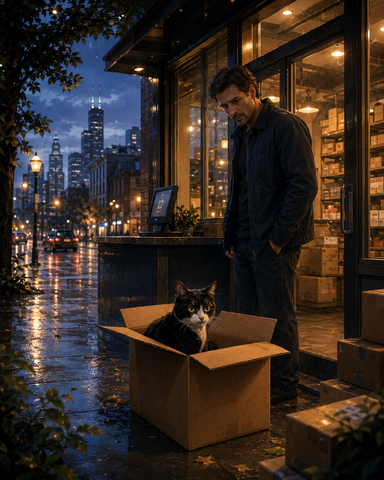
The box answered with an irritated, muffled meow.
Alex removed the protein bar from her mouth.
“Of course,” she said. “What else were we missing? A cat with no paperwork.”
A customer brightened.
“This is a health-code violation.”
“Thank you, Cook County Health Department,” Alex said. “Without you we would have licked him and eaten off the floor.”
I cut through the tape with a box cutter.
The cardboard was damp but sturdy. The tape stretched like a cloudy tendon.
The box smelled of rain, dust, old paper, and something warm, furry, and offended.
When the flaps opened, two yellow eyes appeared first.
Then ears.
Then a face.
The cat was black with a white chest, soaked through, heavy-looking, and completely ungrateful.
He sat inside the box like a supervisor accidentally shipped to the wrong branch.
There was no collar.
A narrow white stripe ran down his nose, as though someone had started painting a barcode and changed their mind.
His eyes were not cute.
Cute eyes belong to kittens on greeting cards who have never paid taxes, lost anyone, or downloaded the OmniCart app.
This cat had the eyes of a creature that had reviewed every return you had ever made and approved none of them.
“Hi,” said the girl with the goose.
The cat looked at her.
Then at the goose.
The goose seemed to lose confidence.
Inside the box, beside the cat, lay a ledger.
Not a novel. Not a gift book.
An old gray clothbound register, swollen with age and dampness. The kind once kept in schools, housing offices, city archives, and businesses where everything important was written by hand because databases hadn’t yet learned how to forget people.
A yellowing label had been pasted onto the cover:
RETURNS. MANUAL REVIEW.
I lifted the book out.
It was unexpectedly heavy.
Not book-heavy.
Wet-sand heavy.
The courier stepped back.
“Sign for it,” he said.
“Where?”
He handed me a cheap blue ballpoint pen.
Printed on the side:
TAKE BACK WHAT MATTERS.
I knew that line.
I had written it years ago, back when I believed words stopped belonging to you once the invoice cleared.
“I’m not accepting anything,” I said.
“You already did.”
I looked up.
The courier was gone.
The door chimed as if someone had left, but I hadn’t seen him cross the room.
Alex hadn’t either.
The man in line turned around.
“Where’d that guy go?”
“Probably dissolved into customer service,” Alex said, though she no longer sounded amused.
I pulled up the security footage.
6:37 p.m.
The door opened.
Rain blew in.
No courier entered.
The counter was empty.
Then the box was simply there.
No hands.
No transition.
Just present.
“Wow,” Alex said.
“Camera glitch.”
“Sure. We get those all the time. Self-delivering cat boxes. Standard Tuesday.”
The cat climbed out.
Not jumped.
Walked.
Slowly. Insulted. With the dignity of a wet government official.
He crossed the counter, leaving paw prints on the gray laminate, sniffed the scanner, sneezed, and sat beside the monitor.
“We have to move him,” Alex said.
“Where?”
“Into life. A shelter. The back room. Congress. I don’t know.”
The cat looked at her.
“Fine,” she said. “Not Congress. Too much competition.”
I tried to pick him up.
He bent himself into a bracket, hooked his claws into the signature pad, and made a sound that clearly meant:
Touch me again and I’ll file you under nonrefundable.
“Nice kitty,” I said.
He slapped me.
No claws.
For now.
The line had stopped pretending not to watch.
A woman took out her phone. The health-code man forgot about sanitation. The little girl whispered:
“Is he in charge?”
“Not yet,” I said.
The computer screen flickered.
I wasn’t touching the keyboard.
The returns form opened by itself.
White screen. Gray fields. Blue buttons.
Our familiar interface, the one that sometimes appeared in my dreams: I stood before God, and God said, Complete all required fields.
The ORDER NUMBER field was empty.
Then digits appeared.
0000000000
ITEM CATEGORY:LIVE. UNCLASSIFIED.
Alex stopped chewing completely.
“Matt…”
“I see it.”
CONDITION:USED.
PACKAGING:COMPROMISED.
SIGNS OF USE:SIGNIFICANT.
“Is that about the cat?” Alex whispered.
The cat sat straighter, like someone at passport control with nothing to hide except several lives.
I moved the mouse to close the window.
The cursor froze.
Then jumped to the next field.
RECIPIENT.
Letters appeared.
HALE, MATTHEW.
My fingers went cold.
Then my wrist.
Then some inner place coffee couldn’t reach.
“That’s you,” Alex said quietly.
I didn’t answer.
The final field blinked.
REASON FOR RETURN.
The pause lasted maybe three seconds.
In those three seconds, I remembered everything I usually avoided remembering.
Valerie standing beside a box in our old apartment.
The marketing department where I had invented better lives for strangers.
My father’s final call, which I ignored because I was “not in the right headspace.”
The laptop that had spent five years in someone else’s closet.
The book I promised I would write.
The person I had carefully taken off, folded, taped shut, and classified under OTHER.
The field filled itself.
DIDN’T FIT HIMSELF.
No one in line could see it. The monitor faced me.
Alex stood at an angle.
She read it.
Her expression changed.
Normally Alex’s face resembled a cash register after a minor electrical fire: functional, alive, potentially dangerous.
Now it was simply human.
That made everything worse.
The cat looked at me.
Not kindly.
Not wisely.
Not like a spirit guide sent by the universe with soft paws and a plan to heal my soul in twenty-four chapters.
He looked like a creature tired of watching me lie on forms.
“Matt,” Alex said, “this is some seriously weird shit.”
I wanted to agree.
I wanted to say technical malfunction.
Virus.
Prank.
Marketing campaign.
Some corporate experiment meant to go viral.
I wanted to say anything solid, adult, stamped, numbered, and suitable for escalation.
Instead, I clicked CANCEL.
The system did not cancel.
I clicked again.
A message appeared:
CANCELLATION UNAVAILABLE. RETURN ALREADY ACCEPTED.
The store smelled of wet fur, cardboard, and the beginning of trouble.
Outside, rain struck the window.
The word EASY flickered above the door, as though even it had finally become embarrassed.
The cat yawned, jumped down from the counter, walked between the bins, and settled on top of the gray tote containing the red evening dress.
He put his head on his paws.
Closed his eyes.
As if, for his first day on the job, he had already chosen the first return.
Subscribe now