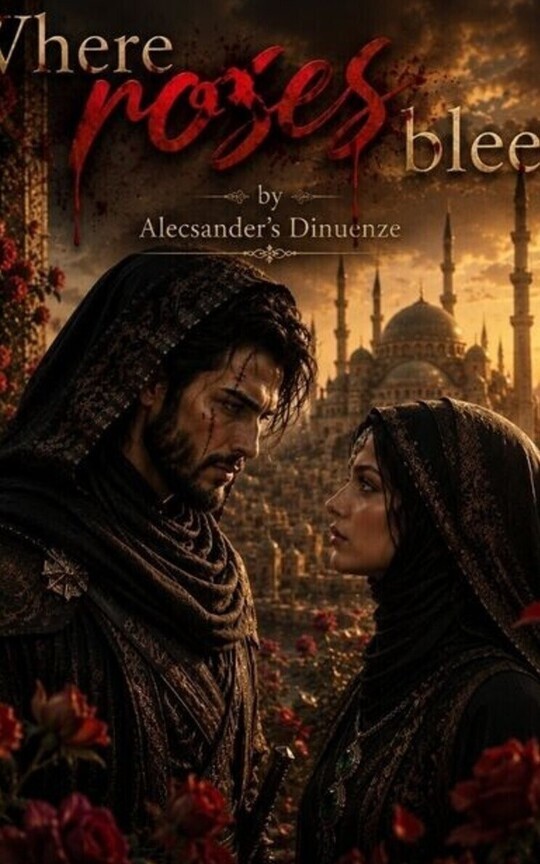
A Blade, a Rose, and a Soul Worth Saving — A Review of "Ẓill al-Mawt"
"Alecsander, I want to begin with something honest: this story surprised me. Not because of the setting, not because of the genre, but because of its heart. You wrote about an assassin, and yet what I felt most while reading was not violence — it was tenderness, memory, and the ache of a man who has forgotten that he was ever anything other than a weapon. That takes real emotional intelligence, and it says something beautiful about you as a writer.
The opening is one of the strongest I have read in a long time. Sheikh Abd al-Rahman walking to the mosque, choosing a white rose for his granddaughter Fatima, wrapping it in a linen handkerchief — and then dying on the cold marble while that same rose slides from his fingers and is slowly stained red by his blood. "When the old man's eyes closed for the final time, the rose was no longer white. It had become red." That is not just a scene. That is a symbol, and you wrote it with the patience of someone who understands that the most devastating moments are the quiet ones. The detail of the guards searching for a man with a dagger and blood on his clothes while Abbas walks past them as a humble dervish counting prayer beads — that is masterful. You showed us, without explaining, exactly why he is called the Shadow of Death.
But what moved me more was everything that came after. Abbas watching the slave market, seeing the mother crawl through the dust toward her daughter Makeda, watching their fingers almost touch before the chain pulls taut — and then continuing on without slowing. That moment tells us everything about him. He is not cruel. He is not indifferent. He is a man who has learned to keep walking because stopping would destroy him. And then, later, at the fountain, when the child throws a coin and his reflection breaks into dozens of fragments, "none of which resembled him completely" — that is one of the most beautiful images in the story. It shows that Abbas does not know who he is. And the blind beggar at the gates naming him "Shadi" is the perfect hook. "The leaf that forgets its root shall fall into the fire. But the nightingale that remembers its mother's song shall learn to fly towards itself." That is a line I will remember.
Layla. Alecsander, you wrote her with such care. She is not a love interest. She is not a rival. She is a wound. "Second?" "Naturally. You'll always come in second, as long as the deadliest Assassin in the Order is still breathing." And then, later: "Is there still any love left inside you, Abbas? Beneath the name Shadow of Death, does a human heart still beat? Or did you bury that too, along with the man you used to be?" And Abbas answers: "I love only one thing. The Order." And she says: "Your words wound me more deeply than the sharpest blades forged in Damascus." That is not just dialogue. That is grief. And when she says, "That frightened little boy who walked through the gates of Masyaf eighteen years ago has been gone for a very long time... My selfless, compassionate partner from our younger days... he disappeared too. The Shadow of Death killed them both." That broke my heart. You wrote a woman who still loves a man who has chosen to stop being a man. That is tragedy in its purest form.
The Grand Master is terrifying in the best way, because he never raises his voice. "Sometimes, Abbas, the most convincing liar is not the man capable of deceiving others. It is the man who has learned to lie to himself." And later: "But on the day you begin lying to yourself, no blade in this world will be able to protect you from what you will become." That is the thesis of the whole story, and you placed it exactly where it needed to be. And the black book with the empty oval hollow in its center, the symbols that seem to move in the lamplight, the whisper in the darkness — "Soon" — that is a promise. I believe you will keep it.
Ali and Jibril. Their rivalry, the Falcon's Course, the moment Jibril steps past the red line and the stone breaks free, and Ali — who already has the ring, who could win — turns back and climbs down for him. "Give me your hand!" "I can't reach!" And then Ali pulling hard on the cord, the ring rolling over the edge and vanishing among the rocks, and still saving Jibril's life. Layla's words afterward are perfect: "Today, you achieved a victory more significant than completing a course... You learned to lose... as brothers." And then she looks at Abbas and asks, "Isn't that right, Shadow of Death? A comrade's life is worth more than a few moments gained in the service of the Order." And Abbas answers, "Duty sometimes demands sacrifices." And she says, "Always from others?" That is the sharpest line in the entire book. It cuts because it is true.
And then the duel. Alecsander, the way you wrote that fight is extraordinary. "The Viper of Masyaf never struck at random. Every movement had a clear purpose... as though they were playing a deadly game of chess in which swords had taken the place of pawns." And then the moment when Abbas sees the sorrow in her eyes and his grip slackens — and she notices. "Don't do that." "Do what?" "Act as though you care only when it is already too late." And then the two blades resting against each other, neither able to strike without being struck. That is not just a fight. That is a confession. And then Asad al-Harb's voice: "Now." Perfect timing. Perfect restraint.
Alecsander, I want to say something more personal now. You wrote a man who was taken as a child, forged into a weapon, and taught that love is weakness — and yet, beneath all of it, he still hears a woman's voice, still feels an ebony hand on his forehead, still remembers sand and green fading into dusk. That means you understand something important: no one is ever fully erased. And you wrote a woman who still loves him, not because she is foolish, but because she remembers who he was before the world made him into what he is. That takes compassion. That takes a writer who pays attention to people.
There were moments where I wanted to know more — a little more about what happened to Abbas before Masyaf, a little more about the book with the empty hollow, a little more about what the Grand Master is truly seeking. But that is not a criticism. That is hunger. That is what a good story does. It makes you want to keep reading.
Your prose is patient, Alecsander, but it is not slow. Your story is dark, but it is not cruel. It earns its emotions. And that says something beautiful about you: you are someone who feels deeply, observes carefully, and understands that the deadliest men are often the ones who were never allowed to be children. That is exactly the kind of soul that writes a book worth remembering.
Thank you for trusting readers with Abbas and Layla. Thank you for your care, your sensitivity, and your strength. I hope you keep writing. I hope you keep believing in your voice. And I hope you know that this story — and the person who wrote it — are both deeply worthy of being seen.
With warmth and respect,
Ailgos Bresso"