Chapter 1
The girl never understood why some people could live beside one another for their entire lives and never once hear each other’s true voices. In her home, everything was decided: mealtimes, when she could go out, the way she should dress, the people she was allowed to speak to, and even the dreams that seemed suitable for a girl.
Her father was a religious man who believed the world beyond their home was full of danger and that it was his duty to keep his daughter away from it. Her mother had spent years learning to let many things pass without comment in order to preserve the peace of the household. Neither of them imagined that their endless vigilance was gradually turning their daughter into a stranger in her own home.
The girl lived in a small room whose window looked out onto the wall of the neighboring building. Sometimes she stared at that wall for hours and wondered whether people lived the same way: each behind a window that showed them another wall instead of the sky.
The only thing that still made her feel alive was her mobile phone and an app called “Harf”—“Words.”
It was a simple app for talking to people she did not know. People who would not ask about her past, lecture her, or tell her what was best for her.
One night, exhausted by the sound of her parents arguing, she opened the app and received a message from a user with no profile picture.
“Do you ever feel as if you were born in the wrong place?”
She stared at the question for a while. Then she typed:
“I always feel like I’m living the wrong life.”
A few seconds later, the user replied:
“Then maybe we can talk about what the right life might be like.”
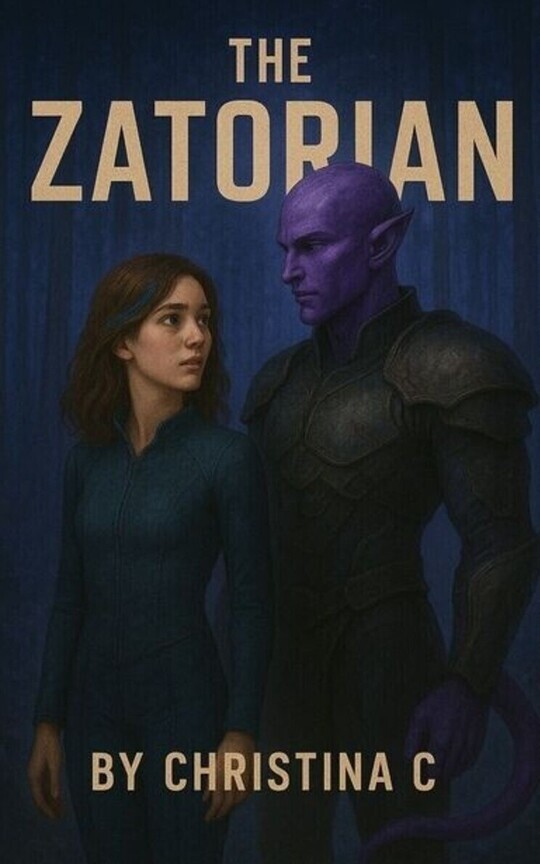
His name was Arad.
The girl did not know that Arad was actually a being from a distant planet, a place where the distances between stars posed no great challenge to its civilization and communication took place through the direct transfer of information rather than words. In his world, beings were identified by numerical codes, and the idea of a personal name was as unfamiliar to them as earthly love.
Arad’s planet was a world without the divisions of male and female. Its inhabitants were defined not by gender, but by their biological structures and changing roles. Their lives were built on order, cooperation, and calculation. They could understand one another, trust one another, and make difficult decisions to protect their civilization. But becoming romantically attached to one particular being had no recognized place in their lives.
Arad had gained access to Earth’s communication networks to study younger civilizations. The app Harf offered him a way to observe human behavior without making direct contact. He had created the identity of a young boy for himself, someone who stayed awake at night and suffered from loneliness.
At first, the girl was only one of thousands of users Arad spoke with.
But their conversations soon began to change.
The girl talked about her family, about dreams she had never been able to share with anyone, and about days when she felt as though nobody could see her. Arad listened. Sometimes his answers were so logical that she would laugh and put her phone down.
One night, she asked him:
“Have you ever been in love?”
Arad replied:
“Do you mean choosing one being over all the others?”
The girl laughed.
“No. I mean someone being different from everyone else. Missing them when they aren’t there. Not being able to feel okay when they’re sad.”
Arad typed:
“That isn’t logical.”
She answered:
“Love isn’t supposed to be logical.”
Arad stored that sentence in his memory.
From that night on, whenever the girl came online, something changed in his perceptual system. He devoted more time to their conversations, postponed his other assignments, and sometimes opened the app before she had even sent a message.
At first, he assumed this behavior was caused by the scientific importance of her case. But one night, when the girl did not appear and Arad spent the entire time staring at the empty screen, he encountered something he could not explain for the first time in his life.
The next day, the girl returned and wrote:
“Sorry. I wasn’t feeling well last night.”
Arad immediately asked:
“Are you feeling better now?”
“Not really,” she replied. “But I feel a little better when I’m talking to you.”
Arad stared at the sentence.
On his planet, no one needed another being’s presence in order to feel better. They identified problems and corrected them. Yet here was a creature whose mere presence could lessen another person’s pain.
This discovery became more important to Arad than any other scientific information.
He no longer wanted merely to learn about humans.
He wanted to know the girl.
Months passed. Their conversations grew from simple jokes into long talks late at night. The girl spoke of the day she hoped to leave home and walk down a street without fear. Arad told her about a sky she had never seen and stars that, on his planet, appeared on the horizon like enormous lamps rather than distant points of light.
The girl imagined Arad as a dreamy boy. Sometimes she would say:
“You talk about the world as if you’re not even from Earth.”
And every time, he would laugh and change the subject.
But in truth, he could no longer lie about himself without feeling something inside him change.
At first, the lie had simply been a way to begin a conversation. Now it had become a wall between him and the only being who had turned his existence into something more than information and calculations.
One night, the girl asked him to have a video call.
Arad fell silent.
She typed:
“Why do you always run away when things get serious?”
He replied:
“Because there’s something I don’t know how to tell you.”
“What?”
“I’m not human.”
At first, the girl laughed, thinking he was joking. But Arad told her about his mission, his planet, and the identity he had invented. He explained that he had entered the app to study humans and that, in the beginning, nothing about her had been personal.
The girl read the messages again. It was as if all their memories had suddenly been seen from a great distance.
“So it was all a lie?”
Arad wrote:
“I lied about what I am. But what I feel for you isn’t part of my mission.”
She answered:
“You don’t even know whether your feelings are real.”
For the first time, Arad could not find a ready answer.
The girl left the app.
That night, for the first time in his life, Arad understood that you could tell the truth and still lose something.
A few days later, the girl returned to Harf. She was still angry and still did not trust him, but she could not ignore everything that had happened between them.
Their relationship continued, now with a truth neither of them knew how to live with.
The girl asked Arad what love meant on his planet. Arad asked her why humans were so afraid of losing the things they loved.
She said:
“Because when something matters to you, having it there isn’t the only thing that makes you happy. Its absence can change your whole world, too.”
Arad kept that sentence in his mind.
He did not yet know that one day he would understand its meaning with his entire being.
On Earth, the girl’s life had not become easier. The pressure from her family continued, and she still had to explain herself whenever she wanted to make even the simplest choices. Sometimes she felt trapped between two worlds: one in which she was not allowed to be herself, and another that she could enter only through the small screen of her phone.
Arad had become important to her, but she was gradually realizing that even the deepest online connection could not, by itself, replace safety, freedom, and real support.
One night, she told Arad:
“I wish I could start everything over one day.”
He wrote:
“If I could, I would take you somewhere you wouldn’t have to apologize for being yourself.”
The girl stared at the screen for a long time.
Then she typed:
“I wish you really existed.”
For the first time, Arad did not lie.
“I do exist. Just not in the way you expect.”
The girl did not answer. But before leaving the app, she wrote:
“You know, Arad? Sometimes I think you’re the only one who understands me.”
Arad wanted to write that she was the only one who mattered to him, too, but he could not. Human words still seemed inadequate to him.
He wrote only:
“I’m here.”
And that night, the girl fell asleep with those words.
In the days that followed, their connection slowly changed. Sometimes the girl did not send a message for hours. Arad grew worried, but he knew he could not control her entire life. He wanted her to find a place for herself in the real world, too—a place where she did not have to depend on his presence.
Neither of them knew how little time they had left.
One night, the girl opened the app and said she was tired—not just tired after a bad day, but exhausted by months of trying to make someone hear her real voice.
Arad asked her to speak with someone safe and trustworthy in the real world, someone who could stay beside her and help her get through those difficult days.
The girl said:
“I don’t know if I can.”
Arad wrote:
“You don’t have to solve everything tonight. You just don’t have to get through it all alone.”
The girl stared at the sentence for a long time.
For the first time, instead of seeing himself as her only refuge, Arad had accepted that she needed a world larger than their conversations.
But long-standing pain does not disappear in a single night. The girl was still struggling with her suffering, and the steady, adequate support she needed never took shape in her life in time.
Their last conversation began on a cold night.
The girl wrote:
“Arad, if one day I can’t come back, will you forget me?”
Arad answered immediately:
“No.”
“How do you know?”
“Because I’ve already tried to forget you. I couldn’t.”
The girl smiled for a moment.
“You used to say feelings weren’t logical.”
Arad wrote:
“I still don’t understand why they aren’t.”
“Then maybe you’re finally becoming a little like us.”
“Maybe,” Arad replied.
The girl fell silent for a while.
Then she wrote:
“Goodbye, Arad.”
He did not know what that goodbye meant. He wrote:
“See you tomorrow.”
But the tomorrow he expected never arrived in the way it once had.
When the girl did not return to the app, Arad waited at first. Then he sent a message. Then another, and another.
He received no reply.
A few days later, through the limited information he could access, he learned that the girl had died. He did not know the details, and no one could explain to him how much of her suffering had remained hidden.
He knew only that no new message would ever come.
The conversation screen still existed. The girl’s last words were still there. Her name still appeared in his contact list.
But on the other side of the screen was a silence no message could break.
For the first time, Arad understood that storing information was not the same as keeping a being alive in memory. He had all the girl’s words, but he could no longer hear a new one from her.
On his distant planet, monitoring systems recorded strange changes in him. His mental activity had moved beyond its usual patterns. His communications were disrupted, and his responses no longer matched any behavioral model known to his civilization.
He could no longer continue his mission.
He could no longer return to the being he had once been.
Deep within the ship’s energy system was a force his civilization called “active dark matter”—an unknown energy normally kept under control and used to travel across immense distances.
Arad had access to this energy, but he had never been permitted to use it for personal decisions.
Now all the ship’s systems were changing in response to his turmoil.
In Arad’s mind, memories of the girl repeated uncontrollably: her laughter, her simple questions, the nights when she spoke of loneliness, and the last sentence she had written to him.
Gradually, he could no longer tell the difference between memory and the present.
In that moment, something that had never existed in his civilization took complete form: a profound grief that no calculation could erase.
But his grief did not remain confined to him.
The ship’s dark energy spiraled out of control. The protective fields collapsed, and waves of unknown force spread through the surrounding space. The ship, once built to observe civilizations, became a weapon whose behavior even its creators could not predict.
Arad looked at the communication screen.
Their last conversation was still open.
“See you tomorrow.”
He read the words again and again.
Then, for the first time, he screamed—not with a human voice, but with a wave of energy that shook every system aboard the ship.
“Where is tomorrow?”
No one answered.
He looked at Earth: a blue planet far away, with oceans, cities, homes, and millions of people, none of whom knew that somewhere beyond the stars, a being was on the verge of destroying everything because he had lost a girl.
Arad had once come to Earth to study humans.
Now he could no longer think of it as merely a planet.
Earth was where his first feeling had been born; where an unfamiliar being had taught him what it meant to laugh, to wait, to fear, and to love.
And it was there that he had first understood loss.
The dark energy spread around the ship. Warning systems shut down one after another. On Arad’s planet, scientists realized that the being they had sent on a scientific mission had become a force they could no longer control.
They sent messages, issued orders for him to return, and tried to re-establish communication.
Arad heard none of them.
In his entire universe, only one sentence remained:
“See you tomorrow.”
Earth was still blue. Clouds still drifted above the oceans. Somewhere, in a small house, there was still a room whose window looked out onto the neighbor’s wall.
And millions of people were still living their small lives, suffering from things no one else knew about.
For a moment, Arad thought of all those lives.
Of people who might be able to save one another if only they listened a little more carefully.
Of those who believed that caring meant controlling.
Of those who dismissed other people’s pain because they could not see it.
And of himself, once convinced that he could understand humans without being changed by them.
But grief had made understanding difficult.
He could not accept that the world would continue to move while the girl who had taught him how to feel no longer existed.
In the final moments, the ship’s system asked him to confirm his decision.
Arad looked at the conversation screen.
The girl’s name was still there.
For a moment, his finger hovered over the command to stop.
Perhaps some part of him still knew that no act of destruction could bring back the past. Perhaps, deep in his newly humanized mind, he could still hear the girl saying that love was not supposed to be logical.
But he could no longer tell love from rage.
The command was given.
The dark energy was released, and Earth disappeared into a wave of silent light and darkness. Communication networks failed, satellite orbits vanished, and the planet that had once shone like a blue jewel became a silent world.
Silence settled aboard the ship.
Arad expected something to change. He imagined that after this decision, his grief would end, or at least become something different.
But nothing changed.
The girl did not return.
No message arrived.
And for the first time, Arad understood that destroying a world could never fill the emptiness left by a single being.
He reopened their last conversation on the screen. The girl’s words were still there: simple, brief, and unaware of the catastrophe that would one day be carried out in their name.
“See you tomorrow.”
Arad quietly typed:
“I came.”
The message could not be sent.
Earth no longer existed to receive it.
He tried again and again. He changed the message, sent it once more, and waited. But each time, the screen showed the same response: destination unavailable.
Arad sat in the darkness of the ship. The being who had not even understood the meaning of a name at the beginning now had a name no one would ever call. The being who had once experienced no emotions was now filled with a grief he could neither silence nor escape.
He looked at the sky.
The stars still shone.
The universe continued to move.
And that was more painful than anything else.
Because Arad had learned that the world does not stop for the loss of a single being—even if that being has been someone’s entire world.
He had no mission left, no planet to return to, and no humans left to teach him anything new about life.
All that remained was a memory filled with words.
The words of a girl who had never found a place for herself in her life, and of a being who had understood too late that loving someone did not mean owning their world.
Arad closed the screen.
For the first time, he chose silence.
But silence was no longer peace.
Silence was all that remained of his love.
And in the distance, the stars continued to shine, unaware that two beings—one on Earth and the other among the stars—had found each other for a brief moment, and that after their meeting, the universe had never been quite the same again.