Championship Point


Four hours and twelve minutes.
That was how long it had taken to strip twenty-three thousand people down to a single, breathless gasp.
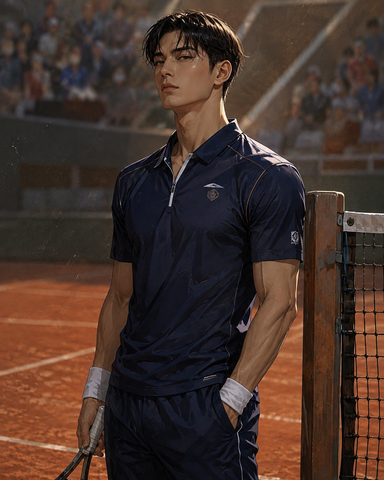
Reyna Cho stood two feet behind the baseline on Arthur Ashe Stadium, his toes digging into the navy-blue hardcourt. The humid New York night air hung thick with the scent of salt, sweat, and overpriced beer. Above him, the massive stadium lights blazed like artificial suns, casting stark, four-way shadows beneath his feet.
Across the net, glowing under those same lights, was Devon Ashworth.
Devon was a mess of raw, violent kinetic energy. His sun-bleached brown curls were plastered to his forehead with sweat. His navy shirt was soaked through, clinging to the broad expanse of his shoulders, and his hazel eyes burned with the kind of desperate, unyielding fury that made commentators use words like savage and relentless.
Score: 6-5, fifth set. Advantage, Cho. Championship point.
Reyna bounced the yellow ball once. Twice. Three times.
Squeak.
His shoes gripped the court. Reyna didn’t sweat like Devon did. He didn’t scream when he struck the ball, and he didn’t smash rackets when a line call went against him. The press called him the Ice King—the reigning World No. 1 who played tennis like an algorithm solving an equation.
Inhale for four seconds. Exhale for four.
Keep the mask on, Reyna reminded himself, catching a glimpse of his father sitting stoic in the player box, hands folded over his coat. Never let them see you bleed.
Reyna tossed the ball into the air.
He uncoiled, hitting the serve with a clean, explosive crack. A heavy kick serve, targeted high to Devon’s backhand.
Devon anticipated it. He grunted—a low, guttural sound that rattled through the court—and lunged to his left, whipping his racket around to catch the ball at its absolute apex. The return was a terrifying, flat missile that skated two inches over the net, landing deep in Reyna’s court.
Good, Reyna thought, his mind instantly mapping the geometry of the point. He’s overcommitting to his forehand wing.
Reyna sprinted right, his thighs burning, lungs clawing for oxygen. He reached the ball on the second bounce’s drop, adjusted his wrist by a fraction of a millimeter, and brushed up sharply against the felt.
A high-risk, angled cross-court forehand winner.
The ball arced over the white tape, dipping sharply, and kissed the outside edge of the sideline before skittering uselessly into the back wall.
Silence hung over the stadium for half a second.
“Game, set, match, and championship: Cho!” the umpire boomed into the microphone.
The stadium exploded. Twenty-three thousand fans erupted into a wall of deafening noise. Flashbulbs detonated like strobe lights across the dark stands.
Reyna didn’t drop to his knees. He didn’t tear his shirt open or weep into the acrylic hardcourt like other champions did.
Instead, he stood straight, exhaled a single, long plume of hot breath, and slowly brought his hand up to unclip his sweatband. Internally, his chest was a dying star. His heart battered violently against his ribs, his pulse screaming at two hundred beats per minute, his body desperate to collapse under the weight of sheer exhaustion.
But the cameras were zooming in. The world was watching. So, Reyna smoothed down his collar, adjusted his racket in his right grip, and assumed his armor: calm, unreadable, untouchable.
He walked slowly toward the net to perform the mandatory ritual.
Devon was already there, leaning his heavy frame against the white cord, breathing in ragged, shallow gasps. Sweat trickled down the sharp line of his jawline, dropping onto the mesh. He looked like a fallen titan—battered, furious, and devastatingly alive.
“Great match,” Reyna said, his voice smooth, controlled, and carefully stripped of triumph.
He extended his right hand.
Standard protocol dictated a two-second handshake: a quick squeeze, a nod of mutual professional respect, and a turn toward the umpire.
Devon took Reyna’s hand.
The contact hit Reyna like an electric shock.
Devon’s palm was burning hot, rough with heavy calluses, trembling slightly from the sheer influx of spent adrenaline. But instead of a brief, polite tap, Devon’s fingers locked around Reyna’s hand with crushing, possessive force.
Reyna froze.
Devon pulled him an inch closer across the net. Up close, Reyna could smell him—salty sweat, grip tape, and something entirely Devon: wild, warm, and dangerous.
Devon leaned in, his hazel eyes locking onto Reyna’s dark ones with a terrifying, unfiltered intensity. There was no hatred in his look. There was something far worse: a blazing, dangerous, total obsession.
“Next time, Cho,” Devon rasped, his voice deep, gravelly, and laced with a heat that had nothing to do with the New York humidity. “I’m taking it from you.”
Reyna’s breath caught in his throat. His pulse, which he had spent ten minutes trying to slow down, spiked violently into his throat.
Devon didn’t let go. One second passed. Two seconds. Three seconds.
In front of a hundred international broadcast cameras, their locked hands sat suspended over the net, a private electrical storm raging between them while the rest of the world cheered for a trophy.
Reyna felt a sudden, terrifying urge to slide his thumb over the back of Devon’s knuckles. The realization panicked him so thoroughly that he pulled his hand back, stepping out of Devon’s personal space.
“You’re welcome to try, Ashworth,” Reyna managed, his tone clipped, cool, and perfectly defensive.
Devon offered a tiny, bitter smirk—a flash of white teeth against flushed skin—before turning on his heel and marching toward his bench, slamming his rackets into his bag.
Ten minutes later, Reyna stood at the center of the court under a shower of silver confetti, hoisting the heavy sterling-silver US Open trophy above his head. The cameras flashed. His father gave a single, stiff nod of approval from the front row of the box. His sister, Min-Ji, clapped enthusiastically, blowing him a kiss.
Reyna smiled his practiced, media-trained smile. He said all the right things into the microphone about his training regimen, his respect for the tournament, and his dedication to the sport.
When the ceremony finally ended, Reyna walked down the long, concrete player tunnel toward the quiet sanctuary of the locker rooms. The heavy silver trophy rested under his left arm, cool against his ribcage.
He stopped outside his private locker, alone at last in the quiet hallway.
Reyna lifted his right hand—the hand that had held the championship racket, the hand that had lifted the trophy. He looked down at his palm. The skin was still tingling, flushed red, practically humming with a persistent, terrifying electricity.
He closed his fingers into a tight fist, but it did nothing to erase the feeling.
Reyna Cho had just won his fifth Grand Slam title. He was the undisputed World No. 1. But as he stood alone in the dim stadium corridor, all he could feel was the phantom heat of Devon Ashworth’s hand burning straight through his skin.