
Chapter 1
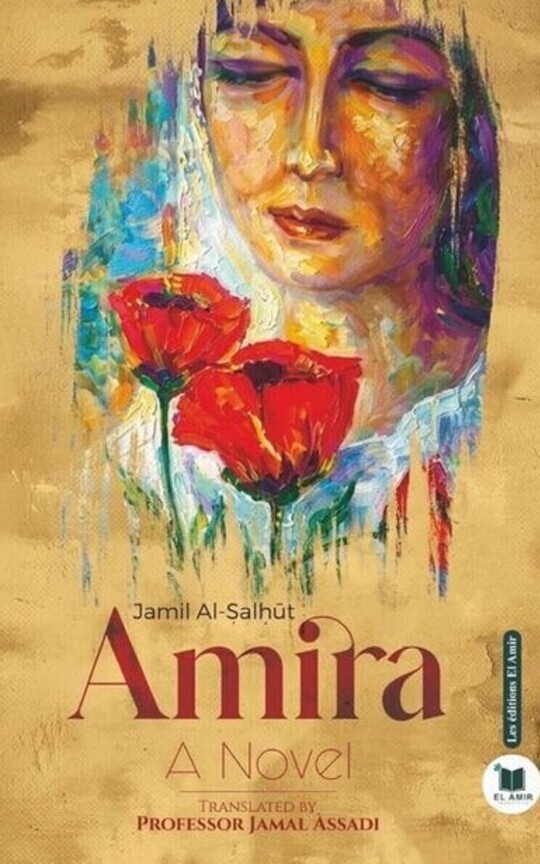
Amıra
A Novel
Translated by
Professor Jamal Assadi
Disclaimer
All names appearing in this novel arefictional, except for the names of theleaders. Any resemblance to realpersons is purely coincidental.
5
Dedication
To those who carried theirhomes within them, when the doors of those homes were closed.
To the mothers who hidtheir grief so that theirchildren might endure,
To the fathers who stood betweenloss and dignity, and to those who gave their lives so that others mightremain,
To every child who grew up betweenmemory and
absence,
learning belonging before return.
Furthermore, to all whocontinue to wait—not for the past to return
but for justice tobe fulfilled, this book is for you.
Introduction
This volume forms part of a sustained intellectual and literary engagementwith the work of Jamil al-Salḥūt, whose fiction occupies a distinctive place within modern Arabic narrative. His writing does not merely recount events; it reconstructs the lived realities ofPalestinian society at the level ofeveryday life, where the private and thecollective intersect, and where the smallest gestures carry the weight of history, tradition, and socialexpectation. The present translation isthe fourth in a series of works I have translated from Al-Salḥūt, followingThe First Night, Al-Wabsh (TheDegenerate), and The Widow. Thesetexts are not isolated productions;rather, they constitute a loosely connected narrative field through which recurring concerns —intimacy, social control, gendered experience, and moral judgment— are explored across different contexts and narrative situations.
To read these works sequentially is toobserve a movement that is boththematic and structural. The First Nightenters the most intimate domain—the conjugal space—and demonstrates howeven this sphere is permeated bycollective expectations andsurveillance. The private momentbecomes public, and personal experience is subjected to communal interpretation. Al-Wabsh extends thisdynamic, revealing the mechanisms through which fear, superstition, and social anxiety are transformed into systems of exploitation, where individuals —particularly women— become vulnerable to manipulationunder the guise of cultural or religiouslegitimacy. The Widow, in contrast,shifts the narrative focus toward loss, endurance, and the ethical complexity of continuation. It explores how individuals, especially women, navigate the aftermath of rupture — how theyinhabit grief while remaining exposedto the same social structures that shapedtheir earlier lives.
1
The joy of ʿAbbās Ṭāhir al-Maḥmūd was beyond description when the faceof the midwife, Katerina, appeared atthe door of his wife’s room, asking himfor the customary reward as sheannounced the good news. Her voicebrimmed with happiness as she said:“God has blessed you with a bride as radiant as the full moon…”
He smiled at her and replied, “Yourreward is an English gold lira, set andhung on its chain.”
“God willing, she will live in comfortand prosperity,” she said.
“But reassure me,” he asked. “How isSaʿdiyya? May I see her now?”
“Wait a little,” she answered. “She is exhausted from childbirth—this is her first.”
“Praise be to God,” he said. “This is agood omen for us. I will name her Amira—for she will be the princess ofmy heart.”
Katerina returned to the room, whereSaʿdiyya lay with her mother and hermother-in-law seated beside her. Themother-in-law, Umm ʿAbbās, said, “Ihad hoped for a boy, someone to be his father’s support.”
The midwife Katerina replied, “She who bears daughters will bear sons aswell. And if your son ʿAbbās heardyou, he would be upset. When I toldhim it was a girl, he was overjoyed. Hepromised me an English gold lira withits chain and said he would name herAmira, because she would be theprincess of his heart.”
Umm ʿAbbās frowned and said, “Why the rush to name her? In anycase, we are living in times whenneither a boy nor a girl is of any use… Ithought he would name her Khadīja,
13
after me. But God is sufficient againstthe oppressors and the sons of bastards.”
Saʿdiyya turned toward her mother,and the two exchanged knowing glances.
At that moment, ʿAbbās’s voice rose joyfully from the house balcony as he called out to Saʿīd, the worker in the orchard, saying:
“Slaughter three rams. One you andyour colleague Fayez may share—takeit to your families. The second, cut it inhalf: half for the midwife Katerina, andbring one and a half to the kitchen.”
“Has the lady of the house givenbirth?” Saʿīd asked.
“Yes. God has blessed us with Amira.”
“Blessings upon her, God willing—and may sons follow.” “And don’tforget,” ʿAbbās added, “from todayand for the
next three days, whoever wants orangesor lemons from the
orchard for household use—take nopayment from them. This is our thanks to God for blessing us with Amira.”
“God willing, she will grow up incomfort under your care.”
At that moment, the midwife Katerinacame out and asked permission toleave. But ʿAbbās swore that he wouldnot allow her to depart before havingdinner at their house, and that he himself would drive her in his private car to her home in the Ajami neighborhood of Jaffa. The distance between Bayt Dajan and Jaffa was notlong—only nine kilometers—and the drive would take no more than ten minutes.
Katerina had no choice but to yield to the master of the house, and shereturned to Saʿdiyya’s room with asmile.