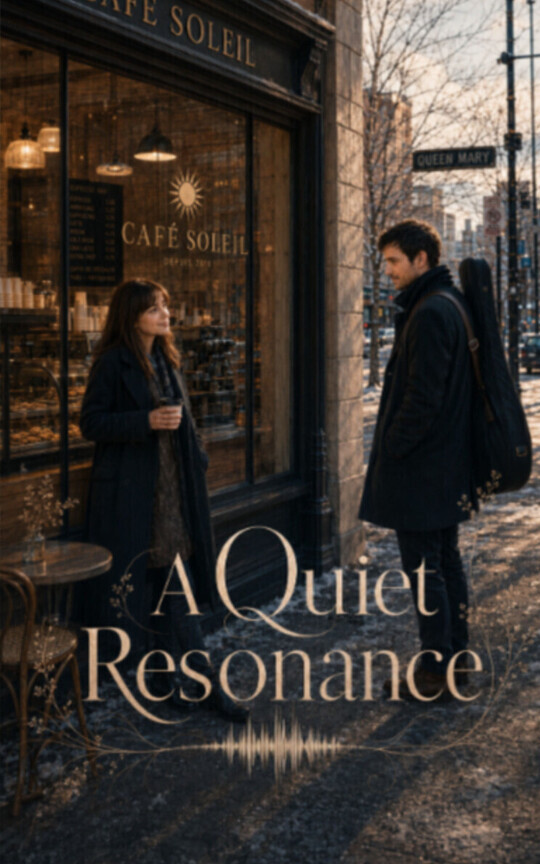

Long Enough to Learn a Route
The cold hadn’t broken yet. Mid-March in Montréal was a liar: the sun showed up at a promising angle and you thought, okay, maybe, and then the wind came off the mountain and your face remembered what month it was. The snowbanks along Queen Mary had gone the colour of old concrete. Everything was grey and brown and salt-stained, the city wearing its worst outfit, daring you to love it anyway.
I was working on it. Ten weeks wasn’t long enough to love a city. It was long enough to learn a route.
Mine went like this: out the door of the apartment I shared with Ruby, down the hallway past the neighbour’s mat with the salt stain shaped like Australia, down the stairs and out into the cold. South on Victoria. West on Queen Mary.
Then the part my feet had before I did. Grit the whole way, February’s salt ground into March’s ice, a dry scrape underfoot that got into my teeth. Past the Subway and the bagel place that made the block smell like sesame and wood smoke on mornings when the wind was right. Past the Pharmaprix. Past both Jean Coutus, which I still found absurd. Two of them. Within four blocks of each other. The neighbourhood couldn’t commit.
Past Snowdon métro, where the grate breathed warm air up the backs of my knees, hot brakes and something like peanuts. I’d started slowing down for it. Then the produce markets with their crates of clementines stacked on the sidewalk. Cold takes the smell out of everything. You could stand in front of forty kilos of citrus out there and get nothing at all. Clothing boutiques I couldn’t afford and Ruby would have lost her mind in. Twenty minutes door to door, slower if I stopped to buy a coffee from the place on the corner that wasn’t as good as what I made at work but gave me something warm to hold.
I didn’t always buy the coffee. I bought it when my hands needed something to do. Which was most mornings.
Today, no coffee. Just the walk, the first breath of it going down like something swallowed wrong, my bag heavy with flashcards for the OQLF French exam I should have studied for last night. Instead I’d stayed up in Stardew Valley trying to get a blue chicken. Shane had shown me his once he trusted me, and I’d married Shane, so I felt I’d earned one. Marnie kept offering me white ones. Brown ones. More white ones. I kept trying. Then, close to midnight, a blue one. I named her Periwinkle.
The flashcards were still in their elastic. The exam was months out and I still hadn’t booked it. It wasn’t the French. I’d had the French since I was five, and the clinical words were all there on the cards in my own handwriting. If it had been the French, I’d have known what to do about it. Booking it would take five minutes. I kept not taking them. I could have skipped ahead. Québec’s nursing order, the OIIQ, would have given me a temporary permit and let me work the floor with the exam still out in front of me, a date I’d keep letting slide. I didn’t want it like that. The exam first, squared away, before I stood at anyone’s bedside in this province. One thing at a time.
I would study tonight. I had said that yesterday.
A woman passed me on the sidewalk, pushing a stroller with a newborn who was furious about something. Existence, probably.
She was pale, breathing a little quick for the pace she kept. She favoured her left side when she bent to tuck the blanket back in, careful about the reach. Something healing, maybe. A C-section, possibly. Iron, maybe, for the pallor. I hoped somebody at home was carrying the stroller up the stairs for her. She didn’t know I’d seen any of it.
Knock it off, Julie. She’s a stranger on a sidewalk. She didn’t sign up for this.
I couldn’t stop.
The café paid rent. The café was fine. Nobody there needed me to notice who was breathing too fast. Today the café was making lattes. The nurse could wait.
There was a song stuck in my head. The one Ruby had on last night while she drafted. I didn’t know the band. I didn’t know most of the lyrics. I had the chorus and a couple of lines from the second verse and my brain had been running them on loop since I got out of bed, with the missing words filled in by whatever approximate noise made the metre work. I’d been humming it into my scarf since Victoria without noticing, and the wool had gone damp where my breath kept landing.
Something something I keep coming back. Something something in the dark. Or the park. Probably the dark.
The walk still had things in it I hadn’t learned. I hadn’t memorized which produce market had the better avocados, didn’t know which intersections had that Montréal timing where the light changed before you expected it, and my ears had gone past aching into the numb part under the hat. In Timmins, seven hundred kilometres northwest, this would have counted as a mild morning. Ruby said the cold here was wetter and got in differently, and that I’d stop noticing. She’d grown up in Timmins too, same high school, same hallways, and she’d been here longer. She had come first, found the apartment, said there’s a room. Didn’t ask if I was sure.
Her mom still called every Sunday with the weather up there and news about people I’d trained myself to stop thinking about, and before she hung up she always asked for me. My father was dead. My mother was alive and had been a person I did not talk about for longer than I had been an adult.
I had left in January. Packed my own car with what fit and drove nine hours south without stopping.
Not even at Cordelia. Cordelia is the halfway point and it had been a rule my whole childhood. The diner with the brown vinyl, grilled cheese and black coffee and a chocolate milk, then the arcade across the road. Both directions. Forty minutes added to every trip my father and I ever took anywhere. I could still taste it, the cheese gone orange at the edges, the coffee too hot for a kid to be allowed and drunk anyway. I came up on the sign a little after three in the afternoon with my hands at ten and two and my jaw aching from however long I’d been holding it, and I kept my eyes on the road, and I drove past it. Stopping would have meant thinking. Thinking would have meant turning around.
I didn’t turn around.
My thumb pressed the side of my middle finger. Small circles. The cold was making my cuticles worse. I had been picking at the skin around my index finger since I left the apartment. I stopped. Tried to. Started again without noticing. The skin around my thumbnail was raw. I caught it between my teeth and tasted copper.
Café Soleil appeared on the corner at Earnscliffe, wedged next to the TD bank. Gold lettering on the window, and the little sun Mimi had drawn herself and was unreasonably proud of. Eight rays, one of them shorter than the rest, because she had run out of napkin.
I pushed through the door and the warmth hit like a wall: espresso, browned sugar from the pastry case, the humid press inside a small room where the ovens had been going since before dawn. Underneath it, cardamom from whatever Mimi was proofing in the back.
Ashley was already behind the counter, apron on, phone propped against the register, dark curls pulled into a knot that was somehow still styled.
“You’re late,” she said without looking up. Her thumb kept moving on the phone.
“I’m on time.”
“That’s late for you.” She was already moving, lining the milk jugs along the steam wand, quick, three things going at once and none of them me.
She wasn’t wrong. I dropped my bag in the back and hung my coat on the second hook. The first one still hung crooked off its screw, as it had the morning Mimi hired me. I tied on my apron. The strings had a small coffee stain near the knot from last Tuesday’s oat milk incident. My fingers were stiff from the walk, slow on them. I tightened the bow twice.
Mimi was in the kitchen, her radio tuned to the same French talk station, voices debating something political with the casual intensity of people who would never agree and didn’t want to. She came out of the back long enough to set a plate at my elbow, one of the cardamom buns, split and buttered, and was gone again before I could say anything about it.
I ate it. The bun gave under my thumb where she’d split it, the butter already gone to liquid in the seam, and it was finished in four bites before I’d decided to be hungry. I said thank you anyway, to the kitchen door.
By nine the café was half-full. Three regulars I knew by now, two faces I hadn’t seen before. The espresso machine hissed. Ashley’s phone buzzed. Outside, someone’s dog was tied to the bike rack, watching the door with an optimism I found both moving and delusional.
Max arrived at 9:20, twenty minutes early. I had learned to expect it. I’d have minded, now, if they’d come on time. They went straight for the espresso machine, coat off in one motion, and pulled a shot. Tasted it. Frowned. Adjusted something on the grinder. Pulled another. A small ritual that would have read as fussy from anyone else. Coffee was one of maybe three things in the world Max was like this about, and I was still working out the other two.
“How is it today?” they asked, settling in beside me with the cup they had deemed acceptable. They wrapped both hands around the mug, testing the temperature before they drank.
“Quiet.”
“Good. I need quiet. My smoke alarm decided at midnight that it was dying and then took until three to prove it.”
“That explains your face.”
“My face is fine.”
Max took a careful first sip, eyes closing briefly. Assessment in progress. They lowered the cup. “I crushed you in Mario Kart last night, by the way. You’re getting worse.”
“I let you win.”
“You drove into the ocean. Twice.”
“Strategically. Did you at least kill the smoke alarm?”
“I negotiated with it.” Max took another sip. “It chirps every forty seconds. I know that because I timed it, because at one in the morning timing it felt like progress. I stood on a chair and pressed the button with the broom handle, and it turns out that’s the button that makes it chirp louder. So I took it down, and it went on chirping in my hand, which felt personal. It’s in the drawer with the tea towels.”
“Max. You need one on the ceiling.”
“I know.” They looked into the cup. “I’ll buy one on the way home.”
Ashley was talking to a customer at the register now, laughing too loudly at something. She had come at me like weather on my second day, all volume and lip gloss and asking me things nobody else was asking. I’d answered more of them than I’d meant to. Mimi ran the kitchen and the radio and the café and had never once asked me where I came from.
Ashley’s phone buzzed again. She flipped it over, then picked it straight back up.
“He sent me a poem.”
“Who?” I asked.
“The Bumble guy. At two in the morning.”
Max set their cup down. “Does it scan?”
“I don’t know.” She scrolled back to the top. “What do you even say to a poem?”
“Did you like it?” I asked.
“Yes. Some of it.” She held the phone toward me, then drew it back before I could read. “It’s embarrassing.”
“For him?”
“For me. I was going to show you and now I don’t want to.”
“Then don’t.”
She kept reading. She was smiling at it now. I looked down at the milk jugs before she caught me smiling too.
Mimi came out of the kitchen with another tray and stopped beside the pastry case.
“How much cardamom is left?”
“Nearly gone,” I said. “There’s plenty of almond.”
“Put those at the front. The next batch needs a few minutes.” She set the tray down and looked toward the register. A customer was waiting there. “Ashley.”
Ashley slipped the phone into her apron and went to serve him. I moved the almond pastries forward while Mimi made room behind them, lifting the empty tray out over my hands.
When the customer left, Ashley came back.
“I said thank you. And that I liked it.”
Max reached for their cup. “Can I read it now?”
“Later. You can’t read it out loud.”
“All right.”
She took the phone out again and held it out to Max.
Ten weeks and these three. That was more than I usually managed.
Outside, Montréal was still pretending it was almost spring. I was still learning its streets, and I wanted it to stay that way.
The bell went over the door. Cold came in as far as my ankles. I reached for the milk.