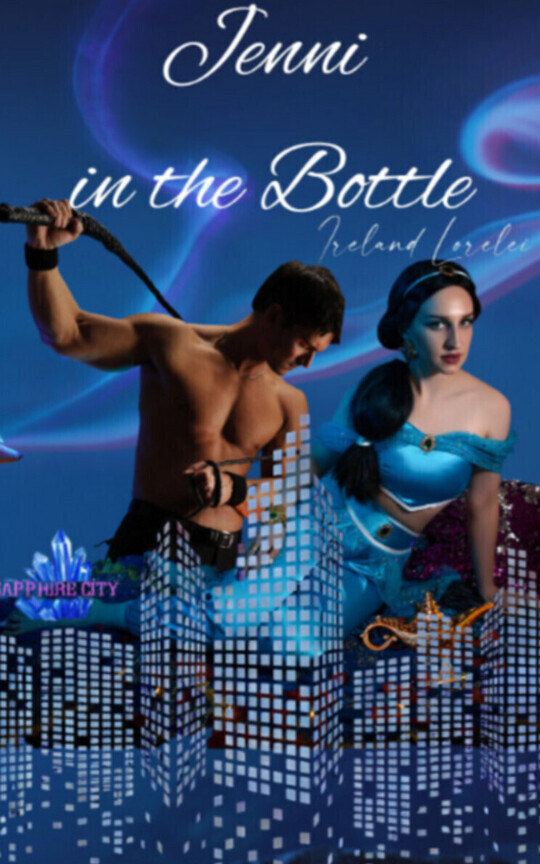

Centuries of Solitude
Jenni Almasi
I brace myself as the world lurches again, the merchant’s cart is hitting every treacherous crack in Sapphire City’s ancient roads. The jolt rattles my prison, clanging glass against brass. Inside, my limbs are flying everywhere, and my hair is slapping me in the face from all directions. The bottle is just large enough to let me coil upright waist-length obsidian hair splaying like a living inkblot against the convex walls, my skin an uncanny, almost radioactive white where the sunlight penetrates the cage’s fretwork.
The bottle is constructed from thick, faintly green hand-blown glass marked by age. The exterior features gilt filigree with scrolling leaves, detailed flower petals, and a frieze of scarabs. The gold was soldered to endure beyond the life of its original owner. At times, the craftsmanship is notable, and the recurring patterns in the latticework resemble repeated cycles or periods associated with different owners.
Outside, the sun beats down, lighting up the bottle and making its interior a blur of colors. I never blink; every bit of dust inside is visible. The filigree throws shifting light and shadows over my skin. All of this brings back memories. The first scream is from my memory as a sultan seals me inside with incense and fear. His breath smelled of cinnamon and decay. He demanded gold, and I gave it, because refusal was never an option.
The present reasserts itself with the next judder. The cart’s canvas roof is tattered and thin, admitting orange wedges of late morning sun. Through the bottle’s distortion, I glimpse a ceiling of dust and pigeons. The city’s market roar seeps through glass as a muddy tumult: men hawking everything from olives to knockoff perfumes, a woman laughing with serrated delight, an undercurrent of radios blaring soccer scores, and, above all, the honking horns so insistent you’d think they were protesting their own existence. There is a secondary rhythm, older and more honest, in the staccato of haggling and the stuttering wail of children denied sweets.
Another bump. I slam shoulder-first into the bottle’s wall, feeling the impact with an intimate, almost carnal clarity. The force brings in a memory of an Englishman in military garb, crimson-faced and wild-eyed, forcing my bottle open with shaking hands. Victorian Sapphire City, all cigar smoke and stone dust, soldiers like pale ghosts flooding the bazaar. This colonel wanted vengeance, so I gave it to him. The memory returns not merely as a simple recollection, but as a vivid and immersive experience. The distinct smell of gunpowder, the metallic scent of blood, and the silent shock as numerous lives were lost at his command.
I hate these memories not for their pain, but for their accuracy. I cannot edit them, cannot occlude their details. They surface at the whim of trauma and caprice, as if the bottle itself delights in torturing me with a greatest-hits reel of servitude. Sometimes I try to will them away, focusing instead on the here and now: the shimmer of gold across my knuckles, the faint hum of market day, the way the bottle’s base vibrates against the merchant’s wagon floor. But the past always comes crawling back.
The world outside glides by in smeared fragments. A wall covered in bright bougainvillea stands out against the brown dust; a confident young boy weaves through traffic, and women, some unveiled, bargain for vegetables. Through the distortions of glass, all faces are mask-like, eyes round and slightly alien, voices warbled as if underwater.
I try to guess the hour by the flavor of the sunlight. Morning brings a buttery softness; midday is sharp, medicinal, bleached. This is neither. It is late enough for the shadows to stretch thin, late enough that the air should be cooling. I know the cart is headed toward the oldest part of the city, because I can smell the river, even through the must of the bottle and the merchant’s cheap cologne.
Sometimes, in moments of private rebellion, I imagine what it would feel like to be free. But I have learned that with every change of a master, I have been carved down. I am more shape than substance now, and the shape is defined by this bottle: five inches wide at the belly, tapering to a neck so narrow I could choke on it. There is always a stopper, though the material changes, sometimes glass, sometimes cork, once a plug of human bone. I have tried, in every way imaginable, to break the seal from within. My fingernails have reduced themselves to translucent scraps. My voice, when I shout, rebounds and rebounds until I almost believe the echo is another Jenni, trapped alongside me, mocking my effort.
There was a day, a few centuries ago, when someone tried to free me, a woman. I remember only fragments: her hands, small and delicate; her eyes, so dark they swallowed the candlelight; the whisper of her scarf as she twisted it into a makeshift glove. She cradled the bottle as if it were a newborn, cooed at it, and pressed her lips to the glass. I had no words for gratitude, but I tried to send her what warmth I could. In the end, it was the man beside her, her husband, who wrenched the bottle away and flung it into the sea. For a few blessed decades, I knew only water, salt, silence.
The present day is less forgiving. The world has grown noisier, brighter, more crowded. It bombards even those who want nothing more than to be left alone. The merchant driving the cart is old, but not ancient. His hands are pocked with age spots, veins bulging like blue rope beneath the skin. He speaks to himself as he rides. I cannot make out the words. I wonder if he suspects what he carries. Most of them do not. They see only the craftsmanship, the novelty. Even those who know the legends of the three wishes and diabolical bargains assume it is nothing more than that, a legend. Sometimes they rub the glass, expecting a genie to pop out like a party trick, and when nothing happens, they sigh and move on to the next curiosity. I am almost grateful for their ignorance. The worst masters are those who believe.
A sharp turn nearly tips the bottle. I right myself, cursing as my head knocks against the gilded cap. The merchant has hit a traffic snarl; he shouts at someone, then mutters a prayer under his breath. A child, emboldened by the chaos, darts up and tries to grab something from the wagon’s open back. The merchant’s hand flashes out, smacking the child’s knuckles. The boy vanishes, yelping, but not before I see the wolfish grin of triumph on his face. The city breeds thieves and survivors in equal measure.
Through the bottle’s warping, I glimpse a banner: Al-Hussein Bazaar, painted in fading blue. The cart slows, and the air thickens with the smell of roasting meat, petrol, and hot stone. We have arrived. The merchant climbs down, groaning as his knees crack. I hear him unlatch the wagon’s side and begin unloading his wares. Pots, mirrors, a set of tarnished brass scales, a pyramid of cheap teacups. He handles each object with a thrift-store clerk’s carelessness, but when he comes to my bottle, his whole manner changes. He wipes his palms on his robe, then reaches in gently, as if retrieving a heart or a bomb. His fingers, dry as parchment, close around the neck. He lifts me out, and for a moment, I am suspended in midair, seeing the whole bazaar refracted through a thousand golden grids.
He polishes the bottle with a square of velvet, then holds it up to the sun. To any onlooker, I am just a shimmer inside the glass: a trick of the light, a flaw, a hallucination. But he pauses, staring hard. Perhaps, in a half-remembered childhood story, he recognizes something, or perhaps he admires the effect, already counting the profit he’ll make from some credulous foreigner.
He sets the bottle on a table draped in blue and white stripes. I slide down to the base, curling my body to fit the curve. From here, I can see the crowd passing by: women in jeans and tank tops, men in football jerseys, tourists with cameras dangling from their necks. No one looks twice at the bottle. I am simultaneously invisible and on display.
A tremor runs through me. This memory is not of violence but of hunger. A desert, sun-bleached and infinite, a caravan master bargaining for water. He opened my bottle with hands trembling from thirst, and his first wish was for rain. I gave it to him, and for a day, the sand blossomed with life. The second wish was for a woman to love him, but I could not fabricate love, only the illusion of it. By the third wish, he wanted only oblivion. I granted that, too.
I hate them for their weakness, but I hate myself more for being their instrument. I do not know if I am capable of kindness, but I sometimes long to try.
The merchant is negotiating with a customer now. Their words mesh and overlap, each syllable tinged with the music of commerce. I lean in, focusing on the nuances. I can always tell who will buy me by the way they touch the bottle. Some with awe, some with fear, some with a casual indifference that burns worse than hate. I play the game, shifting my pose, altering my shimmer, anything to catch the right eye or avoid the wrong one.
This man is rich. His suit looks sharp. He runs a thumb along the bottle’s neck, then examines his finger as if expecting it to come away gilded. The merchant makes his pitch, gesturing at me, recounting whatever lies he thinks will loosen the man’s purse strings. The customer listens, impassive, then snaps his briefcase shut and walks away. I exhale.
Dusk is coming. I can feel the city softening, the market’s chaos mellowing into a din of quiet deals and satisfied exhaustion. I know my reprieve is temporary; someone always buys the bottle, eventually. My only hope is that the next owner is careless or kind, or that, just once, the stopper will shatter on opening and let me vanish into the night. But until then, I am here.
***
The next morning brings a rude awakening. The shriek of hinges, a slap of sunlight, and the whip of heavy cloth as the merchant peels back the wagon’s covering. My world, previously a half-lit aquarium, explodes into a sea of glare. I am momentarily, authentically, blind. Sun drills through the glass, ricocheting from every tiny imperfection until the bottle becomes a chamber of white noise and afterimages. I curl tight, eyelids squeezed, waiting for my vision to adapt.
The merchant’s hands descend, thumb and forefinger bracing the neck. His nails are thick, yellowed, with years of grime pressed into the crescent moons. He rotates the bottle in slow, deliberate increments, holding me up to the light to inspect for cracks or, God forbid, leaks. He then sets me down and wipes the outside with the edge of his sleeve, careful not to smudge the gleam. The ritual is both for his benefit and for the crowd’s: here, he says, is something precious, something worth your attention.
From my vantage, the bazaar is a study in the absurdity of contrasts. The old city is still there, crusted in stone and tradition. There are baskets of dried herbs and beadwork hanging from battered nails. But the new city keeps leaking in, one knockoff at a time. I watch a woman in a black abaya haggle over the price of a Bluetooth speaker shaped like a cartoon panda. Two boys, faces sticky with syrup, take selfies in front of a plastic sphinx, their laughter pinging off a row of satellite dishes. Every transaction is overseen by some remnant of history: an Ottoman minaret, a mural of Nasser in faded navy, a writhing tangle of phone cables strung like party streamers above the chaos.
All of it filters through my bottle’s curved surface, so nothing is quite as it should be. Faces elongate or compress, depending on the angle. Eyes multiply, mouths blur. Sometimes I imagine myself as an insect, gifted compound sight and condemned to see the world fractured forever. Other times, it is a crueler trick: the glass makes everything appear closer, more intimate, than it really is. A couple arguing over soccer scores suddenly seem to be screaming directly at me, their breath fogging my personal space. A passing hand, raised in laughter, becomes a giant’s fist poised to shatter my cage.
But I am not helpless. I have been observing for a very long time, and I am a connoisseur of human intention. I can tell, for instance, which tourist will be most susceptible to the merchant’s patter. I know by the tilt of a wrist, the distracted flick of a thumb across a phone screen, who is truly hunting for treasure and who is only killing time before their next air-conditioned café. I can spot the ones with money; they move differently, seem more entitled, and appear more bored. I can also spot the ones with hunger, the ones who touch things and then return them, as if it costs them a piece of their own skin. The best, though, are the children. They look at everything as if it might bite them, or offer up a miracle, or both.
Today, a boy about eight years old is the first to spot me. He tugs at his mother’s sleeve, points, and whispers something I can’t hear. The mother looks up, frowns at the price tag, and shakes her head in disapproval. The boy is not discouraged. He returns twice, circling the table, always with his hands tucked safely behind his back. I give him my best smile. The one I practiced for centuries in the hope that someone, somewhere, might find it disarming rather than eerie. His face opens in astonishment, like a flower punched into bloom by a sudden rain. But his mother is already halfway down the row, and he scampers after her.
The morning advances, and so does the game. The merchant is now in full theater mode, beckoning passersby with exaggerated gestures, offering the bottle for inspection, and sometimes even uncorking the cap to let buyers sniff at the empty air. He tells a different story each time: this one is cursed, this one belonged to a caliph who lost his mind from its power. My favorite story is the most outrageous one of all. The one that the bottle contains the soul of a dead queen, waiting to be reincarnated. I suppose, in a way, it does.
I scrutinize every potential buyer, just as a predator scrutinizes its prey. I catalog them: the American tourist in white sneakers and a sunburn so fresh it glows; the German couple, both gaunt and severe, discussing the filigree’s merits in clipped English; the local businessman who paws the merchandise with a practiced, almost lascivious touch. I have learned to read character in the hands, not the faces. The greedy ones squeeze too hard, as if they could wring wishes out of me like juice from a fig. The cautious ones barely graze the glass, wary of contagion or disappointment. The sad ones cradle the bottle as if it might offer up comfort, or a better past.
I rehearse, as always, the role I’ll have to play next. Some masters want a slave. Some want a muse. A few, the most dangerous, want a lover. I have performed every part, sometimes all at once, and the only thing that never changes is the mask. I must smile and bow, and offer wisdom or power or solace, while inside the core of me dries out a little more with every transaction. The scripts vary, but the structure is eternal: Three wishes, yes, but at a price. What price? That, of course, is the catch.
In rare moments, I dream of improvising, of inventing a persona so persuasive that the master will unstopper the bottle, then throw it away, convinced the real magic is elsewhere. But I have never been quite brave enough, or perhaps I am only too well trained. The centuries have left me polished and brittle. There is no escape hatch, only the next act.
Midday, and the heat turns everything gummy and slow. The merchant fans himself with an advertising flyer, eyes hooded, waiting for the next rush. The crowd shifts: more tourists, fewer locals, a gaggle of teenage girls in matching pink hijabs and Doc Martens. They drift past my table, giggling, but one lingers. She reaches out, her index finger tracing the bottle’s silhouette in the air, just short of touching. Her nails are painted a defiant black. She leans in close, peers at the interior, and for an electric instant, I think she sees me, truly sees me, in all my haunted glory.
But then she shrugs, says something to her friends, and the moment passes. I exhale, the way you do when you are caught between hope and dread.
Afternoon brings the inevitable: a buyer with an agenda. He is tall, balding, with a shirt so starched it could slice bread. His wrist bears a watch worth more than the merchant’s entire stall. He is accompanied by a woman who wears sunglasses indoors, her lips painted a color never found in nature. They approach the bottle together, twin predators scouting a kill.
His hands are immaculate. The first thing I notice before the tailored suit, the mirrored sunglasses, the aftershave that arrives before he does, is the trim precision of his nails. They are cut glass, so smooth the sunlight ricochets off the half-moons, leaving streaks of glare in my eyes. When he lifts the bottle, he does not cup it, but grips the neck as a man might a snake: with both contempt and anticipation.
He is the kind who knows what he wants. Every word, every gesture, is a blade. He slices through the merchant’s opening price with a short, derisive laugh, then counteroffers at a quarter of the value, all without ever meeting the merchant’s eye. His thumb taps a staccato against the face of an obscenely expensive watch, an import, gold, possibly custom-made. The band is tight enough to leave a ghost impression in the skin.
The merchant holds his ground, but I can see the sweat start to collect in his mustache. He launches into a fevered defense of the artifact’s provenance, layering lies like lacquer. The bottle, he claims, is pharaonic, unearthed from a dig in the shadow of the pyramids, blessed by priests and sealed with a curse no sane man would dare invoke. His voice quivers at the word “curse,” a practiced tremolo designed to thrill and terrify. My buyer listens, impassive, the corners of his mouth twitching in what might be amusement or disdain.
Inside the bottle, I study him with all the forensic precision that centuries of servitude have bred in me. His cologne is French, understated, meant to evoke power without betraying effort. His suit is bespoke, the fabric a deep, improbable navy, with a lining so subtly iridescent it must have cost more than the merchant’s annual rent. The shirt cuffs peek out at precisely the right length. There is a faint, almost invisible scar just above the knuckle of his left index finger. He is not young, but his movements are youthfully impatient, as if he resents the friction of aging.
I press myself against the glass, watching for the fissures in his performance. The final offer comes not as a question but a verdict. The merchant, faced with extinction, surrenders with a grand, theatrical sigh and names his lowest acceptable price. My new owner nods, flicks open his wallet, and pays in crisp new bills.It is almost a relief, the inevitability of it. For a moment, I allow myself the delusion that this time will be different, that the buyer will admire the bottle for its beauty, place it on a shelf, and leave me undisturbed for a few more years. But even as I think this, I know better. Power is a magnet, and I am a particularly dangerous kind of iron.
The transaction concludes. The merchant wraps the bottle in soft velvet, then slips it into a rigid black box. I am enveloped, not just in cloth but in a dense, expectant silence. For the first time all day, the light does not reach me. The darkness is almost soothing. I listen to the rhythm of the man’s gait as he leaves the bazaar: not hurried, not hesitant, but measured. I picture him navigating the snarl of traffic outside, sliding behind the wheel of some air-conditioned leviathan, the bottle placed on the passenger seat like a prom date.
In the muffled gloom, I drift. My senses are not bound by ordinary matter, but darkness still has its own gravity, its own hush. I float, arms loose, legs tangled in a ripple of hair. For a time, I allow myself to dissolve, to become only smoke and memory, unshaped by want or fear. But the reprieve is brief. The memory of the man’s hand, those perfect, lacquered nails, taps at the inside of my skull, insistent as a drum.
He will open me. They always do. Sometimes they hesitate, drawing out the moment with ritual or wine, but it always ends the same way. I brace myself for the first twist of the stopper, the shock of air rushing in, the brief, giddy hope that maybe, just maybe, this time it will be different.
The voice comes before the light. It is softer than I expect, almost kind, but the edge is there, sharp as the glint on his watch. “Let’s see what you can do,” he murmurs, not to me, but to the room, or to the darkness itself. I readied my face, arranging my mouth in a smile that was meant to be mysterious, alluring, yet not too eager. Every master wants a different flavor of obedience. My job is to become the wish before it is spoken.
The seal breaks. I feel it first as a loosening of pressure, a shudder through my spine. Then the velvet falls away, the box opens, and I am bathed in the ice-blue light of an office or a penthouse, the kind of illumination that kills all secrets. The man regards me with something like triumph or relief. For a second, I glimpse myself reflected in his sunglasses: hair wild, lips bloodless, eyes enormous and black. I look like the spirit of insomnia.
He says nothing, just lifts the bottle to eye level, watching the way my shape distorts and reforms behind the glass. There is a pause, then he sets the bottle on a marble countertop and leans in close.
“Three wishes,” he says. “No tricks.”
He smiles, and it is both an invitation and a threat.
I nod and begin the ritual. I will do what I have always done, because I must. But deep inside, I nurse a single, secret hope: that one day, someone will wish for my freedom, and mean it.