Chapter 1


Your online reputation can influence customer trust, search visibility, sales, recruitment, and business growth. A few negative reviews or harmful search results may cause potential customers to choose a competitor before they ever contact you.
That is why choosing the right online reputation management company is an important business decision. The right provider should not simply promise to remove negative search results. It should understand the source of the problem, create a practical recovery strategy, manage customer feedback, and help your business build a stronger digital presence.
This guide explains how to choose an ORM company for your business and how to compare different providers before making a decision.
What Is an ORM Company?
An ORM company is an Online Reputation Management company that helps businesses and individuals monitor, manage, protect, and improve their digital reputation
An ORM provider may monitor your brand across:
Google Search.
Google Business Profile.
Review websites.
Social media platforms.
News websites.
Blogs and forums.
Business directories.
Images and videos.
Search suggestions and autocomplete results.
Online reputation management providers integrate technology and strategy to address modern brand challenges. Their services span negative link removal, suppression of negative search result, review management and fake review deletion, creation of positive content, search engine optimization, social media monitoring, and crisis response. By combining SEO expertise, content strategy, customer communication, public relations, and platform reporting, these firms help organizations build and protect their online presence across multiple channels.
For example, a business dealing with fake bad reviews may need a review audit and policy-based reporting, or a company affected by negative press articles may need positive content creation,, digital press release, crisis communication and search engine optimization.
Online Reputation Manage provides support for negative comment suppression, fake review removal assistance, crisis management, review response management, positive content creation, social media monitoring, and search engine optimization.
Why Do Businesses Need Online Reputation Management?
Customers often research a company online before buying a product, booking a service, or making an enquiry. They may look at your Google reviews, search results, social media pages, news coverage, and customer comments.
A business may need professional online reputation support when it is facing:
Fake or misleading reviews.
A sudden increase in negative feedback.
Unanswered customer complaints.
Negative news articles or press notes.
Harmful social media content.
Negative Google autocomplete suggestions.
Incorrect business information.
Defamatory or inaccurate content.
A public crisis involving the business or its leadership.
Online reputation management (ORM)is not about hiding genuine criticism. It is about ensuring that customers can find accurate information, that legitimate concerns receive professional responses, and that policy-violating content is reported through the proper channels.
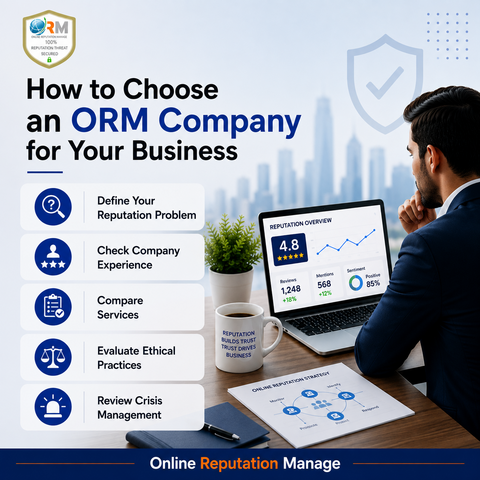
How to choose the best an ORM Company
1. Define Your Reputation Problem
Before contacting an ORM company, search for your business name, leadership team, products, services, and major locations.
Record the following:
Negative search results
Fake bad reviews
Unanswered reviews
Negative press coverage
Social media complaints
Incorrect listings
Harmful images or videos
Negative search suggestions
Competitor content appearing above your website
This research will help you understand what type of service you require. A review management platform may be suitable if your primary need is to collect feedback and respond to customers. A full-service ORM agency may be more suitable if you are dealing with negative press, search-result damage, fake reviews, or a serious reputation crisis.
2. Check the Company’s Experience
Experience is important because reputation management may involve SEO, content writing, customer communication, public relations, platform policies, and crisis response.
Ask each provider
How many years have you worked in ORM?
Have you managed businesses in my industry?
Have you handled a similar problem?
Who will work on my account?
Is the work completed in-house?
Can you provide case studies?
How quickly can you respond during a crisis?
Online Reputation Manage has more than 10 years of experience in reputation management. Its approach includes negative comment suppression, fake review removal assistance, crisis management, positive content development, and search optimization.
A provider with relevant experience should be able to explain the strategy in plain language. Be cautious if a company makes broad promises but cannot show a process, examples, or measurable deliverables.
3. Compare the Services Offered
Not every reputation management company provides the same services. Some competitors focus mainly on software and automated review requests. Others specialize in search engine suppression, content removal, digital press release, or crisis communication. So, research the company that fulfills your exact requirements and the services you need for your business.
4. Understand Google Review Removal
Many business owners search online for:
How to remove Google reviews
How to delete google review
How do I remove a Google review?
How do you remove a Google review?
How can I remove a Google review?
How do you remove Google reviews?
How to remove Google reviews
How to delete google review
How do I remove a Google review?
Business owners cannot unilaterally remove negative search results. Instead, Google allows them to report reviews that violate its policies—including spam, harassment, prohibited content, conflicts of interest, or other breaches. Google then evaluates each report and determines whether the content warrants removal.
A professional ORM company can help you
Assess whether the review may violate Google’s policies.
Collect relevant evidence and screenshots.
Submit a policy-based removal request.
Escalate the report when appropriate.
Write a professional response if the review remains online.
Build a strategy to generate genuine customer feedback.
Monitor future reviews and mentions.
A legitimate provider If a review is genuine and does not violate platform policies, the best approach may be a calm response, improved customer service, and a long-term online reputation strategy.
5. Ask About Removal and Suppression
Removal and suppression are different strategies.
Removal involves requesting that content be taken down by Google, a publisher, a website owner, or another platform. Removal may be possible if content violates a policy or applicable law.
Suppression involves creating, optimizing, and promoting accurate positive content so that harmful results become less visible in search results.
Ask the provider:
What content may be eligible for removal?
What happens if removal is rejected?
What content will be created?
Who owns the websites, profiles, and content?
How will search visibility be measured?
What results are realistic within three, six, and twelve months?
A reputable company should explain that search engines, publishers, and review platforms control their own content and rankings. No ethical provider can guarantee complete removal or a specific Google position.
6. Evaluate Ethical Practices
Your ORM provider will represent your brand online. Its methods should protect your business rather than create additional risk. Avoid providers that offer to create fake reviews, use fake customer accounts, or impersonate reviewers. Similarly, steer clear of firms that threaten customers or publishers, publish false information, or manipulate search engines through deceptive techniques. Red flags also include guarantees of immediate review removal or any reluctance to be transparent about their process.
Any provider unwilling to disclose their methods or hiding operations from your view introduces legal and reputational liability that far outweighs short-term gains. Legitimate ORM firms operate openly, explain their strategies clearly, and build your reputation through ethical, sustainable practices.
Ethical reputation management rests on foundational practices: accurate content, authentic customer feedback, professional communication, and compliant reporting. Industry standards now emphasize white-hat methods exclusively, supported by verifiable case studies, transparent deliverables, and clear accountability over all content and digital assets.
7. Review Crisis Management Capabilities
A reputation crisis can develop quickly. A negative press note, viral complaint, or social media post may reach a large audience within a short time.
When evaluating an ORM provider, ask whether they offer emergency reputation assessments to quickly identify vulnerabilities in your online presence. Inquire about their crisis communication planning capabilities—the ability to develop and execute response strategies during high-pressure situations. Find out if they provide rapid review response services to address negative feedback before it spreads. Confirm that they have robust media and social media monitoring systems in place to catch emerging issues early.
Ask whether they’ll assign you a named account manager who understands your business and serves as your primary point of contact. Determine if they can coordinate with your legal or public-relations teams to ensure consistent messaging and compliance during sensitive situations. Finally, verify that they commit to providing regular crisis updates, keeping you informed throughout any reputation challenges. A provider that offers these comprehensive services demonstrates the infrastructure and commitment needed to protect your brand during both routine and emergencies.
Online Reputation Manage supports crisis management alongside review response management, positive content creation, and search optimization. For urgent cases, ask the provider to define its response time and escalation process in writing.
8. Compare Reporting and Communication
A professional online rep management campaign should be measurable. Request a sample report before signing a contract.
A useful report may include:
New negative mentions.
Review volume and rating changes.
Sentiment trends.
Search-result visibility.
Content created or optimized.
Removal requests and their status.
Actions completed during the reporting period.
Risks requiring attention.
Planned work for the following period.
You should also know who your main contact is, how often you will receive updates, and whether you will have access to dashboards, listings, profiles, and content created during the campaign.









![His Luna Queen [Discontinued]](https://cdn-gcs.inkitt.com/vertical_storycovers/ipad_31ca7c3fb8cb023d576c297a7081cb10.jpg)