
Chapter 1 - Prologue - The Anomaly
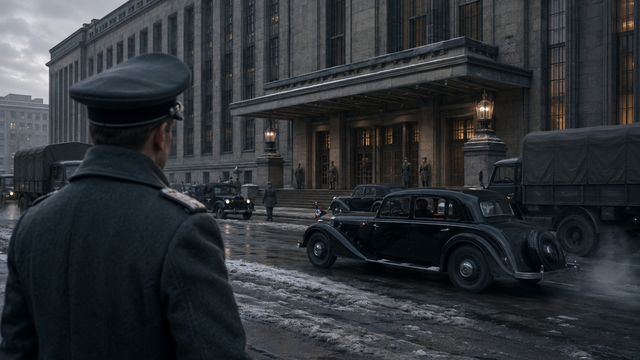
Berlin, February 1943
The siren began before dawn.
Its wail rolled over Berlin in long waves, passed through the still-dark districts, and echoed against the blackened façades. On Wilhelmstrasse, the few pedestrians did not run. They looked up, assessed the sky, then made their way without haste toward the entrance of a shelter.
Friedrich Adler remained beneath the portico of his building until a low rumble reached him from the west. Too distant to be engines. Too continuous to be an explosion. He waited a few seconds longer, buttoned his coat, and stepped into the street.
Grey snow filled the gutters. It had ceased to be white the moment it touched the cobblestones, mixed with soot, plaster, and ash from the chimneys. Two buildings away, a civil defence crew was clearing debris from a collapsed shopfront.
No one spoke.
Adler checked his watch without slowing.
Six twenty-three.
His summons was set for seven o’clock sharp at the Air Ministry. The document had been delivered the previous evening by a motorcycle courier who had refused to hand it to anyone else. A single sheet. No mission orders. Only his name and a signature he did not recognise.
He had spent part of the night searching his service record for anything that might justify a summons to Berlin. His unit was not expecting an inspection. No disciplinary report bore his name. His most recent posting held nothing exceptional, except for a number of dead men that no one now cared to write out in full.
The siren stopped abruptly.
The silence that followed lasted only a moment. The trams resumed their grinding, the shelter doors opened, and the city began moving again like a wounded man refusing to remain on the ground.
Adler crossed the road in front of a truck loaded with ammunition crates and made his way to the next stop.
Inside the tram, nearly every seat was occupied by someone in uniform. Airmen. Two nurses. A naval officer whose empty sleeve had been folded beneath the shoulder. Near one window, a woman held a sleeping child against her and clutched a sack of potatoes tied shut with string.
No one was reading the newspapers.
The morning headlines were nevertheless visible on a rack near the driver. They spoke of resistance, sacrifice, and imminent victory with the same certainty they had shown six months earlier.
Adler looked away.
After promising the impossible often enough, words eventually ceased to mean anything.
The tram slowed at a congested intersection. A column of soldiers crossed the street toward a railway station, packs on their backs and rifles over their shoulders. Several were too young to conceal their fear. The older ones stared straight ahead with the expressions of men who already knew their destination.
Adler watched the column until it disappeared behind a building.
He had never believed that protecting his men meant bringing all of them home. No serious officer could promise such a thing. His duty was not to waste their lives, a distinction some general staffs seemed to have forgotten now that losses were counted in divisions.
The tram moved on.
The Air Ministry appeared a few minutes later, an immense mass of stone rising above the government district. Bombing had scarred the surrounding streets, but the building itself seemed almost untouched. Its windows formed endless identical rows, behind which thousands of men administered a war that was devouring Europe.
Adler got off one stop before the main entrance.
Snow crunched beneath his boots. Two Luftwaffe trucks stood along the pavement with their engines running. Closer to the steps, several official cars waited under the supervision of the Feldgendarmerie. Their drivers were not smoking. None of them left their vehicles.
A black Horch displayed a pennant Adler recognised immediately.
He slowed.
The presence of a general would have been enough to explain the security. That pennant suggested something more.
Adler studied the sentries, the cars, then the building. The summons had not come from some minor office tasked with reassigning a captain who had outlived his usefulness.
The conclusion did not reassure him.
At the entrance, a non-commissioned officer examined his papers, compared the number on the summons with a handwritten list, and asked to see his military record book. He checked even the stamps from Adler’s former postings before returning the documents.
“You’re expected on the lower level, Captain,” he said.
“By whom?”
The non-commissioned officer closed the ledger.
“I was only ordered to take you there, Captain.”
He walked around the checkpoint without another word.
Adler followed him into the entrance hall, where the smell of damp coal mingled with tobacco and wax. Secretaries moved between offices with files pressed against their chests. Behind a partition, a battery of typewriters hammered without pause.
Instead of taking the central staircase, the non-commissioned officer opened a door reserved for staff.
They descended two floors, crossed a service corridor, then passed through a second checkpoint. Marble walls gave way to painted concrete. The windows disappeared.
At every intersection, armed soldiers waited beneath lamps protected by metal grilles. No insignia identified the departments hidden behind the steel doors.
Adler memorised the route effortlessly: two turns to the right, a narrow staircase, then a corridor running east.
“Have you worked here long?” he asked.
The non-commissioned officer kept his eyes forward.
“Long enough not to ask that question anymore, Captain.”
Adler did not reply.
The man had just given him the only information he was willing to provide. This part of the ministry did not contain ordinary offices. Visitors were not brought here by mistake, and those who worked within its walls had learned to regard ignorance as a professional skill.
They stopped before an unnumbered door.
Two sentries stood guard. One of them checked the summons again, then knocked three times at measured intervals.
A bolt slid back on the other side.
The door opened onto a small antechamber where a uniformed secretary waited behind an empty desk.
“Your weapon.”
Adler removed his holster, placed his pistol on the wooden surface, and emptied his pockets of anything that could be used for writing. The secretary placed each object inside a metal box, wrote Adler’s name on a card, and handed him a numbered token.
“You may keep your watch.”
“How generous.”
The secretary ignored the irony.
He stood, opened the inner door, and announced simply:
“Hauptmann Adler.”
The room beyond was larger than the antechamber, but almost as bare. A rectangular table occupied the centre. Several closed files had been arranged in front of an empty chair. On the far wall, a map of Asia covered the entire space between two lamps.
Adler recognised General Ernst Vogel, seated to the right of the table.
Vogel had directed several aerial intelligence operations before the war and now worked close enough to power to have disappeared from official communiqués.
The man seated opposite him was a civilian.
Grey hair, round spectacles, narrow shoulders beneath a dark suit.
It took Adler a few seconds to remember his name.
Heinrich Falkenberg.
Professor of geology and specialist in the world’s great mountain ranges. His work was taught in military academies, particularly to those who preferred to study the terrain before sending men into it.
The third man stood at the back of the room.
Hermann Göring was examining the map without acknowledging the captain’s arrival. His massive figure seemed to fill the space between the two lamps. A cigarette burned in his right hand, sending a thin thread of smoke toward the ceiling.
Adler saluted immediately.
“Herr Reichsmarschall.”
Göring turned his head slightly. His gaze settled on the captain, cold and brief, before returning to the map.
“Sit down.”
Adler took his place before the files.
Vogel offered no word of welcome. Falkenberg inclined his head politely, but his fingers remained on a leather briefcase that he held closed against him.
The professor looked tired.
Not the fatigue of a sleepless night. Rather, the exhaustion of a man who had been waiting for this meeting for a very long time.
A wall clock showed two minutes to seven.
No one spoke until it reached the exact hour.
At the first stroke, Göring crushed his cigarette into an ashtray beside the map. He returned to the table, took his seat at the end, and held out one hand without looking at Vogel.
The general immediately opened one of his files and removed a sealed envelope.
Göring took it, inspected the two wax seals, then slid it toward Falkenberg.
The professor placed it inside his briefcase.
Not a word was exchanged.
Adler followed the movement.
From Falkenberg’s lack of surprise, he understood that the professor had been expecting the envelope. Perhaps he even knew what it contained.
Vogel, meanwhile, had looked away as though the exchange did not concern him.
Göring placed both hands on the table.
“General,” he said casually.
Vogel opened the file in front of him.
“The captain has received no prior information?”
“None,” Göring replied.
“Very well.”
The general selected a photograph from several prints and placed it before Adler.
The image showed a mountain range photographed from a considerable altitude. The peaks rose above a layer of cloud, white beneath a low sun. Nothing indicated the scale or the region.
Adler waited.
Vogel offered no explanation.
He merely pulled an adjustable lamp closer and directed its beam onto the photograph.
Falkenberg studied the image as though he had already examined it hundreds of times.
Göring, standing slightly back, watched Adler.
The captain picked up the photograph.
“What do you expect of me?”
“For now,” Vogel replied, “only that you look.”
Adler brought the print closer to the light.
The terrain was sharp, but some areas remained drowned in shadow. He made out a glacier, a rocky ridge, then a narrow valley disappearing between two massifs.
Nothing that justified this room.
He placed the photograph back on the table.
“Where was it taken?”
Vogel consulted a card.
“In the north-western reaches of the British Raj, in the foothills of the Himalayas.”
Adler looked again at the wall map.
A single black pin had been driven into it, far from the fronts, far from German routes, far from anywhere the Reich could reasonably reach.
Europe was burning. Trains returned from the East filled with wounded men. Entire cities vanished beneath bombs.
And Berlin was examining a mountain.
Vogel placed a magnifying glass beside the photograph.
“Look at the eastern slope.”
Adler leaned forward.
Under magnification, the slope revealed details invisible to the naked eye: strata, shadows, several crevasses. He moved the magnifying glass slowly until a dark line crossed the circle of glass.
It descended almost vertically along the rock.
Too regular.
Adler adjusted the angle of the magnifying glass.
The line remained in exactly the same place.
It followed neither a natural fracture nor the path of a glacier. Its edges appeared sharp along the entire visible section, as though the mountain had been split open by some gigantic instrument.
“A flaw in the film?” Adler asked.
“That was the first laboratory’s conclusion,” Vogel replied.
The general placed a second print beside the first.
The same summit.
Different light.
A different angle.
The line was still there.
Then a third photograph joined the others.
“Three different cameras,” Vogel continued. “Two photographic units. Several weeks apart.”
Adler studied the images without answering.
The same fissure appeared in every photograph, sometimes reduced to a narrow line, sometimes broad enough to form a black band. It did not merely seem deep.
It seemed clean.
Free of rubble, snow, or any visible irregularity.
Falkenberg finally spoke.
“A photograph can distort relief. Light can create boundaries that do not exist. A mountain can also produce shapes far more regular than one might imagine.”
His voice was calm, with no attempt to dramatise what they were seeing.
“But?” Adler asked.
The professor looked at the third print.
“But I know of no natural formation that maintains edges so constant over such a height.”
Vogel closed the first file.
“Yet it was not the fissure that prompted this meeting.”
He opened another, much older file.
The cardboard had yellowed. Its corners were worn. A date had been stamped on the cover in violet ink.
1938
Adler felt Göring’s attention settle on him.
The general removed two identification photographs and placed them between the images of the mountain.
Two men in suits, both in their thirties, their expressions neutral.
Nothing revealed their profession.
“Abwehr agents?” Adler asked.
Vogel did not answer immediately.
“They worked for Berlin.”
A carefully chosen distinction.
Adler did not comment on it.
The general picked up a typed sheet.
“Beginning in 1930, several British expeditions followed one another into the Himalayas. Officially, they pursued sporting, cartographic, or scientific objectives. A single expedition would not have interested us. The fact that they kept returning did.”
“In the same sector?”
“Not exactly. Close enough for certain analysts to begin asking questions.”
Falkenberg moved one of the identification photographs.
“The British had perfectly legitimate reasons to explore the region. They had the experience, the resources, and access to the territory.”
“That is not what alarmed Berlin,” Vogel said.
“What did?”
The general looked at Göring.
The Reichsmarschall did not move.
“The fact that our questions attracted attention.”
Vogel pushed the two portraits toward Adler.
“These men were sent into the British Raj in the spring of 1938. Their mission was to determine whether certain expeditions were transporting equipment unrelated to their declared objectives.”
“What kind of equipment?”
“They did not have time to specify.”
Adler studied the two faces.
“Captured?”
“The first disappeared in Peshawar. The second was supposed to meet a contact farther north. We lost track of him three weeks later.”
“The British?”
“Perhaps.”
“The bodies?”
“None.”
Vogel returned the sheet to the file.
“A transmission nevertheless reached Berlin before their disappearance. An extremely short message, sent through a relay whose operator we never identified.”
Adler waited.
The general removed a narrow strip of paper protected between two transparent sheets.
A single line had been typed on it, followed by a series of incomplete characters.
HIMALAYA
Nothing else.
Adler read the word again.
“They were already in the Himalayas. The message told you nothing.”
“They had received no orders to go there,” Vogel replied.
For the first time, the silence in the room changed.
Adler looked at the portraits, the message, then at the aerial photographs taken four years later.
Two agents sent to observe British movements had left their assigned area without informing Berlin. One of them had managed to transmit a single word before both men disappeared.
The war had then swallowed the file.
Until a German aircraft photographed an impossible fissure in the same mountain range.
Göring took another cigarette but did not light it.
“It is intolerable,” he said, “that the British should be developing anything in an inaccessible region without the Reich knowing what it is.”
His voice was not loud.
It did not need to be.
“Perhaps they are developing nothing,” Falkenberg replied.
Göring turned his eyes toward him.
“Then you will return and confirm it.”
The professor held his gaze, then inclined his head slightly.
Vogel placed an unmarked map in front of Adler. It showed the western frontiers of the British Raj, Afghanistan, and the mountain ranges to the north.
Several routes had been pencilled in.
None reached the black pin.
“Why me?” Adler asked.
“Because we need an officer capable of commanding far from any regular military structure,” Vogel replied. “A man who knows how to move forward without receiving new orders from Berlin every morning.”
“How many men?”
“You will be told once the mission has been assembled.”
“What is the objective?”
Vogel looked at the photographs.
“To verify that the fissure exists.”
“And then?”
This time, no one answered.
Adler slowly turned his head toward Göring.
The Reichsmarschall finally lit his cigarette, drew in the first breath of smoke, and watched it rise between them.
“Then, Captain,” he said, “you will discover why two of our men died to send us the name of a mountain.”







