
The Announcement
The Deschamps estate had never looked so much like a cage.
Margaux stood before the long mirror in her mother’s dressing room, watching a stranger take shape in the glass; a young woman poured into ivory silk, her dark hair pinned and curled into obedience, a string of her grandmother’s pearls fastened cold against her throat. Her mother circled her like a sculptor inspecting unfinished marble, tugging a sleeve here, smoothing a fold there, murmuring approval to no one in particular.
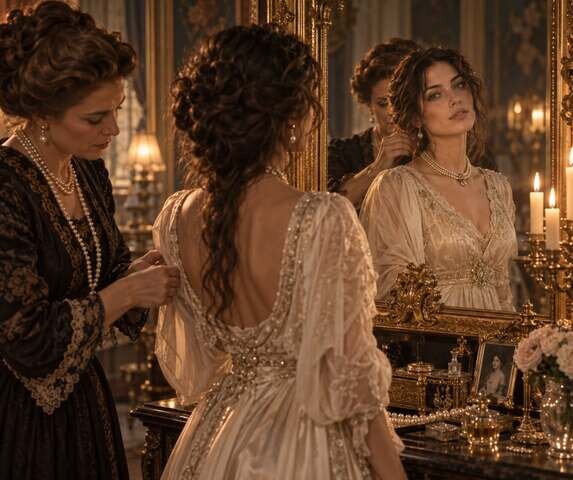


“There,” her mother said at last, stepping back. “Now you look like a Deschamps.”
Margaux said nothing. She had learned, over twenty-two years, that silence was safer than the truth; that the girl who wanted to run barefoot through the vineyards, who filled the margins of her books with charcoal sketches instead of notes, who longed for air that didn’t smell of her mother’s perfume, was not a girl anyone in this house wished to meet.
Tonight, she understood only that a dinner had been arranged; one of her father’s endless business affairs, dressed up as a family celebration. She had asked, twice, what they were celebrating. Both times her mother had smiled the smile she used for guests and said, You’ll see, chérie. Wear the ivory.
By the time she descended the grand staircase, the dining hall below was already glittering; crystal, candlelight, the murmured conversation of two dozen guests she recognized only by their family names. Every head turned as she entered. She felt it the way she always did, that particular weight of being looked at rather than seen ; assessed like a piece of the estate itself, another asset to be admired and accounted for.
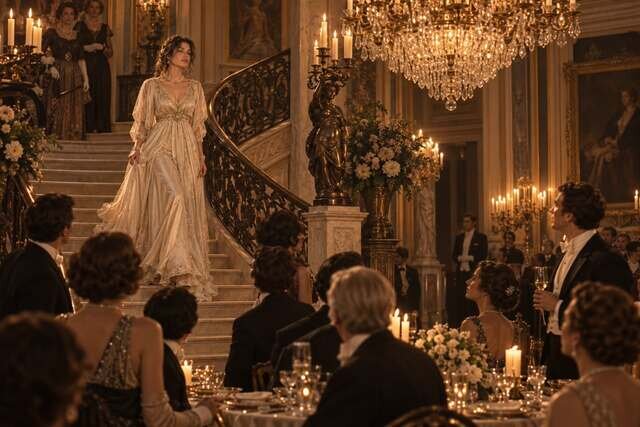
Her father stood at the head of the table, glass already raised, his face flushed with the particular satisfaction he wore when a deal had closed in his favor. Beside him, her mother beamed with a brightness that made Margaux’s stomach tighten with unease before a single word had been said.
“Friends,” her father began, “family, thank you for joining us on such an important evening.”
Margaux found her seat, smoothing her skirts, offering the practiced half-smile expected of her. She caught her mother’s eye across the table and saw something there she couldn’t quite name, pride, perhaps, or relief, or the particular triumph of a woman who has finally, after years of maneuvering, secured what she wanted.
“It is my great honor,” her father continued, “to announce the engagement of my daughter, Margaux Deschamps,”
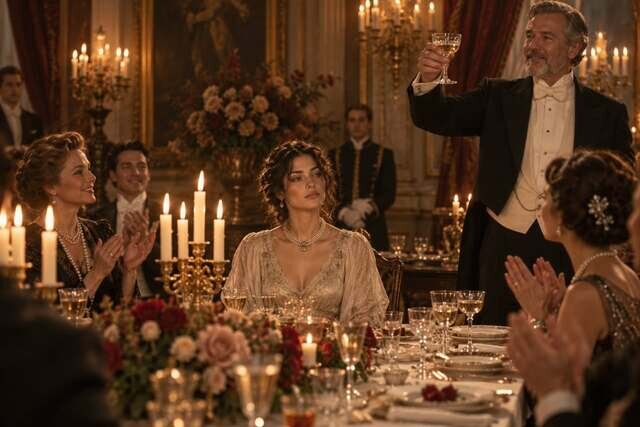
The room seemed to tilt.
“to the House of Valcourt.”
Applause rose around her like water closing over her head. Glasses lifted. Someone (she would never remember who) pressed a hand warmly to her shoulder in congratulations. She sat frozen at the center of it all, a smile fixed so tightly to her face that her cheeks ached, while inside her everything had gone terribly, dangerously still.
Valcourt. She knew the name only in the way one knows a rumor passed between women at parties behind gloved hands, dropped into conversation with a knowing lift of the eyebrows. The Valcourt heir. A man of considerable fortune and, by every account she had ever heard, considerably less discretion; a name that arrived in Paris drawing rooms trailing stories of broken hearts and hastily ended affairs, of a man who collected women the way other men collected art. She had never met him. She had never been meant to. This was not a courtship. It was a transaction, her family’s name and beauty exchanged for the Valcourt fortune, brokered over brandy and cigars long before she’d been told a single word of it.
She looked down the table for him and found only an empty chair, a place setting untouched. He had not even come. Of course he hadn’t. Why would he, when the outcome required nothing of him but his name?
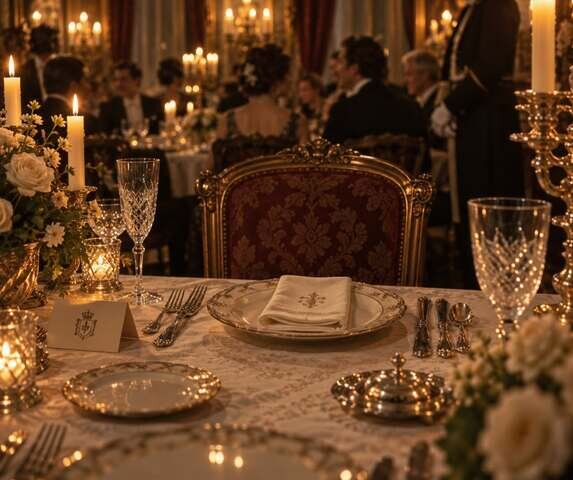
“To the future Comtesse de Valcourt,” someone called, and the toast rose again, and Margaux lifted her own glass because there was nothing else to do, because two dozen pairs of eyes were fixed on her and any hesitation would be its own kind of scandal.
She could not confront them. Not here, not now, not with the Lefèvres and the Montforts and half of her mother’s carefully cultivated society watching her face for any crack in its composure. She had been raised for exactly this moment (to smile through what could not be undone in public) and so she smiled, and she thanked her father’s guests for their kindness, and she felt something in her quietly, irrevocably, begin to break.
She waited until the last carriage had rolled away down the long drive, until the servants had cleared the final glasses, until the house had gone hushed and dim, before she went to find her parents in her father’s study.
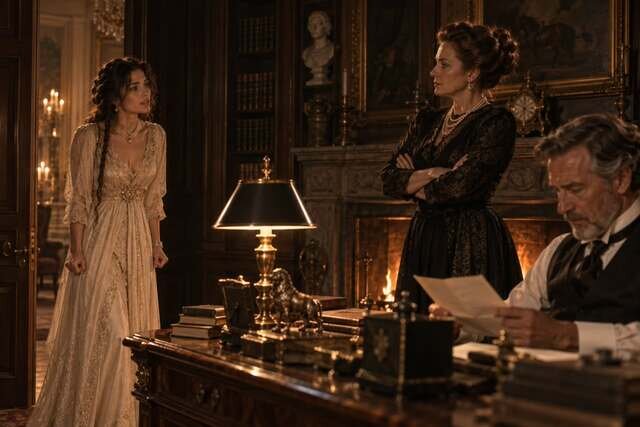
“I won’t do it,” she said, before the door had even fully closed behind her. Her voice shook, but she made herself say it anyway. “You cannot simply announce my life to a room full of strangers and expect me to smile and accept it.”
Her father did not look up from his papers. “It’s done, Margaux. The arrangements are made.”
“Then unmake them.” She stepped further into the room, hands clenched at her sides. “I don’t know this man. I’ve heard nothing of him that gives me any comfort, Maman, you’ve heard the same stories I have,”
“Rumors,” her mother said sharply, “spread by women who envy what you’re about to have. A title. A fortune beyond anything this family has ever touched. Do you understand what you’re being given?”
“I understand what I’m being sold,” Margaux said, and the word landed in the room like a struck bell.
Her mother’s face hardened into something Margaux had seen only rarely not anger, exactly, but a kind of cold, final resolve. “You are a Deschamps. This family’s name, this house, everything you have ever had, it comes with an obligation. You do not get to decide, one evening, that you would rather not honor it.”
“And if I refuse?”
“You won’t,” her father said simply, still not looking up. “Because you understand, better than most, what it costs a woman to have nothing.”
The words settled into her like stones.
She left the study without another word, because there was nothing left to say that either of them would hear.
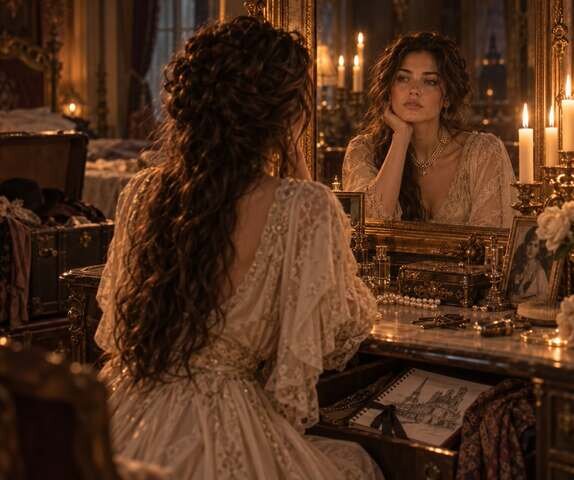
Alone in her room, she sat at her dressing table and stared at the girl in the mirror, the pearls still fastened at her throat, the pins still holding her hair in its careful shape, the ivory silk that had been chosen for her, worn for her, decided for her, just like everything else in this house.
She thought of the sketchbooks hidden beneath her floorboards, filled with drawings she’d never shown a soul. She thought of the man she had never met and would apparently spend the rest of her life beside Valcourt, a name, a fortune, a stranger’s ring. She thought of her mother’s voice (what it costs a woman to have nothing) and understood, with sudden and total clarity, that she would rather have nothing of her own than everything that belonged to someone else’s plan for her.
She did not pack. She did not plan. She simply stood, pulled a plain wool coat over the ivory gown because it was the first thing her hands found, took what money and jewelry lay within reach on her dressing table, and walked out of her room, down the back stair the servants used, and out into the dark.

The night air hit her like something almost holy, cold, unstructured, entirely her own.
Behind her, the estate stood lit and glittering, full of a life that had just been decided for her without her consent. Ahead of her lay the road to Paris, and beyond it, nothing she could yet see or name.
For the first time in her life, Margaux Deschamps had absolutely no idea what would happen next.
And for the first time in her life, that felt less like fear than like freedom.





![[Moving to Galatea] What We Never Healed](https://cdn-gcs.inkitt.com/vertical_storycovers/ipad_b00b828931c645f2eccdf3396cb15498.jpg)













Brilliant first chapter! I love it! And you know what's something I love most of all? I can really relate to Margaux. Because, like her, I know what it's like to live a life filled with expectations and the pressure of having to maintain a certain image.
Plus, she draws! She's an artist, just like me! Which I absolutely love. 😂 Though unlike her, I was given a little more freedom than most when it came to that kind of thing.
But anyway, I really loved the beginning. Every description was beautiful--the tone, the atmosphere, and the delicate way you described what she's wearing while also showing what's going on in her heart. It really made me feel like I was there with her.
I can't wait to see what happens next!--Oh, oh! And I also love the pictures! Helps with visualizing the scenes more. Hehehe. ❤️