where it all began.
*PROLOGUE -*
The storm wasn't hitting the wood. It was biting it. Outside, the sea wanted to flip us over. Inside, in the belly of the galley, there was no light. Only a thick stench of black water, old sweat, and dead rats. The air tasted like vomit and iron. We were one hundred and fifty. One hundred and fifty men, condemned to never get out of here. Oar slaves. For life. Almost naked, with filthy loincloths stuck to our skin. Four men to each oar. I was the skinniest on my oar, the one with the smallest hands. My back was still narrow and it was already marked like theirs. Next to me were old men, with beards and years of scars. I didn't even have a beard yet. And I was already condemned like them.
"ROW!"
The overseer's whip cracked and the whole wood groaned with us.
The next lash found me. I felt the burn like living fire on my back. The scream escaped me, sharp, broken. "Aaaahh!!" I couldn't hold it in, I still wasn't used to it. Another. And another. Each strike made me scream and each scream burned my throat. My hands, already skinless, slipped bloody over the oar. Another. And another lash. So I wouldn't stop pushing. I wanted to stop, but the oar wouldn't stop. Finally, they gave the order to rest. I pressed my burning forehead against the damp wood and tears burned my eyes. Not from the pain. But from how stupid I had been.
My name is Schonn. If you are reading this, it's because I haven't died here yet.
The old man warned me. I listened to him. And even so, I chose him. I chose to rot here, by his side.
This is the story of how I ended up chained to this oar.
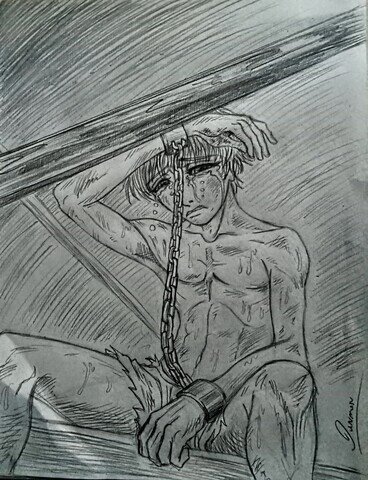


"Hope is the strength that drives us forward, even in the hardest moments."
A year ago, after a winter that killed half the livestock, the sun finally came out. The village was waking up. The smell of fresh bread hit him in the face. Merchants shouted with full baskets, shepherds dragged their sheep, the blacksmiths' hammers rumbled in his empty stomach. None of that was for him.
In a corner, a hooded boy came out of his shack. He stretched, yawned, and the cold of the night still bit his bones. He walked to a wooden fence and leaned there just to feel the sun for a second. He looked unkempt, blonde hair peeking out from under the hood, and you could only see his eyes. He wasn't looking at the village like just another villager. He was looking at it like a dog looks at a full table: knowing he won't be invited.
Then he looked up. Up there. The castle. Without knowing he was about to meet someone who would change his life forever.
Inside the castle, King Gericht Gottlich walked slowly through the high gallery, accompanied by his advisor and two scribes carrying papers. The gallery was no longer the bare stone of old times, the walls were covered with Flemish tapestries and the afternoon light came in colored by the stained glass, painting red and blue patches on the floor. They spoke in low voices about Council matters, about the new edict on grain, about the tribute that had still not arrived from the north and about the rumors of heresy that had risen in a village in the valley, things that could break the peace of the kingdom if they were not stopped in time. When the conversation turned to succession and the future of the crown, the king stopped dead and looked towards the courtyard.
"Where is my son Edel?" he asked, without hiding his impatience.
"In the lower courtyard, Your Majesty," the advisor answered at once. "He is at arms practice with the guard."
"Take me to him," the king ordered, and kept walking.
In the training yard, better kept than in his grandparents' time, with a stone floor and a fountain in the center, Edel was practicing fencing. The clang of steel echoed against the walls. He had already disarmed three guards who stepped aside, breathing hard. One remained, the youngest, who stared at him. Edel moved fast, with a short feint, locked his wrist and sent his sword flying through the air. Before it fell, he marked his chest with the tip, without touching him, just to end the duel. The guard raised his hands and lowered his head in defeat. Edel sheathed his sword calmly and offered him a hand to help him up.
"Good work," he said, in a short, calm voice.
He wiped his forehead with his forearm, his white shirt clinging to his body, and walked toward the shade of the corridor with that small, satisfied smile of his, as if none of it had cost him anything.
Edel was 21 years old.
He was tall, broad-shouldered and athletic, one of those who don't need to show strength because you can see it in the way he stands, in his straight back, in how he holds a jug or opens a door. Years of training showed without him having to say it.
His hair was long, dark brown, almost black when the light didn't hit it, loose down his back. That gave him a wild, slightly untamable air, which contrasted with the fine clothes he wore. He looked at once noble and like a stranger in his own home.
His gaze was what struck you most. Intense, furrowed, not from anger but from habit, as if he were always evaluating, measuring, waiting to find someone worth his time. When he stared, it felt like he could see more than you wanted to show.
His face was angular, manly, marked by a quiet determination. And on his lips almost always that little smile of his, arrogant without being cruel, the smile of someone used to getting his way not by shouting, but with patience.
He did nothing to draw attention. He didn't need to. When Edel entered a place, the air changed a little. People looked at him without meaning to, like you look at fire.
Edel laughed, a deep laugh that came from his chest and spread to the guards, and nodded as he shook the dust from his sleeves. It was then that King Gericht Gottlich's voice came down from the second-floor balcony, which looked directly onto the training yard. The soldiers, hearing him, bowed at once, and the afternoon sun made their swords and their still-dented breastplates shine.
"Very well, my son!" the king said, in that deep, proud voice that seemed to fill the whole yard. "You are a skilled swordsman, no doubt. You have improved quite a lot since the last time I saw you fight."
Edel, unlike the others, remained upright, his chest still heaving and his gaze fixed on his father up there, without lowering his head. His forehead was beaded with sweat and his shirt was stuck to his back.
"But I need you not to get distracted!" the king continued, and his tone grew more serious. "Focus on your duties, on what truly matters. On your marriage to the daughter of the other fiefdom. The peace between our lands depends on that.
Edel took a breath and nodded, more slowly this time.
"Yes, father. I just wanted to train a little, not to lose my hand with the sword. I don't like staying still doing nothing," he said, with that sincerity of his that sometimes sounded like an excuse and sometimes like a challenge.
King Gericht watched him from above and, in the end, his face softened and he smiled with pride.
"Alright, I understand. But responsibility comes first. You will be the next king and your people look up to you, you cannot let them down. Now go and change, you are all sweaty and soon the princess will arrive with the important guests of your wedding. They will come to greet you and congratulate you," he concluded, waving his hand to dismiss him.
Edel said no more. He nodded one last time, hung his sword on his belt and left the yard with firm steps, leaving behind the shine of armor and the murmur of soldiers.
A few hours later, Princess Amanda Dunkel made her appearance. She didn't need to be announced. Her dress brushed the floor like silk and all eyes turned to her without meaning to.
She greeted Edel with a short, elegant curtsy. She wore a majestic cut dress, dark, with silver embroidery that caught the light every time she passed near a candle. Her blonde hair fell loose over her shoulders, still a little tousled from the cold outside. She was of medium height, with fine features, with that kind of beauty that makes you stare a second longer.
Amanda was the very image of royalty.
Edel took her hand. He leaned a little toward her and said in a low voice:
"Princess, you look beautiful." ---
Amanda blushed. A soft flush rose to her cheeks and she smiled, holding back a laugh.
"Thank you. I'll take it as a compliment!" she replied, and brushed his face with her hand, just a touch. "How do you feel? Soon we will marry and I will be your wife. You will occupy your father's throne. I am anxious for that day to come." ---
Edel fell silent. He looked at her, but his gaze went a little further. He didn't care about the throne, nor his father's legacy. He didn't want power. He wanted something simpler and harder: to be truly happy and to be loved for who he was, not for the crown he was going to inherit.
He was not a greedy person nor one with great worldly ambitions, but a man who, with silent determination, would fight for justice and the welfare of the people, as if his heart were tuned to the very heartbeats of those he would serve. His silence was eloquent, a space where the true intentions of his soul seemed to resonate, far from the noise of external expectations.
"I am happy and proud to follow in my father's footsteps on the throne and to give you the greatest happiness possible!" Edel said, trying to please her, with that voice of his that wanted to sound confident but came out a little forced. The princess looked at him and smiled, sweetly.
"Come on," she said, taking his arm gently, "the guests will be here soon to congratulate us!" ---
They both headed to the main hall of the castle, where they were already waiting to celebrate the future kings. The hall was in half-light, warm, lit by tall torches and by candelabras with many candles that made the light tremble on the walls. The crimson tapestries hung heavy and the shadows swayed over them as if they were breathing. In the air floated the smell of incense and melted beeswax, mixed with the rare perfumes brought by dignitaries from outside, a sweet and slightly smoky aroma that made everything feel more solemn. Edel and Amanda took their seats in their carved ebony chairs, with fine gold motifs that caught the firelight and returned it in small glints. They were together, with serene and majestic faces, aware that all eyes were on them. From the great door the line of guests began to enter, a long and slow row that crossed the hall, people arrived from the far reaches of the kingdom and from lands beyond the sea, with embroidered cloaks and jewels that jingled as they walked, all coming closer to congratulate the union.
Dukes of noble lineage, counts with piercing gazes and other lords of high rank advanced in their finest attire, brocades brought from Italy, dark velvets and white ermines that whispered with each step. They paraded in measured pace before the royal hosts, and in each face you could read the mark of their lineage and in each word, carefully chosen, the sincere wish of happiness for the princes who would soon marry.
One by one they approached with contained reverence to the dais where Edel and Amanda, radiant in their future union, received congratulations. He with an elegant nod of his head, she with a measured smile, and both with their hands intertwined on the armrest, a simple gesture that already sealed before all the bond they would soon make before the kingdom and before God.
The hall, adorned with purple draperies that fell heavy and smooth over the gray stone walls, was alive with the low murmur of conversations in several languages, that collective whisper of the court that comes and goes, mixed with the discreet jingling of jewels and the luxurious rustle of fabrics. Chiseled silver candelabras held tall candles whose fire cast trembling glints on ceremonial armors and made the stones on chests and throats sparkle, like a sky of low stars inside the hall.
Every detail seemed placed to make the night feel grand, where past and present touched in the same air. A mantle of sweet expectation enveloped everyone as the night advanced, unhurried, toward the heart of the celebration: the union of Edel and his princess, a bond that was going to intertwine the fate of the kingdom.
The Herald, with a powerful voice that resonated like contained thunder in the stone walls of the great hall, announced the arrival of Marquis Lucius Chamberlain, whose elegant figure emerged from the crowd like a living statue wrapped in midnight blue velvet and adorned with silver threads that glittered under the trembling torchlight. He approached the princes with a warm and genuine smile, his clear eyes radiating an affability that seemed to momentarily dispel the shadows dancing in the corners of the room. "My most sincere congratulations to the two young and future kings of this palace," he exclaimed as he bowed with a formal grace that denoted his long experience in court protocols. "May your union be the foundation of an era of prosperity and peace for our beloved kingdom." Both princes smiled with evident pleasure and thanked the Marquis, whose words were received like a balm of benevolence in that atmosphere charged with expectations. Next, the herald solemnly proclaimed the arrival of Duke Santiago Adams and his wife Kristine, who approached with the dignified bearing of those who hold an ancient and honorable lineage. The Duke, dressed in a doublet of golden brocade that seemed to both absorb and reflect the light, spoke with a grave and cordial voice: "Young princes, I wish you the best and may this wedding be worthy of you and bring happiness to the kingdom. May the bonds that are tightened today strengthen the fabric of our noble domain and bless our subjects with peace and abundance!" --- The Duke made a measured bow, while his wife Kristine, with a serene face and eyes bright as stars on a clear night, smiled warmly, conveying a sense of peaceful benevolence. The princes thanked the noble Duke and his wife, who withdrew with a smile that seemed to leave a trail of serenity in the air.
Then the herald paused for an instant, as if it cost him to pronounce it, and his voice dropped a tone, drier, and announced the arrival of the Count and Captain of the King's Galley, Spanker Henderzon. His name did not sound like the others, it fell heavy in the hall. Conversations were cut short, toasts were left half-finished and even the clinking of cups went silent. The air tensed.
Through the large door appeared Spanker. He was not like the other nobles. Young, with an androgynous and serious face, without a single smile, with a piercing gaze that asked no permission and made his superiority clear. He dressed all in black, an elegant but daring suit. At his belt he wore his rapier, thin and clean, more ornament than weapon and at the same time more threatening than any other.
He walked slowly, sure of himself, with that calm of someone who knows everyone is watching him. He did not bring the smell of salt or worn leather, he brought sharp elegance, the elegance of one who became count and captain in the king's galley and now entered a hall on dry land as if it were his own. As he passed, dukes and nobles stepped aside on their own without him having to ask.
In the dimly lit hall of the King, where shadows seemed to take on a life of their own over the crimson silk tapestries, Prince Edel and the Princess waited seated on their carved ebony thrones, their serene and majestic faces reflecting the gravity of the moment.
The gesture hung in the air and no one dared to break it. Spanker approached the princes with a measured, slow step, and bowed barely, rigid, without taking off his black hat. It was not forgetfulness. Before the ebony throne, that was an affront. A muffled murmur ran through the hall. The courtiers looked at each other, uncomfortable, some with a hand over their mouth. It was something that surprised the princes and everyone present, because no one in that kingdom dared to present himself before Edel and the Princess without uncovering his head. It was then that they could see him up close. A youthful face, pale, androgynous, serious, without a trace of a smile, with a beauty that was unsettling. His hair was red, dyed, short, with loose strands falling over his forehead, a vivid red that clashed brutally against the solid black of his suit. And on that pale face, two black painted lines, straight, running down from his eyes, which gave him a fearsome and mysterious appearance, like a war mark.
He was dressed all in black, a tight doublet, cape, gloves, a wide-brimmed hat with dark feathers, high-quality leather boots and the rapier at his belt. Elegant, but with a reckless elegance. And his gaze, piercing and fixed, full of superiority, as if even while bowing he was looking down at the princes.
He did not utter a single word, not even a conventional greeting. He only bowed rigidly, without taking off his hat, a gesture that, as has been said, seemed a deliberate affront to the princes, a silent challenge to the rules of protocol that governed that place.
At his side, as a sort of human contrast, came a young man of about eighteen, of short stature and jet-black hair that fell in soft waves over his forehead, barely brushing his fine eyebrows.
He also dressed in black. The same black as the Count, but not in the same way. If Spanker's black was imposing, reckless and expensive, made to defy, the young man's was less intimidating, more formal and elegant, neat to the extreme, like a uniform he had not chosen. It was the same tone, the same shadow, and yet it felt like a brand. Like a seal that said without words: "he is mine." Although that was not yet mentioned, it was intuited. His face was of an androgynous beauty, yes, but opposite to his master's. If Spanker was cold, narcissistic and cruel androgyny, of a beauty that wounded and subjugated, his was clear, sweet and noble, with fine and submissive features that inspired an immediate, almost protective trust.
It was this young man who, unlike his companion, took off his hat with a fluid gesture and bowed deeply before the thrones, with a respect so sincere and overwhelming that for an instant it eased the previous affront. His voice, soft and melodious, broke the uncomfortable silence that Spanker had left:
"The Count and Captain Spanker Henderzon wishes you a prosperous and joyful life. May God enlighten you and grant you long life!" he said, keeping his gaze down as a sign of deference. Prince Edel frowned slightly. He was not looking at the young man. He was looking at Spanker, disconcerted by his muteness, by that silent superiority.
"I appreciate the wish," said Edel, in a measured tone that hid his doubt. "But I would like to hear it from his own mouth."
Then Spanker looked up. He fixed his eyes on Edel, two points of ice that seemed to penetrate his soul and left a barely perceptible shiver down his spine. His pale, serious face, marked by those two black painted lines under his eyes, tensed with a flash of annoyance and irritation.
The young man with jet-black hair intervened quickly, as if he feared an uncomfortable outcome, as if he knew by heart what was coming next:
"No, no! My lord has a sore throat and cannot speak, my lord."
Spanker, however, seemed to recover with an unnatural speed. He took a breath, and with a low, raspy and guttural voice that sounded like contained thunder, he exclaimed: "My... sincere congratulations."
Then he bowed again, with a mixture of arrogance and barely contained disdain, and withdrew from the line with measured steps that seemed to resonate in the silence. And behind him, at an exact step away, the young man in black followed him, with his hat still in his hand, not daring to look at him.
After all the guests congratulated the princes, the King approached Edel and asked him how the meeting with the guests had gone. Edel replied: "It was a somewhat unsettling experience... but I also felt good and flattered. Being congratulated by the great monarchs and kings from other places!"
The King was pleased and replied: "Oh, how nice. That's how I felt when I first married your mother!"
Prince Edel set his glass aside. "But... there was one guest who did not fit in. He did not speak in your presence. His gaze was... empty. He didn't even bother to look at me. As if we all owed him something. The herald said he was Count and Captain of the galley."
King Gericht didn't need more.
"Spanker Henderzon."
He said it like someone naming an expensive and dangerous tool. "His father gave this kingdom twenty years of clean routes. The son has given us three. He is arrogant, yes. Vain, too. But since he took command, no pirate ship dares to approach our coasts. And no rower dares to mutiny."
Edel frowned. "I have heard what he does on that galley, Father. The people in the lower port say that not even half of them return! That the lashings can be heard from the dock!" Edel exclaimed.
"The people in the lower port always exaggerate!" the King cut in, but his tone hardened. "What exactly have you heard?" he asked.
"That it is not a prison. That it is a cemetery with oars!"
The King rose slowly and walked to the great map of the kingdom that hung behind the throne. He placed a finger on the coast, several hours on foot from the castle.
"It is anchored right here! And no, Edel. I do not turn prisoners into slaves. But even so, they are murderers, and thieves who have shed blood, whom your grandfather locked up for six months and they came out laughing at us. I don't have enough dungeons to keep them, nor bread to feed them without the people going hungry. But I do have a coast full of pirates. So yes, I chain them to an oar. They row for this kingdom. And if they endure five years, I take off their chains. Alive and free. That is more than they gave their victims!"
Edel felt a knot in his stomach. It wasn't stupidity, it was the first time he understood the real price of the peace he had always taken for granted.
"And does that make it just?" he murmured.
"No. It makes it necessary. Which is different!" Gericht replied. "And that is the difference between a prince and a king. The prince can afford to want to be just. The king has to carry what is necessary!"
The silence became heavy. It was an argument that neither was going to win at that moment. The King looked him up and down and his voice changed. He was no longer the sovereign explaining, he was the father hitting where it hurts.
"You talk a lot about what is just without ever having held a sword that weighs more than a training one. You want to judge my galley, my captain and my laws. Very well. But first understand what you are going to defend!"
He walked up to him and squeezed his shoulder. It was not an affectionate gesture. It was firm.
"Your new sword is in the smithy. The master said he tempers it today. Go. Look at it! Hold it! And ask yourself if with speeches you are going to keep men like Henderzon at bay! Or those whom Henderzon keeps at bay for us!"
Edel looked away. He was not excited. He was frustrated and with his head about to explode. He needed to get out of that room.
"I will go!" he said dryly. "I need air!"
He did not wait for permission. He took his cloak and left. Minutes later, the castle gate opened and his horse crossed the bridge towards the city, with the escort behind him. In his mind was not the sword. It was the sound of the oars he had never heard, and the face of that captain who, without knowing it, had just become his measure of everything he did not want to be.
As he rode, Edel contemplated the landscape, enjoying the wind on his face and the sun that shone in the sky. The soldiers, firm and without lowering their guard, escorted the prince, three on each side and two more in the rear. Armed with swords, spears and crossbows, they also carried their shields and wore formidable and elegant silver armors in the Roman style.
One of the guards, an experienced man and connoisseur of the place, guided the prince to the forge. The villagers bowed and looked with pride and admiration at Prince Edel on his horse. "It's the prince!" exclaimed some villagers, admiring his presence, as if they were seeing a divine being or a god.
Edel felt a little uncomfortable in front of the people who wouldn't stop staring at him, but he smiled to cover it and not make a bad impression on them. Finally, they arrived at the forge, which was far from the city, since it was important to avoid a great fire in case any incident occurred in the forge.
The prince and his men were received by one of the blacksmiths, a tall man with a beard with few gray hairs, bushy eyebrows and a handkerchief on his head. His physique was impressive, and his presence radiated confidence and experience.
"I am Salbei Brann!" the blacksmith introduced himself, kneeling before Edel. "I am the eldest son of my father, who used to forge weapons for King Gericht Gottlich. It is an honor to receive you in my humble workshop, my lord!"
"Alright, alright, that's enough!" said Prince Edel with a smile. "Please, get up! I came because my father recommended I visit you and see how my new sword is coming along. I would like to know it. Can I see it?"
The blacksmith, Salbei Brann, smiled and stood up, making way for the prince. "Of course, my young lord. Please come in!" he said while the soldiers escorted the entrance of the forge.
The blacksmith took a sword blade that shone with splendor and beauty. The bevel that formed the fuller was perfectly even, like the surface of the steel. The blacksmith handed him the blade with a cloth so that the prince's fingers would not touch the blade and damage the polishing of the metal.
Prince Edel was amazed by the work and the finish of the steel. He held the blade by the tang of the sword, admiring its length and width. "It's beautiful!" he said. "It truly is a work of art!"
The prince returned the sword to the blacksmith and asked: "When do you think it will be completely ready?"
"My young lord, it will be ready as soon as possible!" the blacksmith replied. "Since the King ordered me that it must be ready before his coronation!"
The prince nodded enthusiastically. "Alright, I will eagerly await my new sword. I truly congratulate you, you are a great weaponsmith. When I am King, I will make your workshop bigger and have more tools so you can make the best swords and spears in the whole world. And I will get you new assistants to help you in the making of weapons!"
"Thank you very much, my young master!" said the blacksmith with a smile. "But actually, I have my younger brother who helps me in this workshop. With him it is enough. And an assistant who also helps us. But my brother... he hardly helps me at all. Most of the time he spends in the street drinking and looking for trouble. But he is a good man. If you happen to see him, please, make him understand his duties."
Prince Edel nodded with understanding. "I understand. If I happen to see him, I will make him understand and fulfill his duties!"
The prince said goodbye to the blacksmith and mounted his horse, leaving the place with his men. "Thank you, my good lord," said the blacksmith gratefully, bidding farewell to the prince.
Meanwhile, in the shadowy streets of the city, the beggar boy walked with a slow step, dragging his feet.
He had his arms crossed over his chest, clutching against himself an old hooded sackcloth, of coarse wool, dirty and matted by the rain. It did not keep him warm. It was just a thick sack with an attached hood, the kind the poor use, and the cold still seeped in through the seams, chilling him to the bone.
His half-bare feet sank into the mud of the path. His shoes, of worn leather, soaked and open at the toe, weighed like lead. Each step left a footprint that the mud erased instantly. Under the hood, his face was pale, haggard, with lips cracked from the cold. It was not the face of a child, it was the face of someone who had gone days without eating. His eyes, tired and sunken, did not look at people, they scrutinized. Every corner, every corner, every closed stall, looking for a crust of bread, a peel, anything to calm the acid fire of the empty stomach. His ragged clothes gave him away. An inhabitant of the streets. One more among the mud and misery.
He did not beg for alms. Not anymore. He just looked, with that low and fearful gaze of those who have been rejected so many times that they have learned not to open their mouth.
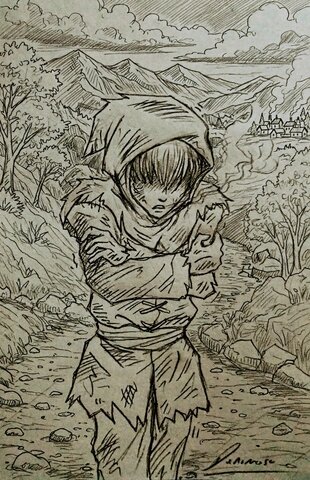
The beggar advanced with tired steps along a stony path that crackled under his broken shoes. Each stone marked the boundary between the mud outside and the village, sunk in an oppressive silence, as if no one wanted to be a witness to anything. The air was impregnated with damp earth and dry leaves. The afternoon sun slipped low, casting elongated and ghostly shadows on the uneven ground. Then he saw it. An apple rolled. Alone. With a clumsy, almost capricious movement, it crossed the dust and stopped right against the tip of his open shoe. Schonn held his breath. He couldn't believe his luck. He threw himself to the ground with an animal desperation, his knees against the stones, his dirty, trembling and cracked hands extended towards the fruit as if it were a treasure, as if his life were in it.
But he was not alone. From the lateral gloom, another hand emerged at the same instant. It was not a hand from the mud. It was long, pale, with fine and neat fingers, accustomed to not touching the rawness of the world. It was covered by a sleeve of black cloth, formal and elegant, impeccable to the point of obsession. The same black as the Count. The same seal. But not intimidating, not defiant. Neat. Like a uniform of belonging.
"Don't touch it! I saw it first!" Schonn exclaimed, with a sharp and broken voice, hunching his body over the apple to protect it, with an instinctive gesture of a wounded animal. He looked up then, with a mixture of defiance and fear. And he saw him. In front of him, standing on the forgotten path, was a young man formally dressed, completely in black, cape and hat included. He was of his same stature, perhaps a little taller, but everything about him was opposite to the mud. On his belt, a beautiful dagger with a silver hilt shone, not with a malevolent gleam, but neat and noble, like a family ornament.
But it was his face that disarmed the destitute. It was of an androgynous beauty that took your breath away, different from any other. With jet-black hair that fell in soft waves over his pale forehead. And his eyes... his eyes were blue. Of a light, sweet and merciful blue, that seemed to emanate a faint inner light, a light that did not judge, that did not threaten. Noble and humble eyes that inspired immediate trust. He was not a shadow incarnate. He was the opposite of a shadow.
It was the first time they saw each other. The beggar and the young nobleman. Neither knew it then, but in that mud, over an apple, their destinies had just crossed.