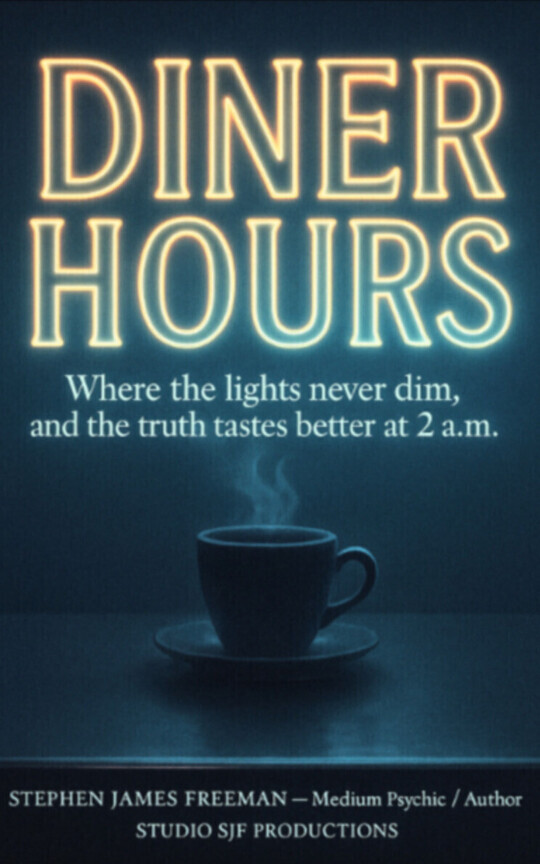

Diner hours
The Diner Hours
The streets of New York in the 1990s had a pulse that got under your skin before your shoes even touched the sidewalk. Morning or midnight, it didn’t matter. There was always that hum, that collective breath of millions trying to arrive somewhere all at once. You could feel it pressing at your back the moment a cab door shut behind you. No Uber, no Lyft, just your arm flung into the air, hoping a yellow cab would swerve close enough to see you. If you were lucky, it did. If you weren’t, you joined the rest of us in the shuffle, walking fast, eyes forward, pretending the wind wasn’t full of grit.
Every few months, a few of us would pool our tips, rent a car, and head to New Jersey. Costco runs before Costco was ironic. The kind of trip where someone always forgot the directions, someone else fell asleep, and we’d end up blasting Madonna or Massive Attack while the skyline fell behind us like a closing curtain. We’d load up the trunk with paper towels, hairspray, and cheap wine, then drive back across the bridge at night, city lights spilling over us like applause. It felt adult somehow, like survival with a soundtrack.
Back in Manhattan, limousines slid through traffic like black sharks. I hated them, those moving capsules of vanity. The irony of wanting to disappear but insisting on being noticed. They’d park outside the galleries, the fashion shows, Saks, and those basement clubs that only opened when the city was asleep. The door would open, a cloud of perfume or smoke or both would spill out, and some beautifully disinterested person would glide toward their next scene.
But me, I liked the sidewalks. The filth and the life of them. The cracks that held old gum, melted candy, cigarette butts, and sometimes even a lost earring glinting underfoot like a secret. You could read the city there if you looked long enough. Every block told you something: yesterday’s rain, tonight’s garbage, the lipstick of someone who kissed a wall because they had nowhere else to leave it.
And yet, my eyes were always drawn up. Those skyscrapers, monuments of glass and ego. Each one catching a different shade of the sky, each one holding a thousand windows filled with stories you’d never know. I used to walk to work or nowhere at all, neck craned, memorizing shapes. The reflections of sunlight would bounce from one building to another until the whole avenue felt alive.
When the city got too loud, too full of everyone else’s performance, I’d slide into a diner. Always the same kind: narrow, edged in silver, smelling of grease and nostalgia. The kind where the waitress had been there long enough to stop pretending. Where the Formica table was always just a little sticky, and the menu had grease thumbprints like a record of other hands.
Inside, the world slowed down. You could breathe again. The air was heavy with burnt coffee, bacon fat, cigarettes, and the faint perfume of someone’s bad decisions from last night. I always sat in a booth, the kind that let you disappear. I’d shrug off the layers, coat, scarf, gloves, the New York armor, and let the heat thaw me out.
My order never changed much: hot turkey sandwich smothered in gravy, mashed potatoes collapsing under the weight of it, and a cup of coffee that could strip paint. The first sip always burned my throat, but in that sting was proof of being alive. Around me, the city rearranged itself: cab drivers arguing at the counter, old men reading the Post, waitresses clinking plates like percussionists in an unending symphony.
The waitress. There was always one who felt familiar. Simple hair, eyes that didn’t flinch. She’d refill your cup before you asked, and for a moment, that gesture made you feel like somebody was taking care of you. That mattered more than anyone said out loud. She never noticed the way I’d pocket a spoon or a tiny dish. A small act of collection. Not theft, exactly. Just preservation. Something of the city I could hold in my hand when I went home to my small rented room and silence.
In those diners, time warped. I’d sit for hours doodling on napkins, writing half sentences, rearranging the condiments until they felt like balance. Salt and pepper to the left, Tabasco to the right, syrup behind the napkin holder, coffee on the right. The rituals of control when life itself was chaos.
I used to watch the regulars, the ones who didn’t need menus. They’d order “the usual” and get it. They’d sit at the bar with their paper folded in half and talk like life was still something you could explain. “How’s the wife? How’s the dog?” Sometimes they’d laugh, sometimes they’d sigh, and every so often, one of them would go quiet in the middle of a sentence. Those were the ones whose stories stayed with me, the ones you could feel were unraveling but too proud to say so.
There was a certain vibration in those diners, a buzz beyond the neon. The chatter, the sizzling grill, the doorbell that chimed every time someone came in or left. It all blended into a living hum. Energy layered on energy, the kind of thing you don’t notice until you stop moving. Sometimes I’d catch my reflection in the window, blurred by rain or grease, and barely recognize the face staring back. That’s how you knew you were becoming part of New York: when the city started looking back through you.
When it was time to leave, I’d gather my things, the scarf, the man bag, the tiny treasures clinking faintly in my pocket, and slide a twenty into the waitress’s hand. Always with eye contact. “Thank you,” I’d say. “I see you.” And she’d nod, maybe smile, maybe not. But it didn’t matter. The exchange was the point.
Outside, the cold would hit the back of my neck, sharp and real. The city resumed its rhythm around me: horns, footsteps, laughter, the hiss of steam from a grate. And for a heartbeat, I’d feel the loop reset. The next person would take my booth, the next story would start, and the city would keep feeding itself.
That’s what New York was to me then, a living portal. A place that took your hunger, your ambition, your shame, and turned it into motion. I didn’t know it at the time, but those hours, the diner hours, were when I was learning how to see. How to listen. How to find the divine in the ordinary.
In a city that never slept, I learned how to sit still.
Stephen James Freeman
Medium, Psychic, Author