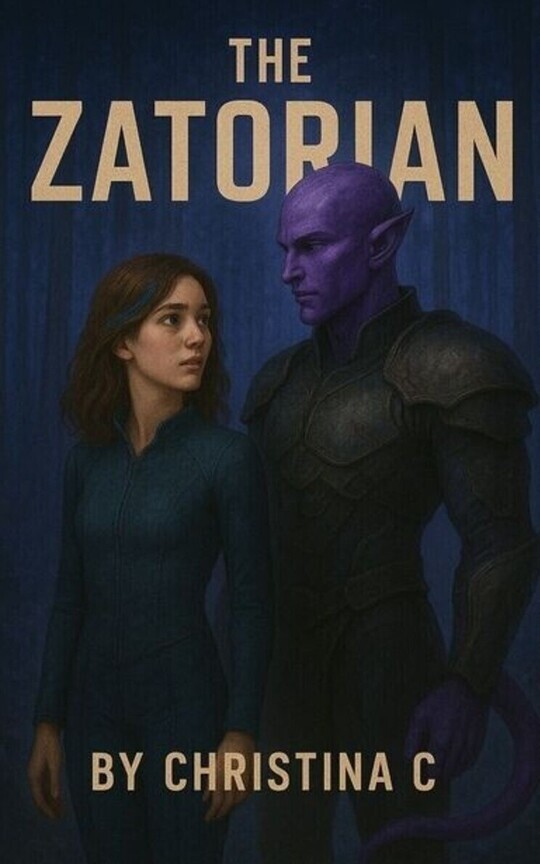
Prologue
7089 A.H.R.
The clan woke when the light went.
All along the shore, where the jungle leaned out over the water and the caves opened their mouths in the rock, the AkinEkong came up out of the day's stillness. They rose from the shade of the great roots. They climbed down out of the branches with children on their backs and children under their arms, children everywhere, because the children belonged to everyone and everyone belonged to the children.
The little ones had slept in a pile in the cool of the caves, the way they always slept, arms and tails tangled without thought. Now they spilled out onto the sand in a loud, bright knot, chasing each other down to the water's edge and back, and the elders let them run. The ocean was calm tonight. The ocean was theirs.
Elios came down from the high roots last.
He was eight feet of him when he stood at his full height, and he stood at his full height now, working the stiffness out of his shoulders while the day's heat drained out of the stones around him. His armor moved with him in its fitted pieces, chitin over chitin, the plates dark and scarred and oiled to a low shine. He had kept the same armor since his coming of age. Every Aliana did. You did not throw away your life and start a new one. You repaired it, and you added to it, and anyone who knew how to read could read you.
There was a plain piece at his chest that he had been given on the day he came of age, before he had done anything at all. There was a notched plate along his left forearm, cut the night he killed the dark hunter on the shore path with a child's screaming still ringing in his ears and the child's mother already too late to need him to be fast. There was a smooth new plate at his right side, pale at the edges where it had not yet weathered, added the season he pulled two of the little ones out of the Parting waters when the current changed its mind early.
His life was on him, in order, for anyone to read.
Under the armor, where the plates did not cover, his skin showed lighter than the chitin, and the markings ran across it in their great dark bands. Other Alianas carried small marks, neat and contained, a hand's width at the shoulder or a curve along the ribs. The king-line marks were not small. Elios's ran from his shoulders down across his chest and back, wide as rivers on a map, and they changed color with his energy and with feelings he would have preferred to keep to himself.
So the clan, who loved him, did not look at them.
It was the oldest courtesy. Markings were private. Colors were feelings, and feelings were not public property, and a stranger who stared at your markings was a stranger you walked away from. Only a mate could look freely. Everyone else kept their eyes on your face, your hands, your work.
For the king-line, whose markings could not be missed and could not be hidden, the courtesy became something else. The whole clan practiced not seeing Elios. They spoke to his face. They read his signs. They noted his armor, which was a record anyone was allowed to read, and they let the rest of him go politely unseen, the way you do not look at a man who is changing his clothes, even when he is standing in the middle of the shore.
He had been respectfully unlooked-at his whole life.
"Elios."
A small person had arrived at the height of his knee and was looking up at him with total seriousness. Pell, who was four years into the world and believed most problems could be solved by announcing them.
"Your tail," Pell signed, with the enormous care of a child who has been corrected about tails many times and intends to be correct this time, "is in the path."
Elios looked down. His tail, which was as long as he was tall and ended in a stinger the size of a child's head, had curled in its resting arc across the path down to the water. Pell was right. It was in the path, and Pell had not stepped over it, and had not touched it, and had come to report it through proper channels.
Elios lifted the whole arc of it, slow and deliberate, and set it down again on the other side of the path, clear of the traffic to the water.
"Better," Pell signed, and went down to the water at a run, satisfied with government.
He watched the children for a while. It was the hour when the shore belonged to them, before the hunting parties went out and the real night began. They were screaming with joy over nothing. One of the smallest had found a shell crab and was holding it up over her head like a prize of war while the crab waved its legs in outrage.
Someone should eat soon, he thought. Someone should hunt.
He went to find Vesh.
Vesh was down at the fish racks, stealing.
"You are eating tomorrow's fish," Elios signed.
Vesh did not stop chewing. He was a head shorter than Elios and a full plate broader, and he had been Elios's friend since they were both small enough to sleep in the pile, and he had never once in his life been embarrassed about anything.
"I am eating a fish," Vesh signed, one-handed, around the fish. "If it is tomorrow's fish, then tomorrow I will catch two. Come hunting. The grazers were down at the salt grass this morning, the fat ones. Your favorite."
"My favorite is whichever one you are not eating raw on the way."
"Then come and choose."
They went into the jungle as the last of the light failed, and the jungle changed around them.
To sight, it went dark in layers. To the heat-sight, it lit up.
Elios let his vision shift the way his people had always let it shift, half a thought, and the world remade itself in warmth and cold. The stones of the path were cool blue-grey, still holding the shape of the day's shade. The trees ran cold at their hearts and warm along their sun-side bark. Small lives burned everywhere in the undergrowth, quick bright coins of heat, a scurry of them going still as the hunters passed. High in the canopy a troop of something feathered sat in a row like coals on a branch, cooling slowly into sleep.
Vesh signed without looking at him, the signs small and low, hunter's talk. "Two. Ahead. By the water grass."
Elios had already seen them. The grazers stood in the salt grass at the edge of the marsh, two big heat-shapes, warm through their thick hides, their breath puffing out in soft clouds that cooled as they rose. Grazers were built like barrels and armed like arguments. A horn on the forehead as long as a forearm. A hide that turned claws. A temper that started at insult and ended at murder.
They ate well when a grazer died. The clan ate for two nights.
"Yours is the far one," Vesh signed. "Mine has the scar. I saw it first, I get the story."
"You get the story if yours dies cleaner."
"Yours will die apologizing," Vesh signed, and went.
They went in the last stretch slowly, and as they went, they went out of sight.
It was not magic, and it was not a trick of the light. It was the other thing their skin did, the quiet thing. The exposed skin along Elios's arms and throat dulled and broke into pattern, marsh-dark and leaf-dark, and the great markings sank their colors down until they were only a suggestion moving under the surface. Beside him, Vesh was already half a rumor in the grass. A hunting pair of Alianas did not cross open ground. The ground simply held, for a while, more shadows than it had held before.
They came at the grazers from two sides, out of the dark, and the marsh erupted.
Elios's grazer wheeled on him with a speed that something that size had no business owning, and the horn came around low, aimed at his legs, at the joints of the armor where the plates met. He stepped inside it. The pincer of his right gauntlet closed on the horn at its root and held, and the grazer's whole charge stopped in his arm with a shock that ran up into his shoulder and across his back, and the markings there lit with the effort before he could govern them. The grazer bellowed. It planted its feet and pushed, trying to drive him back into the marsh mud, and its breath was hot on his face, and its eyes were small and furious and entirely without negotiation.
He did not reach for his tail.
The stinger rode high over his shoulder, loaded and ready, the way it always rode. One dose would have ended this in silence. One dose would have dropped the grazer where it stood, meat for two nights, no struggle, no risk.
Venom was not for this.
Venom was the most serious thing his body made. It was not spent on dinner. It was not spent on convenience. It was not spent at all, by a king-line of the AkinEkong, unless the spending meant something.
He set his second pincer into the grazer's jaw, braced his legs the way the roots brace in a storm, and twisted.
The crack of it went out across the marsh and came back off the trees. The grazer went down on its knees and then on its side, all at once, all its argument gone out of it in one breath. Elios stayed where he was a moment, holding the horn, breathing hard, while his markings cooled down out of their bright working color and back toward rest.
Vesh's grazer died a few breaths later, less cleanly, with considerably more splashing.
"Yours apologized," Vesh admitted, arriving with mud to his waist. "I saw it in his eyes at the end. He was sorry."
"Carry your sorry one's head end," Elios signed. "You talk less with your mouth full of work."
They carried the meat back between them through the dark, and the shore received it the way the shore received everything, with immediate practical joy. Fires came up. Knives came out. The children were removed from underfoot and then removed again. The smell of roasting grazer rolled out over the water until the whole shore smelled like a promise kept, and the clan ate in the firelight with their hands, talking in a storm of signs, passing the best cuts toward the elders and the nursing mothers and the children first, the way it was done.
Elios ate last.
He had hunted it. That was the law, and it was older than the caves. The provider ate last. He sat at the edge of the firelight with his piece cooling in his hands and watched his people eat, and the tight, busy warmth of it settled something in his chest that the hunt had not.
Beyond the firelight, out past the salt grass, past the marsh, the jungle went on in the dark, and the jungle was not empty and never had been.
Late, when the meal was down to bones and the talk was slowing, a sound came out of the deep trees.
It was not loud. It did not need to be. Every head on the shore turned toward it in the same moment, the way grass turns. The children stopped mid-sign. The fires seemed to get smaller.
The sound did not come again. Out in the dark, something that hunted in the night had come to the edge of the clan's ground, and had read the shore the way the clan read armor, and had found the one signature it feared written across the whole territory in heat and habit and warning.
It went away to hunt easier things.
The children went back to their games. The talk picked up again, lower. Pell, half asleep against an elder's side, signed drowsily at nobody.
Elios finished his food, alone at the edge of the light, in the order the law required.
After the meal, Elios walked the shore perimeter, the way he walked it every night the clan fed well and slept early.
Vesh walked it with him, digesting at full volume.
"The elders signed your name today," Vesh said, when they were far enough from the fires that the dark was doing most of the seeing for them. "With Kia's name after it. At the water. In front of witnesses. My mother is already planning something, I can tell by how she is not telling me anything."
"Your mother is always planning something."
"Yes, but now she is planning with material." Vesh stepped over a sleeping root that had not been there yesterday. The jungle rearranged itself at night in small ways, root and vine and path, and the clan rearranged back, nightly, on these walks. "You could do worse than Kia, Elios. Half the coast would sign yes before the question finished."
"I know Kia's worth."
"You know everyone's worth. It is your most exhausting quality." Vesh stopped at the marsh edge and stood a moment, reading the dark with his heat-sight, and Elios read it with him: the marsh cooling, the small lives banking down, nothing large, nothing wrong. "Whoever it is, in the end, it will be a person and not an arrangement. Everyone knows that too. The clan can wait. The clan is only loud because waiting makes them loud."
Far out on the water, something turned over in the black, and a long shape of light went with it — slow, green-gold, a tail like a banner sinking. One of the shining ones. The children begged for stories about the singers in the water and the elders obliged with warnings dressed as stories, and on nights like this the truth of both showed itself at a distance and went down again.
"There is a sermon in that," Vesh signed.
"There is a sermon in everything, with you."
They finished the perimeter in the comfortable silence of two people who had been walking the same ground since childhood, and found nothing wrong anywhere, and the clan slept behind them in its pile and its caves and its branches, safe inside the boundary of Elios's nightly attention, which had never once been breached by anything that hunted.
He was mending armor when Kia found him.
The notched plate on his left forearm had worked loose at one binding during the hunt, and he sat in the mouth of his cave with the piece across his knees, rethreading the binding cord with the patience of a man who has done this repair four hundred times and will do it four hundred more. The armor outlived nothing and no one. It was kept. That was the whole of the law.
Kia came up the path without announcing, because Kia had never announced anything in their life. They moved through the clan the way water moves through grass, without asking it to part.
"You are hiding," Kia signed.
"I am repairing."
"You repair at the fire when you want company. You repair in your cave when you do not." Kia sat down across from him, uninvited, in the exact spot that made it clear the visit was not casual, and folded their hands, and waited.
Elios set the binding cord down. It is rude to keep working through a formal visit, and whatever else this was, it was formal. He could feel it in the way Kia held still. Kia was the best of the clan at stillness, better than the hunters, better than the elders. Kia's markings, small and fine along the collarbones, almost never showed anything Kia had not decided to show.
"Say it," Elios signed.
"The elders signed my name after yours again today," Kia said. "At the water. In front of the children. The little ones have started signing us together as one word. Did you know that? They have a sign that means the two of us."
"I did not know that."
"You did. You have known it since we were children. Everyone born in our years has known it." Kia's hands stayed level and unhurried, which was how you knew the words were costing something. "I am not asking you to hurry, Elios. The king-line mates when the king-line mates, and I am not a child and I am not desperate, and this clan will wait as long as it has to wait. That is not what I came to say."
Elios waited.
"I came to say that you apologize with your silence," Kia signed. "Every season. You go quiet around me like I am a debt. I am not a debt. I am the person the clan chose for you, and the clan chose well, and whatever is wrong, it is not something I did."
The markings across Elios's chest shifted before he could stop them, a slow bruise of color going through the dark bands, guilt with nowhere to hide, the same as always. He watched Kia not watch it.
Kia's eyes stayed on his face, courteous as a closed door.
"There," Kia signed. "That. That is the whole of my complaint. You are turning colors in front of me like weather, and I am sitting here being polite about the sky."
"Kia—"
"Let me finish, since I came all the way up the path." Kia leaned forward. "The clan does not look at you. I know. I have watched them not look at you since we were small, and I have done it too, because it is manners, and because your grandfather asked it of everyone while you were still growing, and it became the shape of things. But I am not the clan, Elios. If I am to stand beside you, I will look at you. All of you. That is what a mate is for. You deserve to be looked at by somebody, and if the work falls to me, I will do it properly."
The cave was very quiet. Down on the shore the fires were burning low, and a child was laughing at something, and the sound came up the path thin and far away.
"You deserve a mate who looks at you the way the songs describe," Elios signed at last. "All at once. Without deciding to."
"Yes," Kia said. "I do. And you deserve to be looked at. It appears we are both waiting on the same person." Kia stood up, unhurried, and brushed the cave dust from their knees. "Sahn tells the old story tonight, at the deep fire. The whole clan. Come and sit where the children can see you. They are starting to think you are a story too."
Kia went down the path the way water goes through grass.
Elios sat with the armor across his knees and the binding cord forgotten, and finished nothing, and after a while he got up and followed.
The deep fire was the clan's fire for stories, and it was lit in the hollow where the shore curved in on itself, where the rock kept the wind off and the sound in. The whole AkinEkong came down to it in the dark, the elders first, the children carried and walking and riding, the hunters with the day's catch still on their breath. They settled in the old arrangement, in rings, the little ones in the center where it was warmest and where small bodies could fall asleep against whatever adult was nearest, because all adults were nearest.
Elios took his place where the children could see him, as instructed, and Pell immediately relocated to sit against his leg like furniture, with the total confidence of a person who has never once been told no by that leg.
Elder Sahn came into the firelight the way Sahn came into everything, slowly, because there was no longer any reason in the world to hurry.
Sahn was the clan's memory. Other elders kept the ceremonies. Sahn kept the stories, all of them, signed in the old forms, in the order they had been handed down, hand to hand, back through more generations than the clan bothered to count, because counting was not the point. The point was that nothing was dropped.
Sahn's hands rose. The hollow went quiet. Even the children went quiet, the way children learn to, at that exact rise of the hands.
"Tonight," Sahn signed, "the old one. The one underneath all the others. Settle your tails."
Every tail in the hollow settled, in a ripple, large and small.
"This is the story of Mayanna," Sahn signed, "who was AkinEkong, of the king-line's root, in the days when the world was young and strange and the sky had traffic in it. And of Netto, who was human."
A small stir went through the children's ring. The humans were the children's favorite part of the old stories, always. Humans, who had no tails and no markings and no heat-sight, who came down out of the sky in their metal birds and walked around on the ground in their soft skins, fearless as children and twice as breakable.
"In those days," Sahn signed, "the sky-people came and went. They landed their birds on the high ground and traded and measured and poked at the world, and the clans watched them the way you watch weather, because they were not ours and they were not staying. Netto stayed."
The fire cracked. Sahn's hands moved in the old rhythm, the storytelling rhythm, each sign finished fully before the next began, the past tense of the whole language.
"Netto came down with the measurers, and the measurers left, and Netto did not go with them. The stories argue about why. This one says his bird broke. That one says he asked to stay, and the sky-people let him, because in those days the sky-people were generous with things they did not understand. Sahn's grandmother's grandmother, who carried this story to me, said the simplest thing. She said he saw Mayanna."
Elios felt Pell lean harder against his leg, delighted, already lost.
"Mayanna was hunting alone in the deep green, because Mayanna did everything alone and at full speed, which the elders of that age considered a character flaw and Mayanna considered a schedule. And she came over the ridge at the salt marsh, and there was the human, alone, with his machines, talking to himself in his mouth-language because there was no one to talk to. And the human saw her. And did not run."
"He did not run," Sahn signed, "and he did not raise a weapon, and he did not fall down and make the noises. He stood in the marsh grass with the water at his knees and he looked at her, all of her, the armor and the legs and the tail and the stinger, the whole of her, the way nobody looks at anybody, and he said something in his language that no one has ever translated. The story keeps the sound of it. It does not keep the meaning. Some things the story keeps for the two of them."
"And Mayanna—"
Sahn paused. The whole hollow leaned.
"Mayanna, who had never been looked at like that in her life, who had been courted correctly by half the king-line's cousins, who had refused three formal speakers and a prince of the grey clan—"
The grey clan's delegation, visiting for the season, made a show of offense. Laughter moved through the rings in a ripple of hands.
"—Mayanna lowered her tail."
The children's ring made the sound children make, a breath all at once. The adults were quieter. Every adult in the hollow knew what the sign cost and what it meant, and that it could not be taken back, and that it was done once, once in a life, with your whole heart standing behind it like an honor guard.
"She lowered it there, in the marsh, in front of nobody," Sahn signed. "No witnesses. No elders. No formal speaker, no fine words, no season of courtship, no approval of the clan, who would not have approved. She saw him look at her like that, and she answered with the only true thing she owned."
Sahn's hands slowed, gentled.
"The clan did approve, in the end. The clan always approves in the end, when a thing is already true. It just takes the clan a while to catch up to its own heart. Mayanna brought him home the way you bring home weather, and the elders made the speeches, and he learned the signs with his clumsy hands—" here the children's ring lost itself laughing, because Sahn performed Netto's signing, enormous and wrong, and every child in the hollow copied it, "—and he never did learn to sign below a shout, and she loved him at full volume for fifty years."
"Fifty years," Sahn signed, "is what the story gives them, and for a human that is nearly the whole of a life, spent."
The hollow had gone very quiet, the good quiet, the held quiet that comes in the second half of the old story.
"He built his machine on the high ground, with her people helping him, though they did not know what they were building and he could not explain it in signs he had. A light that talks to the sky. A voice made of light, that says we are here, we are here, we are here, in case the sky-people ever came back over the world and wanted to find the way down to this shore. He tended it all his life. On clear nights he climbed the high ground and he stood with his machine and he sent his light up, and Mayanna went with him every time, though the light said nothing she could hear, because standing with him was the point. The story is clear about that. Standing with him was the point."
"He grew old. Humans do it fast. It is the one thing they hurry at. When his hands could no longer climb the path, the clan carried him. When he died—"
Sahn's hands stopped, briefly, the storyteller's rest, the place in the old one where the hands always stopped.
"—Mayanna carried him to the water herself, and the clan walked with them, every one, and the ocean took him, the way the ocean takes all of ours. The planet has him now. It kept him. Remember that, children, when the sky-people are only a story to you. The planet keeps what it is given."
The fire burned lower. Sahn was not finished. Sahn was never finished when you expected.
"And Mayanna lived after him a long time, as our people do, and she tended his machine in his place. And the clan tended it after her, because she asked it, and then because it had become the custom, and then because it was ours. His light still talks to the sky from the high ground, children. It says we are here, we are here, in a language of light none of us speaks, for a people who—"
Sahn's hands slowed down to single signs, spaced wide, the old forms at their oldest.
"—who stopped coming."
Nobody moved. The hollow held the quiet the way the rock held the wind off.
"In the time of Mayanna's grandchildren's grandchildren, the sky went empty. No birds landed. No lights crossed. Year after year, the elders climbed the high ground and stood with the machine and listened to a sky that had nothing in it. The listening elders of that age took the flowers and went under the influence and asked the planet what had gone wrong with the world, and the planet answered that nothing was wrong with the world. The world was well. The wrongness was far away, in the place the sky-people came from, and it was not a wrongness the planet could reach or mend."
"We do not know what happened to them," Sahn signed. "The story does not know. The story only knows the sky was full, and then it was empty, and no one came back to say why."
"The clan keeps their story anyway."
Sahn looked out across the whole hollow then, across the rings and the fire and the children's upturned faces, and signed it large enough for the back rows, for the trees, for the dark:
"If they ever come back, someone should be able to tell them who they were."
Pell, against Elios's leg, had been vibrating with a question for some time, the way a pot vibrates before it boils. Pell's hands came up now, fast, too fast, tangling the signs—
—and stopped, because Sahn was already answering.
"Yes," Sahn signed, patient, "he had a tail in the story the measurers told. No, small one, the measurers' stories are not this story. In this story he had no tail, and she loved him anyway, which is the whole of the lesson, and if you interrupt the lesson again I will have your grandmother sign you the genealogy for a week."
The hollow rippled with laughter, hands everywhere, and Pell subsided, outraged and satisfied at once, having been answered before finishing asking, which was Sahn's oldest trick and worked every time.
Elios sat in the firelight with the child asleep against his leg by the story's end, and thought about Sahn's trick, the way he always thought about it after a telling. Sahn heard thoughts the way other people heard weather coming. Most of the clan could, one way or another — a gift the king-line shared with everyone, everyone except him.
Elios had never heard a thought in his life.
If he wanted to know what Pell was asking, he had to watch her hands. If he wanted to know what Kia meant, he had to listen to the whole of the visit, the stillness and the seating and the words, and reason it out afterward, alone, the slow way. He was the only one of his kind who lived entirely outside other people's heads. The clan considered it a king-line mystery, or a king-line burden, depending on the elder.
Elios considered it the reason the clan's politeness had never cost him anything. You cannot miss a room you have never been in.
He lifted the sleeping Pell, carefully, the way you lift something the whole world is responsible for, and carried her down to the caves with the other adults carrying the other children, one by one, into the pile, for the rest of the night.
He did not sleep.
The tending of the machine on the high ground fell to the king-line on a rotation older than Elios's grandfather, and tonight it fell to him, and he was glad of the duty the way he was always glad of it, with a gladness he had never explained to anyone, because there was no one he could explain it to. He climbed the path alone in the deep of the night, when the jungle was at its coolest and the glow-flowers along the path were opening their throats to the dark, breathing out their sweet influence in small clouds that he walked through without taking any of it in. Elders used the flowers to listen. Elios was not listening tonight. Elios was only climbing.
The Shrine was not grand. That was the thing visitors from the other clans never understood, the grey clan and the white clan and the rest, when they climbed to see the famous place. A shelter of woven mats on poles, kept in repair. A path swept clear. A stone seat where Mayanna had sat. And the machine.
The machine was older than the clan's memory and it looked it — metal gone the color of deep water, seams grown over with a skin of moss that the tenders left alone because it did no harm and the machine seemed to like it, shapes under the casing that no living Aliana could name. It stood the height of a child. On its face, under a lip of metal, a small light lived.
The light blinked. Slow, green, patient. We are here. We are here. We are here. Seven thousand years of we are here, blinked up into an empty sky by a machine tended by the descendants of the woman it was built to stand beside.
Elios swept the path though it did not need sweeping. He checked the shelter's bindings and replaced one that had frayed, working by heat-sight and touch, his big hands careful in the way they were careful with everything that mattered. He cleared fallen leaves out of the casing's vents with the tip of one claw, one leaf at a time. The casing was warm from the day it had stored, and it hummed, faintly, under his palm when he rested his hand on it to say the visit was done.
Then he did the thing he had done since he was young, the thing that was not in the rotation and not in the law and not in any story, the thing nobody knew about.
He signed the names.
Not his own name-sign. Theirs. The two name-signs from the story, the human's clumsy broad one and Mayanna's, which the storytellers still taught exactly as she had made it, her hands preserved in the chain of hands for seven thousand years. Elios signed them both to the empty hill, slowly, in the old forms, the way Sahn had signed them at the fire.
Netto.
Mayanna.
The machine blinked. The jungle breathed out its sweetness below him. His markings, alone in the dark where nobody's courtesy was required, moved slowly through colors he did not have to govern, and he stood a while in the state he was almost never permitted: looked at by no one, and entirely himself.
He thought about Kia, sitting across from him in the cave, eyes on his face like a closed door. You deserve to be looked at. He thought about the story, which he had heard more times than he could count, and about its hole in the middle, the place where the sky went empty and the story could not follow. He thought about standing with someone on a hill while a light said we are here to nobody. Standing with him was the point.
He was still thinking it when the sky changed.
At first it was only a star out of place. He marked it the way a hunter marks anything, without decision, the eyes reporting before the mind had voted. A light, high up, brighter than a star should be, and moving.
Nothing moved up there. Nothing had moved up there in seven thousand years. The old stories had sky-traffic in them the way they had talking weather in them, as furniture of a world that was gone.
The light crossed a hand's width of sky while he watched.
It did not fade. It did not thin out and die the way the night-sky's small fires died. It grew.
Elios's whole body came awake in the old order — eyes first, then the heat-sight widening, then the tail rising slow into its high arc over his shoulder, the stinger catching the glow-flowers' light as it came up. His markings lit along his back and shoulders in a color he would have been ashamed of in company, because it was not caution and it was not fear.
It was recognition, and under the recognition, joy, arriving from a place in him that had been waiting its whole life without telling him.
The light was coming down. Not falling the way dead things fell. Coming down the way the birds in the stories came down, aimed at the world, aimed at the high ground, aimed — he understood this with the whole of his body before his mind had finished the sentence — at the shore where a machine had spent seven thousand years saying we are here, we are here, we are here.
He should wake the clan. He should go down the path at a run and raise the elders and empty the caves and have the whole AkinEkong standing on the shore in order when the sky arrived, the way a people should meet the end of an age.
He went alone.
Not down to the caves. Down the far side of the high ground, toward the place the light was choosing, moving fast and silent through the deep green in the last of the night, with his heart going like something he had caught and was carrying.
The sky had been empty for seven thousand years.
It was not empty anymore.
Question for you: the sky has been silent for seven thousand years, and tonight a light is coming down — if you were Elios, would you wake the whole clan first, or go meet it alone?