
Chapter 1
Luke
The Chicago River runs east between the towers until it meets Lake Michigan. Luke Bennett follows it to the end and walks south along the harbor, past concrete steps still crusted with ice and broken plates of it bobbing on the water. Beyond the harbor wall the lake runs open to the horizon, wide as a sea, slate-dark under the clouds and bright where the sun breaks through.
The last time he saw a lake freeze, he still lived in Michigan. He watches the next wave roll in, and the one after, while the wind blows at his back off the city and straight through his coat, a perfectly good coat in Houston. The knit hat and gloves he bought on Friday at a drugstore on State Street are the only things he owns that were made for this wind.
At home he would be at his desk by now, as he is most Sundays, getting a head start on a week he could describe in advance. The blizzard at the start of February left roofs sagging all over Chicago, too many for his firm’s office here to inspect, so he has been sent up from Houston for seven weeks as a structural engineer. His reports will tell owners and their insurers which buildings are still safe to use. This is the first morning he has had to himself.
He stays at the water until his ears ache with the cold, then heads back into the wind to Millennium Park and the sculpture his new colleagues told him not to miss.
Cloud Gate sits on its plaza like a drop of mercury the size of a house. They call it the Bean, and he can see why. Meltwater drips in the sun from the white crust of snow on its top, cracked where the steel shows through. On the first mild morning he has seen here, a crowd has come out to photograph their reflections in it, a father holding a little boy up to the steel, two teenage girls with their arms flung wide. The polished steel gives back the sky and the skyline bent around it, and somewhere in the middle, small and stretched out of shape, Luke finds himself, hands jammed in the pockets of the wrong coat. He looks cold even in there.
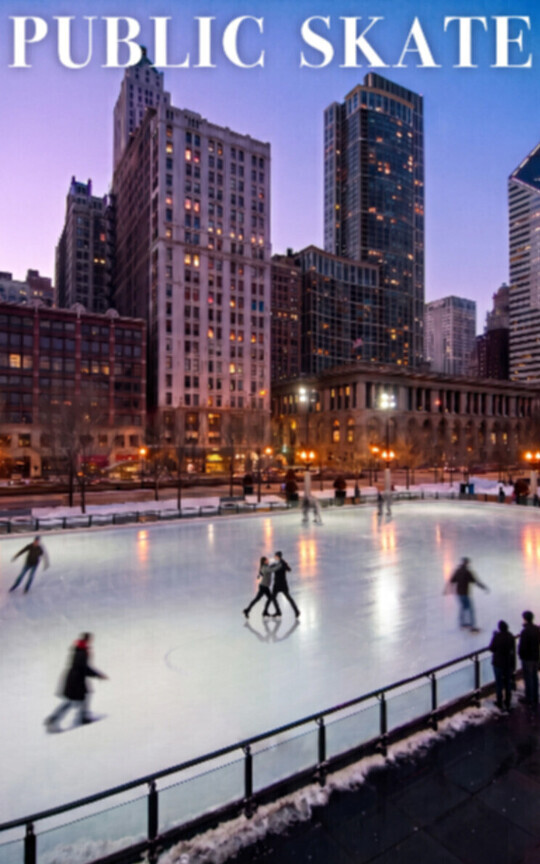
At the edge of the plaza he stops at a stone railing and looks down on an ice rink, a story below him on the Michigan Avenue side.
A resurfacing machine drones down the long side, laying a skin of water behind it that shines like glass and dulls as it freezes. Luke knows that drone from the rinks of his childhood. A short line has formed at the gate, people in rental skates stamping their feet and blowing into their gloves.
When the machine leaves the ice, a rink guard swings the gate open, an older man with a gray mustache and an orange vest over his parka. The line spills onto the ice. A father tows a little girl in a pink helmet along the boards, and two teenage boys race each other down the long side and go down in a heap at the end, laughing. They all circle the outside, counterclockwise.
One woman nods to the guard on her way through the gate, pushes off and heads for the empty middle of the ice.
Within a few seconds he recognizes a trained skater. She wears black leggings and a gray fleece zipped to the chin. A dark brown braid hangs down her back, and white earbud cords run from her ears into her collar. Low in the knees, she pushes from the edge of each blade in long, nearly silent strokes. She takes the far end in crossovers, one foot passing over the other, and comes out of the curve faster than she went in.
For a while she skates nothing but edges, long curves on one foot from one end of the rink to the other, changing feet at the center without a scrape. It is the drill coaches make children do until they hate it. Luke dreaded it as a boy, on dark mornings before school, with his coach calling out every wobble from the boards. She seems to enjoy it. At the railing he has to hold himself still, because his weight rocks from one foot to the other with her changes of edge. The loudspeakers under the plaza play “Born This Way,” the new Lady Gaga song, out on Friday and already all over the radio. The woman in the middle of the ice ignores it and skates to a slower beat of her own.
Halfway down the long side she goes into twizzles. Luke has not thought the word in a long time. Twizzles are fast turns on one foot that travel down the ice while the skater spins, four and five in a line. Her braid swings out straight behind her. Luke holds his breath, full of wonder. His shoulders twist a little, following each of her turns. She comes out of the last one on a clean edge with her arms already open, and he breathes out as if he had done them himself.
He did them himself, at ten and twelve and sixteen. Luke came to ice dance because his sister Sarah skated at their club outside Detroit and the club never had enough boys. He stayed because he liked it. When his partner quit at seventeen, he quit too. He did not miss it, or not so that he noticed.
People drift to the railing beside Luke, glance down at the woman dancing so beautifully on the ice and wander on to the Bean. She skates in her own world and does not look up at any of them.
At the far end she opens her feet into a spread eagle, heels toward each other, and rides the long side on a single curve with her arms wide. Luke smiles. He remembers how good that feels, gliding without a push, the cold air streaming past his open arms.
He wants to see her skate from close up, so he takes the stone stairs down and finds a place at the boards near the gate. Down here the Park Grill’s kitchen vents coffee and bacon into the cold. Ten steps behind him, under the plaza, a window says SKATE RENTAL.
The woman sweeps past on a back edge, three feet from the boards, with a clean hiss of steel he had forgotten. Close up, she is younger than he guessed from above, somewhere in her twenties, her cheeks red with cold, dark eyes under dark brows drawn together, her wide mouth pressed tight in concentration. She is so beautiful that Luke forgets what he came down to see. She has a skater’s legs, strong through the thighs under the black leggings. Her eyes stay on the ice a few yards ahead of her, and he is glad, because he is staring. Her blades are cut short behind the heel. Dance blades.
Luke looks back at the rental window.
He could skate, but he knows exactly how it would go. Rental boots are soft, so his ankles would fold on every edge, and rental blades are sharpened flat for beginners, with nothing in them to hold a curve. He would skate like someone who used to skate, in front of someone who still does. That is worse than skating like a tourist, because a tourist can laugh at a fall.
She skates to the gate and sits down on the bench beside it, her earbuds still in. Luke would have liked to watch her longer. She unlaces with quick, hard tugs, pushes her feet into snow boots, zips a long black coat over the fleece and slings the skates over her shoulder by their knotted laces.
On her way to the stairs she pulls a lanyard out of her coat pocket and hangs it around her neck. A plastic badge swings from it, too far away to read. She climbs to the plaza two steps at a time and heads off past the Bean.
A badge on a Sunday means a job that starts soon. She was at the gate when it opened, nodded to the guard like a regular and came off the ice as if a bell had rung. Luke hopes she skates here on other Sunday mornings on her way to work.
The guard skates over to the boards and stops beside him. He has a creased face, a walkie-talkie clipped to the orange vest and a patient look.
“Morning.” He tips his head toward the window behind Luke. “Rentals are right there, if you want to go around.”
“Morning. Thanks, but not today.”
The guard looks out at the middle of the ice, where the father is towing the little girl in a slow circle, and back at Luke. “Yeah. Hard act to follow, huh?”
Luke laughs, his breath white in front of his face. The guard pushes off on his round again with his hands clasped behind his back. Not ready to leave the ice yet, Luke stays at the boards, watching the rental skaters wobble across the middle of the rink, until the cold has come up through his shoes into his shins. It surprises him how much he wants to be out on the ice, with an edge under his feet and the wind of his own speed in his face.
The apartment the firm rents for him is on the twenty-second floor over Wabash Avenue, furnished by someone who liked beige, with a beige couch, a beige rug, and a framed photograph of the skyline he can see out the window anyway. Below, the elevated trains screech around a curve, loud enough to reach him through the glass. Luke sits on the couch with his laptop open on a spreadsheet of the roofs he has to inspect tomorrow, and he has not read a line of it in half an hour. It is a good job, and he is not bad at it. It does not make him happy.
His sister calls from Ann Arbor once her baby is asleep.
“Hey, Chicago.” Sarah sounds tired and pleased. “Are they working you to death yet?”
“Hi, Sarah. Not till tomorrow.”
“So what did you do with a whole Sunday in Chicago?”
“I walked to the lake. It’s frozen along the shore. I forgot lakes do that.”
“You forgot winter. That’s what Houston does to people.”
“And I saw the Bean.”
“And?”
“It’s a very large bean.” He leans his head back against the couch. “There’s a skating rink right underneath it.”
Sarah goes quiet for a moment.
“Did you skate?”
“In rental skates?”
“So no.”
“So no.” He looks out at the lit windows across the street. “There was a dancer on the ice, though.”
“A real dancer?”
“Twizzles, Sarah. Five in a row, and she came out of them on an edge.” He can hear his own voice climbing. “And so steady. You could have set a glass of water on her head.”
“Was she good?”
“She was better than I ever was.”
“You were good.”
“I was fine. We were fine.”
Sarah lets that stand. She knows their results as well as he does.
“Did you talk to her?”
“She had her earbuds in. She skated forty minutes and left at twenty to eleven.”
“You timed her.”
“I happened to look at my watch.”
Sarah laughs, and he smiles out of the window, caught.
“When were you last on the ice? Seventeen?”
“Seventeen.”
“That’s ten years, Luke.”
The number surprises him. He wonders why he never went back to the ice, and now he regrets it a little. Before he can answer, the baby starts to cry, a thin, sleepy wail, and Sarah sighs into the phone. “There goes my evening. I have to go. Call me this week?”
“I will. Go.”
“Luke?” The crying climbs a notch. “They sell skates in Chicago, you know.”
“I’m only here seven weeks.”
“Seven weeks is a lot of Sundays. Night, Luke.” She hangs up before he can think of an answer.
He sets the phone down on the couch, closes the spreadsheet, opens a browser and types “skate pro shop Chicago” into the search box.