Chapter 1
“I love you,” he says, looking straight into my eyes. His palm closes around my wrist through my jacket, gentle, but determined to keep holding on. I don’t answer. There’s nothing left to say. My eyes tell him the same thing they’ve told him all those times before. The weight in my chest grows heavier with every word. I need him to let me go. I try to pull my hand away, and he lets me.
“I’ll never let you go,” he adds, even as my palm slips free. I stand there, just looking at him. I wait for what comes next.
You don’t get to decide this alone. His mouth doesn’t move, but I already know the sentence. He’s said it so many times it doesn’t need sound anymore. I can’t stand it. I turn and take the stairs two at a time, trying to get away as fast as I can.
I hear a painful sob behind me. He doesn’t follow me. He can’t.
*
I run up rusty escalators. The stairs seem endless. I cross the main hall of the abandoned train station and keep going, until I finally step outside and breathe in fresh air.
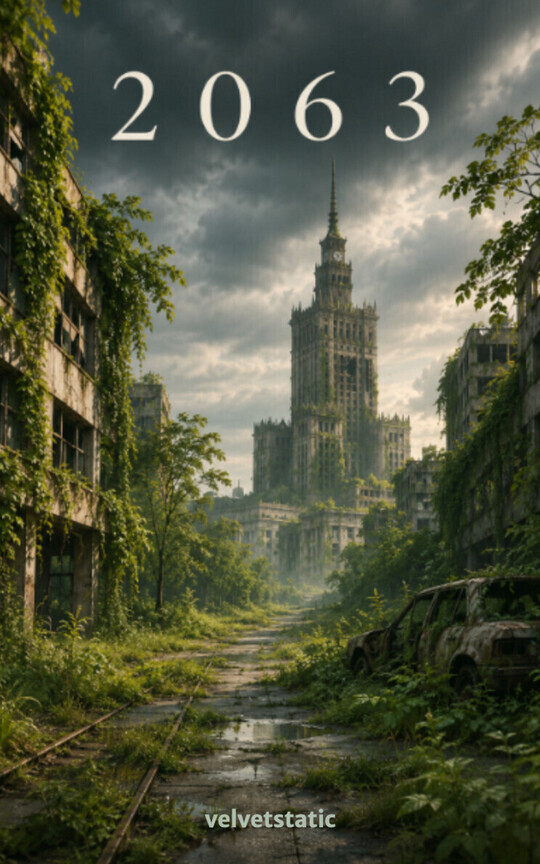
Four silhouettes turn toward me, waiting for me to join them. Without any signal to move, we just start walking. I lost count of how many runs we’ve done. We head out to scout another part of the city, leaving the Palace of Culture and Science behind us - a massive, Soviet-era tower rising over the ruins of the city.
We move in silence, though my heart keeps shouting Kaspar’s words, I’ll never let you go. I focus on the mission but it doesn’t stop me from torturing myself.
The city is completely abandoned and quiet. Nature has torn into every building, and now there is more green than gray, where buildings once dominated the landscape. Most of them are ruined, missing windows, torn open by huge holes, as if some giant took a bite out of brick and glass. Streets and sidewalks are cracked; here and there, a tree grows between rusted car wrecks. I notice a plant growing through a tram rail and I wonder, was it always there?
There aren’t many things left to scout within a radius of ten kilometers, so reaching the target area will take time. We follow Aleje Jerozolimskie, the main street in Warsaw. It’s easier to hide behind abandoned cars if we need to. We go by memory and at some point I see one of us already turning before the leader signals. The look of reproach he gets is terrifying.
One of the girls walks at the front of the group, about ten meters ahead of us, silent and alert, careful not to miss a single sound. The Others are loud. They don’t try to be quiet. You only need to listen to stay alive. And she listens. The moment she hears a familiar growl from ahead, she signals for us to stop, her fist raised. We all freeze and listen.
Avoiding danger at all costs is the first rule of the remaining survivors - the first rule of our unspoken code. Confrontation is fatal. We’ve learned that the hard way, too many times.
The leader decides to change our route, and soon we’re slipping between buildings onto a narrower street. It means taking a longer way around, but nobody complains. Not long after, we reach the designated area.
It’s not our first time here, but the place hasn’t been searched thoroughly yet. Scouting doesn’t just take courage to leave the station and risk your life. Going door to door, room to room, cabinet to cabinet is monotonous work. It’s boring. But everything counts. Even finding a handful of batteries feels like a victory. Sometimes there are drugs or bandages, weapons, books, or crayons, things that matter more than they should. And sometimes, if you’re lucky, you find food.
There’s nothing more tempting than eating a can of meat, or a fresh, sweet, juicy apple, and never telling anyone you found it. Along with courage and patience, you need empathy.
I freeze, staring at the oranges growing on a small potted tree, as if it isn’t five degrees above zero outside. How is this even possible? At first, I think about taking only the fruit. Then I decide the whole tree should come with me. It won’t be comfortable to carry, but... I lean into it, breathing in the scent.
Oh my god.
Ecstatic.
A couple of hours later, we’re done. When we regroup, I notice the reaction to my greatest treasure is divided. Two of them light up at the sight of the orange tree. Just two. The others roll their eyes. The disappointment hits harder than it should. I don’t understand how anyone could look at this and see nothing.
“You’d better not drop it,” someone whispers behind me. I know exactly who it is. I grit my teeth but don’t answer. From that moment on, I’m extra careful.
Our bags are heavy, filled with new finds. We’re all exhausted, but satisfied with what we’ll bring back. Even with the extra weight, this part of the run is always the best.
No one mentions that we’re behind schedule. The sun is low, too low for us to make it back in time. We hurry through ruined streets and shattered buildings. We never talk while running, but now we exchange impatient, uncertain looks more often than usual.
Fear drags up memories of staying outside too late. Memories I don’t want to revisit. Memories I don’t want to live through again. The city comes alive at night.
Seeing the station building, crossing the main hall, going down the escalators, and finding the doors open, with the watchers visibly relieved to see us, feels like coming home. I’m relieved Kaspar isn’t anywhere around. Part of me wants to tell him everything anyway: about the spider that bit me, about how one of us slipped on the stairs and scared us half to death, about the hour we spent waiting for the Others to pass without noticing us.
“The door should be closed,” the leader says to today’s watchers. It sounds like a reprimand, but the relief in his voice gives him away. Only now do I realize how long he must have been worrying about finding those doors closed.
“You scared me to death,” one of them replies. “We’ve been waiting for you for an hour. The sun set ten minutes ago, and I should be yelling at you for being late, but I’m not, so shut the hell up.” He snaps back to our leader, and I notice he still isn’t closing the doors behind us. The atmosphere shifts. It takes only a heartbeat for me to understand why.
“We’re the last ones?” I ask, already knowing we’re not.
The silence answers for him.
“Mark’s group should have been back two hours ago.” We all turn toward the stairs. No one speaks. The orange tree in my arms suddenly feels much heavier, much less special. The watchers still don’t close the doors. With every passing minute, as the outside grows darker, it becomes painfully clear they aren’t coming back.
With our heads down, we split up. The raiders head off to share what we’ve brought in. The watchers stay by the door.
This is my home, underground, in the main train station in Warsaw, turned into living quarters for nearly two hundred people. As I walk, I wonder if the doors are still open.