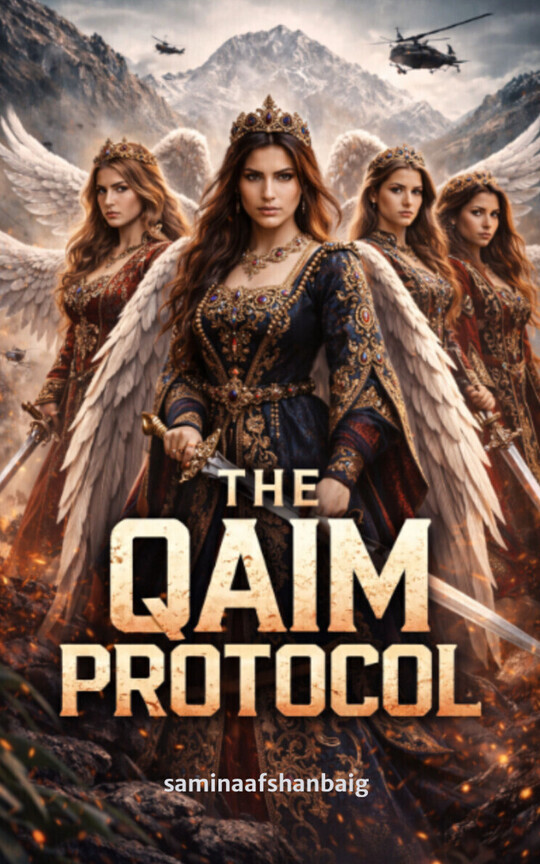

The Identification
The order arrived at Red Heaven before sunrise.
It was not marked urgent.
It did not need to be.
There were certain communications within the military establishment of Dardistan that carried an importance beyond the words printed upon them. They were handled by designated personnel, delivered through secure channels, and brought directly to the attention of those whose authority permitted them to understand their significance.
This was one of them.
Inside the Red Heaven Military Cantonment, the morning had begun as it always did. Personnel were reporting for duty. Vehicles moved along the cantonment roads. Officers arrived at their respective commands, soldiers assembled for their scheduled activities, and the administrative machinery of a military institution continued its familiar rhythm.
Beyond its perimeter, the mountains stood beneath the pale light of dawn.
Red Heaven was not a place that announced its importance. It did not need to. Its discipline, its history and the authority of the institution it housed were evident in the way it functioned. Every building had a purpose. Every department had responsibilities. Every officer understood the importance of the chain of command.
And yet, that morning, a communication had arrived that would place the entire establishment on a different footing.
The Qaim had been identified.
For several moments, the words remained on the screen.
There was no immediate discussion. No one rushed to fill the silence. The officers present understood that they were dealing with something that could not be approached as an ordinary military matter.
The identification concerned a fifteen-year-old girl.
Durreshehvar Khan.
The youngest of four sisters. A member of the Dardistani royal family. A girl whose life, until that moment, had belonged to the familiar world of family, education, private interests and the expectations that accompanied her position.
Now her name appeared in a communication of national significance.
The question was no longer simply who she was.
It was what her identification meant.
And what would have to happen next.
Durreshehvar Khan had no idea that the course of her life had already begun to change.
Her morning had been entirely unremarkable.
There were things she had intended to do that day, conversations she had meant to have, and the ordinary collection of small responsibilities that occupied the life of a fifteen-year-old. Outside, Dardistan was waking up. The day was brightening over the mountains, and the world continued with the reassuring indifference of a place unaware that something extraordinary had occurred.
She was not thinking about military cantonments.
She was not thinking about ancient mysteries.
And she certainly was not thinking about the Qaim.
The word had existed in the world long before she understood its significance. It belonged to a history she had not yet begun to comprehend, to conversations that were not held in front of her, and to questions for which she had never thought to seek answers.
She had no reason to suspect that it had anything to do with her.
Until she was summoned.
The summons was not accompanied by an explanation. She was simply told that Zarine wanted to see her.
That, in itself, was not unusual.
Zarine Khan was the eldest of the four sisters, and at thirty-five she occupied a position in the family that was quite unlike that of her younger siblings. She was a Major General, a senior military officer whose professional life demanded a degree of discipline, responsibility and authority that extended well beyond the boundaries of family life.
Her work was not something Durreshehvar could always understand.
The military had its own language, its own customs and its own hierarchy. It operated according to obligations that could not be put aside simply because someone had a family waiting at home.
Zarine understood that better than anyone.
When Durreshehvar entered, she noticed immediately that something was different.
Her eldest sister was standing rather than sitting. There were documents on the table, and the expression on her face was more serious than Durreshehvar had expected.
For a moment, neither spoke.
“What’s happened?”
Zarine looked at her.
“Sit down, Durreshehvar.”
It was not the sort of instruction that invited an argument.
Durreshehvar took the seat opposite her.
“Am I in trouble?”
“No.”
“Then why are you looking at me like that?”
Zarine did not answer immediately. She studied her younger sister, perhaps searching for the right way to begin a conversation for which there was no ordinary introduction.
“Something has happened,” she said at last. “And I need you to listen carefully.”
Durreshehvar’s expression changed.
“What sort of something?”
“The Qaim has been identified.”
The words meant very little to her at first.
She knew the name. She had heard it before, though never in a context that had made her particularly curious. It belonged to the larger collection of histories and mysteries associated with Dardistan, things that adults occasionally discussed with a seriousness she could not always follow.
She waited for Zarine to continue.
“Who is it?” she asked.
Zarine held her gaze.
“You are.”
Silence.
Durreshehvar looked at her sister, waiting for the explanation that would make the statement comprehensible.
It did not come.
“What?”
“You have been identified as the Qaim.”
“No.”
The answer came instinctively.
Zarine did not move.
“No?” she repeated quietly.
“I think there’s been a mistake.”
“I understand that this is difficult to hear.”
“No, you don’t understand. What does that even mean?”
“It means that your identity has been established.”
“How?”
“That is not something I can explain in a single conversation.”
“Then explain it in more than one.”
For the first time, something resembling the familiar expression of an older sister crossed Zarine’s face. It disappeared almost as quickly as it had arrived.
“Durreshehvar, I need you to understand that this is serious.”
“You’re telling me I’m something I’ve never even understood, and you expect me to sit here quietly?”
“I’m not expecting you to sit quietly. I’m asking you to listen.”
Durreshehvar looked down at the documents on the table.
Her name was there.
She recognised it immediately.
It was strange to see something so familiar in a setting that felt so unfamiliar. Her name had always belonged to her. It appeared on school records, personal correspondence and the countless ordinary things that made up her life.
Here, it seemed to belong to someone else.
Someone she had never met.
Someone whose existence had already become a matter of official concern.
“What happens now?” she asked.
Zarine took a breath.
“You will be going to Red Heaven.”
Durreshehvar looked up.
“Red Heaven Military Cantonment?”
“Yes.”
“Why?”
“Because that is where you need to be.”
“But why?”
“Your situation requires an appropriate level of protection, supervision and preparation. Red Heaven is where those responsibilities can be managed.”
“By the military?”
“By the people responsible for them.”
She leaned back, trying to make sense of what she was hearing.
“How long?”
Zarine did not answer immediately.
That was enough to make Durreshehvar uneasy.
“Zarine.”
“I don’t have a date to give you.”
“So I’m just supposed to go there?”
“You are being informed of a decision that has been made for your protection.”
“That isn’t the same as answering me.”
“No,” Zarine said. “It isn’t.”
For a moment, the two sisters looked at one another.
There were ten years between them. Ten years of different experiences, different responsibilities and different understandings of the world. Zarine had spent much of her adult life within the military establishment. Durreshehvar had spent her fifteen years growing up in a world where the military was something that existed around her, not something that would determine the direction of her own life.
Now the distance between those two worlds had disappeared.
“Do you know what the Qaim is?” Durreshehvar asked.
Zarine’s expression became difficult to read.
“I know enough to understand the importance of this identification.”
“That’s not what I asked.”
“I know.”
“Then what is it?”
Zarine looked towards the documents.
“That is one of the things you will need to learn.”
Durreshehvar felt a sudden frustration rise within her.
Everyone seemed to know something she did not. Her name had been placed into a world of decisions, authority and responsibility without anyone first asking whether she understood what was happening.
She was fifteen.
She had not asked to become the subject of a military communication.
She had not asked to be sent to a cantonment.
And she certainly had not asked to become the answer to a question she had never known existed.
“Does everyone know?” she asked.
“Not everyone.”
“Who does?”
“The people who need to know.”
“And who decides that?”
“That is determined by the responsibilities of the people involved.”
Durreshehvar gave a small, disbelieving laugh.
“You sound like an officer.”
“I am an officer.”
“I know that, Zarine.”
“Then you understand why I cannot discuss every detail with you.”
She fell silent.
Zarine moved towards her. The formality in her expression softened, though the seriousness remained.
“I know you have questions. I know you are frightened, even if you don’t want to admit it. But you are not going to face this without support.”
“You’re coming with me?”
Zarine paused.
“I have responsibilities at Red Heaven.”
“That isn’t an answer.”
“I will be there.”
Durreshehvar searched her face.
“Promise?”
Zarine placed a hand over hers.
“I will be there.”
It was the closest thing to reassurance she could offer.
The journey to Red Heaven would mark the beginning of a life Durreshehvar had never imagined.
Beyond the familiar boundaries of her world stood an institution built around discipline, command and responsibility. Its personnel had their own duties. Its officers had their own obligations. Its structures existed for purposes that extended far beyond the ordinary concerns of civilian life.
And within that institution, the identification of the Qaim would require attention.
Durreshehvar did not yet know what the Qaim meant.
She did not know why she had been identified, what had led to the decision, or what expectations would be placed upon her. She did not know the full history of the Warrior Angels or the Fallen Angels, nor how deeply their existence was woven into the history of Dardistan.
She knew only that her life was changing.
And that Red Heaven was where it would begin.
In the mountains of Dardistan, the morning continued.
Soldiers reported for duty. Officers attended their briefings. Vehicles moved through the cantonment, and the machinery of military life proceeded with its accustomed precision.
Somewhere within Red Heaven, a place was being prepared for a girl who had never expected to find herself there.
Her name was Durreshehvar Khan.
And she was the Qaim.