
The Setting Sun
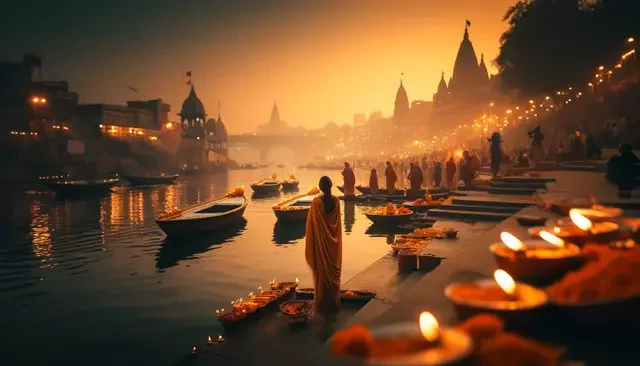


Banaras, also known as Varanasi, is a city where time stands still. Nestled along the sacred banks of the Ganges, it is a place where the spiritual and the material coalesce in an intricate tapestry of life and death. As the sun dipped below the horizon, painting the sky in hues of gold and crimson, the city seemed to come alive with whispers of ancient secrets.
Anu Sharma stood at the Dashashwamedh Ghat, feeling the pulse of the city beneath her feet. The ghats, with their steep steps leading down to the river, were bustling with activity. Priests conducted evening aarti, their chants echoing through the air, while devotees lit earthen lamps, setting them afloat on the river’s surface. The lamps, tiny beacons of hope and prayer, mirrored the stars in the darkening sky.
Anu was a journalist from Delhi, drawn to Banaras by a story that had haunted her for months. Rumors of mysterious disappearances had circulated in the city, whispers that were dismissed by some as superstition, but which had a chilling ring of truth. She had come to Banaras not just to chase a story, but to seek answers to a puzzle that had eluded many.
As she walked through the narrow lanes, the city enveloped her with its age-old charm. The alleys, barely wide enough for two people to pass, were lined with ancient buildings, their facades adorned with intricate carvings and faded murals. The air was thick with the scent of incense, mixed with the aroma of street food being prepared in tiny stalls. Vendors called out their wares, and the sound of temple bells mingled with the chatter of locals and tourists alike.
Despite the apparent liveliness, there was an undercurrent of unease. Anu could sense it in the wary glances of the shopkeepers and the hurried steps of the locals as dusk settled in. The city, with its rich history and spiritual significance, held its secrets close. And Anu was determined to uncover them.
Her investigation began with a visit to a small, dimly lit bookstore tucked away in one of the quieter lanes. The store, with its shelves overflowing with books on spirituality, history, and folklore, seemed like a portal to another time. The owner, an elderly man with a thin frame and spectacles perched precariously on his nose, looked up from behind a counter cluttered with manuscripts.
“Namaste,” Anu greeted, her voice carrying a blend of curiosity and determination. “I’m looking for information about the recent disappearances in Banaras.”
The old man’s eyes, sharp and probing, met hers. “You seek the truth in a city built on myths and legends. Sometimes, it is best to let the shadows remain undisturbed.”
Undeterred, Anu pressed on. “I believe these stories hold a kernel of truth. There must be records, old texts, anything that might offer a clue.”
With a sigh, the owner reached under the counter and pulled out a dusty book. Its leather cover was cracked with age, and the title, “Whispering Shadows,” was embossed in faded gold letters. He handed it to her with a solemn expression. “This might help. But remember, not all truths are meant to be uncovered.”
The book was a compendium of Banaras’ darker lore – tales of rituals, sacrifices, and a hidden temple said to be cursed. As Anu leafed through its pages, she felt a shiver run down her spine. The descriptions were vivid, almost as if the book itself was a living entity, breathing life into the past.
Guided by the cryptic clues in the book, Anu ventured further into the city’s depths. The streets grew narrower, the buildings older and more decrepit. The labyrinthine alleys seemed to close in on her, but she pressed on, driven by a mix of curiosity and foreboding.
Her journey led her to Manikarnika Ghat, the holiest of the city’s cremation grounds. Here, the veil between life and death was at its thinnest. The ghat was shrouded in smoke from the funeral pyres, the air heavy with the scent of burning wood and incense. Priests chanted ancient mantras, their voices rising and falling in a hypnotic cadence. It was a place where souls were believed to attain moksha, liberation from the cycle of rebirth.
Amidst the flames and the chants, Anu noticed a narrow, almost hidden path leading away from the ghat. The alley was lined with ancient banyan trees, their roots twisting and turning like skeletal fingers reaching for the sky. The further she walked, the quieter it became, until all she could hear was the rustle of leaves and her own heartbeat.
At the end of the path stood an old, dilapidated temple, its entrance obscured by a curtain of vines. The temple seemed to pulse with a malevolent energy, its stone walls whispering secrets of long-forgotten rituals. The setting sun cast long shadows, giving the temple an eerie, otherworldly glow.
Inside, the temple was dark and cold. Anu’s footsteps echoed in the silence as she moved cautiously through the space. The air was thick with the smell of damp stone and decay. An ancient altar stood at the center, covered in dust and cobwebs. Symbols were carved into the stone, their meanings lost to time. As she explored, her flashlight flickered, casting eerie shadows that danced on the walls.
In a corner of the temple, Anu stumbled upon a hidden chamber. The entrance was concealed behind a stone panel that had been partially dislodged. Inside, the air was colder, and a sense of foreboding washed over her. The chamber was small, barely larger than a closet, and filled with old photographs and trinkets – relics of the lives that had vanished.
The photographs were yellowed with age, their edges frayed. The faces in the pictures stared back at her, their eyes holding silent pleas for justice. Among the trinkets were personal items – a locket, a pair of spectacles, a child’s toy. Each item told a story, a life abruptly interrupted.
As Anu stood in the chamber, piecing together the fragments of the past, a realization dawned on her. The disappearances were not random. They were part of something much larger, something deeply rooted in the city’s history and its hidden rituals.
With renewed determination, she left the temple, her mind racing with questions. Who were the victims? What connected them? And most importantly, who was behind these sinister acts?
The city of Banaras, with its ancient soul and timeless mysteries, had given her a glimpse into its darkest corners. And Anu was prepared to follow the trail, no matter where it led. For in the heart of Banaras, where life and death danced in an eternal embrace, the truth was waiting to be uncovered.