
Chapter 1


It was no surprise that he’d heard her. The house was so tiny that, from Leda’s room, you could hear the rats combing their whiskers under the eaves at the front door.
“Never better.” The worry lines around his eyes softened and she gave him her widest smile. “My belly hasn’t been this full since... I can’t remember when.”
“Are you cold?”
“Not very. Just restless. Alex, tell me the story of when I was a baby.”
Her brother took a step into the room “When you were a baby,” he said, and groaned. “Ah, when you were a baby.” He sat down on the edge of her bed, for there was nowhere else to sit.
“When you were a baby, I had no idea what to do with you,” he said. “Nobody did. You were so angry—so red in the face, and you bawled and bawled as if to breathe was to cry. Nobody could stop you—not the nurse, not the chambermaid, not the cook, not the coachman. In despair, on the third day after—” he paused and swallowed.
“On the third day after Mother died and Father drowned,” Leda said. She didn’t remember her mother, of course—you don’t remember your mother if your arrival is what kills her. Nor did she remember her father. You don’t remember your father if he falls into a river, grief-stricken, and drowns without ever looking at you. You remember him even less if you go by your mother’s family name. When she was only an infant and her brother Alex barely more than a boy, he had decided they would go by the name of Ryder—and so they had, ever since.
Alex had been too angry with their drowned father to bear his name.
“On the third day,” said her brother, “the wet nurse had fed you but still you bawled, and they brought you to me. ‘Maybe you can soothe her,’ they said. ‘You are her only blood, after all.’ I was ten years old. I had never held a baby before, nor ever wanted to. I didn’t want to then, but the nurse plunked you down on my lap and left the room.”
“And you were very sad, were you not?” asked Leda.
“I was very sad. Mother—” his voice still broke on the word, after all these years. “I didn’t know how to live without her.”
Leda nodded. “I know.” And neither of them said more on that subject.
“So you lay there in my lap, bundled tight, with your eyes closed and your face red, and you bawled and bawled until I could bear it no longer. So I clamped you in my arms and stood up and walked with you. I meant to take you straight back to the nurse, but when I began to walk, your crying became less agitated. Slowly, you stopped crying altogether. You hiccupped. You looked at me. I looked back at you and you had Mother’s eyes.”
They were both quiet for a moment, Leda looking up at the stars in the window. “Tell me about the banister,” she said.
He laughed. “I was ten years old. A boy, not at all the person who should have been put in charge of a baby. But from then on, whenever you cried, they brought you to me. I walked around with you in my arms and sometimes that was enough to calm you. If it wasn’t, I found it helpful to run. For some reason, speed soothed you. If running didn’t work, I would try jumping. Down the corridors I would go in long, graceless leaps, swishing through the air.”
Leda laughed. Her eyes were closed now, and just for a moment, she was a baby in a half-grown boy’s arms as he hurtled down draughty corridors. Colors blurred as the two of them sped recklessly past tapestries and oil paintings and sconces, the back of her head wobbling against his chest. He held her in a most unconventional way, facing forward, so she could see. The wind blew in her face.
“There came a day when you didn’t calm down despite all my running and leaping and cavorting,” he said. “That was the day we slid down the banister of the grand staircase.” He laughed out loud. “Nurse saw me and screamed. She thought we would come to grief on that slippery rail, for we were sliding almost as fast as if we were falling.”
“But you never let harm come to me,” Leda said, opening her eyes.
“Not then and not now,” said Alex, and he kissed her head and left her to sleep.
Leda listened to her brother settling down in the other room. She listened to the spider spinning its web in a corner. She listened to the rats in the ceiling as they scurried and squeaked. She listened to the wind outside, whistling in the eaves.
Through Leda’s small, high window, the patch of night-sky was like black velvet studded with scattered diamonds. The splendor of the sky made up for the bareness of the walls in their tiny house. That living patch of darkness, pulsing with tiny lights, was more beautiful than the priceless works of art that used to grace the walls of the great hall of her ancestral home.
The intricate tapestries, the oil paintings of sweeping landscapes, the luminous still-life pictures of flowers and fruit—she barely missed them.
She pulled her knees up close to her chest and wrapped her arms around them.
She was warm enough beneath the threadbare blanket that covered her narrow bed. She didn’t miss the rich and sumptuous furnishings that had gradually disappeared from their household. She didn’t at all mind using her woolen coat as an extra cover when the weather turned cold—as it had tonight.
It was a good thing her room was so small. The smallness made it snug, and she had no furniture to fill it but her bed. As long as she still had books to read, she would never feel poor.
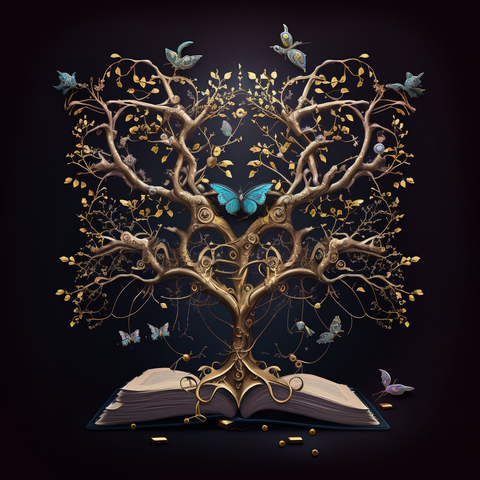
Books, and the jewel tree.
That very evening, the jewel tree had twinkled and glittered on the table as she and Alex ate the birthday dinner he had cooked for her. She had just turned sixteen.
She and Alex were poorer than church mice, yes, but nobody in all the realm had a more beautiful centerpiece on their table, not even the king and queen.
The birthday meal had been simple—potato soup, chicken pie, and fresh cherries for dessert—but Leda savored every mouthful. They hardly ever ate chicken anymore, let alone fresh fruit. Their diet was mostly cabbage, carrots, and potatoes—anything they could grow themselves—with an occasional egg or wedge of cheese when they had the coin to pay for it.
She told herself she was happy—but when she closed her eyes to sleep that night, Leda had the dream again.
She dreamed that the jewel tree was withering with some sickness that afflicted trees out in the forests, a sickness that caused its bark to fall off in sheets, that made its branches shrivel and snap, that forced its trunk to gnarl up into knots.
Even in her dream, she knew this was impossible. The jewel tree was made of silver and gold. It wasn’t subject to the rot and decay of living things.
***
Towards dawn that same night, Alex crept into the kitchen cradling something in his arms. He set the thing down carefully on the table and stared at it by the light of a single oil lamp.
It was the Ryder family tree, and he had just taken it out of the chest where it was stored—for the second time that day. The tree had been on this table only hours earlier, a symbol of hope and celebration, to mark Leda’s sixteenth birthday.
Now he needed it for something else.
It was a miniature tree fashioned of precious metal, its many branches curled into decorative scrolls. From each scroll dangled a tiny, bejeweled charm. Some of the charms were birds—there was a hummingbird, an owl, a starling, a robin, and even a crow. Others were pinecones. Others were lanterns. The most beautiful of all were tiny, perfect blossoms.
From the pocket of his jacket, Alex brought out a miniature set of tools, the kind people use to repair eyeglasses. Using these, he carefully detached one of the tiny blossoms. It was designed to look like a spray of jasmine, with diamonds for petals and small emeralds for leaves.
Sighing deeply, Alex dropped the blossom into an envelope, sealed it, and tucked it into the pocket of his green coat. He put the jewel tree back into the leather chest in the parlor. Locking the chest, he let himself quietly out of the house and made his way into the heart of the great city. Dawn was beginning to redden the sky.
At a certain discreet shop, on a certain street corner, he rang a copper bell and was welcomed inside by the yawning pawnbroker, who was still tucking his shirt into his trousers. “Must you come so early in the morning?” the pawnbroker asked.
Alex said nothing, merely holding out his envelope.
The pawnbroker whistled long and low. “What is this?” he asked. “It appears like a pendant, and yet not quite.”
“It is taken from an ornamental tree,” Alex said.
This was by no means the first time the pawnbroker had done business with Alex Ryder, but it was the first time he laid eyes on any of the charms from the Ryder family tree. He had heard of the tree, of course. Everybody in his line of business in the great city had heard of the Ryder tree of jewels. Some said it had been lost more than a generation before. Some said it was nothing but legend, a fabrication that flew on the wings of rumor and speculation.
But this pawnbroker now knew the tree of jewels to be real.
The pawnbroker brought out his scales and his magnifying glass. He claimed he saw inclusions in the biggest diamonds; he claimed two of the emeralds were glass. But his heart was beating very fast in his chest because he knew this could be the beginning of something big.
The Ryder jewel tree was a sacred artifact. It was said that the souls of departed family members resided in its curiously wrought charms. The pawnbroker knew of several collectors who would pay almost anything for just one charm from this legendary tree.
In this furtive way, Alex sold off the first priceless jewel from the branches of the precious little tree.
He had sworn to himself that he would never touch this particular heirloom. The tree had been in his family for more than three hundred years, gathering charms as babies were born. It represented all the dead Ryders who had gone before, who had made the family name great, who had amassed fortune after fortune down the generations.
Yes, he had sworn never to touch it—but Lady Luck was set against him, as she’d been set against all Ryders for the last thirty years, and he was down to his last penny. He had to keep a roof over Leda’s head.
Leda was thin, dark-eyed, and solemn. You hardly noticed her, most of the time. But then, when something interested her, she lit up like a lantern. When she was happy, she could electrify an entire room with the crackle of her energy. Her rare laughter was so contagious it made dogs dance and cats purr.
Alex would have thrown himself off a cliff to protect her. When she was very little, he would sit in the rocking chair watching her sleep long after he had read her a bedtime story. His eyes on the blonde tufts of hair above the blanket, he would renew his solemn vow to win back the family’s lost fortune.
Anybody could see that Leda was special. She was born to be a great lady, and it was up to Alex to provide the substantial dowry such a girl deserved.
Alex couldn’t sail away and seek his fortune, leaving Leda in the hands of servants. He couldn’t mount his horse and ride off to the battlefield. Who would protect Leda if he died, too? The only way a gentleman in his predicament could possibly make money was at the gaming tables.
Or so he told himself.
Repeated setbacks and disappointments could not change his course. He was determined to win their fortune back on the throw of a dice.
When Leda was five, he sold away the family estate to pay the vast debts that the two of them had inherited from their parents. He’d been little more than a child himself—just fifteen years old—when he made the momentous decision to put the great house and extensive property on the market. Nobody had reasoned with him or tried to stop him, for he and Leda had been alone in the world then, just as they were now.
He’d kept many things of great value—paintings and furnishings and crystal and plate ware, rugs and silver goblets and suits of armor and statues.
In a modest mansion, these things were stacked high around the two of them, making big rooms small. Five-year-old Leda set up her wooden blocks on a pile of priceless handwoven rugs. When she played hide-and-seek with her nurse, she hid inside a trunk of carved ebony that had once held the trousseau of a queen.
While Leda played with silver baubles and dust bunnies, Alex plied his trade at the card tables and in the gaming halls. And the crowded rooms began to empty.
Lady Luck refused to smile on him.
Grimly, Alex sold off ever more Ryder heirlooms. His belief that his luck was about to turn was unshakeable.
About once a year, he was obliged to let Leda know that they would be moving again, and each time they moved into a smaller house, with fewer possessions.
By now, they were in a house so small that Alex slept in the parlor, and Leda slept in the only bedroom.
Alex thought the price of the tiny jasmine spray would keep the bank account fat for months, but the money slipped through his fingers like water. It had a way of doing that.
Within a matter of days, he needed to take another charm from the tree. This time, he chose the owl because it featured a large diamond and he thought it would fetch perhaps twice as much as the jasmine charm. It did fetch a little more, but not enough to get them through the month.
Alex had a particularly bad run at baccarat that week—but he felt in his bones that this time his luck would finally turn. Another charm was plucked from the tree. The pawnbroker became accustomed to his dawn visits.
And so the year passed, with each month marked by the loss of more jewels from the tree--until its branches were all but bare.
Before Leda turned seventeen, they were obliged to move into a house so small it could only be called a hovel. Leda slept in the kitchen, on a pallet next to the stove. Alex slept in the other room, on a blanket on a bare dirt floor.
“I am sorry, Leda,” Alex said as they sat together at the rough-hewn table on the eve of her sixteenth birthday. “We have come very low. But the good news is, we have nowhere to go from here but up.”
And he smiled the smile that crinkled the skin at the corners of his eyes. Leda took a long sip of her mug of weak tea. It was all they had for their dinner.
“I’m not worried, Al,” she said. “We’re not down and out yet. After all, we are still wealthy beyond most people’s dreams. We still have the jewel tree.”


















Strong start..
Wow, great story/plo! Layered and compelling, great read!
Thanks! Glad you're enjoying it! I'd love to hear what you think as you read on.