
Morning Stillness
The coffee had long since gone cold in her hands, but Callie didn’t move.
She sat at the edge of the porch swing, bare feet pressed to the peeling wooden floorboards, her eyes fixed on the horizon where the fog still clung low over the fields. The morning was quiet—too quiet. The kind of quiet that used to feel peaceful, back when it was full of someone else’s footsteps, another voice calling out from the kitchen, the sound of two pairs of boots instead of one.
Now, it just felt hollow.
Behind her, the screen door creaked gently on its hinges as the wind pushed against it. She didn’t bother to fix it. There were too many other things demanding her attention—fences to mend, bills to stretch, grief to tuck away until after bedtime.
A soft thud came from inside the house.
Callie turned her head, just slightly, waiting.
“Momma?” Willow’s voice came like a whisper through the screen. “Can I come out?”
Callie blinked, dragging herself back from wherever her thoughts had taken her, and nodded. “Yeah, baby. You can.”
The door opened, and her four-year-old stepped out onto the porch, dragging a threadbare stuffed bunny in one hand, still dressed in pink pajamas with tiny sunflowers on them. Her curls were messy, her brown eyes wide and blinking against the light.
Willow padded over and climbed into her lap without a word. Callie wrapped her arms around her daughter, resting her chin against the top of her head, breathing in the sweet, familiar scent of syrup, sleep and childhood.
“Where’s Daddy?” Willow asked softly, her voice small but curious, like she was asking about the weather.
Callie’s arms tightened around her without thinking.
“He had to go away, honey,” she said gently, brushing a strand of hair from Willow’s cheek. “But I’m right here, okay?”
Willow nodded, her attention already drifting to the porch railings where a ladybug was crawling. Callie watched her for a moment, until the screen door creaked again.
Westin stepped out this time, taller and quieter than his sister, his face still soft with sleep but his eyes sharper than they should’ve been at eight years old. His brown hair stuck up on one side, and he rubbed at his face with the back of his hand like he was trying to shake off whatever dream still clung to him.
He didn’t say anything right away. Just walked to the edge of the porch and stood beside the swing, looking out over the fields like she had.
“Is he ever coming back?” he asked finally, his voice flat. Not angry. Just... tired.
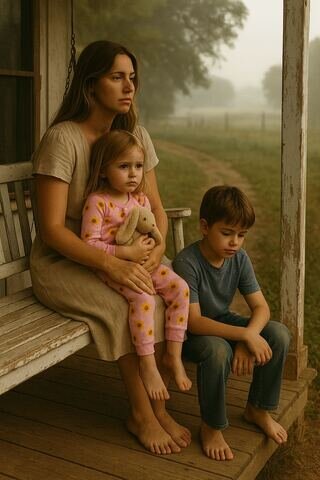
Callie swallowed the knot in her throat and met her son’s eyes. “I don’t know,” she whispered. “But we’re gonna be okay. You, me, and Willow. We’re gonna figure it out.”
Westin didn’t answer, but after a few seconds, he came and sat on the step below her, leaning his shoulder against her knee.
And for a moment, just that moment, they were quiet together. Three pieces trying to feel whole again.
Willow leaned forward on Callie’s lap to point at the ladybug, and for a moment, Callie smiled. It was small, fleeting—but real.
Then Westin shifted where he sat on the step, and the creak of wood beneath him brought it all rushing back.
⸻
She could still see it.
The front door swinging open on a warm April morning.
Her husband’s duffel bag slung over his shoulder like he was just heading off for a weekend trip, not walking out on their life.
He hadn’t looked at her when he said it.
“I can’t do this anymore, Cal.”
The kids were still eating breakfast in the kitchen. She remembered the smell of toast. She remembered the sound of Willow giggling with syrup on her cheeks.
And she remembered standing there, barefoot on the tile floor, her whole body frozen while he walked past her like a ghost.
No goodbye kiss. No note. Just boots on the porch and then silence.
⸻
She blinked herself out of it before the tears could make it all the way to the surface.
The sound of tires crunching over gravel pulled her back. Callie looked up just as an old pickup truck pulled into the driveway, familiar in a way that made her chest ache with both comfort and memory.
Her grandfather climbed out slowly, his worn jeans stiff at the knees, his gray hair poking out beneath a dusty ballcap that read Monroe Feed Supply. He moved with the kind of stubborn strength that came from a life of hard work and refusing to slow down—until life forced him to.
Willow’s face lit up. “Pawpaw!”
Callie stood, setting her mug aside as her daughter darted toward the truck. Westin followed behind her, slower, but smiling.
“Hey there, little bugs,” her grandfather said warmly, crouching just enough to catch Willow in his arms. “You grow a whole foot since Tuesday?”
Willow giggled and shook her head as Westin leaned into his side for a one-armed hug.
Callie made her way down the steps, folding her arms against the morning chill.
“You didn’t have to drive all the way out here,” she said, though her voice softened as she said it.
“I wanted to,” he said, giving her a look that told her he meant it. “Wanted to see my girl.”
He looked at her for a beat longer than she could handle, and then shifted his attention to the field.
“Looks like the north fence is sagging,” he murmured. “You patch it up?”
Callie let out a breath. “I was gonna try this weekend.”
“Well, you’re not. Not alone, anyway.” He reached into his back pocket and pulled out a folded piece of paper. “I hired someone. He’s supposed to come by later today. Good kid. Works hard. Quiet type.”
Callie frowned. “You didn’t have to—”
“I did,” he said gently, meeting her eyes. “You’ve been carrying too much, Callie. And I’m not strong enough to carry it with you anymore.”
That cracked something open in her she hadn’t meant to show.
She nodded, biting the inside of her cheek. “Okay.”
“I’ll keep coming out as much as I can,” he added, patting her shoulder. “But it’s time someone else steps in a bit.”
Willow tugged on her grandfather’s hand. “Can we show you the wildflowers by the fence?”
His smile returned, softer this time. “I’d be honored, darlin’.”
As the kids led him toward the back of the property, Callie stayed behind for just a second longer—watching them go, wind brushing her hair, heart still learning how to let people help her carry the weight.
——————
Callie leaned against the kitchen counter, one hand curled around the edge of the sink, the other holding her phone to her ear as she listened to Lanie’s voice crackle through the speaker.
“So... have you cried in the chicken coop yet today?” Lanie asked, deadpan.
Callie huffed out a laugh despite herself. “Not yet. But the day’s still young.”
“I’m just saying, when the hens are your most stable emotional support system, it might be time to get out more.”
Callie glanced out the window above the sink. Her grandfather’s truck was still parked out by the side gate, and the kids were chasing butterflies behind him as he examined the wildflowers along the fence line.
“I get out plenty,” Callie said. “Went to the feed store, the gas station, and the mailbox. Living the dream.”
Lanie snorted. “All right, well, just so you know, you are allowed to have a life that includes something other than grief and grape jelly stains.”
Callie smiled. “Thanks, Dr. Phil.”
There was a pause on the line—just long enough for Lanie’s tone to shift.
“Hey,” she said softly. “You’re doing good, Cal. I mean it. Even on the days it feels like you’re just holding the pieces together with duct tape and prayer... You’re doing good.”
Callie’s throat tightened. She didn’t know how to answer that. So she didn’t.
Instead, she turned back toward the kitchen window—and that’s when she saw it.
A truck she didn’t recognize pulling into the driveway..
Callie straightened instinctively, heart skipping once before she told it to settle the hell down.
“Lanie,” she said into the phone, her voice a little too steady. “I think my new farmhand just pulled in.”
“Ooh,” Lanie purred. “Is he old and crusty like every ad says, or...”
Callie didn’t answer. She was still staring.
“Cal?” Lanie prompted.
“I gotta go,” she said quickly, voice tight. “I’ll call you later.”
She ended the call before Lanie could pry further, setting her phone down with a soft clink on the counter.
The engine cut off, and a tall man stepped out, his movements slow but purposeful. Worn jeans, a faded blue work shirt rolled at the sleeves, and a tan cowboy hat pulled low over his brow. She couldn’t see his face—not clearly—but something about him made her spine straighten.
Her grandfather was already heading out from the barn, waving the man down. They exchanged words she couldn’t hear, short and direct.
The screen door creaked as she stepped onto the porch. She crossed her arms and waited.
Her grandfather waved her over. “Callie,” he said as she approached, “this here’s Colter Ridge. He’s the one I told you about.”
The man tipped his hat, just slightly. “Ma’am.”
His voice was low and rough, like a gravel road after rain. His face stayed in shadow, and she couldn’t quite place him—not that she tried to.
She nodded. “You’ve done this kind of work before?”
“Yes, ma’am.”
Her arms folded tighter. She hated being called ma’am, but she didn’t correct him.
“Been working land since I could walk,” he added.
Her grandfather stepped in before the silence grew too sharp. “He’s solid, Cal. Worked for the Mitchells three seasons. Knows his way around a busted fence line and a temperamental water pump.”
Callie gave a tight nod but didn’t smile. “We’ve had folks come through before. Didn’t always end well.”
Colter didn’t react, didn’t flinch. “I’m not just passing through.”
That answer didn’t comfort her. If anything, it made her more cautious.
Her grandfather handed him the keys to the shed. “Get started on the north fence when you can. Callie can show you where everything is.”
Callie hesitated, then turned toward the barn. “This way.”
They walked in silence. The wind rustled through the trees lining the edge of the pasture, the faint buzz of bees somewhere near the wildflowers that clung to the fence line.
He didn’t talk, and she didn’t offer anything either.
At the shed, she pulled open the door. “Tools are in here. There’s a post puller, new wire, and some spare boards in the back.”
He stepped forward without a word, grabbing what he needed. As he moved, she caught a glimpse of dark ink trailing down his back beneath the collar of his shirt—a tattoo, something bold and deliberate.
She looked away quickly.
“Anything else you want done today?” he asked, voice even.
“No,” she said, then paused. “Just... don’t leave a mess.”
He nodded once. “I don’t.”
She watched him walk off toward the fence, tools in hand, shoulders squared against the sun.
There was something about him—something quiet but heavy, like a story buried deep under dirt and time.
But she didn’t ask.
Not yet.



















😭
_