
Chapter 1
 He was running.The salty taste of a droplet sliding from his forehead down to his nose met his pointed tongue as it slipped between his lips. Yet he did not stop. He kept running, turning sharply from one street into another. Believing that looking back would slow him down, he fixed his gaze straight ahead.
What was driving him so relentlessly, enough to make his heels ache? The question suddenly lodged itself in his mind. Truly—why was he running? Where was he going, and what was coming after him?
He woke up.
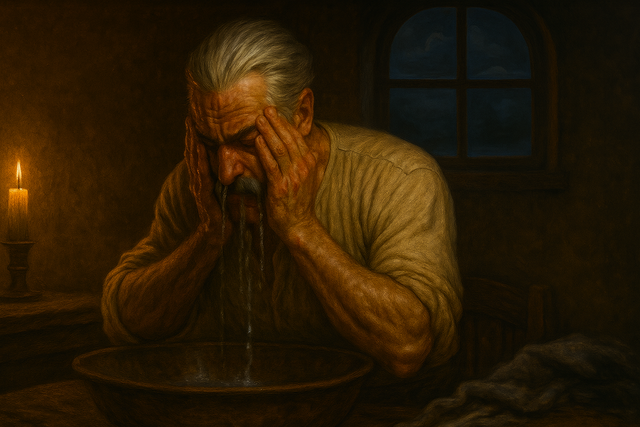
A sharp, salty taste lingered on the tip of his tongue—no longer quite as pointed as in the dream—and the thin woolen blanket draped over him was soaked through. For some time now, he had been seeing the same dream at night, the same one, leaving him drenched in sweat. Always the same dream.
He had completed his week-long journey from Slambol to Düve just the night before, and now, in the attic of an old friend, he was splashing water over his parched mind, still under the influence of that dream. The sky had begun to reveal its pale blue hue; only a few minutes remained before the double-headed roosters would start crowing.
Yet he had already pulled on his leather boots beneath his black leather trousers. His leather tunic and the cloak that gave him the look of a traveler had quickly settled over his wounded body. Before the double-headed roosters could even announce the morning, the cawing of crows had driven him out into the farm’s garden.
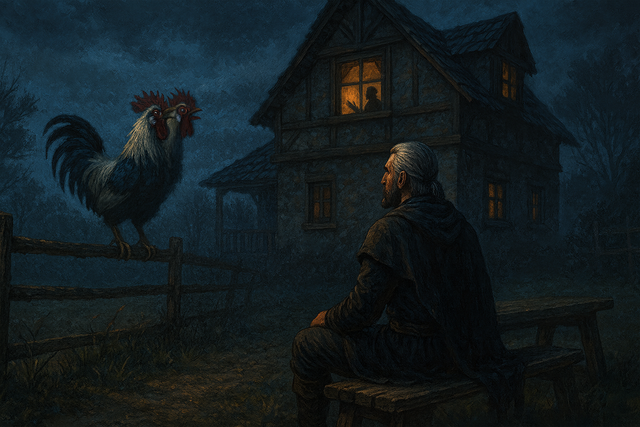 It was a remarkably wide garden—wide enough for children to play, for animals and children alike to lounge about, and for adults to sit and drink something proper. Lengthwise, however, there stood a large table at which only children could fit. Though his friend was an orderly man, it seemed the children who had ransacked the garden had not appealed to him.
The double-headed roosters crowed at last. His friend responded with what he must have considered a pair of affectionate words—though affection, of course, was a matter of perspective, for his sentence involved a remark about the roosters having only one head instead of two.
A few minutes later, his friend’s wife descended into the garden before her husband. She began stacking firewood, then wedging kindling between the logs. “Nasah, come on, you ox—get over here and light this fire!” she shouted.
She suddenly stopped and turned toward him. “Actually,” she said with a smile, “a little help wouldn’t hurt, would it?”
She was answered with a willing “With pleasure,” followed by the sharp snap of fingers. Without waiting for the kindling, the logs burst into flame.
From inside the house came a voice: “Haa! What was that? Ahhh! Didn’t I tell you no such things would be done on this farm?”
The owner of the voice had stepped outside now and stood in the garden. “Well, you’re right,” came the reply. “If you want, I can put it back the way it was.”
“Oh, get out of here. Never mind now. You came late last night, and in my sleepy state I could only say welcome and explain a few house rules,” he said, taking a few steps forward and approaching the one he had just scolded—albeit with a hint of unease.
Nasah barely stood a meter tall; his beard might well have matched that length—perhaps a little shorter. His wife was of similar height. They were a couple who completed each other perfectly.
“Since we’re awake now, let’s shake hands like two men, eh, Son of Fire,” Nasah said. They clasped arms like two pieces meant to fit together.
“Before we start the farm work, we’ll wake the children and have breakfast. Until they wake up, how about telling us a little about your journey, eh? You’ve come a long way.”
“The road was long and arduous. And when I reached the end of it, matters would not become any easier.” There was no exaggeration or embellishment in the Shamur’s words.
“Once, I traveled the roads of Slambol myself. I wasn’t alone like you, of course—I joined a caravan. Still, the roads were safe back then. Truth be told, nothing troubled the caravan too much, but—hey! Son of Fire, your road doesn’t seem to have been as comfortable as mine, eh?” the dwarf said.
The Shamur’s curt dismissal of the subject clearly displeased him, though he must have known better than to press further. “Come now, Shamur! There’s no problem a good breakfast can’t solve!”
At breakfast, Nasah’s sons—who had expected to hear countless tales from Slambol and were eager for them—heard nothing beyond a few customary praises and a handful of beautiful places immortalized in epics.
“Yes, that bridge connecting the two continents is real." “No, of course it isn’t a magical bridge in the sky; it was built by people through years of hard work." “And yes, if you behave yourselves, one day you might see Slambol too.” “Hmph.”
That final exhalation announced—coolly for the air, but familiarly for him—that the conversation was over.
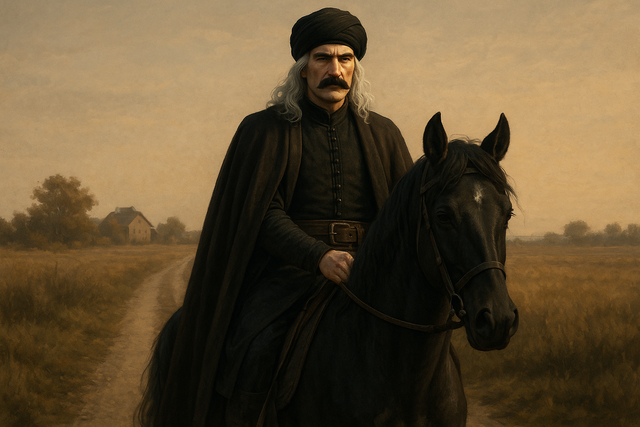 Leaving Nasah and his wife Meysa to their farm work, he saddled his horse Ifkı and set off toward the city walls, ten kilometers away. He stroked and brushed Ifkı from mane to back, a habit he practiced whenever possible, treating the horse with the respect one grants an ancient friend. Perhaps because Ifkı was truly the only friend he could trust.
Though the road was short, the day was long. He did not push the horse, guiding the reins gently. With much to think about, his mind wandered back to how he had first met Nasah—the dwarf who would become his friend.
“How many times must I say this? I am a merchant. I’ve been on the road for weeks to sell the goods I brought from Düve,” said the man whose voice was far bolder than his body suggested.
“My dear treasurer, we don’t want any trouble in the inn. Perhaps I could invite you to a nice room in the back?” the innkeeper offered.
The treasurer kept his eyes fixed on the dwarf’s goods, waiting with infinite patience as the janissaries rummaged through the bags containing them.
“And since when did dwarves stop forging iron and start trading?” It was one of those questions that expected no answer—and none was given.
This time, the heavy, creaking door of the inn opened quietly, so quietly that neither the guards nor the innkeeper noticed the newcomer. Those seated inside with their faces turned toward the door, however, could not say the same. A broken groan and the sudden pallor that washed over dark faces gave those with their backs turned an idea of who had entered.
He slipped in silently and settled into one of the inn’s dark corners with almost delicate steps.
Without delay, the innkeeper’s daughter brought coffee and plenty of nuts to the table. As she turned back to whisper something into her father’s ear, the sharpened guards—already well aware of the pitiful argument between the treasurer and the dwarf—began to grow angry. The so-called merchant’s goods lay scattered, and the innkeeper was breaking into a cold sweat.
“So that’s how it is, gentlemen,” the innkeeper said. “I don’t suppose you’d want to cause further trouble here. Let us not sully the presence of such a distinguished guest.”
The treasurer failed to understand what the innkeeper meant. The innkeeper nodded toward the darkest corner of the inn, and at that moment, the snap of fingers was heard. The corner was dark no longer.
The treasurer knew how keen that man’s ears were. Still, he could not restrain himself from spitting on the ground and hissing, “Damnable demons.”
“We’re leaving. And you, dwarf—you’ll come to the tax office tomorrow and register every last one of these goods. Individually!” he said, before storming out with quick steps befitting a man of the state, the janissaries following close behind.
Relieved—if not with the dignity of a statesman, then with that of an innkeeper—the man returned behind the counter, wiped his brow with the towel on his shoulder, and began polishing glasses.
Even more relieved was the dwarf, who began stuffing his scattered wares back into their oxhide bags, cursing all the while. After a time, he shuffled toward the dark corner with flat, undistinguished steps. He leaned all three bags against the wall.
“I don’t know why, but I feel indebted to you,” he said. “Those bastards—I mean, the treasurer and his janissaries—do they really have to press me so hard just because I’m a dwarf?”
When no reply came, the dwarf spoke again, more fervently now, yet in a gentler tone.
“Ah, foolish head of mine. What business do I have being a merchant anyway? We used to harvest in the summers and sell the crops in Düve during the winters—living like rose and thorn with my dear Meysa. All this trouble comes from always wanting more.”
“By the way, I’m Nasah, and you must be—”
“Were you going to say, ‘a Shamur’?” the enigmatic man asked.
The dwarf sighed with relief, smiling as he leaned back, pleased to have finally received a response.
“I thought your kind existed only in epics. But when I saw you light up this corner in an instant… how is it that I never encountered one of you back where I come from?”
“Then you are a—”
“A Fire Shamur. Yes.”
“I see your coffee is finished and your nuts nearly gone. If you’d allow me, I could fetch some more right awa—”
“Dwarf,” the Shamur said coldly, “you are not indebted to me. Sit beside me if you wish, but if words are silver, silence is gold.”
For the first time, the dwarf felt fear. He immediately realized that not having feared sooner had been a mistake. Though the hour was still early, the number of patrons in the inn had noticeably dwindled since the Shamur entered. Those who remained wore an air of unease.
Silence fell between the two. Coffee, grounds, nuts, and tobacco accompanied it.
The dwarf—known by all for his loose tongue—was the first to break the silence.
“At least grant me your name,” he said. “So I may remember you properly and include you in my prayers.”
As time passed and the Shamur consumed his coffee and nuts, he seemed to soften enough to answer—though the same could not be said for his expression.
“Sirosi,” he said. “Sirosi, Son of Fire.”
The dwarf fixated on the phrase Son of Fire.
“So that means it passes from father to son, eh, Sham—”
But when the Shamur swiftly turned his head and fixed him with eyes like living flame, the dwarf quickly backtracked.
“I mean… or maybe not. What difference does it make, eh? We’re all someone’s son, after all—ha, ha.”
Silence fell once more.
Another stretch of silence followed, broken once more by the dwarf.
“Look, honorable Sirosi,” Nasah said carefully, “I am clearly a stranger in these lands, and it seems you are… quite important here. I ask only for a little guidance, nothing more. Just—please—don’t look at me like that, not with those flame-like pupils behind your eyes.”
The Shamur understood that there were only two ways out of this moment: either rise from the table and leave, or throw the dwarf from it. He did neither. He was far too content where he sat to consider the first, and the second would only further tarnish the already poor reputation of the Shamirs—something he had never intended.
“Wisdom,” the Shamur said at last, “stands above all.”
He paused, then continued, “But wisdom must be used, dwarf.”
“Nasah,” the dwarf said quickly. “Please, call me Nasah, honorable Sirosi.”
“The treasurer Üleyman,” the Shamur went on, “is a man who loves his work and is well regarded by those around him. It will be to your benefit to indulge his nature.”
“For example?” Nasah asked.
The Shamur sighed and leaned back, studying the dwarf closely before taking another sip of coffee. The foam passed slowly over his palate, followed by the bitter liquid, before he spoke again.
“You understand neither the man you are speaking to nor the craft of trade,” he said evenly. “Had you understood the first, you would never have sat at my table—you would have fled this inn, heels striking the ground in panic. Had you understood the second, you would know that the treasurer holds an important position, and that to keep him pleased requires certain privileges—though never bribes.”
His face remained unreadable as he continued.
“At first light, perform an act of charity, and ensure that the treasurer becomes aware of it. Then, when he performs his duty, he will not bend you double.”
The dwarf rose to his feet—though it was hardly noticeable that he had done so—and performed a bow fit for courtiers, albeit without their grace.
“Ah, now I understand,” he said. “And once again I find myself indebted to this most honorable figure.”
He scratched his head as he returned to his seat.
“But there is one thing I still do not understand,” he added. “Why would I ever run from someone as honorable as you?”
The Shamur’s lips moved—not quite a smile, but something that brushed close to it. His eyes burned as he turned them upon the dwarf.
In that moment, Nasah recited every prayer he knew to the god he believed in and all that god held sacred. He threw in a few curses for good measure and prayed never to see such a sight again.
By the time he neared the unremarkable yet imposing walls of Düve Fortress, he saw the soldiers atop the ramparts leveling their bows toward the road. Above them, Düve’s crescent banner—red, green, and white—fluttered in the wind.
“But—but—you…” Nasah began, rising abruptly and clutching the table to keep from falling.
Seeing the dwarf’s state, the Shamur chastised himself for what he had done.
“Now you understand,” he said wearily, “why the others abandoned the inn, and why those who remained grew uneasy.”
Nasah stood for a moment, staring at the corner of the table he clung to, then slowly sat back down. What he had earlier called conversation now felt like nothing more than idle chatter to the Shamur, and his desire to speak faded entirely.
Silence settled again between them.
Believing the dwarf too frightened to rise, the Shamur broke it.
“Go,” he said. “Do not think yourself indebted to me, and do not pay the bill. You were a guest at my table—and brevity is the virtue of a guest.”
Nasah turned one last time to look at the Shamur. He muttered something resembling thanks, gathered the bags he had wedged into the corner, and slipped quietly out of the inn.
Late into the night, the Shamur remained seated in one dark corner of the inn, while in another sat two young lovers, newly come of age. They showed no intention of leaving, but the Shamur was no longer content to remain.
After tossing a few coins onto the table, he left the inn as silently as he had entered.
Though by the human calendar it was September, and by the elven calendar Velen, the night was thick with mist and rain beneath the moonlight. The Wayfarer’s Inn—renowned for its view of the palace in all its splendor—extinguished its final candles. Only the dim, oil-fed glow of street lamps now ruled the area.
The Shamur set out toward the place where he was staying, at a distance where even a bird’s flight would have room for another palace between. He never thought of it as his home, for he had none. A home, in his mind, was defined by its people—and such people had never existed in his life.
Because of his position, he had been given fine lodgings in a refined quarter inhabited by cultured folk. They were not wrong to call this side of the bridge the district of culture and state.
Just as he was about to enter a neighboring street, his keen ears trembled at the sound of a groan.
His hearing—sharper than any human’s, keener than an elf’s, and carrying a sixth sense belonging to no definable being—caught the sound immediately. And yet, despite possessing none of those traits by birth, the Shamur bore them all within his body.
At the recess of the alley—designed so that mounted riders could pass through Slambol’s streets without obstruction—two figures stood upright. One of them had his foot suspended in the air, as though pressing down upon a sack of sand.
For a human, an elf, or a dwarf to cover the five meters between them in an instant would have required a leap—perhaps several, in the case of a dwarf. For him, however, it required only a silent glide.
Even without light, his sharp eyes could recognize the face on the ground. And for that face, he felt traces of a sensation he rarely knew—sorrow.
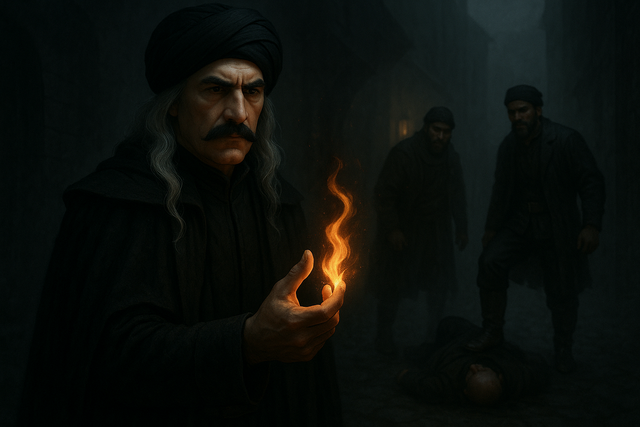 The snap of fingers echoed.
There was no longer any need for keen eyes to see the faces.
“Gentlemen,” said the cold-voiced man whose fingers now spat fire, “it seems you may need some help lifting your fallen friend.”
After those cold words, and after they saw not only his hand but his eyes burning with flame, the gentlemen are quite willing run away—but they failed. Within seconds, both were slammed to the muddy ground, face-down, parallel to one another, struck by a heat that could only be described as scorching—nearly boiling.
Yet the presence of the one resembling a sack of sand still disturbed the Shamur, for the sack did not move.
With delicate steps, he reached the post at the corner of the street and ignited its wick. The post burst into flame. He then returned slowly to the recess, his sensitive ears already catching the sound of Janissaries running toward the alley—the wet slap of boots against mud, and even the metallic clatter of buckles striking leather.
What lay before him was no sack of sand.
It was a dwarf.
A dwarf foreign to these lands.
When the Janissaries arrived, no more than a few minutes could have passed since the incident, yet thin trails of smoke were already rising from the cheeks of the two men lying face-down in the mud.







