
Chapter 1: Departure


I was told the Silence Trials were an honor. Most people believed that. I believed it because I understood it.
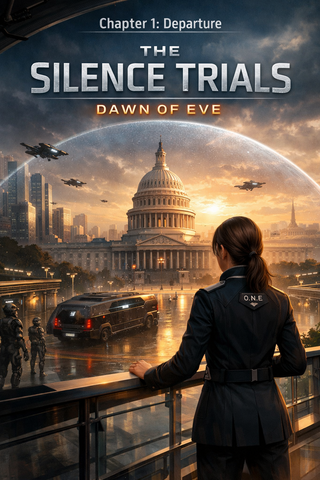
From the upper balcony of our home in Washington, D.C., I could see the Capitol spire cutting through the morning haze — sharp, deliberate, unyielding. The city beneath it moved in an ordered rhythm. Transport lines glided silently. Patrol drones traced invisible arcs across the sky. The armored carriers along Constitution Avenue reflected sunlight like polished bone. There was a time, my father once told me, when cities required walls. Now they require something stronger.
Control.
I adjusted the collar of my academy uniform There was nothing outwardly remarkable about me. That had always been the point. My mother stood behind me. “You’ll do well,” she said. It wasn’t encouragement, no it was an expectation. I turned and offered her the smile I had practiced since childhood — warm, reassuring, measured. “I intend to.”
My father brought the car around to the front of our building just as the morning light began reflecting off the glass towers of Washington, D.C. The vehicle moved silently, as all government transports do, gliding to a precise stop in front of our entrance. “Are you ready to go, dear?” my mother asked. Her voice was calm, measured — the same tone she uses when presenting policy projections before the Strategic Council. I nodded. There wasn’t much else to say.
We stepped out together, the doors sealing behind us automatically as we began our journey to Richmond, Virginia.
As we drove through Washington, D.C., I watched the city with a sense of quiet admiration. Even after living here my entire life, it never failed to impress me. Since the rebellion just over a year ago, the President reorganized our government. We no longer referred to ourselves as the World Government. That name belonged to a different era — an era that assumed humanity would naturally align under shared progress.
Now we are O.N.E.
One Nation Earth.
It makes more sense this way.
The concept of a World Government worked for a time, but people — especially in this age — still resist what is clearly better for humanity as a whole. Unity requires structure. Structure requires discipline. A “world government” sounds optional. O.N.E sounds definitive.
The rebellion itself never made sense to me.
I try to understand how they live at all. I’ve seen the news footage of the old destroyed cities where supposedly rebel forces like to hide out at— buildings cracked open, infrastructure abandoned, communities fractured by disorder. I cannot imagine choosing that over what we have built.
Here in Washington, our skyline reflects the marvel of human ingenuity and the strength of centralized order. The Capitol building — once a place where politicians wasted time arguing over party lines — has been transformed into the Headquarters of O.N.E. Now the greatest minds gather there, not to debate ego, but to calculate solutions.
And the White House.
Once occupied by leaders expanding political interests.
Now home to a President focused solely on the advancement of humanity.
At nearly every corner, you can see the true might of our government — disciplined soldiers standing side by side with robotic android units, integrated seamlessly. Drones hum overhead in steady patrol patterns, their sound oddly comforting. Protection. Precision. Peace.
It is a marvelous city.
One I will miss while I am away for the Trials.
My parents sat in the front, saying very little. They are not talkative people. Their silence is not cold — it is intellectual. They think before they speak. Both of them are regarded as some of the brightest minds within O.N.E’s defense infrastructure. Their strategic developments are part of the reason the rebel forces remain contained far from the capital.
As we approached the outer perimeter of Washington, the skyline gradually shifted behind us.
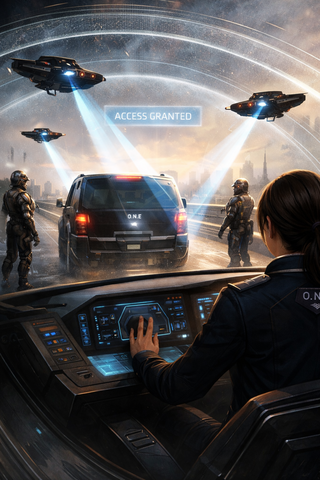
To enter or exit the capital, all must pass through the Atmospheric Containment Grid — the ACG.
At certain angles, you can see it shimmer faintly, like heat suspended in the air. Drones slow just before touching it, adjusting altitude automatically. The Grid is a layered electromagnetic defense system designed to neutralize aerial assault and identify unauthorized movement. After the Battle of Dallas — when walls proved insufficient — President Eht promised that no major city would fall again and O.N.E’s solution, the ACG.
Walls can be breached.
Grids adapt.
When we reached the exit checkpoint, drones descended immediately — silent triangles of black alloy scanning our vehicle from every direction. A soft pulse flickered across the windshield as our authorization codes were verified through the system embedded in our transport.
For a moment, everything held still. Then the barrier parted.“Access granted.”Once we moved beyond the perimeter, the difference in society is immediate. Inside the cities, the elite class of O.N.E lives in structured advancement. Outside lies what we refer to as the outskirts.
Their neural chips operate differently from ours. Limited thoughts, emotions, and freedoms. It isn’t that they do not deserve the same opportunities — but history has shown, repeatedly, that they are more susceptible to emotional instability than we are. We tried to educate them. We even implemented programs to help ease their transition. Still, they struggle to adapt.
I will admit their role is important. They perform labor tasks many elites choose not to. Manufacturing. Extraction. Infrastructure repair. In many ways, they appear content. But when towns like Picture, Oklahoma who produced wanted criminals like Jaren Velez who joined the rebellion, the consequences were unavoidable. If instability threatens the whole, action must be taken. Humanity as a whole must be protected.
I rested my uniform jacket across my knees — pressed perfectly, insignia stitched into the collar with exact alignment. The fabric felt structured beneath my fingers. After what felt like hours, Richmond appeared on the horizon. Like Washington, it was enclosed within its own Atmospheric Containment Grid. As we approached, the shimmer of the barrier caught the sunlight in fractured lines.
The drones descended again.
Scan.
Verification.
As we passed through, the elite insignia on my collar caught a narrow beam of light. For a brief second, I felt a faint pulse at the base of my neck where my chip rests beneath the skin.“Identity confirmed: Access granted.”The message wasn’t audible — more like a silent internal acknowledgment.
Richmond felt different from the capital. It was cleaner, more symmetrical, buildings aligned with mathematical precision. Trees planted at identical intervals along immaculate streets. Even the shadows seemed deliberate, cast at uniform angles between structures. It was beautiful. And strangely suffocating. I wasn’t sure what I felt. Nervous? Excited? Anticipatory possibly?
“How much longer until we reach the Academy?” I asked without meaning to. “Soon, Eve,” my father replied. As we continued what seemed to me to be an endless journey, I watched the city through the glass and caught my reflection staring back at me.
Burnette hair — lighter than my mother’s dark brown, falling neatly past my shoulders. A natural wave, controlled but not rigid. Light tan skin. Silver-grey eyes.
My eyes have always looked... different. Not bright. Not unnatural. Just reflective. Like polished metal under soft light. Sometimes when I look at myself, it feels like I’m observing someone else. It’s a strange neurological reality — we can never see ourselves directly, only reflections constructed by external surfaces.
“Here we are,” my father announced.
The Academy rose before us — expansive white stone and glass, modern but imposing. Other vehicles were already arriving, students stepping out alongside their parents. The courtyard began filling with uniforms identical to mine.
As soon as we stopped, I stepped out of the vehicle. My parents followed. They looked at me — really looked — and offered small, proud smiles. Not dramatic. Not emotional. Controlled.
I hugged each of them. “I’ll make you proud,” I said. They nodded. “We know,” my mother replied. “Good luck,” my father added. I turned and ran toward the main entrance, joining the gathering of elite students assembled outside. We stood together beneath the towering structure of the Academy, waiting for the doors to open.
My life.
My role in our society.
Had only just begun.







![The Moon's Weapon : the cursed mate [ MOVING TO GALATEA]](https://cdn-gcs.inkitt.com/vertical_storycovers/ipad_123f31099804e79c6de11657975bcaae.jpg)


![Fated to My Ex- Best Friend [Moving to Galatea]](https://cdn-gcs.inkitt.com/vertical_storycovers/ipad_49edb1dbf9a28b50b9c4d68d8598359b.jpg)








If you haven't read the first book "The Silence Trials" I recommend you read it before continuing on with book 2. Yes I admit I personally like Book 2 more but it would make a whole lot more sense if you took the time to read to the first one lol