
PROLOGUE — THE FIRST SILENCE
By the time the church lamps went dim, the night had turned mean.
Not loud. Not wild. Mean in the way only country dark could be, where the black between the trees looked deeper than it ought to and the road home felt twice as long as it had on the way there. The last of the evening chatter leaked out of Saint Matthew’s fellowship hall in soft bursts as women gathered casseroles and folded tablecloths, and men shrugged into coats, talking weather, crops, and the Turner mule that still hadn’t taken to the new harness.
Inside, the room still smelled of coffee gone bitter on the burner, fried chicken, starch, and too many bodies packed close for too many hours. Outside, the October air had teeth.
Elsie Turner stood near the side door with her coat half-buttoned, balancing a covered dish against her hip while Miss Bevins hunted for her gloves in a handbag big enough to lose a child in. The laughter around her came in bright little scraps, brittle against the cold. Somebody was teasing Ruth Gentry about the pie she’d brought, something about too much nutmeg and too little shame. Somebody else was already talking about Sunday. In Saint’s Crossing, there was always another service, another supper, another reason to stand shoulder to shoulder and pretend hardship was easier in company.
Elsie smiled when she was supposed to. Nodded when someone spoke to her. Said goodnight three separate times to three separate people who all answered as if she were setting off for another state instead of the short walk back to the little white farmhouse she shared with her husband at the eastern edge of town.
“Ben ain’t come for you?” Miss Bevins finally asked, still digging through the abyss of her purse.
Elsie adjusted the dish against her side. “He had to see to the calf. Said he’d be waiting if I was too long.”
Miss Bevins clicked her tongue. “Men. If they had the Lord Himself standing on the porch, they’d still finish with the livestock first.”
Elsie laughed, because there wasn’t much else to do with that. “It’s not far.”
“Nothing is far until it is,” Miss Bevins muttered.
The words landed softer than warning, too ordinary to be ominous, and yet they stayed with Elsie longer than they had any right to.
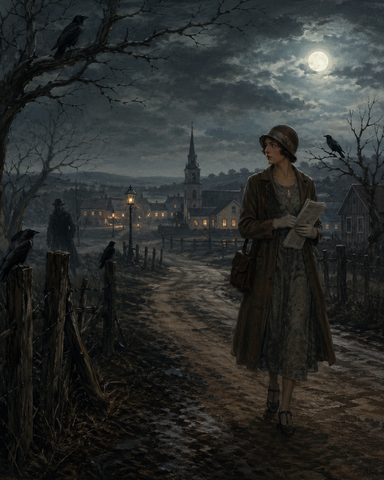
She found herself looking past the knot of women by the door, past the glow spilling onto the church steps, toward the road where the dark had already gathered. The moon was thin and shy behind a skin of clouds. Not enough light to trust by. The kind of night where shapes made bargains with the eye.
She had walked that road more times than she could count. She knew every rut in it, every leaning fence post, every patch where spring mud hardened into cruel ridges by fall. She knew where the Johnson place sat back from the road and where the ditch deepened near the sycamore stand. She knew which dogs barked if you passed too near, and which porch on the south side always kept a lamp burning late.
Still, when she looked out at it, something inside her tightened. Not fear, exactly. Just reluctance. The sort a person felt before stepping into cold water.
“You all right, honey?” asked Ruth Gentry, drawing her shawl tighter around her shoulders.
Elsie blinked and smiled too quickly. “Of course.”
“Then get on before you freeze. Tell Ben I still say he owes us for taking the biggest roast.”
“I’ll tell him.”
“You better not forget.”
“I said I’ll tell him.”
Ruth grinned, satisfied, and gave her arm a squeeze on the way past. Then Elsie was outside.
The church door thudded shut behind her, muffling the voices inside until they became nothing more than warmth trapped behind wood and glass. She stood for a moment on the steps, breathing steam into the night, and listened.
Leaves skittered across the packed earth by the road. Somewhere in the distance, a dog barked once, then stopped.
Farther off still, she thought she heard the low iron groan of the late freight moving along the tracks west of town, a sound so much a part of Saint’s Crossing it might as well have been the place clearing its throat.
She started walking.
Her shoes made small, steady sounds against the road. Gravel. Dirt. The occasional damp patch where the afternoon had not fully dried. The covered dish was still warm through the cloth wrapped around it, and she shifted it from one arm to the other as she passed the cemetery gate and the sloping field beyond it.
The night smelled of woodsmoke and old leaves. There’d been rain two days before, and the earth still held some of it. Rich, damp, mineral. A living smell. Honest.
She told herself she was foolish.
The road was empty because it was late. Quiet because people had gone home. Dark because the moon had more pride than usefulness tonight. That was all. Nothing in the world had changed just because one poor girl had been found dead near Miller’s Creek ten days ago. Nothing in the world had changed because folks had started bolting their doors earlier and peering a little too hard into shadows.
Only that wasn’t quite true.
Something had changed.
You could feel it in the way people spoke too softly about the wrong things and too loudly about the right ones. In the way men walked their wives home from prayer meeting now, as if decency itself had suddenly become armed. In the way every snapped twig had become a story before the sound even died.
The girl by Miller’s Creek. Annie Colter. That had been the name. Barely nineteen, if the talk at the dry goods store could be believed. Her mother had said she’d gone to visit an aunt. Her father had said she should not have gone alone. The sheriff had said little. The doctor even less. But the women in town had eyes, and eyes took stock. Too pale, they said. Not right, they said. Hardly any blood in her, they whispered, then crossed themselves or scolded each other for saying such things aloud.
Elsie did not like thinking of Annie Colter. So she thought instead of Ben at home, probably still smelling of hay and animal sweat, sleeves rolled, hair falling over his forehead because he never remembered to get it cut before it annoyed him. She pictured the kitchen lamp lit. His boots by the door. The wash basin still half full from supper. Ordinary things. Good things. Things with weight enough to anchor a woman.
The road bent near the Gentry place, and the church lights disappeared behind trees. Now it was really dark. Elsie pulled her coat tighter. The dish had gone only lukewarm.
She walked faster. Past the stand of sycamores. Past the split-rail fence with the broken post. Past the ditch where water ran wild in spring and lay low and black this time of year.
There.
That was odd.
She stopped without meaning to.
Nothing moved. Nothing called out. Nothing obvious, anyway. But she could have sworn she’d heard another set of steps behind her a moment before. Not close. Not right close. Just there. A second rhythm under her own. Soft enough she might have mistaken it for leaves, except leaves didn’t know how to keep time.
Elsie turned.
The road behind her lay empty in both directions, a pale ribbon smudged by darkness. The church was too far now to cast even the faintest gold at her back. The hedges and trees stood still. Thin branches swayed in the high dark where the wind moved, but down at the road, everything waited.
She listened until the blood in her ears grew louder than the night.
Nothing.
“You’re being ridiculous,” she whispered to herself.
The sound of her own voice comforted her for all of half a second. Then she started walking again, quicker now, not quite hurrying because hurrying felt too much like admitting she was afraid. She had gone perhaps twenty yards when she heard it again.
Step.
Step.
Behind her.
Not matching her stride this time. Following it. The dish slipped in her grip, and she nearly dropped it.
“Who’s there?” she called, hating how small she sounded.
No answer. Only the faint scrape of gravel.
Elsie’s mouth went dry. “Ben?”
That was foolish. Ben would have called out. Ben would have laughed at her and jogged to catch up, apologizing for startling her, reaching for the dish with those big rough hands of his. Ben was flesh and noise and apology. Not this.
The road offered nothing back.
She took another step, then another, and then she was no longer pretending not to hurry. The dish knocked against her hip. Her breath shortened. The cold burned in her throat.
Step.
Step.
Closer.
Elsie turned so fast she lost her footing in the loose gravel and the dish fell from her arms, hitting the road with a crack of crockery under cloth. She gasped and stumbled backward.
There was someone there now.
A shape at first. A man’s shape. Tall. Still. So still it made every hair along her arms rise. He stood just beyond what little the night would give her, coat dark, face lost in shadow.
Relief and terror hit her at once, because a man could be reasoned with. A man could be known. A man could be named.
“What do you want?” she asked.
He did not move.
“Who are you?”
Still nothing. The wind pulled at the bare branches overhead. Elsie backed away another step. Her heel caught the edge of the ditch and slipped. She righted herself at the last second, heart hammering high and hard in her chest.
“Stay back.”
It came out too thin to be useful. The man took one step forward. Just one. And somehow that was worse than if he had rushed her. Elsie turned to run. She never made it.
A hand caught her from behind so fast she did not even feel the approach, only the impact, the force of him wrenching her backward. Her scream broke off beneath a palm over her mouth. The world tipped sickeningly as he dragged her into the dark beside the road, into the tall dead grass and the smell of wet earth. The covered dish lay shattered somewhere behind them.
Elsie kicked, clawed, bit against the hand smothering her cry, but he held her with impossible control, not clumsy, not frantic. Precise. One arm banded across her ribs, pinning her, the other forcing her head back just enough that her neck arched painfully and her breath came in desperate little bursts through her nose.
“Please,” she choked against his palm.
The word barely existed. He said nothing. That frightened her more than anything.
A man should have cursed. Grunted. Threatened. Breathed hard with effort. He should have felt like panic and sweat and fumbling violence. This man felt like decision.
His face passed briefly through the thin wash of cloud-light as he bent over her, and for one impossible second she thought she saw eyes that caught what little night there was and made it colder.
Pain came sharp and strange, not where she expected, not like a knife, not like a blow. It was pressure first. A horrible intimate pressure, and then a tearing heat that made her whole body convulse.
Elsie screamed into his hand. Her knees gave under her. Only his hold kept her upright. The world went distorted around the edges. Sound stretched. The wind thinned. The dark grew larger.
She could feel him holding her against him, not roughly now but with a terrible steadiness, as if he knew exactly how long a person could fight before strength left them. Her hands beat uselessly against his coat. One found the fabric at his sleeve and clutched hard enough to hurt her own fingers. Under the cloth, he was unnaturally cool.
Her vision blurred. There should have been more pain. There should have been agony bright enough to split the world in two. Instead there was a weakening. A draining. A sense of herself slipping backward inside her own body, like someone unlatching her from within.
No.
No, no, no.
Ben would come looking for her. The church women would notice she had not arrived home. The dog at the Gentry place would bark. Something would happen. Somebody would come.
Nothing came.
The hand at her mouth eased, not from mercy but because there was no need for it now. She could not have screamed again if the Lord Himself had ordered it. Her head lolled against his shoulder, and she caught the smell of him at last.
Not sweat.
Not whiskey.
Cold air. Damp wool. Something metallic under both, like old pennies warmed in a palm.
He lifted his head. Elsie tried to turn her face to see him, to hold some piece of him in memory, but her eyes would not focus. Only shape. The sharp line of cheek. Dark hair. Pale skin, or skin made pale by moonlight. And those eyes.
Dear God.
Those eyes.
Not glowing. Not anything so ridiculous. Just wrong in a way she could not have explained if she’d had ten years and all the words in the world. Too fixed. Too clear. Like he was not looking at a woman dying in his arms but at something he had chosen and would not be denied.
He touched her face. The gesture was so gentle she nearly wept from the horror of it. Then, from far away, there came the rattle of wheels. A wagon on the road. Distant but coming nearer.
For the first time, he moved with anything like urgency. He shifted her in his arms, and she felt the strength in him then, impossible and effortless. He laid her down in the grass with care so deliberate it felt obscene. One gloved hand pressed briefly to the wound at her shoulder, not hard enough to help, not soft enough to comfort. Measuring, maybe. Or simply making sure of his own work.
Elsie tried to reach for him. She didn’t know why. Perhaps because a dying body reached for whatever was nearest. Perhaps because she wanted to claw his face. Perhaps because there was something in her, even then, that could not endure his vanishing without proof he had been there.
Her fingers brushed his coat. He caught her wrist. Another impossible stillness.
The wagon wheels were louder now. A man’s voice, faint on the wind, talking to a horse. The stranger looked toward the road. Then back down at her.
For one lunatic moment, Elsie thought he might finish it. Thought he might bend again and take the rest of her before help arrived. Instead he released her wrist. He stepped back. And he was gone.
Not with spectacle. Not smoke. Not magic. Just speed so sudden and clean her fogged mind could not make sense of it. One instant he stood over her, shape carved out of shadow. The next the dark had swallowed him whole.
Elsie lay in the wet grass staring up at a sky the clouds were finally beginning to abandon. The stars looked meaner than she remembered. She tried to call out. Nothing came but a wet little sound. The wheels on the road slowed. Then stopped.
“Hello?” a man called. “You there?”
She could hear him climbing down from the wagon now. Boots on gravel. The creak of leather. A lantern being lifted.
“Who’s out there?”
Light bobbed along the roadside. Warm, human, golden. It struck the broken dish first, glinting off pale shards in the dirt. Then the grass. Then her. The man swore so hard it sounded like prayer torn open.
“Jesus Christ.”
He was on his knees beside her a second later, lantern set down crooked in the road, one hand hovering over her and not knowing where to touch. His face was broad and bearded and frightened. Mr. Holcomb, she thought dimly. The feed man from two farms over. Or maybe not. Faces had started slipping.
“Missus Turner? Missus Turner, can you hear me?”
She blinked.
He shouted for help though there was no one near enough to hear but the horse, which tossed its head and stamped once in distress.
“Stay with me,” he said, voice breaking all over itself. “Stay with me now.”
He pulled off his coat and pressed it to her shoulder. Pain flashed white-hot this time, sudden enough to make her jerk.
“There you are, there you are,” he said, as if hurting were proof of life. “Good girl. Good, that’s good.”
Blood.
That was blood. Her blood. More of it than there should have been. More than could still possibly be inside her. His hands were slick with it in the lantern light.
“Who did this?” he demanded, looking wildly into the trees as though he might yet catch the man by glaring hard enough. “Elsie, who did this?”
Her lips moved. No sound.
He bent low. “What was that?”
She could not tell him. She did not know his name. Did not know if he had one she was meant to know. All she had was the shape of him and the impossible eyes and the feel of a hand too gentle for such violence.
The lantern hissed softly on the road. Mr. Holcomb kept talking. Promising. Pleading. Calling her by name as if names could tether a person to the world.
Overhead, somewhere high in the black branches, a crow cried out once. Then another answered. Then both fell silent.
By the time they carried Elsie Turner back into Saint’s Crossing, the town had already begun to change.
Not openly. Not all at once. Change rarely arrived with the courtesy of announcing itself. It moved instead in tightened mouths and longer glances. In husbands who barred doors that had never before been barred. In women who pretended not to notice when one another looked over their shoulders on the walk home. In children pulled closer by the hand. In the way lamps were left lit later than usual, though no one admitted why.
Sheriff Amos Whitaker arrived before dawn, boots muddy, face set in the hard lines of a man already bracing for what the morning would bring. Dr. Miriam Bell followed not long after with her hair pinned hastily and her medical bag clutched like a weapon. Ben Turner came last, wild-eyed and white-faced, after someone pounded on his door hard enough to wake the dead and the living both.
He made a sound when he saw his wife that those who heard it would remember longer than they wished.
The house filled quickly after that.
Neighbors.
Whispers.
Questions.
Coffee forgotten as it cooled untouched in shaking hands.
The doctor worked. The sheriff watched. Ben hovered close enough to break and too far to help. And all the while, outside that little white farmhouse, Saint’s Crossing held its breath.
By sunrise, everyone knew.
Not the facts. Facts came later, if they came at all. But the shape of it. A woman taken on the road. A body bled pale. Strange wound. Strange silence. No clear thief, no clear motive, no comfortingly ordinary explanation to fold over the thing and call it done.
By breakfast, the story had moved from house to house, growing teeth as it went. By noon, mothers were calling daughters in early. By evening, the road where Elsie Turner had fallen lay empty long before dark.
And somewhere beyond the last fence post, beyond the rail line and the prayer-meeting lights and the reach of every locked door in Saint’s Crossing, the thing that had done it moved unseen through the gathering dusk, patient as a curse and quiet as a grave.
The town would spend the next weeks asking who had taken Elsie Turner from the road. That was the wrong question.
The right one, though no one yet knew enough to ask it, was far worse.
What had?



















aint gonna lie that prologue had me HOOKED