1. The End
Peace makes people stupid.
Not all at once. It worked slowly, like weathering a stone. A generation passed without dragons in the sky, without demon processions crawling up from the deep dark, without whole towns getting erased overnight, and people started to relax in ways Elias found insulting.
Sure, the roads were paved. Walls were rebuilt. Guild signs got polished. Merchants filled their stalls with dried fruit, salted meat, cheap wine, and little useless luxuries that only existed because somebody believed tomorrow would arrive guaranteed. Folks looked at all that and decided the world had changed, but it had not.
The forests still swallowed the careless, mountains still kept bones, and the places under the earth still belonged to things with claws, teeth, and malice. Monsters still tore apart farms too far from the walls. Villages still vanished in bad seasons. People still went out on lonely roads and failed to come back every day.
The only difference now was that people liked dressing the truth in softer words. They called it peace because it sounded better than saying civilization was just, surviving…
Then men started disappearing in the north.
At first it was the sort no one rushed to mourn. Drunkards. Hunters. Wanderers with more nerve than sense. Then it became a pair of brothers. A merchant guard. An adventuring team that went looking for the first batch and never returned either. By the time the rumors reached town proper, they had grown teeth of their own.
There must be something in the mountain. Something old. Something with scales. People laughed when they said dragon, right until enough names piled up that laughing started to feel disrespectful. Then they called for adventurers. Typical.
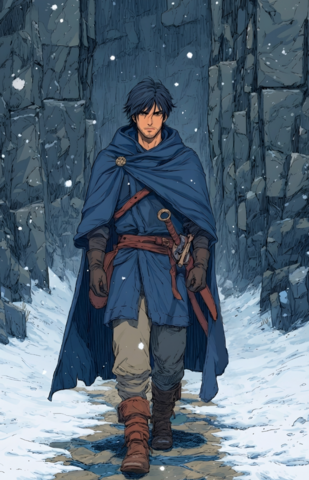
Elias walked with the others along a narrow path cut into the lower slope of the Crown of Winter, his boots scraping loose frost and gravel as the morning cold bit through his cheap armor and found every seam in it. The wind coming down from the heights had teeth. It got under his collar, under the plates, under the mood he had woken up with, which had already been poor.
Ahead of him, one of the younger adventurers was still talking, “Look, I’m not saying nobody disappeared,” the man said, hands moving more than necessary as he walked, “I’m saying people hear three stories, add two dead goats, then suddenly it’s a dragon. It’s always a dragon with mountain folk.”
“It is the north,” said another, a woman with a spear strapped over her shoulder, “They like their stories dramatic.”
“Because a pack of cliff hounds dragging off shepherds sounds boring,” said the first man as they laughed, but Elias did not.
He kept his eyes on the rising path ahead, on the dark cuts in the mountain face, on the pale sky stretched above the ridges. Draemharrow sat miles behind them now, all black stone, smoke, and grim walls. The town had been buzzing for days over the reports. A trapper gone. Then two brothers who went looking for him. Then a merchant guard who never came back from a short pass road that should have taken half a day. Then another adventuring pair who thought a dragon rumor sounded profitable.
Nobody had found bodies. That’s the part that sat wrong with people. Bodies, even torn up ones, made things easier. Bodies meant something ordinary had killed you, but no bodies meant the imagination got to work.
“You’ve been quiet,” the spearwoman said, glancing back at Elias, “What do you think?”
Elias looked at her. She was young, maybe twenty, maybe less, with a face still hopeful enough to ask questions like the answer mattered. He had been traveling with this group since dawn, six adventurers gathered by the guild for a scouting run into the lower mountain routes. He did not know any of their names. He was fairly sure two of them had told him. He had not cared enough to keep them.
“I think,” Elias said, “If it is a dragon, we die.”
The younger man barked a laugh, “Straight to the point.”
“And if it isn’t,” Elias went on, “We still might. So I’m struggling to see where optimism improves the walk.”
That got a snort from one of the older men in the group, a broad-shouldered axeman with a scar over one eye.
The spearwoman rolled her own, “You’re cheerful.”
“I’ve been told.”
The younger man grinned, “You come all the way out here to say things like that?”
Elias pulled his cloak tighter against the wind, “I came all the way out here because if people are vanishing, something is doing it. If something is doing it, there’s coin for killing it.”
That was not the whole truth, but it was close enough for strangers.
The whole truth was uglier and smaller. Elias was thirty-one years old, broke, cold, unknown, and tired in ways sleep had stopped fixing years ago. He had no wife waiting for him, no children, no land, no home worth returning to, and no reputation beyond surviving long enough to become the sort of adventurer guild clerks barely looked up for. Men younger than him had become names. Men worse than him had become rich. Men with less experience had managed to somehow look like they belonged in the life more than he ever had.
So when a dragon rumor spread through Draemharrow, he had signed on. Not because he thought he would slay a dragon, but because maybe if he did not come back, at least it would sound impressive.
They rounded a bend in the path where the stone widened and leveled into a shelf of broken slate and scrub grass silvered with frost. Above them, the mountain rose in layered black ridges and old snow. Below, the slope dropped into pine and shadow. Then the wind shifted.
Elias stopped. The others went a few paces before noticing.
“What?” said the axeman.
Elias lifted a hand for quiet. For a moment all he heard was the wind scraping past rock, the thin rattle of loose stone, the slow clink of gear as one of the others shifted their weight.
Then he heard it. A scraping from above. A skittering slide. Claws on rock, “Up,” Elias said pointing.
Something dropped from the ridge to their left. It landed wrong, all at once, with too many limbs finding the ground in a wet scramble. A mountain skulk. Then another. Then a third came spilling down behind it, pale and long-bodied, with hooked forelimbs and a jaw that split too wide.
The younger man swore, “God Damned Skulks?!”
“Thought you said cliff hounds would be boring,” Elias muttered, drawing his sword.
Mountain skulks were not clever monsters. They were mean, hungry, and built for steep terrain, all lean muscle and rough grey hide with white, lidless eyes that hated torchlight and loved ambushes. The front claws could gut a man if they got in close. The hind legs were stronger than they looked and their bite was filthy, a death sentence. They rarely traveled alone.
The first one lunged for the spearwoman. She met it with a thrust that punched through it’s throat, but the thing still crashed into her, knocking her sideways with its dying weight. The second skulk sprang over both of them and landed in the middle of the group with a shriek that scraped the ears raw.
Steel flashed as the axeman buried his blade in it’s shoulder. The younger man hacked badly at one of its hind legs.
Another adventurer shouted something Elias did not catch over the mess of it, as the third creature came for him low and fast. He stepped back and barely avoided the first swipe.
Claws raked across the front of his cheap breastplate, screeching metal. The impact jarred him hard enough to sting his teeth. Elias pivoted and cut down into the creature’s neck. The blade bit, not deep enough, but enough to make black blood splash hot over his hand. The skulk recoiled with a hiss. Then a fourth came down from the ridge above.
Of course there was a fourth.
It landed behind Elias. He heard it, but turned too late, and caught the skulk on instinct as it smashed into him. Claws tore his sleeve. Weight hit his side. The edge of the path vanished under one boot and the world lurched.
Elias slammed shoulder-first into stone, twisted, and drove his sword upward under the first skulk’s jaw as the second snapped at his face. The blade punched through and the creature spasmed in death as Elias kicked it off him. Then, the other one came again.
Elias gave ground, boots slipping over broken rock, now separated from the others by a crooked rise of stone and the shrieking chaos of the fight. He heard the axeman roaring somewhere to his right. Heard the spearwoman curse. Heard one of the skulks scream in a way that meant somebody had finally split it open.
Good for them I guess.
The one in front of Elias crouched low, pale eyes fixed on him, blood stringing from its teeth.
Elias was breathing harder now. His arm already ached from the jolt of the last block. His legs were unsteady on the slope. One bad step and the mountain would finish the work for the monster. He tightened his grip anyway.
“Come on, then,” he said in disdain.
The skulk sprang. Elias moved to meet it, but his boot came down on nothing. The ground vanished. For one stupid, weightless instant, he had time to sarcastically think that the mountain had decided to be part of the fight after all.
Then stone broke under Elias and he dropped through blackness. He hit a steep chute of rock, bounced hard off one side, slid, struck again, and then rolled through a spray of old dust and gravel before landing in a heap so violently the breath felt punched out of him.
For a while he stayed there. He lay on his back staring up through a jagged crack far overhead where a slice of grey daylight showed and loose stone still trickled down. His whole body hurt. Not sharp, not broken, but the kind of pain that arrived all at once and demanded to be assessed piece by piece.
He flexed one hand. Then the other. Moved an ankle. A knee. His shoulder. Nothing screamed. Nothing snapped.
“Unfortunate,” Elias muttered to the dark.
He pushed himself up with a groan and sat there coughing dust from his lungs. His sword had fallen beside him, his pack was half-open, and one strap on his armor had come loose completely. He noticed his left elbow was bleeding through his sleeve, and something in his side promised to bruise spectacularly by nightfall if he lived to see it.
Above, at the crack, a pale face appeared for a second. The skulk. It peered down into the dark. Elias reached for his sword, but the creature froze.
A low sound reached him then, distant but so deep he felt it more than heard it. Not from above. From within the mountain. The skulk’s whole posture changed as it jerked backwards. Loose stones came rattling down after it. Then it vanished.
Elias stared up at the crack for a moment. Then, slowly, he looked into the darkness ahead. This place was not a cave in the ordinary sense. Not some cramped pocket hollowed out by runoff or old frost.
The chamber around him was broad, the walls curving away into old black stone veined faintly with something pale and glassy. A draft moved through it, deep and steady. Elias squinted, peering further inward.
Ahead, some distance away, there was light. Not daylight, but something softer. Elias got to his feet because sitting there would solve nothing. He picked up his sword. Resettled what was left of his gear. Took one long breath, winced, and started walking.
The path inside the mountain sloped downward and inward in a way that felt natural right up until it didn’t. The rock underfoot was worn too smooth in places, too level, and too broad to be natural. Then the walls widened and the ceiling rose. Once or twice he passed old claw marks deep enough in the stone to make him stop and stare. Each groove was longer than his arm.
The air changed as he went. It grew warmer, though not by much. Less like the breath of winter. More like a place closed off from time. Dust lay thick in some places and strangely absent in others. He passed a scatter of old bones near a split in the passage, deer by the look of them, maybe mountain elk. Further on, he found an iron helm half crushed in on itself, so old, that the leather inside had rotted away.
No body with it. That did not help. The light ahead widened.
Elias came through the last narrowing of stone into an open cavern so enormous his first thought was that the inside of the mountain had no right to exist like this.
The chamber stretched outward like the hollow of a buried world. Columns of black rock rose to a ceiling lost in shadow. Pale mineral veins ran through the walls in dull glimmers like frozen lightning. A pool lay off to one side, dark and still, catching the cavern light and giving it back in broken silver. Beyond it, against the far rise of stone, lay a shape so huge Elias could not make sense of it all at once.
Then it moved. Big and Blue. Not the silly jewel-tone blue painted on old inn signs when merchants wanted a dragon on a barrel label. This was the color of a deep winter sea before a storm. The color of old ice where the light does not quite reach.
They began to emerge from the darkness. Scale layered over scale, vast as shields, dulled in places by age and scars from past battles. Horns curved back from a head large enough to crush a wagon, maybe 3 wagons... in one bite. Wings folded along an immense body that seemed half mountain itself. One forelimb lay stretched before it, talons dark and sharp like long swords.
Elias stopped and he accidentally kicked a stone. The dragon lifted its head. Two eyes opened and fixed on him. For a moment Elias simply stood there with his sword in hand and the full clean understanding that this was the end of his life.
No, not because he was brave enough to make it dramatic. Because he had enough experience to know facts when he saw them. And at this point, Elias was tired. Bruised. Poorly armed. Not special. Only a man. And standing in front of a dragon.
No bard in history could improve these odds. Elias let out a long breath. Then he slid his sword back into its sheath. The sound seemed tiny in the cavern. The dragon blinked once.
Elias lowered his hand from the hilt and looked up at it, “There,” he said, putting his arms out like an offering, “That should save us both some embarrassment.”
The dragon kept watching him. It’s gaze was rather terrible, not in anger, but in scale. Like being noticed by a hurricane and singled out.
Then, to Elias’s complete disbelief, it spoke, “You put your weapon away?”
The voice rolled through the chamber low and deep, old enough to make the stone seem younger for hearing it. Elias stared as the dragon’s head tilted slightly, “Most do not.”
Elias continued staring. He was aware, distantly, that his mouth had gone a little open, “Uh, You can talk,” he said, as a curious statement.
The dragon was silent for a moment, then a sound came from deep in its chest. It took Elias a moment to realize what it was. Amusement in a grumbled chuckle from it’s stomach.
“I would hope so,” the dragon said, “As you have already heard me speak.”
Elias let out one short laugh, half shock and half something near hysteria. It bounced strangely in the vast cavern, while he nodded his head, “Right. Fair enough.”
He looked around as if that might help. It did not. He was still inside a mountain and talking to a dragon.
The dragon studied him curiously, “I have not seen a human in many years,” it said.
“You’re not missing much.”
“You came seeking me.”
Elias shrugged tiredly, “Not exactly. I came with a group following rumors. Then some mountain uglies tried to eat us. Then the mountain decided to eat me. So now I’m here.”
The dragon’s gaze flicked briefly to Elias’s torn sleeve, his damaged armor, the dust on him, the weary way he was standing, “You are not afraid enough,” it quipped.
Elias looked up at it, “No. I am exactly afraid enough. But I’m also exhausted, cold, and past the point where fear feels worth the effort.”
Another low sound from the dragon. Not quite laughter this time, “If it helps, I have only slain those who attacked me,” it said.
That made Elias blink, “Is that meant to reassure me?”
“It is the truth.”
Elias looked at the dragon for a moment. Then, he glanced around before finding an actual target, a broad flat stone for him to sit at. This situation had already crossed so far past reason, there seemed little use guarding his dignity as he limped briefly toward it and sat down with a grunt. The dragon watched the whole process.
“There,” Elias said. “If you’re going to kill me, do it while I’m resting. I’d appreciate the courtesy.”
The dragon’s eyes narrowed, not in threat, but interest, “You are a curious being.”
“You’re a talkative dragon.”
“And doesn’t that outweigh your death?”
Elias considered this fact, “At the moment, I suppose a little.”
Elias sat with his forearms braced on his knees, looking at the thing before him. No one alive, not truly alive, not in the ordinary world of roads and guild halls and petty contracts, had seen this. Not like this. Not breathing. Not real. He could see the scars etched across old blue scales, the worn edges of the horns, and sheer mass of the creature.
“You’re enormous,” Elias stated the obvious.
“I used to be larger.”
That got another short laugh out of Elias before he could stop it, “Of course you were.”
The dragon settled its head a little lower, still watching, “What is your name, human?”
“Elias.”
“Elias,” the dragon repeated with a nod, “I am Kheledryn.”
Elias nodded once as Kheledryn’s great eyes remained fixed on him, “Why did you really put away your sword?”
“Because I know what I look like standing in front of you.”
“And what do you look like?”
Elias glanced down at himself. Cheap armor. Dirt. Worn boots. Blood at the sleeve. A sword good enough for wolves and goblins and men not worth the paperwork, “A worm squirming in the dirt ripe for a raven’s picking.”
Kheledryn was quiet for a while. Then, “Yet you are calm.”
“No,” Elias said, “I am honestly, just tired.”
Elias did not know why he had answered, or kept conversing at all. Maybe because lying to a dragon seemed idiotic. Maybe because the mountain had already stripped the day down to its bones and there was nothing left in him worth dressing up. A part of Elias joked to himself that he should actually be happy about his death day.
Kheledryn shifted slightly. The movement sent a soft grinding murmur through the cavern floor, “Tired of battle?”
“Tired of a lot of things.”
“Speak.”
Elias looked up at him, “Why?”
“Because, you interest me.”
That was somehow worse than a threat. Still, it’s not like Elias truly had anywhere else to be. So, he sat there on that stone in the hidden hollowed heart of the mountain and spoke to a dragon.
He told Kheledryn enough without telling everything at once. About the roads. About the guilds. About the way people talked now, as if the world had become orderly, because the worst things had retreated underground or vanished into story. About how peace was real, in a sense, but thin. There were still people hungry. Still children losing parents to monsters on bad roads. Still villages with no healer. Still men and women taking dangerous work because a warm meal cost more than dignity. Still plenty wrong with the world for such a peaceful era.
Kheledryn listened intently. That was the strangest part to Elias. The dragon truly listened. Then, began to ask questions, and Elias, against all sense, began answering them.
Had Elias loved anyone? Yes, in pieces. A few people over the years. Some good. Some not. Nothing that stayed.
Why had nothing stayed? Because life got in the way. Because he was poor. Because adventurers were hard to build futures around. Because he had never been the sort of man anyone chose first. Because after a while it grew easier not to offer much.
Then, did he hate the world?
“No,” Elias said, in a surprise to himself with how fast it came. He leaned back a little, looking up at the vast old shape of Kheledryn, “No. I don’t think I do.”
Kheledryn’s eyes narrowed slightly, “Yet you speak of it with such disappointment.”
“I speak of people with disappointment,” Elias said, “And systems. And luck. And myself, mostly. The world’s still got good things in it.”
“Name them.”
Elias let out a breath through his nose, “That is a broad request.”
“I am old and even tired myself, but right now, I have time.”
Something about that almost made Elias smile. He thought about it. Then answered.
He spoke of hot soup when it’s cold enough to hurt. Dry socks after a week on the road. A room with a door that locks. Seeing somebody’s child recover from a fever you thought would take them. A decent horse. The smell of rain before it hits summer dust. A stranger who turns out kind for no reason. A village festival where nobody cares who you are as long as you can pay for skewers and keep up with the music. A clear sky. A full stomach. A joke punching better than expected. Meeting people who have no real reason to be good and still are.
As Elias spoke, the cavern seemed less empty. It was like he hadn’t heard himself talk this much, because he never has.
Kheledryn listened with an expression Elias could not read on such an inhuman face, when he realized how much he rambled on.
Then the dragon asked, “But none of these things were for you?”
There it was. Elias looked down at his dirtied, aged hands, “They were… are… can be,” he said after a while, “Sometimes. But not in the way I meant.”
He rubbed a thumb along a scar across his knuckles, “I wasted years,” Elias said softer, “Maybe my whole life. I kept thinking there would be a point where things turned. Where I’d become something. Somebody useful. Somebody with enough coin, enough reputation, enough skill to do more than scrape by and take ugly work from uglier men. And every year passed and I stayed more or less the same.”
The words came easier now, which Elias disliked, “I know there are people out there who need help. Real help. Not just one monster culled from a road and then gone by morning. Sick people. Poor places. Kids with no shot at anything decent. Small lives crushed under bad luck and larger greed. I’ve seen enough of it. More than enough,” he paused, giving a tired laugh, “And what have I done? Survived? Badly. A few decent acts here and there. But no one remembers them. No one should. I’ve accomplished nothing worth saying out loud.”
The dragon did not interrupt. Elias went on because, at this point, why not?
“I am thirty-one years old,” he stated, “Which isn’t ancient, despite how it feels in my knees. And still I look at my life and think this was it. This was the grand shape of it. I got old enough to be tired and young enough for it to feel pathetic.”
Elias finally looked back up. Kheledryn was still watching him with that impossible patient gaze, “You speak as though your life is done,” the dragon noted.
“It might be. You’re still here.”
Kheledryn’s head shifted slightly, “For a little while.”
The dragon’s voice lowered, quieter now, if something so vast could be called quiet, “The world beyond this mountain is no longer mine. It has not been mine for many long years. I remained because age took from me what war did not. Strength leaves. Hunger fades. Memory frays. The world changes shape without asking whether you wished to keep your place in it. You wake one year and find it has become a land for smaller, quicker things.”
Elias sat still, letting the dragon have his turn. Pondering whether or not, what sounded like the dragon’s wisdom, would change anything.
“I have been within this mountain for over four hundred years,” Kheledryn said, “Long enough for your kinds’ empires to break and be forgotten. Long enough for rivers to move. Long enough for men to name me a terror and then turn me into a rumor as you said. I no longer remember how many hundreds of years I lived before that.”
That should have sounded grand. Instead, it sounded lonely. Elias looked around the enormous cavern. At the bones. At the still pool. At the old black stone and the pale veins of light, “This is a terrible retirement plan,” he spouted quickly, before he could help himself.
To his surprise, Kheledryn let out a slow rumble that was unmistakably laughter this time, “Yes, it is.”
They sat in silence for a time after that. Not awkward. Just still. A tired man and an ancient dragon hidden in the mountain while the world above kept turning without either of them.
Then Kheledryn spoke again, “If you had power,” the dragon posited, “Would you do things differently?”
Elias looked up, “Power?”
“The strength to alter the roads before you. To affect more than your own small survival. To shape lives beyond your reach now. Would you do things differently?”
The question seemed rhetorical at first. The sort of grand old thing a dying creature asked because philosophy was easier than sleep. But Elias answered at once anyway.
“Yes.”
There was no hesitation. No false modesty. No noble speech. Just the word. Kheledryn watched, waiting for Elias’ reasons.
Elias leaned forward, forearms on his knees again, “Of course I would! There are things in my past I can’t fix. People I can’t bring back. Years I can’t reclaim. Fine. That’s done. But if I had the power to change what comes next, even a little, then yes! I would do things differently. I’d do a lot differently.”
“How?”
Elias snorted, “What? Do you want a full plan? I don’t-”
“I want truth,” interjected the dragon.
Elias looked away toward the dark pool, thinking, “I’d start small. That’s how anything real gets done. I’d make enough money to stop scraping by. I’d help where help sticks. Find people worth trusting. Heal who I could. Pull some weight where nobody else bothers. Maybe build something. Something useful. Something that stays after I’m gone. I don’t know,” he finally shrugged, “Make the future less miserable than the past was. One step at a time.”
Kheledryn’s eyes did not leave him. Then the dragon said, “So be it.”
Elias frowned, “Wait, what? What do you mean?”
Kheledryn moved in silence as his immense head lowered. Light began to gather under his old blue scales, faint at first, then stronger, shining through the seams between plates like moonlight trapped under ice. The air in the cavern changed, pressure building so fast Elias felt it in his teeth. Dust lifted from the stone floor in trembling little spirals.
Elias pushed to his feet at once, hand going to his sword again on pure reflex, “Kheledryn? What are you doing?”
Elias looked closer. The dragon’s body was coming apart. It was not rotting or collapsing, but rather turning into drifting ash of blue-white sparks from the edges inward.
“Kheledryn!”
The dragon’s voice rolled through the cavern, weaker now, but everywhere at once, “The world is no longer mine. But perhaps it may yet be yours.
The stream of ash shot forward, then the pressure hit Elias like a wave. It pulled violently. Not at his clothes. At him. Under his skin, behind his eyes, through bone, blood, and breath. He gasped and stumbled forward as the light pouring from Kheledryn engulfed him, cold and burning at once.
Whatever it was went inside him before he had time to understand, or to fear. Sound vanished. Stone vanished. The cavern vanished in a flood of blue-white force. Elias had one frantic instant to think that this was a terrible reward for honesty.
Then blackness took him.