
Chapter 1
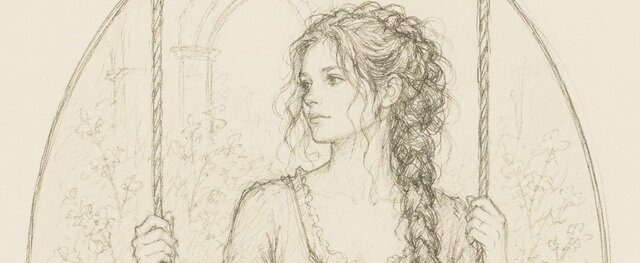


Somerset, June 1818
Evangeline Ashcombe had never been accused of being idle. Idleness was not why she lay flat on her back on the floor of her bedchamber, staring at the ceiling with professional interest. The stain had grown overnight. It bloomed in the far corner near the bay window, an irregular, spreading thing the colour of weak tea. She watched it in silence, hands folded on her stomach, skirts arranged carefully. A drop of water gathered, hesitated, and fell.
Plink.
“Well,” she said to no one in particular, “that settles it.”
The ceiling did not respond. She shifted her head slightly, squinting up at the damage from a new angle, hoping perspective might improve matters. It did not. The stain remained resolutely damp, faintly menacing, and, if she was being honest, rather smug about it. Apparently, her house had decided to drive her out of yet another bedchamber. It had claimed the best ones first, then the second best. What remained was this narrow space tucked beneath the eaves, with one tall window and a view of a yew tree leaning too close to the roof, shedding its needles with malicious consistency. The house itself, Ashcombe Hall had once been the family pride. A respectable country estate, never grand, but comfortable. Now it seemed to be dismantling itself one inconvenience at a time.
Another drop fell.
Evangeline pushed herself up, dusting her palms on her skirts. She climbed onto the chair by the dressing table for a closer look. From here, she could see where the paint had begun to blister, faint cracks spidering outward. She did not need a man to tell her what this meant. The roof needed repairing. She closed her eyes, counted to five, then opened them again.
Her mother had painted the wallpaper in this room, or so she had been told. Evangeline had never known her. Her mother had died bringing her into the world, an absence she had never known keenly enough to miss, but always enough to mark. Her father, indulgent and distracted and far too fond of fresh air and unwise investments, had raised her with affectionate neglect. She had climbed trees, read indiscriminately, eaten bread in the kitchen with Maggie when it suited her, and learned that nothing truly dreadful could happen if one but laughed at the right moment.
She thought about the promises he had made her. A Season in London. A trip to the Peak District. She had never been out of Somerset. There had always been next year, until there wasn’t.
He had died.
Since then, she had learned many useful things, among them how to stretch a joint of meat, how to mend a tear invisibly, how to smile reassuringly at creditors while making no actual promises at all. She had learned which repairs could be delayed (most of them, if one was creative) and which could not (very few, it turned out). The roof, unfortunately, fell into the latter. She sighed, climbed down from the chair, and opened the window to let in the morning air. The outdoors greeted her vigorously with the familiar smell of woodsmoke, and the sweet tinge of last night’s rain. From the open kitchen door below came the sound of pans being set down with purpose. Maggie was already highly operational, which meant breakfast. There would be porridge. There was always porridge when Maggie was displeased with the state of things. And lately, that had become her habitual state.
Evangeline plaited her hair as best she could and went downstairs.
The kitchen met her, warm and bright, and faintly steamy. Maggie stood at the hearth, broad and solid and entirely unimpressed by ceilings, stains, or the slow collapse of inherited mansions. She had been housekeeper, cook, nurse, and quiet bulwark since before Evangeline could remember. Mr Hargreaves sat at the small table by the window, reading yesterday’s paper. Their old butler still possessed the air of a man who believed firmly in routine as a moral good.
“It’s leaking again,” Evangeline announced, by way of greeting. “In my room.”
“That narrows it down to ‘slightly’ or ‘very much,’” Maggie answered, stirring with emphasis, not turning away from her pots of odds and ends. “Which is it, my lady?”
Evangeline considered. “It’s thinking about becoming a problem.”
Maggie snorted. Mr Hargreaves folded his paper with care. “The roof has been thinking that for years,” he said mildly. “It’s merely gathering courage.”
“Well, I wish it wouldn’t.” Evangeline took her seat. “I had other plans for the day.”
“Did they involve finding a husband,” Maggie asked.
“No.”
“Then they were foolish plans.” Maggie ladled porridge into a bowl and placed it before her with a determined thud. “Eat, my lady.”
Evangeline obeyed. She always did when Maggie used that tone. As she ate, she watched the light creep across the kitchen floor and thought, not for the first time, that something would have to change. Ashcombe Hall could not be coaxed much longer on goodwill and careful optimism. There were no relatives of means inclined to intervene, no miraculous reversal hovering just out of sight. It was an irritating conclusion.
Mr Hargreaves cleared his throat. “I fear no one will undertake another repair on credit, my lady. Nothing remains whose sale would meet the costs, and no more money can be raised upon the Hall.”
Evangeline looked from him to Maggie. “Then what would you have me do? Give up?”
Maggie turned from the hearth at last, hands planted on her hips. “Marry, as all other young ladies of your station do.”
“And where would I find a suitable husband? In the attic?!”
“If you mean to keep Ashcombe Hall, marry a man who can afford it. You are very resourceful once your mind is made up.”
“Marriage cannot possibly be the only answer.”
“Name another.”
Evangeline opened her mouth. Nothing useful presented itself. She had, however, decided never to marry on principle, largely because she disliked being managed, and marriage was management made permanent. Unfortunately, reality and adulthood had developed a habit of ignoring her principles. She took another spoonful of porridge. “Well,” she said, reaching for the tea. “It seems I shall have to do something radical.”
Mr Hargreaves glanced up at her over the rim of his cup, his squint thoughtful. “You already are radical, my lady,” he said. “The question is whether you’ll find someone who can live around that.”
Evangeline thought of the spreading stain, picturing its evolution into disaster too clearly. “Yes,” she agreed sweetly. “That will certainly be the largest difficulty to overcome. Not my pride.”
When she had finished her tea, she carried her cup to the basin herself, ignoring Maggie’s look. Maggie believed firmly in roles. Evangeline believed in momentum. She passed through the scullery with determined strides, continuing into the narrow servant’s passage that led toward the back of the house. Ashcombe Hall revealed itself in layers, like a story not edited for years. She paused at the door to what had once been the morning room. The curtains were drawn back unevenly, one tie broken years ago and never replaced. A chaise sat beneath the window, its upholstery faded into a polite ghost of burgundy.
The house was not collapsing dramatically. It was simply tired.
When she passed her father’s study, she slowed. The door stood ajar. A pang of sorrow landed as she glanced inside, half expecting to see him there, studying some botanical journal with his magnifying glass. The room remained much as he had left it. The clock on the mantel had stopped at twenty minutes past four. No one remembered when. It had been Father’s favourite clock, which explained why no one had touched it. Shelves stood crowded with uneven rows of books, holding no discernible order. Papers were stacked and restacked in piles that had once made sense to him alone. A desk sat beneath the window, ink long gone thick in its well. The air still smelled faintly of old herbs. Her father had believed firmly that she ought to know what grew around her, not only for beauty, but for usefulness. He had taught her the difference between sage and savoury before she could read, had sent her out with a basket and instructions whenever she lost patience with indoor lessons.
She closed the door to the memories and continued through the conservatory.
The garden beyond lay in cheerful disarray. Once, it had been planned, paths laid with intention, beds edged neatly with stone. Now it had gone its own way. Lavender spilt over borders, crowding thyme and marjoram with companionable disregard. A tangle of rosemary climbed where it pleased, while lemon balm had made an enthusiastic attempt at conquest near the steps. Evangeline stepped into it and breathed deeply. The garden had never required apologies. It persisted. It forgave neglect as long as one returned eventually. She followed a narrow path, brushing past new stalks of foxglove and fennel. Bees moved lazily, unconcerned by ownership or debts. Near the far wall, the old Orangery leaned at a dangerous angle, one pane replaced with oiled cloth. Father had meant to repair it. He had meant to do many things.
A bed of mint had escaped its boundaries last year. She pinched a leaf between her fingers, releasing its sharp, clean scent, and surveyed the growths with the clear-eyed affection of someone who loved them too much to pretend they were perfect. She squared her shoulders.
“Very well,” she said. “I shall adapt, as all other females must.” Alas, adapting equalled finding a husband. One with solid funds would be preferable if such a cage was to be endured. Finding one promptly would require methods not necessarily recommended to young ladies of her station. Compromising herself, for instance. She did not like it, but dislike had never repaired a roof, and no hidden alternative had presented itself between the breakfast table and the mint bed. To keep her home, she would have to risk surrendering something else. Well, surrendering might be too definite. She preferred to think of it as making room for a few small modifications. The garden rustled in agreement, though that might only have been the breeze.
Behind her, the gate creaked in a way that suggested it had not been consulted about visitors. She looked up in time to see the top of a bonnet bob into view behind the overgrown hedges. “Oh no... It’s Wednesday! Zoot.”
The bonnet paused, then advanced with new purpose. “Must you announce me like a thunderclap,” called a familiar voice. “I might yet turn around.” Miss Clara Whitcombe emerged, cheeks pink from the walk, eyes scanning the beds with proprietary interest. Clara was Evangeline’s neighbour in the loosest sense of the word and her best friend since childhood. Her family lived almost a mile down the lane in a manor that still had its roof firmly attached. “You’ve let the mint escape again, Evangeline.”
“It staged a coup. I was powerless.”
Clara laughed and stepped closer, peering at the plants. “Your father would be appalled.”
“My father encouraged rebellion in all forms.”
They fell into step together, moving along the crooked paths, arms locked together. Clara’s dress was practical but new, her gloves unfrayed, her boots free of the resigned scuffs Evangeline’s had acquired. “So. I hear your roof is leaking again.”
Evangeline stopped. “Who told you?”
“Your chimney. It’s visible from the lane. Also, Mrs Pike.”
Of course. That gossipmonger would spread news faster than a forest fire. “At this stage, it’s only a little leak. Barely an inconvenience.”
“That depends on whether you enjoy indoor rain. Have you done anything about it?”
“I lay on the floor and stared at it until the leak revealed its intentions.”
“And?”
“It intends to worsen.”
Clara nodded. “Sensible of it.” When they reached the old apple tree near the garden wall, they stopped in the shade of its branches. Evangeline leaned against the trunk, folding her arms. Clara hesitated, visibly choosing her words. “Have you considered options?”
“I have considered many things. All of them involve sudden wealth.”
“I meant work. Actual work.”
“I suspected. But no. Not work. Something faster.”
“There are positions,” Clara continued, warming to her own subject. “Companions. Governesses. Lady’s maids, even though I should never recommend that to you. You would be dismissed within the week for insubordination.”
“I would. Possibly sooner.” They shared a grin. “I don’t want to leave the Hall, but I think time has caught up with me. I have decided I will find myself a husband.”
“What!? A husband? You!?”
“Just so.”
“I genuinely thought you’d become a nun first.”
Evangeline scrunched her nose. “I considered that. But the idea was dismissed as soon as I realised it would be far more confining than marriage.”
“And how are you supposed to find yourself a suitable husband, without a season, without a dowry, not even a man to speak for you?”
“Thank you for the clarification of my limits. I have, though, just thought of a plan. A good one. I will simply use the ton’s idiocy against itself.”
“Come again...?”
“I will corner a man, preferably an insanely rich one, arrange it so we’re found, forcing him into marrying me. It’s quite effective.”
“You are deranged. Clearly a lunatic. Did you smell the foxglove too closely?”
Evangeline pushed herself away from the tree. “No. The plan is sound. I only need to find myself in the right spot. With the right man. That’s the difficulty. The rest will just...” She waved a hand. “Unfold on its own.”
“And what man do you consider for this delusional plan?”
“I haven’t decided yet. But it has to be someone local. And rich. I cannot afford to travel. Besides, I’d prefer someone who will know I’m not a fortune seeker.”
“Dear, you are a fortune seeker.”
“Not in the ways that matter. My hand is forced. And as soon as I’m married and given an allowance, I’ll make sure I’ll be free to restore my home, then demand nothing else. I’ll make him sign an agreement for ruining me. See? My plan is sound.”
“And if he wishes for an heir? Married men with funds tend to do that, you know.”
“Our personal preferences do not matter. Ashcombe Hall is what matters. And it needs my resolve.”
“You have clearly taken leave of your senses. And you have not thought about the consequences. Again.” They resumed walking, this time toward the gate. Clara remained thoughtful for so long that it bordered on worrisome.
“There’s talk in the village,” she finally mumbled.
“There’s always talk in the village.”
“Yes, but this is not about you,” Clara said, tapping her chin with her forefinger. “It could prove to be helpful.”
“Do go on.”
“The Duke of Somerset is in residence for the summer. There will be a ball. And his son, the Marquis of Hawkhurst, will be joining. You know, the one the entire ton is whispering about. The one refusing to wed, insisting upon saving the slums in London from smallpox and typhoid fever instead.”
“The physician? Dr Draven Townsend?”
“The very same.”
That left her deeply pensive. Never in her wildest dreams had she considered cornering her rakish neighbour into marriage. But once the idea took root, it would not let go. Hawkhurst was rich. Very much so. “I suppose we need to get ourselves into that ball then. I could sneak in, of course, but it would be difficult. It would include climbing. Entering the ball with you would be far more convenient. Your family is so large that no one would notice an extra head. All you have to do is convince your parents to accept an invitation.”
“You assume they will be welcome?”
“Of course. You’re local gentry. Your own father is a Viscount. Your mother is the daughter of an Earl.”
Clara glared at her. “I hear Miss Arbanville has just received some new ribbons. Walk me there, will you? Before this plan of yours gives me an irreversible headache?”
They continued, arm in arm, through the unhinged front gates of Ashcombe Hall and down the lane. The hedgerows grew high, and the ruts in the road were still holding last night’s rain. They had gone no more than a few hundred yards when Clara slowed to a stop.
“Do you hear that?”
Evangeline did. A low, rolling thunder approached, wrong beneath the pale, rain-washed sky. Not weather. Hooves, many of them, striking the road hard enough that she felt them through the soles of her boots. Then four great black horses burst around the bend, their harness flashing. Behind them came a tall, severe carriage, its lacquered sides black as pitch and its windows shuttered despite the hour.
A crest gleamed on the door, cold and unmistakable.
“Clara...!” Evangeline seized her friend’s arm and hauled her back as the horses bore down on them, so close she could see the whites of their eyes. Mud exploded upward, spattering their skirts, hands, and faces. The coachman did not slow. He did not even look at them as he thundered past. The ground continued to tremble until the black shape vanished into the tunnel of trees.
Clara stood frozen, white-faced, clutching Evangeline’s sleeve. “That was...”
“The Duke of Somerset’s carriage,” Evangeline finished, her voice flat with fury. She stared down the road, heart hammering now that danger had passed. “I saw the crest.”
“They might have killed us!”
“Yes. And blamed the road.” She stepped forward, boots sinking into the torn mud, and brushed at her ruined skirts with sharp, irritated movements. “They drive as if the world exists to part before them.”
Clara patted her arm. “You are considering becoming one of them.”
Evangeline turned on her then, eyes bright, mouth set. “Yes,” she said. “If men like that believe they own the world,” she said, jabbing a finger towards the bend, “then the rest of us must learn to manoeuvre them.”



















poor girl, common problem— big house. no money.