Chapter 1 - Arrival
Author's Note: This is the revised version of The Hidden One — chapters are being rewritten and uploaded fresh. The story you fell in love with, just better written
Saelith
The mountain did not look like a place that wanted peace.
It rose in stacked ridges of pale stone and dark pine, and the Sky hold was cut into the highest shelf like a white scar. Bone-and-gold banners snapped along the switchback, one at every turn, as if the elves wanted us to count how far we had climbed into their country. The air thinned with every mile. By the last turn I was breathing through my mouth and pretending I wasn't.
King James sat across from me and did not speak. He had not spoken much since the border, and I had learned long ago that his silences were not rest. They were a held hand. You waited to see where it would come down.
Somewhere past the third banner I caught myself humming. It was the old song, the one with no words that my mother used to hum over my head while she braided my hair. I didn't remember starting it. I only noticed when his eyes lifted from the treaty in his lap.
"Stop that."
I stopped. I folded my hands in my lap, right over left, the way I had been folding them since I was six, and looked out the window at the pines until the song went back wherever it lived.
"You will not embarrass me up there," he said. "You will be quiet. You will be grateful. You will do what they tell you, and when they tell you to smile, you will already be smiling. Do you understand?"
"Yes, Father."
"Say it like you mean it."
"I understand."
He went back to the treaty. The carriage climbed. I kept my eyes on the trees and counted my breaths, and I did not think about the fact that in an hour I would belong to someone else. A different house, I told myself. Different rules. At least I would be able to see them.
When the wheels finally stilled in the outer courtyard, he stood first and waited for me to follow, as if I were a clause in the treaty and not a daughter climbing down from a carriage.
Sky Elves were already on the steps.
I had been told how tall they were. Being told was nothing. The shortest of them would have looked down on every man in my father's guard, and they stood the way the pines did, straight and still and unbothered by the wind. Fair hair, most of it bound with gold thread. White robes that caught the light. They looked at me with curiosity more than heat. A few faces even softened. A small elf child, already taller than me, stared from behind a woman's skirts until she was hushed and pulled back.
It was not welcome, exactly. It was not hatred either. In the human court I had been told that elves thought humans were dirt. The eyes in front of me did not all match the warning.
A steward in white led us through carved pine and cold marble. The halls were built for people half again my height, and everything felt slightly too far away: the door handles, the window ledges, the lamps. In one long corridor a tapestry hung between two windows. It showed a forest that did not look like these pines. The trees were older and darker, and tall dark-haired figures stood among them, their faces turned toward something outside the weave. The colors had faded to old tea. A small plaque beneath named it The Lost People – woodland myth, age unknown.
I slowed. I didn't mean to. Something in the figures, in the way they held their heads, snagged on me like a sleeve on a nail.
"Keep up," my father said, without turning.
I kept up. I glanced back once, the way you glance at any decoration you haven't been told to study, and then the corridor turned and it was gone.
The throne room faced the drop.
One whole wall was glass, and beyond it there was nothing but sky and the far blue shoulders of other mountains. The floor was white stone veined with gold. My father's boots sounded small on it.
Therion stood instead of sitting. He wore a gold circlet and white robes, and he had a mouth that had learned courtesy as a weapon and sometimes put it down. When he looked at me there was no curl of disgust. There was interest, and something tired underneath it that might have been hope.
"James of the lowlands," Therion said. "You come in good faith."
"I come to end it," James said.
Beside the king, a step down and still towering, was the prince.
Aester.
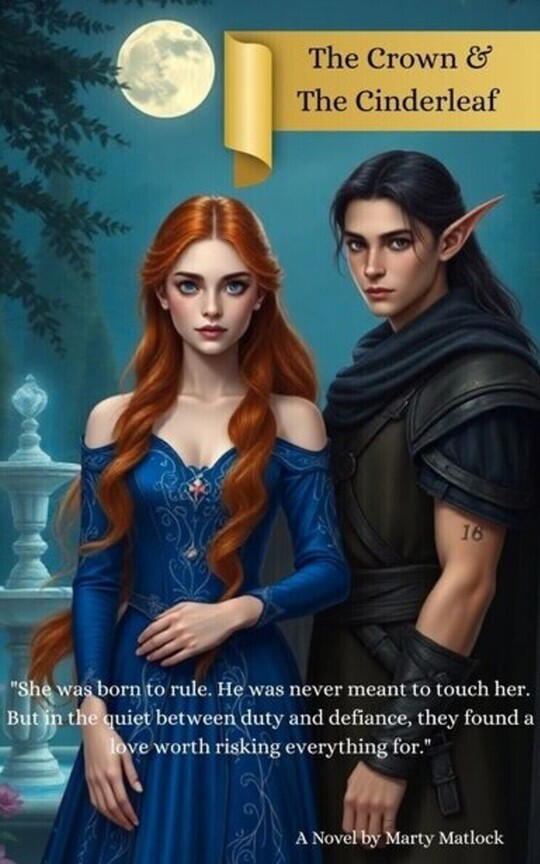
Eight feet of pale gold and dislike. His long blond hair was bound back from a face that belonged on a coin, all clean bone and cold symmetry. His eyes were gold, actual gold, the color of the thread in his sleeves, and they did not warm when they found me. His white-and-gold robes were cut to make his height into a statement. Dark ink showed on his forearms where the sleeves had been turned back, lines and curves I couldn't read from where I stood. Music, the human court had said. He likes music. He did not look like a man who liked anything that had walked up from the dirt.
The difference between father and son was immediate. Therion's gaze could hold a human without flinching. Aester's could not. It touched me and slid off, as if I were something spilled.
I kept my eyes in the safe middle. Not the floor, because the floor made you look guilty. Not his face, because a face was a challenge. The middle distance, somewhere around his chest. I had been taught that range until it lived in my neck.
James bowed the depth a king bows when he needs a war to stop more than he needs his dignity.
"I bring the terms," he said. "And my daughter."
Aester
She was small.
I had known she would be. Humans always were. But knowing it was one thing. Watching one stand on my father's gold-veined floor with her hands folded like a beggar at a temple was another, and the difference annoyed me before I could name it.
Too many pins in her hair. A gown in lowland blue, cut to be modest and failing at it. She was soft everywhere the silk touched, full at the breast and the hip. At her throat a pulse was working far too hard for someone standing so still. My eyes went down the length of her before I sent them, and they came back up slower than they went.
I disliked that more than I disliked her.
She looked at my chest and nowhere else. It was a trained place to look. I had seen soldiers stand like that after the wrong kind of officer. It meant nothing to me. It could not.
Cael did not come back from Hollow Pine. Every human since had smelled of that smoke to me.
This one smelled of road dust and lavender. I told myself it was the same smell.
My father looked at her the way he looked at a colt he had paid too much for, hopeful and measuring. I looked at the window, and the whole time I could still see the pulse in her throat.
Saelith
Therion's attention moved over me once. It was measuring, and kinder than the mountain wind.
"She is of age," he said. "Presented honestly. The fighting ends when the seal is set." He glanced at my father. "Not when we grow bored of being civil."
"It ends," James said.
They signed at the table under the tall windows. Two copies, wax, gold leaf. The sound of a war choosing a quieter way to continue. Aester did not sign. His agreement was that he had not left the room.
Therion sanded the last of the wax and did not look up. "The south has written three times since the talks began. Courtesy. Congratulation. A request to send observers to the rite." His mouth flattened. "I declined. This peace is Sky and human. I will not have another court counting our lamps."
My father's gaze flicked once toward the windows. "They've been counting something. The lowlands hear the same rumors you do. Too many gatherings in the southern halls to be feast-days."
"Then let them gather in their own halls," Therion said. "If they meant us well, they would not need to watch a wedding to prove it."
No one said the word demon. They did not have to. The south had one shape in every mouth that had ever spoken of it.
Therion gestured, slight. "Aester."
The prince stepped forward. He moved the way water moves, without any wasted motion, and he stopped far enough from me that I had to tip my head all the way back to see him. When my eyes finally reached his face, he let me hold the look for a long moment, long enough to make it feel like a mistake I had chosen to make.
Up close he smelled like pine resin and cold air. Up close he was worse, because he was more beautiful, and it was harder to hate something that looked like that. I tried anyway.
"So this is the peace." His voice was calm, and low, and made for singing. It was cold enough to put frost on the word. "A human in my hall. How generous of the dirt to dress itself for the occasion."
He bent, slow, until his shadow covered me.
"Lift your eyes, human. If I am being sold, I want to see the price."
I lifted them. His eyes were cold and close enough that I could count his lashes.
"Brown," he said. "Of course. Even your eyes are the color of your country."
The hall did not murmur agreement. A steward's mouth tightened. Therion's eyes flicked, a warning so small a stranger might have missed it. Aester did not take the words back.
My father's jaw tightened. He said nothing. The treaty was already dry.
My hands stayed folded. Whatever lived under that obedience stayed down, where I had put it years ago. It was used to the dark. It could wait.
"Your Highness," I said.
Aester's mouth moved. It was not a smile.
"You will address me as such until I tell you otherwise. You will not wander the inner courts. You will not speak to my people as if a seal makes you one of them. You are here because my father requires a body to stand next to mine and a war to go quiet. That is the whole of your purpose. Do you understand?"
"Yes, Your Highness."
"Say it so I believe you heard the shape of it."
My father had said nearly the same thing in the carriage an hour ago. For a second the two voices sat on top of each other, and I felt the old cold go down my spine, and then I did what I always did. I made my voice flat and clean and gave the man what he wanted.
"I am here because the treaty requires it. I will not wander. I will not presume."
Something flickered in the gold. Surprise, maybe, that I hadn't cried. It vanished.
"Good." He turned his face away as if I had been placed correctly on a shelf. "See that it stays true."
Therion did not look pleased. He also did not correct his son in front of a human king. He spoke to the room instead.
"There will be no intimacy between them until the vows are spoken. The alliance is a marriage, not a feast. Anyone who confuses the two will answer to me."
Aester inclined his head. "As you will."
He said it like the idea had never crossed his mind and never would. I told myself I was relieved.
My father turned to me then. He really looked at me, for the first time since the courtyard, and whatever he saw, he did not spend coin on it. He stepped close, close enough that the elves could read it as a father's farewell, and took my upper arm in his hand. His thumb found the soft place on the inside, the place he always found, and pressed.
"Behave," he said, quietly. "You know how."
Then he let go and left.
His boots went down the hall and became nothing. The human escort followed. The doors shut on the last of the lowland smell, and I did not rub my arm, because people were watching and because I knew from experience that it would not help.
I stood in a room full of Sky Elves and the man I was to marry, and the mountain wind found the seams in the great window and made a thin music there, a high, sweet whistle that rose and fell.
Aester glanced up at that sound the way another man might glance at an instrument he knew by heart. For one breath his face was different. Softer. Almost listening. Then he noticed me noticing, and his faced closed, and he was done with me.
"Neris will take her," Therion said, before Aester could hand me to a stranger. "She is assigned. She knows the east rooms. She knows how a guest is treated in my house."
The last line had an edge meant for someone other than me. Aester heard it. His face did not change.
A woman stepped out of the line along the wall.
She was tall by human measure and still small beside the prince, dark gold hair braided back, white and green at her sleeves instead of stark gold. Her eyes were kind in a way that felt almost indecent after his. She bowed to me as if the treaty had made me a person and not a term.
"Princess. If you'll come with me."
I followed.
Aester's voice found me at the threshold, pitched low enough that the hall could pretend not to hear.
"Do not mistake my father's courtesy for mine. You are still a human in a Sky hold. Remember that when she smiles at you."
Neris did not turn. Her spine went a fraction straighter, and she kept walking.
The east rooms faced the pines, not the drop. Pale wood, white bedding, a hearth already laid. Gowns hung on a rack by the wardrobe, white on white, in what looked like my size, which meant someone had asked my father's court for my measurements and he had given them. The window was full of dark trees and a slice of sky so sharp it hurt to look at.
Neris closed the door with her own hands.
"He speaks for himself," she said quietly, like the walls might take sides. "Not for the hold, and not for the king. Most of us are glad the fighting stopped. Some of us are glad a human walked in instead of another coffin coming down the ridge." She glanced at me, then away, giving me room. "The air's thin up here. It knocks lowlanders sideways the first day. Sit before you fall."
I sat on the edge of the bed, because sitting when you were told had always been safer than standing like a target.
"Thank you," I said.
Neris's mouth tipped. "You can use my name. Neris. I'm yours until the wedding and after, unless you send me off." She lifted one of the gowns and held it against the light, frowning at the hem. "These should fit. If they don't, I'll have them taken in. And whatever he said to you down there, nobody here means to hide you in a cupboard."
My arm ached where my father's thumb had been. I looked at my hands instead. Folded. The old shape.
I knew what I was. A human princess delivered to end a war, promised to a man who could not stand the sight of me. That was the whole of it. It was more than some girls got.
Down another wing, strings began.
It wasn't a lute or a fiddle or anything I had a name for. It was deeper and brighter at once, a sound like water running over stone, and it came slow and precise and furious, a melody that did not care who heard it.
Neris paused, listening, and fondness and irritation crossed her face together.
"He'll play until the lamps die," she said. "He always does when he's angry. Tomorrow will be worse or better. There's no telling with him." She set the gown down. "I'll bring you food. Eat it, even if your stomach argues. Sleep if you can. Nobody comes through that door but me."
When she was gone I sat there and listened.
I didn't want to. I wanted to hate it the way I was supposed to hate him. But the music climbed and broke and climbed again, and somewhere in the middle of it there was a phrase, just three notes turning over on themselves, that sounded almost like the song my father had told me to stop humming in the carriage.
Almost. Not quite. I told myself I was tired, and that the air was thin, and that every song sounded like every other song when you were far from home.
I stared at the pines until the light thinned.
On paper, the war was over.
In the east rooms I sat on a white bed and listened to a prince make music out of the fact that I existed.
Aester
I played until the lamps died. I always did.
It was meant to be the ridge song, the one I play for Cael when the anger has nowhere to go. It kept going wrong. My hands kept reaching for something softer, shaped like the wind in the great window. Every time they did, I saw her: eyes on my chest, hands folded, saying "Your Highness" so flat I wanted to crack it open just to hear what was underneath.
I wanted to know what she sounded like when she wasn't obeying.
I struck the strings hard enough to make them snarl and started over.
Four weeks. No touching. My father's rule and my own disgust, and I was going to need both.