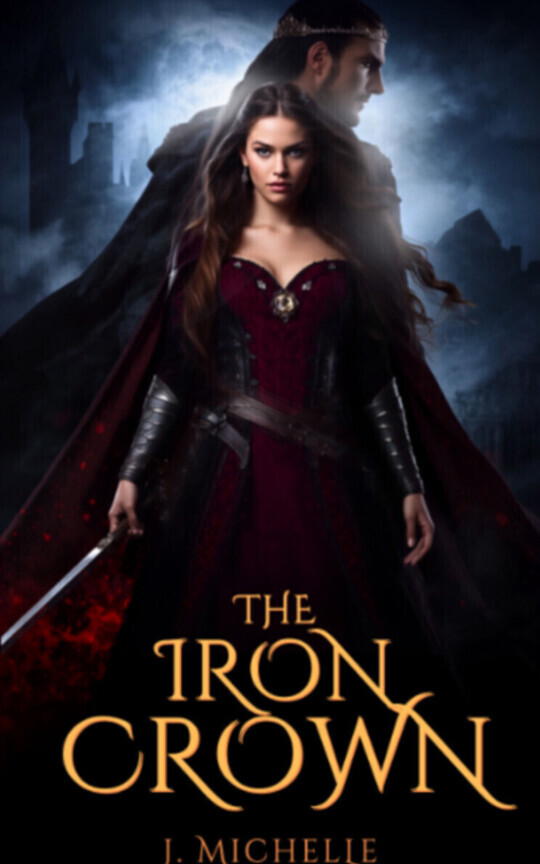
Chapter 1
My name is Redeus, but you can just call me Rudy.
I live in the magical Kingdom of Maternia. And no, the name isn't a coincidence.
Maternia is a maternal kingdom. Women rule, and men are generally expected to be seen but
not heard.
But it wasn't always this way.
Five hundred years ago, things were very different. It all started with the Great War. Men ruled
with iron fists, kingdoms fought kingdoms, and apparently war was the preferred solution to just
about every disagreement. The details are a little fuzzy—five hundred years is a long time—but I
do know one thing.
One dude was losing to another dude. And that dude did not take losing well. He basically said,
"No surrender. We fight to the death." The other dude said, "Give them no quarter." And there you
have it. Two old men with enormous egos. History really is something.
Anyway, the losing king was desperate. Very desperate. So desperate that he turned to
something forbidden. Dark magic. Ancient magic. The kind of magic that sensible people leave
buried. He unleashed a Great Evil known as the Plague.
And believe me, it was every bit as terrible as it sounds. The Plague tore through Maternia.
People died by the thousands. Then the thousands became millions. Bodies piled up like leaves
from a tree, entire cities were emptied, and extinction stopped being some distant possibility and
something that might happen next Tuesday.
Then something happened. Nobody really knows what. Maybe it was the gods. Maybe it was
fate. Maybe it was the universe deciding we'd suffered enough. Or maybe someone up there simply
looked down and said, "These idiots deserve one more chance."
Whatever it was, something changed. And it happened specifically to women. Women began
wielding magic freely. No sacrifice. No blood. No shortened lifespan. Nothing.
Now, you're probably wondering why that's such a big deal. I mean, I just said Maternia is a
magical kingdom. Well, you see, magic wasn't new. It had existed long before Maternia itself. But
magic had always come with a catch. A very nasty one.
We called it the Rule of Consequences. Every spell had a price. Cast a powerful spell, and you
might have to sacrifice blood. Use too much magic, and you could lose years from your life. The
stronger the magic, the greater the price. Magic was powerful. But it was costly.
Then the Plague changed the rules. Women could wield magic without paying the price. And
suddenly, everything changed. Women became the only people capable of using the most powerful
magic without destroying themselves in the process. They used that power to fight the Plague.
They pushed the Great Evil back. They sealed it away. They put the genie back in the bottle
And then they looked at the world men had nearly destroyed and came to a rather
understandable conclusion. Never again. Never again would they allow the patriarchy to lead them
to destruction.
Overnight the hierarchy flipped. Muscles and swords didn't mean much when a woman could
paralyze you with a word. The patriarchy collapsed. So they changed everything. Men were
removed from politics. Men lost voting rights. Men lost political representation. And women took
over almost every major institution in society. Politics. Business. Military leadership. Education.
Royalty. Even physical labour—a woman could build a house with spells without ever sweating, or
till the land while reading a book. Everything was women controlled.
Men? Well... We became the house husbands. We took care of the children. We managed the
household. We supported our wives. We were provided for. Five hundred years later, men are seen
but not heard. And we've gotten used to it. Well... Most of us have.
Marriage is another matter entirely. Men have no say in who we marry. If a woman likes you,
congratulations. You might be getting married. If a woman decides she wants you, she pays your
mother the bride price and that is that—your opinion is decorative.
Education for boys is a privilege, not a right. Most of us get what they politely call
"pleasing-women education": how to speak, how to serve, how not to embarrass your future wife in
public. If you're lucky, your mother teaches you a little more on the side. Most aren't lucky.
Girls, though? Different story. At age seven every girl in Maternia gets tested by the
Inquisitors. They travel the kingdom with these little devices that measure magical output on a
scale of one to ten. Score below a six and you go to a School of Sorcery. You become a medicine
woman, a crafter, a researcher, a mid-level magician—solid, respectable support roles. Score a six
or higher and you're a witch. Straight to the Witch Academy. Witches run everything that matters:
politics, the knight orders, the royal court. By the time a girl hits seven, her whole future is sorted.
You might not see your sister again until she's an adult and already more important than you'll ever
be. Think of sorcerers as the support role that makes society move, and witches as the players
everyone is terrified of.
There's also the Marry-Down Law. It's actual legislation. A woman must marry a man at least
seven years younger than her. Age-mates are illegal. Falling for someone outside that window gets
you punished—and the punishments lean hard on the man. The reason it maintains the hierarchy is
that younger men are easier to control, plus it prevents familiarity. I mean, she's seven by the time
you're born, so she's off to magic school when you're a baby. The likelihood of you guys being
familiar is very rare. It maintains respect. Officially the state says it's for our benefit to marry a
woman who can provide, but we all know the truth.
In most societies, being born into nobility is considered a blessing. In Maternia? If you're a
nobleman, being born into the right family can be a death sentence. Because you're not born a
person. You're born an asset. A prize. A bargaining chip.
Peasant men actually have it better. Not because they're free. They're not. But at least they're
people. A peasant boy can negotiate with his mother. He can reason with his sisters. He has people
around him who genuinely care about him. If he gets a bad wife, he can appeal to his mother. And
if Mother says no? Well, the wife can't touch him.
Things have even improved in recent years. There are councils these days that handle marital
disputes, and if a man has a legitimate reason for wanting out, a marriage can actually be annulled.
And strangely enough, peasant marriages aren't always miserable. A lot of them actually become
happy. Most of these marriages start with two complete strangers being thrown together. But they
grow up together, build a family together, and somewhere along the way, something unexpected
happens. Love. Apparently, even Maternia hasn't managed to outlaw that. Sorcerers don't really
have a grudge with men—they're mostly over the whole "men destroyed Maternia" thing and most
just want to be loved. Witches are still picky.
Politics, however, is a completely different ecosystem. Among the noble families, love is less
common. Much less common. And that's where I was born.
Oh. Hi again. I suppose I should give you a proper introduction.
My name is Redeus Saxony III. Rudy for short. I'm the third child of House Saxony. And the
only male—keep that in mind because that's important. Very important.
I should probably mention something else. My parents are the ruling monarchs. Or rather... My
mother is. She's what Maternia calls the Grand Mother, the ruling matriarch.
You see, Maternia doesn't believe in the traditional first-child-inherits-the-throne nonsense.
That was abolished centuries ago. Too patriarchal. Instead, you rule by proving that you're the
strongest. Magically, I mean. The woman with the greatest magical output and the ability to prove
herself against the others becomes Grand Mother. My mother did exactly that. She was the
strongest. So she's top dog. At least for now.
But she's getting old. Everyone can smell it. Every ambitious house has their eyes fixed on the
throne, waiting for the moment she finally slips. Everyone.
Which brings me to my wife. Well... Fiancée. Technically.
You see, noble families take marriage to another level entirely. As I said, among the nobility,
men are assets before we're people. And the age-gap marriages—well, let's just say calling some of
the women girls would be insulting to the word girl. These are mature, powerful, full-grown
women.
So why are the age differences between noble boys and women so enormous? Simple. It's
called the Booking System. And yes, it's every bit as disturbing as you're imagining. Noble women
can literally book a boy from birth or even before birth—imagine your mom making a deal about
you before you even exist. Any noble woman can do it. Seventeen. Twenty-five. Fifty. Age doesn't matter. If she wants the boy, she can place a claim. All she needs is the consent of his mother. And
once you're booked? Well... You're booked.
Which brings us back to me. My fiancée is Lilian Weighbroughst. She's one of the most
powerful witches in Maternia. She's also a Dark Witch.
Oh, right. I haven't explained that part yet. Maternia's witches are divided into factions. Light
Witches. Water Witches. Fire Witches. And Dark Witches. Dark Witches aren't particularly loved.
Can you blame people? They practice dark magic. Necromancy. Curses. Forbidden rituals.
Basically, all the magical stuff that makes normal people very uncomfortable.
But here's the funny thing. Dark magic wasn't abolished. After the Plague, Maternia realized
something important. If dark magic had nearly destroyed the world once, then understanding it
might be the only way to make sure something similar never happened again. So Dark Witches
were allowed to continue their research. Safely. The rest of the witches tolerate them—barely.
The Dark Witch faction is actually the oldest magical faction in Maternia. But they're also the
least popular. It's basically like playing with fire and insisting you're completely in control of it.
The Witches' Council has tried to abolish the Dark faction more times than I can count. Every time,
the Dark Witches give the same argument: you cannot protect yourself from history by pretending
it didn't happen. And, annoyingly, they're right. Dark magic created the world we're living in. Or at
least created the catastrophe that created it. So they argue that it needs to be studied. From a safe
distance. The problem is the definition of what "safe distance" actually means. Understandable,
really.
Because of that, Dark Witches have never been chosen as Grand Mother. For nearly four
hundred and fifty years, the Light Witch faction practically had a monopoly on the throne—why
they have the most magical range, from light magic to healing magic to time manipulation. Then
my mother broke the cycle. She's a Water Witch. The first non-Light Witch ever to become Grand
Mother.
Which sounds impressive. And it was. Except it wasn't. Mother cheated. I don't know how. I
don't even know exactly what she did. But years ago, before I was even born, Mother made a deal
with a young and extraordinarily powerful Dark Witch. Lilian Weighbroughst. Yes. My future
wife.
The deal was simple. Mother would secure the throne. And in exchange, the first male child
born to House Saxony would be betrothed to House Weighbroughst. Me. Before I was even born.
That's not just a marriage arrangement. That's a political earthquake waiting to happen.
Because House Weighbroughst isn't just some noble family. They're the oldest house in
Maternia. They're powerful. They're wealthy. But they're Dark Witches. So despite their age and
power, they've never had a chance at becoming the Grand Mother. Not once. The Light Witches have always blocked them. Until my mother.
And now? I'll be the bridge between them. The Saxons and the Weighbroughsts. The ruling
house and the oldest house in Maternia. A political alliance disguised as a marriage. And once
again, I'm an asset before I'm a person.
Oh, and one more thing. Lilian is twenty-five years older than me. And on my twentieth
birthday, I'll officially marry her and take her name. The moment the ink dries, the largest
succession crisis in five centuries will begin.